
Choose Mortgage Pros if you want mortgage-broking guidance before choosing a home loan, particularly as a doctor; choose Westpac if you have decided on Westpac and want to apply directly to the bank. The central difference in 2026 is advice and loan selection versus dealing directly with the lender that assesses and funds your application.
- Mortgage Pros vs Westpac compares a mortgage broker with a lender, not two competing banks.
- Choose mortgage-broking support for home loan guidance; choose Westpac direct when you have already selected the bank.
- Doctors have a clear reason to consider specialist broking advice, but lender eligibility still determines approval.
- Compare written loan terms and remuneration disclosures before choosing either application route.
Why this matters
Choosing a broker and choosing a lender are different decisions. A broker helps you assess and arrange borrowing; a lender decides whether to extend credit and on what terms.
That distinction changes what you should compare. A helpful application experience does not establish that a loan suits your finances, and an attractive loan feature does not establish that your application will qualify.
Choose the advice route first, then judge the actual loan on its written terms. For your 2026 decision, separate who helps you prepare the application from who ultimately lends the money.
At a glance
| Dimension | Mortgage Pros | Westpac |
|---|---|---|
| Best for | Borrowers seeking home loan advice and approval support | Borrowers who have selected Westpac and want direct dealings |
| Loan selection | Mortgage-broking guidance before choosing a lender | Direct discussion of Westpac lending options |
| Doctor home loans | An explicitly stated area of specialisation | Assess the bank's current eligibility requirements directly |
| Application relationship | Broker-supported preparation and submission | Direct borrower-to-bank application |
| Existing banking relationship | A separate advice relationship | Direct discussion with your existing bank if you already use Westpac |
| Approval authority | The proposed lender makes the credit decision | Westpac makes the credit decision on its loans |
| Pricing model | Loan costs plus any applicable disclosed broking charges and remuneration | Bank loan interest and applicable product charges |
| Standout feature | Home loan advice alongside application support | Direct access to the organisation making the lending decision |
The table identifies differences in role, not a promise about interest rates, approval speed or borrowing capacity. Those outcomes require an assessment of your circumstances and the proposed loan.
A broker wins when loan selection is still open
Mortgage Pros is the better starting point for borrowers who want home loan guidance before choosing a lender. Its stated service covers home buyers and property owners seeking help with borrowing, refinancing, equity and guarantor arrangements.
Start with your objective rather than a bank name. Buying your first property, changing an existing mortgage and accessing equity raise different questions about structure, documentation and affordability.
The benefit of broking is the advice process before submission. The limitation is scope: ask which lenders the broker can consider, which are excluded and why the recommended option fits your circumstances. Do not assume any broker compares every loan in Australia.
Going directly to Westpac makes more sense once your lender choice is settled. That route focuses the discussion on the bank's own options rather than a wider lender-selection exercise.
Specialist broking wins for doctors seeking tailored guidance
Doctors have a specific reason to consider the broking route: doctor home loans are an explicitly stated specialisation of the firm. That is a relevant service distinction, not evidence that every doctor receives different lending terms.
If you are a doctor, ask how your employment arrangements, income evidence and intended property use affect the recommendation. The useful answer explains the lender's requirements and how your documents address them.
Use the guide to home loan lenders for doctors to frame that conversation. Then request an explanation of why a particular lender suits your application rather than accepting occupation alone as the reason.
Westpac remains a direct route for a doctor who already wants that bank. Specialist advice helps with preparation; it does not replace the lender's assessment or guarantee approval.
Westpac wins when you want a direct bank application
Westpac is the better fit when your objective is to discuss a Westpac loan with Westpac itself. You can put product and application questions directly to the institution responsible for its lending decision.
This suits a borrower who has already compared alternatives and wants to proceed with the bank. It also removes the broker as a separate participant in the application conversation.
The trade-off is the boundary of that conversation. A direct bank application is not a comparison of other lenders, so you remain responsible for deciding whether Westpac's proposal meets your needs relative to alternatives.
Do not confuse direct access with guaranteed speed. For a 2026 application, ask who handles outstanding documents, who communicates assessment questions and how you will receive updates. Choose on the actual process described, not assumptions about which channel is faster.
Westpac wins for an existing-customer bank discussion
If you already bank with Westpac and want to discuss your existing Westpac mortgage, the bank is the direct starting point. That is particularly clear when your question concerns your current account, loan administration or an explanation of existing terms.
A broker serves a different purpose when you want to reassess the loan itself. Refinancing, changing loan structure or reviewing another lender belongs in a broader borrowing discussion rather than a routine account enquiry.
Existing customer convenience is a reason to start a conversation, not a reason to stop comparing. Ask the bank to explain its proposal in writing before deciding whether you need separate broking advice.
Keep servicing and selection separate. The organisation that answers an account question is not automatically the best route for reviewing your next borrowing decision.
Both routes still depend on lender approval
Neither route removes the lender's credit assessment. A broker can help prepare and present an application, but the lender decides whether the proposed borrowing meets its requirements.
Westpac makes that decision for its own loans. With a broker-supported application, the proposed lender makes the decision; the broker does not become the lender simply by arranging the loan.
Your income, expenses, liabilities, credit history and proposed security remain relevant whichever route you choose. Clear documents help the assessor understand the application, but they do not establish an entitlement to approval.
Before submitting, ask what remains conditional. An initial borrowing discussion, an application assessment and final loan documentation are not interchangeable stages. Your 2026 property plans should reflect the actual status of the application, not an informal indication alone.
Neither route wins on features without a specific loan
Offset arrangements, redraw, repayment flexibility and fixed or variable interest structures belong to individual loan terms. They are not automatic advantages of choosing a broker or dealing directly with a bank.
Start with how you intend to use the mortgage. Keeping savings accessible, making additional repayments and managing investment borrowing involve different considerations. Ask for the relevant conditions, restrictions and charges in writing.
A broker should explain how a recommended structure addresses those needs. A bank should explain how its proposed loan operates. In either conversation, ask what you give up as well as what you gain.
There is no feature winner until you compare actual loan documents. A feature that sounds useful but does not match your behaviour adds little to the decision.
Pricing: compare the loan and the advice arrangement separately
There are distinct cost questions here: what the loan costs and how the advice or arrangement service is remunerated. Combining them into a single claim that a broker or bank is cheaper obscures the decision.
Broker-supported borrowing
Ask for a written explanation of any fees payable by you and any remuneration connected with arranging the loan. Check when charges apply and what circumstances trigger them.
Then assess the recommended loan separately. Review interest structure, ongoing charges, repayment conditions and any costs relevant to changing your existing mortgage. Broker involvement does not, by itself, prove a lower total borrowing cost.
Direct bank borrowing
For a direct Westpac application, assess the bank's written loan proposal and applicable charges. Direct dealing does not, by itself, establish that the loan costs less than an alternative obtained through a broker.
Compare proposals using the same borrowing amount, repayment type and loan term. If you are refinancing in 2026, include the costs of leaving the existing loan and establishing the replacement, not just the advertised interest proposition.
The practical trade-off is advice scope versus direct product discussion. Decide which service you need, then compare the documented borrowing costs on a consistent basis.
Use this decision process before you apply
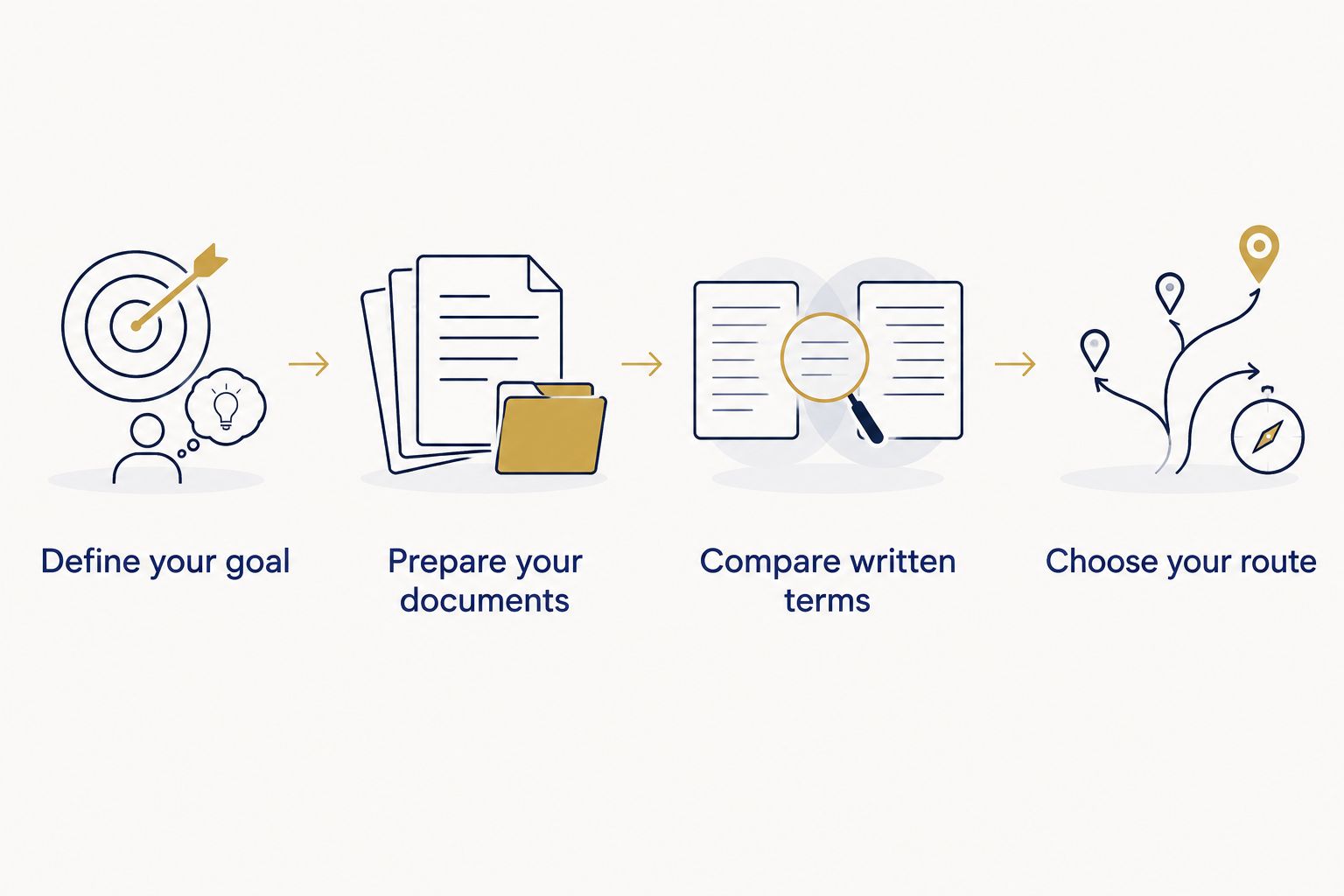
Follow these steps to turn a broker-versus-bank comparison into a useful application decision:
- Define your goal: State whether you are buying, refinancing, accessing equity or considering a guarantor arrangement.
- Prepare your documents: Gather evidence of income, spending, debts and the property details relevant to your proposal.
- Compare written terms: Request an explanation of the recommended structure, conditions, charges and alternatives considered.
- Choose your route: Use broking guidance if lender selection remains open, or deal directly with the bank you have selected.
The order matters. Choosing an application channel before defining the borrowing problem makes it harder to judge whether the proposed solution actually fits.
Keep your questions consistent across conversations. If you ask one provider about repayment flexibility and another only about interest, you will not have a fair comparison to act on.
Discuss your home loan today
Explain your buying or refinancing plans and ask about the next steps for your application.
Final verdict: choose advice or direct bank dealings
Choose Mortgage Pros if you want guidance before selecting a loan
Best for: a doctor, home buyer or property owner seeking mortgage-broking advice and application support. Choose this route when you need help working through borrowing options rather than simply submitting to a bank you have already selected.
Its relevant strength is the advice relationship, including its stated doctor home loan specialisation. Check the lender scope, recommendation rationale and remuneration disclosure before proceeding.
Choose Westpac if you have already selected the bank
Best for: a borrower who wants a Westpac loan and prefers to deal directly with Westpac. Choose this route when the bank choice is deliberate and you want product and application discussions with the lender itself.
Its strength is direct access to the bank. The limitation is that you still need a separate basis for deciding whether its proposal suits you better than other lenders' options.
| Dimension | Winner |
|---|---|
| Guidance before lender selection | Mortgage Pros |
| Stated doctor home loan specialisation | Mortgage Pros |
| Direct Westpac application | Westpac |
| Existing Westpac account discussion | Westpac |
| Ability to bypass lender assessment | Neither |
| Loan features and total cost | No winner without comparable written proposals |
FAQ
Is Mortgage Pros better than Westpac for a home loan?
Mortgage Pros is the better starting point for borrowers seeking mortgage-broking guidance; Westpac suits borrowers who have chosen the bank and want to apply directly. Compare the actual loan proposal separately from the application route.
Am I comparing two home loan lenders?
No, this comparison is between a mortgage-broking firm and a bank. The broker helps arrange borrowing, while the lender assesses and funds the loan.
Should a doctor use a specialist mortgage broker?
A doctor has a clear reason to consider a broker with a stated doctor home loan specialisation. Ask how the advice addresses your income evidence and circumstances; your occupation does not guarantee approval.
Will applying directly to Westpac guarantee faster approval?
Applying directly does not guarantee faster approval. Ask about the assessment process, outstanding documentation and communication arrangements before choosing your route.
Does using a mortgage broker guarantee a cheaper loan?
Using a mortgage broker does not guarantee a cheaper loan. Compare written borrowing terms and request disclosure of any applicable broking fees and remuneration.
Who decides whether my home loan is approved?
The lender decides whether your home loan is approved. A broker can support preparation and submission, but cannot override the lender’s credit assessment.
What should I ask before refinancing in 2026?
Ask whether the proposed refinance improves your position after relevant switching costs and changes to the loan term. Compare repayment conditions and features as well as the interest structure.
One last thing
A lower scheduled repayment does not automatically mean a cheaper refinance. Extending the remaining loan term can reduce the required repayment while leaving you paying interest for longer.
Before signing, ask for a comparison that keeps your repayment goal visible, not just the next payment. Contact the broking team today if you want help explaining your home loan objective and identifying the next application steps.
Related guides