
A mortgage broker in Australia is commonly paid by the lender through commission rather than by you directly, although some brokers charge borrower fees. In 2026, confirm the payment arrangement before you proceed: lender charges, government charges and other home-buying expenses remain separate from the broker’s remuneration.
- How much does a mortgage broker cost? Check borrower fees separately from lender commission and home-loan expenses.
- ASIC’s Moneysmart explains that lenders generally pay mortgage brokers, although some brokers also charge you a fee.
- Mortgage Pros specialises in doctor home loans and suits medical borrowers seeking home-loan advice and approval support.
- Get the fee agreement, commission disclosure and loan recommendation in writing before authorising an application.
How much does a mortgage broker cost in Australia?
There is no single broker fee that applies across Australia. Your arrangement depends on the broker’s disclosed terms, including whether the lender pays commission and whether you agree to a separate service fee.
ASIC’s Moneysmart guidance on using a mortgage broker explains the distinction: lenders generally pay brokers, but some brokers charge consumers fees as well. Ask about both payment sources rather than assuming one excludes the other.
For medical borrowers, the fee question also belongs alongside the broker’s experience with your income. These questions to ask a doctor mortgage broker help you assess the service behind the payment arrangement.
| Payment arrangement | Who pays the broker? | Best for | Benefit | Limitation |
|---|---|---|---|---|
| Lender-paid commission | The lender pays commission under its agreement with the broker | Borrowers seeking broking support without a separate borrower fee, where confirmed | Broker remuneration comes from the lender | Commission still needs disclosure; the broker’s panel does not cover every lender |
| Borrower service fee | You pay a fee under the agreed service terms | Borrowers who understand and accept the defined scope of paid work | The agreement can specify the work and payment trigger | You must check whether lender commission is paid as well |
| Combined arrangement | Both you and the lender contribute | Borrowers who have reviewed both sources of remuneration | Makes the separate payment sources identifiable when properly disclosed | A borrower fee does not replace the need to understand commission |
The table compares payment structures, not service quality. A fee arrangement alone does not establish whether a broker’s recommendation suits you.
Why this matters
The broker’s remuneration is only one part of your borrowing decision. A loan with no separate broker fee still has interest, repayment obligations and any applicable lender or third-party charges.
Your 2026 comparison should therefore answer two different questions: what do you pay for the broking service, and what do you pay for the loan? Keeping those questions separate prevents a discussion about broker fees from obscuring the mortgage itself.
The same discipline applies when refinancing. Approval for a replacement loan does not, by itself, establish that switching improves your position after the relevant expenses and loan features are considered.
Lender-paid commission: understand what is disclosed
Lenders commonly remunerate mortgage brokers through upfront commission and ongoing trail commission. Upfront commission relates to the settled loan, while trail commission is an ongoing payment under the lender’s remuneration arrangement.
Those payments are not the same as an invoice addressed to you. However, you should still understand who pays the broker and how that arrangement relates to the recommendation.
Ask the broker to explain:
- Whether the recommended lender pays upfront commission.
- Whether ongoing trail commission applies.
- How the commission is calculated and disclosed.
- Whether remuneration differs between the loans being considered.
- What ongoing assistance the broker provides after settlement.
Lender-paid does not mean every lender is being compared. Ask which lenders the broker can access and why the proposed loan suits your objectives, financial position and requirements.
For regulated mortgage broking, the best interests duty requires brokers to act in consumers’ best interests. ASIC’s guidance on that duty also addresses conflicts between a consumer’s interests and a broker’s interests; commission disclosure is not a substitute for a suitable recommendation.
Borrower fees: establish the scope before agreeing
Some brokers charge you directly for their services. Before accepting that arrangement, obtain a written explanation of the work, the payment trigger and the circumstances in which payment remains due.
Do not treat an initial conversation as a substitute for reviewing the agreement. An enquiry, an assessment and a submitted application are different stages, so ask exactly when you become committed to a fee.
Your written questions should cover:
- Scope: What work does the fee cover?
- Timing: What event makes the fee payable?
- Outcome: What happens if the application is declined?
- Withdrawal: What happens if you decide not to proceed?
- Overlap: Does the broker also receive lender commission?
- Changes: What happens if your property purchase or loan requirements change?
A defined service fee gives you something concrete to assess. Its limitation is equally important: paying for work does not guarantee approval, a particular loan feature or a lender’s acceptance of your income.
If the terms are unclear, ask for clarification before authorising work. Keep the agreed explanation with your application records rather than relying on a verbal summary.
Why mortgage broker payment arrangements vary
Broker remuneration varies because service agreements and lender arrangements differ. These are the practical factors to examine in 2026, without assuming that any one factor automatically creates a borrower fee:
- The broker’s service agreement: It determines whether a direct fee applies and what work it covers.
- The lender’s commission arrangement: Payment structures differ between lenders and products.
- The scope of work: Initial advice, application support and ongoing loan reviews need clear boundaries.
- The type of lending: Confirm whether the discussion concerns a personal home loan, investment borrowing or a different credit arrangement.
- The application outcome: Any payment linked to submission, settlement or withdrawal needs an explicit explanation.
- Post-settlement support: Ask what assistance continues and whether any separate terms apply.
Complex income is a reason to ask more detailed questions, not a reason to assume a surcharge. Request the broker’s actual terms for your circumstances.
What expenses sit outside the broker’s remuneration?
A broker’s payment arrangement does not describe the full expense of buying, refinancing or maintaining a property loan. Ask for a separate breakdown of lender, government and professional charges relevant to your transaction.
| Expense category | What to check | Why it is separate |
|---|---|---|
| Lender charges | Application, establishment, valuation and ongoing account charges where applicable | These relate to the loan or lender’s services |
| Existing-loan exit expenses | Discharge charges and any applicable fixed-rate break costs | These relate to ending or changing your current loan |
| Government charges | Relevant transfer duty and registration charges | These depend on the transaction and jurisdiction |
| Legal and settlement work | Conveyancing, legal advice and settlement services | These pay for work outside mortgage broking |
| Lenders mortgage insurance | Whether it applies and how it is treated | It protects the lender, not you, against covered loss |
Not every expense applies to every borrower. Obtain a transaction-specific breakdown rather than adding every possible category to your expectations.
For doctors considering a professional lending concession, ask what eligibility evidence is required. A profession-based feature does not remove the need to assess the interest rate, loan structure and other applicable charges.
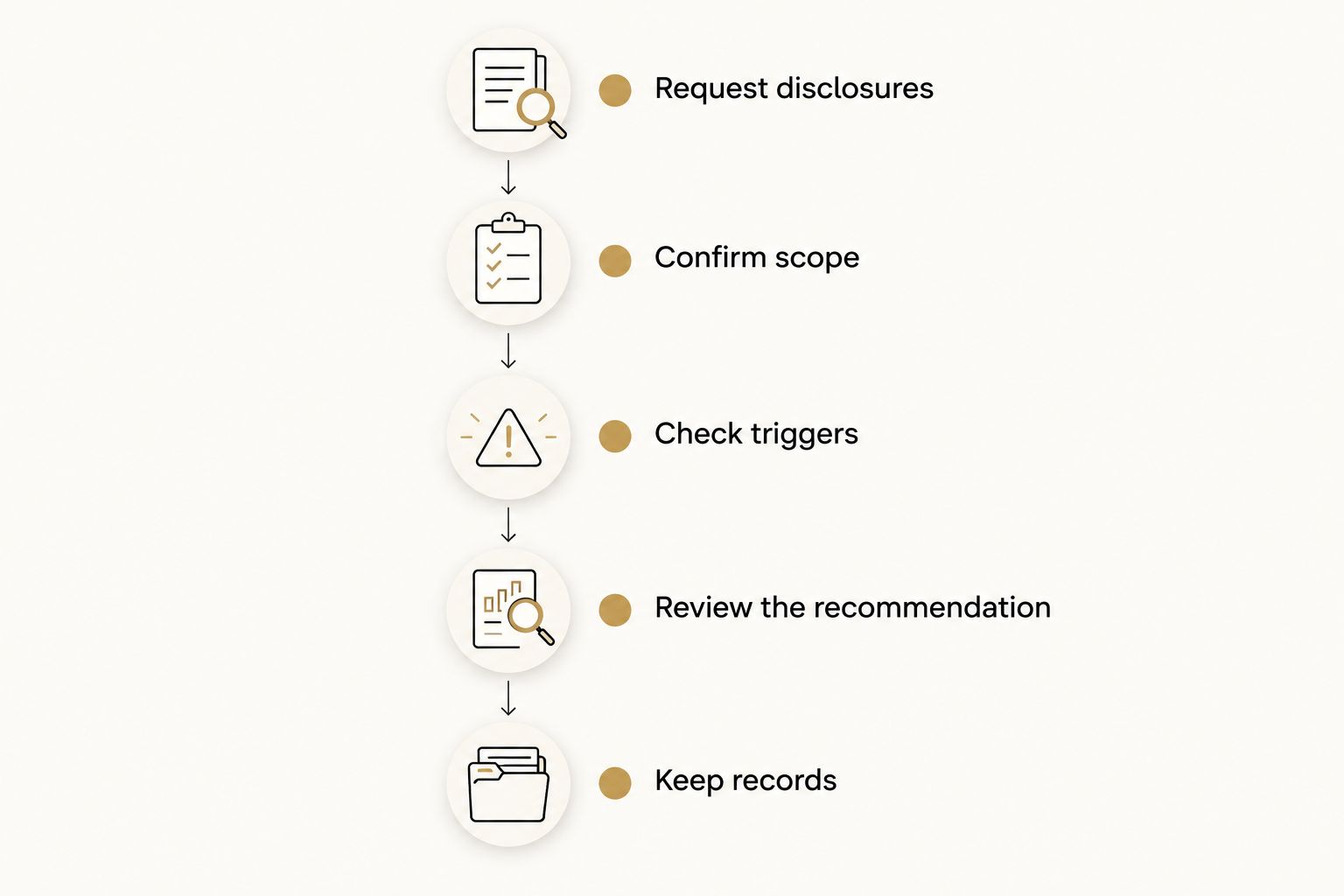
How do I check the arrangement before applying?
Use this sequence before you authorise a home-loan application. The aim is to leave with an understandable agreement, not simply an assurance that the broker is paid by the bank.
- Request disclosures. Ask for the credit guide and relevant remuneration and service-fee documents. Check the credit licence or representative details and the complaints process.
- Confirm scope. Establish whether the service covers assessment, lender selection, application management and post-settlement assistance.
- Check triggers. Identify when any borrower fee becomes payable and what happens if the application does not settle.
- Review the recommendation. Ask why the proposed loan suits your needs and what alternatives were considered.
- Keep records. Retain the written terms, recommendation and explanations with your loan documents.
A broker should be able to distinguish their own remuneration from the lender’s charges without combining them into an unexplained total. If something changes during the application, request an updated explanation before proceeding.
Is a mortgage broker worth using for a doctor home loan?
Mortgage Pros is best suited to medical borrowers seeking specialist home-loan advice and approval support. Its stated specialisation is doctor home loans, with support also available for dentists, surgeons and other borrowers.
For a doctor, useful questions extend beyond remuneration. Ask how the broker will present employment contracts, probation, overtime, on-call payments or locum earnings where those income sources apply to you.
The benefit of specialist assistance is relevance to your borrowing circumstances. The limitation is that a broker cannot guarantee a lender’s approval or make every income source acceptable under every lender’s policy.
During a 2026 enquiry, explain your employment structure and intended purchase or refinance. Then request the service terms and an explanation of how the recommended lender assesses your circumstances.
Discuss your home-loan requirements today
Ask Mortgage Pros about your circumstances, the application process and the applicable service terms.
Can I go directly to a lender instead?
Yes. You can approach a lender directly rather than use a mortgage broker, but you will need to assess that lender’s proposal against your requirements and other options yourself.
Direct dealing gives you a conversation with the lender providing the loan. Its limitation is that the lender is discussing its own lending products, not selecting across a broker’s lender panel.
Neither route removes the need to review the loan documents. Compare the same borrowing amount, repayment basis, term and relevant features so that differences in structure do not distort your assessment.
What happens if I refinance or repay the loan early?
Early repayment can affect the commission arrangement between a lender and broker. A lender’s recovery of commission from a broker is commonly called clawback.
For regulated home loans, brokers cannot pass lender clawback amounts on to consumers. Do not confuse that protection with separate lender discharge charges or fixed-rate break costs, which concern your loan agreement.
If an agreement mentions cancellation, early repayment or an administration fee, ask what service it covers and how it complies with the applicable rules. Obtain an explanation before signing rather than treating every differently named fee as automatically valid.
FAQ
How much does a mortgage broker cost in Australia?
A mortgage broker’s payment arrangement depends on the broker’s disclosed terms. Lenders generally pay commission, but some brokers also charge borrowers a fee, so confirm both sources of remuneration before proceeding.
Do I pay the mortgage broker or does the bank?
The lender generally pays the mortgage broker through commission, although a separate borrower fee can also apply. Ask for written confirmation of who pays, what work is covered and when any fee becomes payable.
Does using a broker make my home loan more expensive?
You need to compare the actual loan terms to establish the effect on your borrowing expenses. Review the interest rate, applicable lender charges, relevant features and any separate broker fee rather than drawing a conclusion from commission alone.
Can a mortgage broker charge me if my application is declined?
Check the written service agreement to establish whether a borrower fee applies after a declined application. Ask what work triggers payment and obtain that explanation before authorising the service.
Can a broker charge me the lender’s commission clawback?
For regulated home loans, mortgage brokers cannot pass lender clawback amounts on to consumers. Separate lender charges, including discharge charges or applicable fixed-rate break costs, need their own assessment.
What should a doctor ask a mortgage broker before applying?
Ask about the broker’s remuneration, relevant lender access and experience assessing your actual income structure. Where relevant, discuss probation, overtime, on-call income or locum work and request an explanation of the recommended lender’s requirements.
Does a mortgage broker compare every Australian lender?
A mortgage broker’s lender panel does not represent every Australian lender. Ask which lenders the broker can access, what relevant options were considered and why the recommendation suits your needs.
One last thing
The most useful question is not simply who pays the broker. Ask what happens if your circumstances change before settlement. A delayed purchase, changed employment contract or revised borrowing requirement makes clear service boundaries especially important.
Before your 2026 application, gather your income documents and request written payment terms alongside the loan recommendation. To discuss your circumstances with Mortgage Pros, contact us today.
This article provides general information, not a personal credit recommendation. Loan eligibility and terms depend on your circumstances and the lender’s assessment.
Related guides
- Can doctors use overtime and on-call pay for a home loan?
- How is self-employed dentist income assessed for a home loan?
- Is refinancing worth it?