
You need enough deposit or lender-accepted equity to cover the part of your construction project that your approved loan will not fund; there is no single minimum that applies to every Australian borrower in 2026. Your cash requirement also includes expenses outside the loan, so a builder’s deposit and your total contribution are not the same thing.
- How much deposit do I need for a construction loan? Your lender must assess the project, valuation and borrowing capacity.
- Land equity can contribute towards construction finance, but existing debt reduces the equity available.
- Keep your builder’s deposit separate from your total funding contribution and construction contingency.
- Mortgage Pros provides home loan advice and approval support for individual borrowers and investors.
Why this matters
A deposit that satisfies the builder does not establish that you have enough money to complete the project. Your lender assesses the security property, the proposed building work and your ability to repay the debt. Those assessments determine how much the lender will fund.
Before comparing construction loan lenders, establish your total project budget and the money you can contribute without borrowing. Comparing lenders before resolving those figures leaves the most important funding question unanswered.
For a 2026 application, use current contract documents, savings balances and loan statements. An earlier borrowing estimate is not confirmation that the lender will approve your final building proposal.
How much deposit do I need for a construction loan?
Your required contribution is the difference between the project funding you need and the loan amount the lender approves, after accounting for any accepted equity. You must also cover expenses the lender excludes from its funding arrangements.
There are two separate calculations:
- Cash funding gap: project expenses that must be paid, less approved loan funds and other confirmed funding.
- Security contribution: the value you contribute through cash or lender-accepted equity, measured against the lender’s valuation and lending limits.
Do not add those figures together automatically. They describe different aspects of the same application, and counting land equity as spendable cash can overstate your available funds.
| Funding position | Best for | Main advantage | Main limitation |
|---|---|---|---|
| Cash savings | Borrowers funding a contribution from money already available | Provides money for approved contributions and expenses outside the loan | Using all savings leaves no reserve for unexpected expenses |
| Existing land equity | Borrowers who already own the building site | Can contribute towards the lender’s security requirements | Equity is not cash, and existing land debt reduces it |
| Cash and land equity | Landowners who also have savings | Separates the security contribution from money needed during construction | Both the valuation and the cash-flow plan still need assessment |
| Guarantor arrangement | Borrowers considering family security support | Can provide additional security if the lender accepts the arrangement | Exposes the guarantor to financial risk and does not replace repayment capacity |
Ask for a written contribution calculation, not just a deposit percentage. The calculation should identify what you must provide, when you must provide it and which expenses remain outside the approved loan.
Using savings for your construction contribution
Savings provide a direct contribution, but your account balance is not necessarily the amount you should commit to the build. Separate money required for the lender’s contribution from money needed for legal work, moving, ongoing accommodation and unexpected expenses.
Ask whether the lender requires evidence of how you accumulated the funds. Savings, gifts and proceeds from selling another asset have different documentation requirements, and the lender decides what evidence it accepts.
Keep evidence of payments already made towards the project. A receipt establishes what you paid, but you still need confirmation of how the lender treats that payment within its contribution calculation.
Do not assume money paid to a builder will later be reimbursed from the loan. Establish the funding treatment before making the payment, especially if you need those savings for another project expense.
Using land equity instead of additional cash
Owning land can change your contribution requirement because the land forms part of the lender’s security. The relevant starting point is the lender’s accepted land value less debt secured against it—not simply what you originally paid.
However, land equity does not automatically pay your invoices. You still need an approved lending arrangement before you can draw borrowed funds against that security, and the lender must accept the proposed construction project.
If your land is already mortgaged, ask how that debt will be handled. The construction application must account for the existing loan rather than treating the land as debt-free.
Also distinguish between the land’s current value and the proposed property’s completed value. A lender’s assessment of the completed property does not guarantee that every item in your building budget will receive funding.
Considering a guarantor arrangement
A guarantor arrangement uses additional security to support borrowing, subject to the lender’s requirements. It is not a substitute for demonstrating that you can afford the loan repayments.
The benefit is additional security support. The drawback is that another person assumes a financial obligation, potentially putting their property at risk if the borrower defaults and the guarantee is called upon.
Before treating a guarantee as part of your construction funding plan, confirm whether the lender accepts it for your proposed transaction. The guarantor should obtain independent legal advice and understand the conditions for eventual release.
Avoid describing this pathway as having no financial contribution. Even where additional security supports the loan, expenses outside the approved funding arrangements still need a payment source.
Why construction loan deposit requirements vary
Your contribution depends on the application as a whole. These factors explain why another borrower’s deposit is not a reliable target for your own project:
- Property valuation: the lender’s accepted security value affects how much it will lend against the property.
- Existing land debt: money already owing against the site reduces the equity available to support construction.
- Borrowing capacity: income, living expenses and other liabilities affect the loan amount you can repay.
- Contract scope: work excluded from the building contract still needs to be funded if it forms part of your project.
- Lender requirements: construction, security and borrower eligibility rules differ between lenders.
- Project changes: variations and additional work can create funding needs beyond the original approval.
For a 2026 application, confirm the requirements against your actual property and building documents. A lender’s general lending limit does not establish what it will approve for your circumstances.
Is the builder’s deposit the same as my loan deposit?
The builder’s deposit is a payment under your building contract; your loan contribution is the funding or equity the lender requires from you. The amounts serve different purposes.
A builder can request payment before the lender is ready to release construction funds. Ask your solicitor or conveyancer about your contractual obligations, and ask your broker or lender how the payment fits into the proposed funding sequence.
Never treat a signed building contract as evidence of finance approval. You need to understand both your obligation to pay the builder and the lender’s conditions for releasing money.
Does a higher completed valuation reduce the cash I need?
A higher accepted valuation can improve the relationship between your loan and the property’s value, but it does not automatically remove your cash funding gap. The lender still assesses repayment capacity and the expenses it agrees to finance.
Keep the valuation and the project budget separate. One measures the lender’s security; the other identifies the payments required to complete your home.
If the valuation is lower than expected, ask for the contribution calculation to be revised before committing further funds. Do not assume the lender will increase the loan to match your contract commitments.
How to establish your actual contribution before you build
Turn your deposit question into a documented funding plan. The construction loan approval process connects your plans and building contract with valuation and lending assessment; a change to the proposed work needs to be considered against the approved funding.
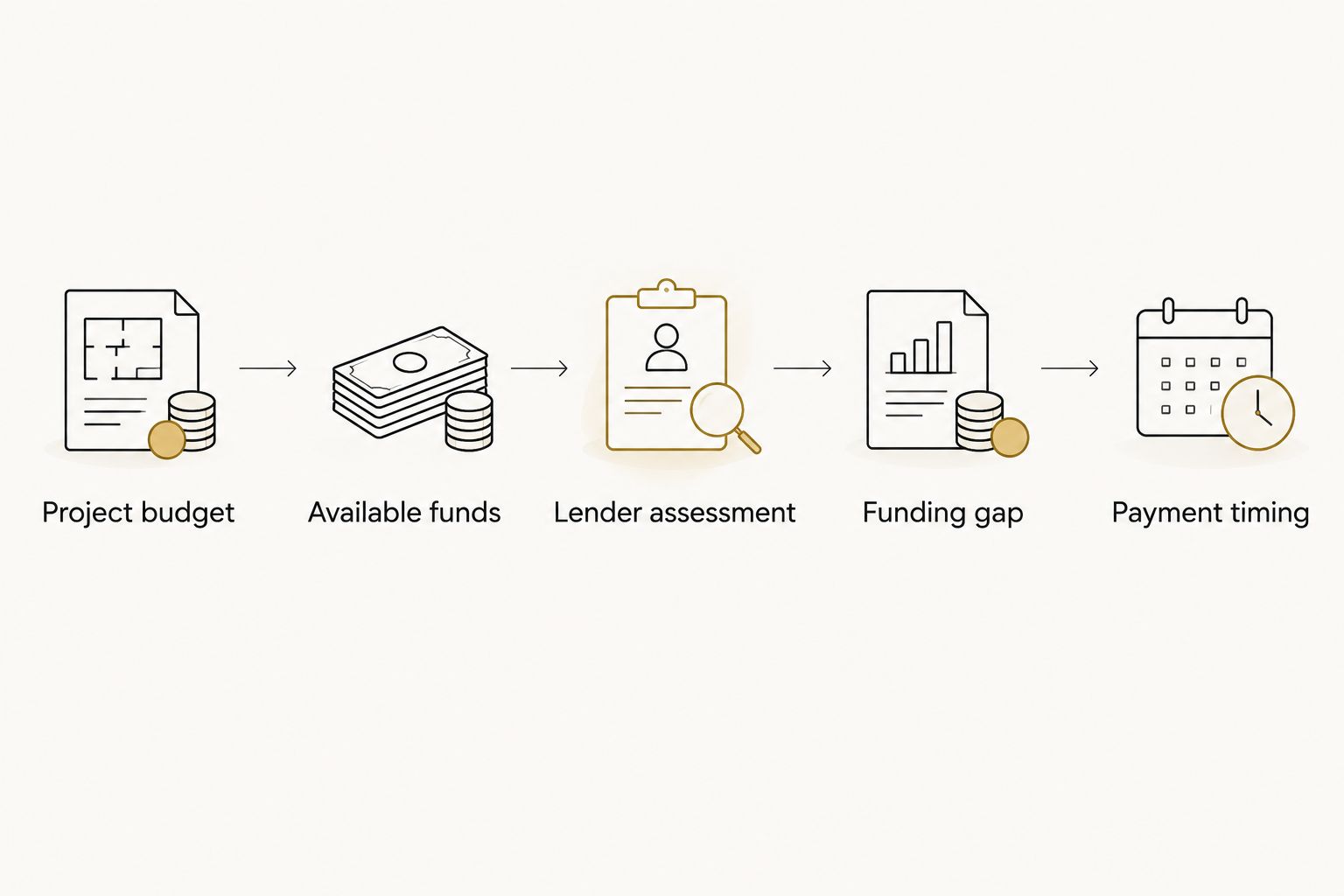
Use this sequence before you rely on a deposit estimate:
- Project budget: assemble the land details, building contract, inclusions, exclusions and expenses you expect to pay separately. Mark anything that is still an estimate.
- Available funds: list savings, existing land debt and other confirmed contributions. Keep expected sale proceeds or unapproved funding separate from money already available.
- Lender assessment: obtain an assessment of your borrowing capacity, acceptable security and proposed construction arrangements. Identify any conditions that remain outstanding.
- Funding gap: reconcile the approved loan with the payments required. Ask which contribution must come from your own funds and when it must be available.
- Payment timing: match the builder’s payment schedule with the lender’s release conditions. Resolve any mismatch before the relevant payment becomes due.
The result should be more specific than an approval amount. You need a schedule showing which payments come from savings, which come from loan drawdowns and what remains reserved for unexpected expenses.
What should doctors check before committing their savings?
Doctors, dentists and surgeons should have their income and proposed construction assessed together. Eligibility for a profession-based lending policy does not establish that the same lender accepts your building contract, proposed security or preferred contribution.
If you receive hospital income alongside private practice earnings, identify which income sources support the application. Supply the evidence requested for each source rather than assuming the lender will treat every payment the same way.
The same principle applies to employment changes. Starting a new role, moving into private practice or changing working arrangements needs to be reflected in the assessment before you rely on a borrowing estimate.
Mortgage Pros is a mortgage broker for home buyers who want home loan advice and approval support. Ask for your profession, income structure and proposed build to be considered together, rather than treating a medical lending policy as construction approval.
When do I need my contribution available?
Your contribution must be available when required by your lender and contractual payment obligations. Those dates are not necessarily the same as the day construction starts.
Construction loans generally release funds progressively, subject to the lender’s requirements. Confirm whether your own contribution must be used before loan funds are drawn and what evidence the lender requires before each release.
For a 2026 build, put those requirements into your payment schedule. Include continuing rent or existing mortgage commitments so that money set aside for the contribution is not also counted towards everyday expenses.
Do not spend your entire cash reserve simply because the lender accepts the initial contribution. Loan approval and a workable household cash-flow plan are separate checks.
Request a construction funding assessment
Prepare your land loan statement, savings evidence, income documents, building contract and available plans before discussing the application. If the contract is not final, distinguish confirmed inclusions from estimates and proposed additions.
Ask Mortgage Pros to assess the home loan contribution alongside the borrowing amount and payment sequence. The practical question is whether you can fund the project through completion—not merely whether your savings meet an advertised deposit threshold.
Confirm your construction funding position
Discuss your savings, land equity and proposed build before committing to a contribution.
FAQ
How much deposit do I need for a construction loan if I already own land?
Your required cash contribution depends on the land equity the lender accepts, your existing debt and the approved construction loan. Owning land does not automatically cover expenses that must be paid in cash.
Can I use land equity as my construction loan deposit?
A lender can accept land equity as part of your contribution, subject to its valuation and lending requirements. You still need to establish how invoices and expenses outside the loan will be paid.
Do I pay my builder’s deposit from the construction loan?
Whether the construction loan funds your builder’s deposit depends on the lender’s approved payment arrangements. Confirm this before paying, rather than assuming the lender will reimburse you.
Can doctors get a construction loan with a smaller deposit?
A doctor’s contribution depends on the lender’s borrower and construction requirements. A profession-based policy does not by itself confirm eligibility for the proposed build or eliminate the need for repayment assessment.
Does construction loan pre-approval mean I can sign a building contract?
Pre-approval does not establish that the lender has accepted your final building contract and property valuation. Check outstanding finance conditions and obtain legal advice before making a binding commitment.
What happens if the construction valuation is lower than expected?
A lower accepted valuation can reduce the loan supported by the property and increase your required contribution. Ask for the funding plan to be reassessed before committing additional money.
Can a guarantor replace my construction loan deposit?
A lender-approved guarantee can provide additional security, but it does not replace repayment capacity or automatically cover project expenses. The guarantor needs to understand the financial risks and obtain independent legal advice.
One last thing
The smallest accepted deposit is not necessarily the contribution that leaves you ready to build. A funding plan needs to work on every payment date, not just on approval day.
Before committing to your 2026 project, ask Mortgage Pros to identify the first payment your construction loan will not cover. Resolving that payment—and keeping a reserve—is a more practical next step than chasing a deposit percentage alone. Contact us today to discuss your proposed build.
Related guides
- How does a guarantor home loan work?
- Is a no-LMI loan better for doctors than saving a bigger deposit?
- Can doctors use overtime and on-call pay for a home loan?