
The equity you can release in 2026 is limited by your lender’s accepted property value, permitted loan-to-value ratio (LVR), existing debt and repayment assessment. An 80% LVR is a common starting benchmark, not a guaranteed approval limit; borrowing against equity also increases your secured debt and brings interest and possible loan-related costs.
- How much equity can I release from my home? Start with the lender’s LVR limit, then subtract existing secured debt.
- An 80% LVR is a common benchmark, not a universal equity-release entitlement.
- Usable equity and borrowing capacity are different: your income must support the additional debt.
- Mortgage Pros suits home owners seeking mortgage broking advice on equity release and refinancing.
Why this matters
Equity is not cash sitting inside your home. Accessing it through a mortgage usually means borrowing more, with your property securing the debt. A higher property value does not automatically mean you can afford a larger loan.
Before applying, decide what the money must achieve and how you will repay it. If accessing equity means replacing your existing mortgage, review whether refinancing is worth it alongside the proposed cash release, rather than judging the transaction by the amount you receive.
How much equity can I release from my home in 2026?
A practical starting calculation is:
Potential usable equity = lender-accepted property value × permitted LVR − existing secured loan balances.
The result is a security-based estimate. Your approved release must also fit the lender’s affordability assessment, cash-out policy and requirements for the proposed use of funds. Approval can therefore be lower than the formula suggests, including no additional borrowing.
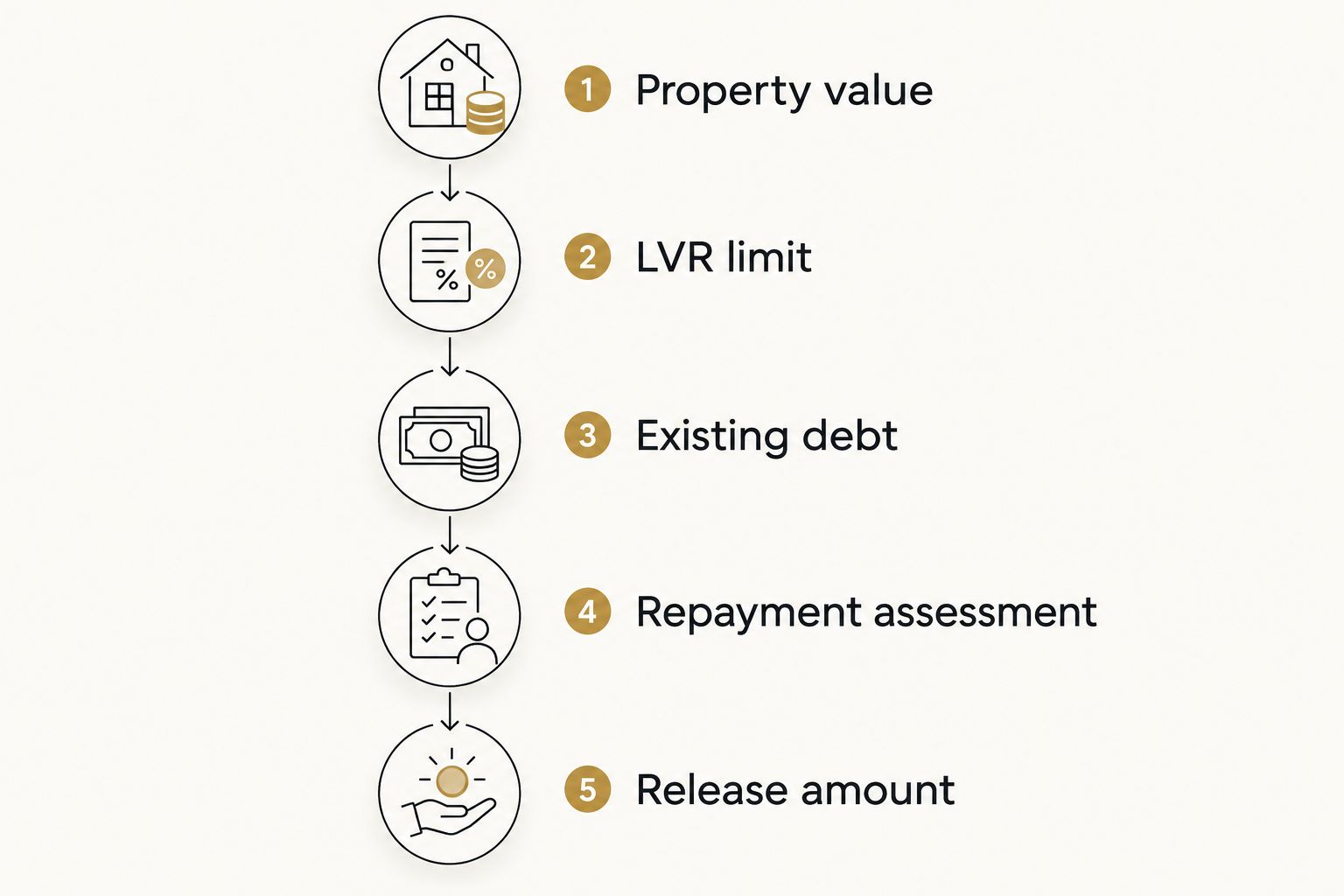
Follow these steps before treating an equity estimate as a spending budget:
- Property value: Obtain the value the lender will accept. An online estimate or agent’s appraisal is not the same as an accepted lending valuation.
- LVR limit: Confirm the permitted LVR for your application, property and intended use of the money. Do not assume the lender will use its highest advertised limit.
- Existing debt: Identify the mortgage balances and other relevant lending secured against the property. Ask how existing limits and loan splits affect the calculation.
- Repayment assessment: Check whether your income, expenses and liabilities support the proposed total debt.
- Release amount: Confirm the amount available after any deductions, retained funds or financed loan-related costs.
A lender’s assessment combines these checks; passing the property-value calculation alone is not enough. For a 2026 application, use current balances, current income evidence and the lender’s current policy.
What does an 80% LVR mean for equity release?
An 80% LVR means the loan balance equals 80% of the lender-accepted property value. At that borrowing level, the remaining 20% represents your equity before selling costs and other adjustments.
The 80% benchmark is commonly used because lenders mortgage insurance generally becomes relevant above that level, although exceptions and lender-specific rules apply. Lenders mortgage insurance protects the lender, not you, and does not replace an affordability assessment.
Do not confuse total equity with usable equity. Total equity is the property’s value less the debt secured against it; usable equity applies the lender’s borrowing limit before subtracting the existing debt.
Even with 100% ownership of an unencumbered property, you cannot assume a lender will advance its full value. The lender still assesses the property, the proposed loan and your ability to make repayments.
Why your equity-release amount varies
The amount you can access in 2026 depends on more than house-price growth. These factors determine whether a theoretical equity figure becomes an approved loan:
- Accepted valuation: A lower lending valuation reduces the amount available under the same LVR limit.
- Permitted LVR: Limits differ according to lender policy, property characteristics and the application. A higher limit is not automatically the right choice.
- Existing secured debt: Current mortgages and relevant secured facilities reduce the room available for additional lending.
- Repayment capacity: Income, living expenses, dependants and other commitments affect the additional debt a lender will approve.
- Purpose and evidence: The lender can require documentation explaining how you will use the funds, such as renovation plans or investment details.
- Loan structure: Refinancing, increasing an existing loan or establishing a separate split creates different repayment and administration considerations.
Use the lower of the security-based amount and the amount your repayment assessment supports. Then decide whether borrowing that much serves your actual goal.
Should I increase my loan, refinance or use redraw?
These options do not give you access to money in the same way. A loan increase and cash-out refinance involve additional borrowing; redraw generally accesses eligible extra repayments already made, subject to your loan’s terms.
| Option | Best for | Main advantage | Main limitation |
|---|---|---|---|
| Existing loan increase | Borrowers wanting to keep their current lender | Lets you request additional lending without necessarily moving the whole mortgage | Requires approval; your current lender’s policy still applies |
| Cash-out refinance | Borrowers reviewing their mortgage as well as accessing equity | Allows a review of the overall loan structure | Requires a new assessment and comparison of switching costs and terms |
| Redraw | Borrowers with eligible extra repayments available | Uses an existing loan feature rather than relying on property growth | Access depends on available redraw and the lender’s conditions |
Existing loan increase: best for retaining your lender
Start by asking whether your current lender will consider the additional borrowing and how it would structure the increase. Keeping your lender does not remove the need to demonstrate affordability.
The advantage is continuity. The drawback is that you remain within that lender’s policy and product settings, so compare the whole arrangement before accepting it.
Cash-out refinance: best for reviewing the whole mortgage
A cash-out refinance replaces the existing mortgage with a new loan that includes approved additional funds. Compare the proposed balance, remaining term, repayments and loan features against your existing arrangement.
A lower repayment does not necessarily mean a lower total borrowing cost. Extending the repayment term can spread the debt over longer, so inspect the term as carefully as the repayment amount.
Redraw: best for accessing eligible extra repayments
Redraw is not an equity-release approval based on a fresh property valuation. It generally lets you withdraw eligible additional repayments under your existing loan conditions.
Check access restrictions and the consequences of the withdrawal before using it. If you intend to invest the money, obtain tax advice about the transaction and keep records of where the funds go.
Can I release equity without increasing my repayments?
Releasing equity through additional borrowing increases your debt, even if a changed rate, repayment structure or longer term keeps the scheduled repayment similar. Compare total debt and total interest, not just the next repayment.
Ask for a repayment comparison using the proposed loan balance and term. Include the repayments you intend to make, rather than assuming the lender’s minimum repayment is your preferred budget.
If your household income changes, the extra debt remains payable. For doctors with variable overtime, on-call earnings or private-practice income, confirm which income components the lender accepts before committing the released funds.
Can I release equity to buy an investment property?
Equity can support an investment-property deposit or associated purchase expenses where the lender approves that purpose. You still need approval for the additional borrowing secured against your home and any separate investment loan.
Assess the combined commitments, not just the deposit. An investment purchase also requires a plan for property expenses, periods without rental income and repayments on both facilities.
Keep investment borrowing clearly identifiable. A separate loan split can assist record-keeping, but tax treatment depends on the use of the borrowed money and your circumstances; get advice from a registered tax agent before moving funds.
Can doctors release more equity from their homes?
Being a doctor does not create an automatic right to a larger equity release. Some lenders offer profession-based lending policies, but eligibility, permitted LVR and cash-out rules require confirmation for the specific application.
For a medical borrower, the useful question is whether the lender recognises the income you actually earn. Hospital salary, allowances, locum earnings and private-practice income require appropriate evidence; professional status does not replace that evidence.
Mortgage Pros equity-release advice is best suited to borrowers seeking broker support with refinancing and additional home lending. The firm also specialises in doctor home loans, but broking support does not guarantee a valuation, loan amount or approval. Request a review of both your usable equity and borrowing capacity before choosing an amount.
What should I prepare before requesting an equity release?
For a 2026 equity-release assessment, organise documents around the property, existing debt, income and purpose of funds. This helps separate a rough estimate from an application a lender can assess.
Prepare:
- Current home-loan statements showing balances and loan splits.
- Details of other debts and credit limits.
- Income evidence appropriate to your employment or business structure.
- A realistic summary of household spending and ongoing commitments.
- Information about the property and any material changes to it.
- A clear explanation of the intended use, supported by relevant documents.
Tell your broker about fixed-rate lending, existing guarantees or planned changes to employment. These details can affect the proposed structure or the decision to refinance.
Ask Mortgage Pros to assess the amount needed for your purpose, not simply the largest amount potentially available. Borrowing less than your maximum leaves you with less debt to service.
Check your equity-release options today
Discuss your property, existing mortgage and borrowing purpose before applying.
FAQ
How much equity can I release from my home in 2026?
Your potential release is the lender-accepted property value multiplied by its permitted LVR, less existing secured debt. The approved amount also depends on affordability, lending policy and the purpose of the funds.
Can I release all the equity in my home?
You cannot assume all your equity is available to borrow. Lenders apply LVR limits and repayment assessments, so total equity is different from the amount they will approve.
Do I need to refinance to access home equity?
Refinancing is not always necessary to access equity. Your current lender can assess a loan increase, while eligible redraw is a separate way to access additional repayments already made.
Can I release equity if I still have a mortgage?
You can apply to release equity while you still have a mortgage. Existing secured debt reduces the potential release, and the lender must approve the proposed total borrowing.
Does releasing equity mean selling part of my home?
Releasing equity through additional mortgage borrowing does not mean selling a share of your home. You take on secured debt, which is different from a home-reversion arrangement involving a sale of an interest in the property.
Can I use released equity for renovations?
Released equity can fund renovations when the lender approves that purpose. Ask what quotes, plans or other evidence the lender needs and whether funds will be released upfront or under specific conditions.
Is interest on released equity tax deductible?
Interest is not automatically deductible because the borrowing is secured against your home. Tax treatment generally follows the use of the borrowed funds; obtain advice from a registered tax agent about your circumstances.
Can a doctor get an equity release with variable income?
A doctor with variable income can apply for equity release, but the lender decides which income components it accepts. Provide evidence of the relevant salary, allowances, locum work or private-practice income before relying on an estimate.
One last thing
An approved loan limit is not a recommendation to spend it. Before accessing equity in 2026, write down the purpose, the amount required and the repayment plan. If the proposal only works by borrowing the maximum or stretching repayments over longer, reassess the amount first.
For a tailored review, contact Mortgage Pros with your current loan balance and intended use of funds. Ask for the security-based estimate and the repayment assessment to be explained separately.
Related guides
- How much equity do I need to buy an investment property?
- How much can I borrow as a doctor in Australia?
- Refinancing a doctor home loan to a standard loan