
Paying down your mortgage is better when you want predictable interest savings and less debt; investing extra cash suits money you can leave invested and expose to potential losses. For your 2026 decision, compare investment returns after tax and costs with the mortgage interest you would avoid, while keeping emergency money accessible.
- To pay off mortgage or invest extra cash, compare after-tax investment returns with mortgage interest avoided.
- Mortgage Pros helps doctors assess home loan arrangements; investment selection requires separate financial advice.
- An eligible offset account reduces mortgage interest while keeping cash separate from the loan.
- Prioritise accessible reserves before committing surplus cash to debt repayment or long-term investments.
Why this matters
The highest possible return is not automatically the best outcome for your household. A strategy also needs to survive an income interruption, an unexpected expense or a fall in investment values.
Your loan structure affects that choice. Before making extra repayments, understand how offset home loan accounts differ from redraw: both can reduce interest, but they do not give you the same legal or practical access to money.
For doctors moving between employment, locum work and private practice, distinguish genuinely spare money from cash reserved for tax, business expenses or an upcoming change in income. Only the surplus belongs in this decision.
Is it better to pay off my mortgage or invest extra cash?
Pay down your mortgage when certainty matters most; consider investing when you can accept uncertainty in pursuit of long-term growth. Neither option removes the need for accessible savings.
| Approach | Best for | Main benefit | Main limitation |
|---|---|---|---|
| Extra mortgage repayments | Borrowers prioritising debt reduction | Reduce the loan balance and interest charged | Access to repayments depends on loan terms and redraw rules |
| Eligible offset account | Borrowers prioritising cash access | Reduce interest while keeping money in a separate account | Account eligibility, offset coverage and loan costs need checking |
| Investing outside super | Borrowers with a long horizon and tolerance for losses | Exposure to income and capital growth | Returns fluctuate, and tax and costs reduce the result |
| Additional super contributions | Borrowers prioritising retirement savings | Build retirement assets within superannuation rules | Contribution limits, tax treatment and access restrictions apply |
For an owner-occupied mortgage whose interest is not deductible, avoiding interest generally does not create taxable income. Investment income and realised gains can create tax obligations, so a headline investment return is not a like-for-like comparison.
Use your actual loan terms and investment assumptions in 2026. Do not substitute an advertised return, a past market result or someone else's mortgage rate for your own figures.
Extra repayments: best for reducing debt
Extra repayments reduce the principal on which your lender calculates interest. Keeping repayments above the required amount can also shorten the repayment period, subject to the loan's terms.
The benefit is easier to assess than a future investment return. You know the interest rate applying to your loan today, although savings on a variable-rate loan change when its rate changes.
The trade-off is access. Money paid into a mortgage is not automatically an emergency fund. Redraw availability depends on the contract, lender rules and the amount available to withdraw.
Check restrictions before paying extra into a fixed-rate loan. Additional repayment limits and break costs can affect whether a lump-sum payment is sensible.
An offset account: best for keeping cash accessible
An eligible offset account reduces the loan balance used to calculate interest without paying that money directly into the mortgage. With a full offset, the eligible account balance offsets the same amount of loan principal for interest calculations.
That separation matters when you need a reserve for tax, leave, family costs or business commitments. You retain money in an account rather than relying on a later redraw request.
An offset is not automatically the better loan arrangement. Compare the loan's interest rate, fees and offset conditions against the interest savings your usual account balance would produce.
For a 2026 review, assess your ordinary balance rather than a temporary peak after a bonus or large invoice payment. An offset only helps while eligible money remains in it, and easy access also makes spending easier.
Investing: best for long-term growth with risk
Investing gives surplus cash a different job: generating income or capital growth rather than directly reducing mortgage interest. The result depends on what you buy, the costs you incur and when you need to sell.
A diversified investment portfolio spreads exposure, but it does not eliminate losses. Do not invest money you need for essential near-term expenses in assets whose value can fall.
Compare returns after investment costs and tax, not before them. Also ask whether the potential reward justifies accepting uncertainty instead of reducing a known borrowing cost.
Investing while carrying a mortgage is not the same as borrowing specifically to invest. Using new debt or redrawing a loan introduces additional repayment, tax and record-keeping questions that need separate advice.
Why the better choice varies
Your decision rests on more than your mortgage rate. These factors change which approach fits:
- Interest avoided: Your actual loan rate determines the immediate benefit of reducing the interest-bearing balance.
- Tax treatment: Owner-occupied debt, investment borrowing, investment income and capital gains require different treatment.
- Cash access: An emergency reserve needs to remain accessible without depending on a sale or fresh credit approval.
- Time horizon: Money needed soon has less time to recover from investment losses.
- Income stability: Variable earnings and planned leave affect how much cash you can safely commit.
- Risk tolerance: A strategy fails in practice if market falls force you to sell or stop meeting repayments.
A doctor's profession does not settle any of these questions. Assess your household commitments and income pattern rather than assuming a higher income automatically makes investing the better choice.
How do I compare the options for my own finances?
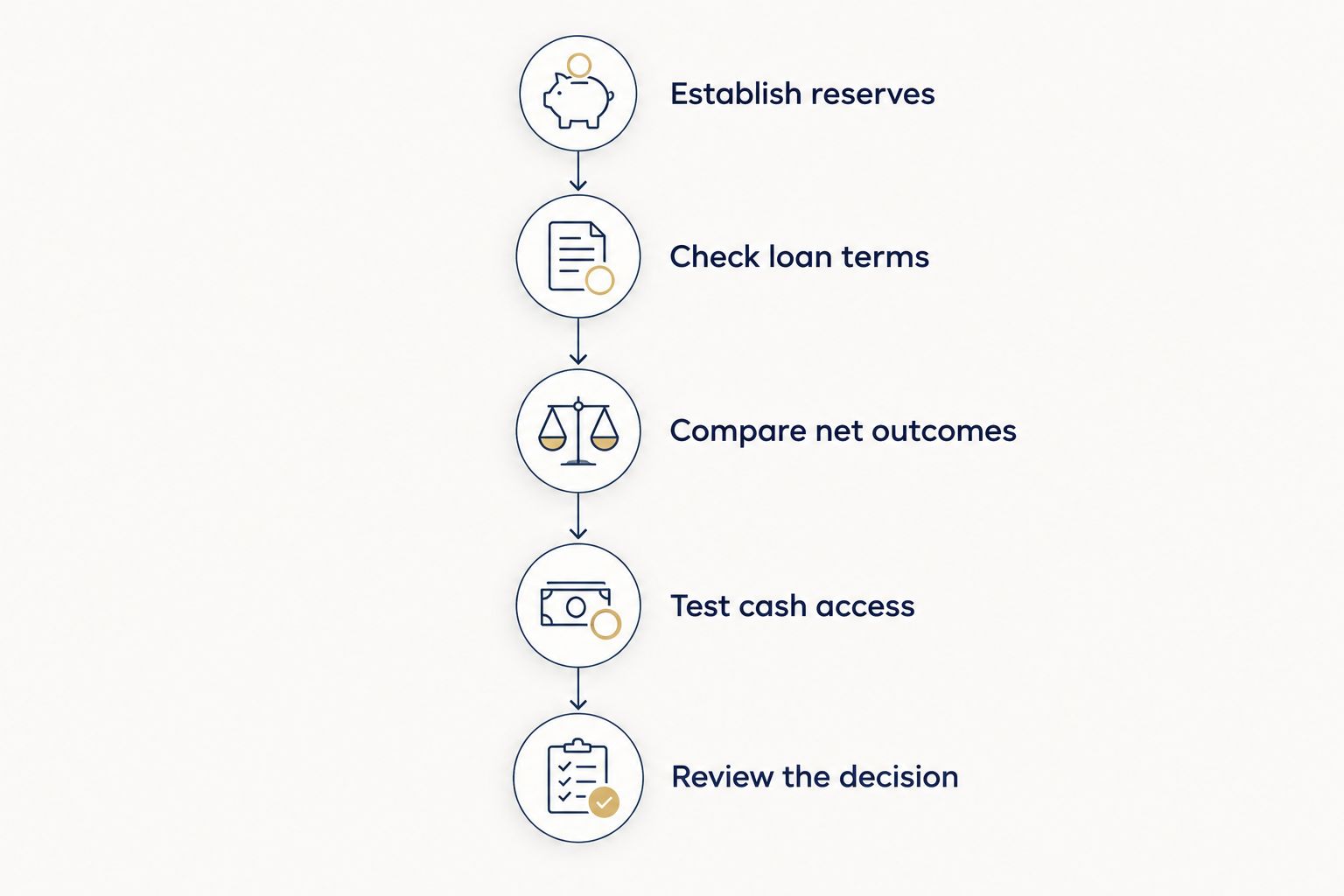
Use this sequence before moving a lump sum or changing your regular savings arrangement. It separates money you need from money you can commit.
Establish reserves
Set aside cash for essential expenses, known bills and foreseeable income gaps. Include tax obligations before treating practice drawings, contract payments or a bonus as available surplus.
There is no universal reserve that suits every borrower. Base yours on household spending, income reliability and the consequences of an interruption.
Check loan terms
Confirm your interest rate, offset eligibility, extra repayment conditions and redraw rules. Ask what happens if you reduce the balance substantially or repay the loan completely.
Check other debts too. A decision focused only on the home loan overlooks the borrowing costs and conditions attached to your wider finances.
Compare net outcomes
For mortgage reduction, identify the interest avoided over your chosen period. For investing, assess the expected return after tax and costs over that same period, including a poor-return scenario.
Keep the comparison consistent. A projected capital gain is uncertain; an interest saving follows the loan rate and balance actually applying during the period.
Test cash access
Ask how you would meet an unexpected bill without selling investments at a loss. Then check whether your chosen mortgage arrangement gives you the access you expect.
Separate cash you control in an account from money accessible only under loan conditions. They are not interchangeable.
Review the decision
Record why you chose the approach and what would trigger a review. A changed mortgage rate, new dependant, planned move or shift into private practice can alter the answer.
Should retirement savings change the decision?
Retirement introduces a separate question: when will you need the money, and under which access rules? Additional super contributions are not interchangeable with an offset balance or investments held outside super.
When funding your retirement plan, distinguish money needed before you can access super from money intended to support later retirement spending. This prevents a retirement-focused strategy from leaving your current household short of accessible cash.
For a 2026 decision, check the contribution rules and tax treatment that apply when you contribute. Your income, existing contributions and eligibility affect the outcome; do not assume the same approach works for every medical professional.
Discuss contribution choices with a licensed financial adviser or tax adviser. Mortgage advice addresses the home loan, not the suitability of a retirement investment strategy.
Can I pay down the mortgage and invest at the same time?
Yes, you can direct part of your surplus towards reducing mortgage interest and part towards investments. A combined approach supports different goals, but it does not remove investment risk or the need for reserves.
Avoid choosing an arbitrary split simply because it feels balanced. First decide how much accessible cash you need, then assess the remaining surplus against your debt-reduction and investment objectives.
A practical arrangement needs to remain affordable during weaker income periods. For a locum doctor or private practitioner, base recurring commitments on sustainable household cash flow rather than the strongest earning month.
Does it matter if I might rent out my home later?
Yes, a future rental plan makes the distinction between offset savings and extra repayments particularly important. Withdrawing your own offset savings is different from redrawing money that has already repaid loan principal.
Australian interest deductibility generally follows the use of borrowed funds, not simply the property securing the debt. Redrawing for private spending can therefore create a different tax outcome from withdrawing cash held separately in an offset account.
Get tax advice before redrawing or restructuring debt connected with a possible future rental property. Keep records showing the purpose of borrowing and avoid mixing private and investment transactions without understanding the consequences.
When should a doctor speak to a mortgage broker?
Speak to a broker when the decision depends on your loan's offset arrangement, repayment restrictions, refinancing options or treatment of changing medical income. Those are home loan questions, even when investing prompted the discussion.
Mortgage Pros is best suited to doctors seeking home loan advice rather than investment selection. Its mortgage broking service addresses the borrowing side of your finances; a licensed financial adviser addresses investment suitability.
Before an enquiry, gather your loan statement, account balances, income information and planned major expenses. Explain whether you expect to move, rent out your home, change employment or enter private practice.
For complex earnings, use these criteria for choosing a doctor mortgage broker. Ask Mortgage Pros to assess the loan structure, then coordinate any investment or tax decisions with the appropriate adviser.
Review your home loan today
Discuss offset access, extra repayments and your medical income with Mortgage Pros.
FAQ
Is paying off my mortgage better than investing in shares?
Paying off your mortgage is better for predictable interest savings; shares suit money you can expose to market losses over a longer horizon. Compare investment returns after tax and costs with the interest you would avoid.
Should I keep my emergency fund in an offset account?
An eligible offset account can keep emergency cash accessible while reducing mortgage interest. Check account access, offset coverage and the overall loan costs before choosing that arrangement.
Is redraw the same as an offset account?
No, redraw accesses additional repayments made into the loan, while an offset holds money in a separate account. Access conditions and tax consequences can differ.
Should doctors invest instead of making extra mortgage repayments?
Doctors should compare their loan costs, cash reserves, tax position and investment risk rather than decide by profession. Variable medical income and planned practice expenses also affect how much money is genuinely surplus.
Can I invest while I still have a mortgage?
Yes, you can invest while carrying a mortgage, provided your budget supports the repayments and investment risk. Keep essential reserves accessible rather than relying on selling investments when a bill arrives.
Should I put extra cash into super or my mortgage?
Super suits retirement savings subject to contribution and access rules, while mortgage reduction lowers borrowing costs. Compare tax treatment and when you need the money with an appropriately qualified adviser.
Does paying off my home loan make investment interest tax deductible later?
No, paying off a home loan does not automatically make later borrowing deductible. Interest deductibility generally depends on how the borrowed money is used; seek tax advice before restructuring or redrawing.
One last thing
Reducing interest does not always reduce your required repayment immediately. Your lender's repayment settings and loan terms determine that, so distinguish lower interest costs from improved monthly cash flow.
Before committing extra cash in 2026, ask what happens to your balance, required repayments and access to money. Contact Mortgage Pros today to review those home loan questions before you act.
This article provides general information, not personal financial, investment or tax advice. Obtain advice suited to your circumstances before changing your borrowing or investment arrangements.
Related guides
- Is refinancing worth it?
- Refinancing a doctor home loan to a standard loan
- How much equity do I need to buy an investment property?