
Yes, you can use your SMSF to buy an investment property in 2026 if the purchase complies with superannuation law, your fund’s investment strategy and the sole purpose test. You cannot use an SMSF-owned residential property as your home or rent it to relatives, and borrowing introduces additional legal requirements through a limited recourse borrowing arrangement.
- Can I use my SMSF to buy an investment property? Yes, subject to superannuation rules and investment strategy requirements.
- SMSF residential property cannot provide accommodation for members or their relatives, even at market rent.
- Borrowing requires a compliant limited recourse borrowing arrangement, not an ordinary investment property loan.
- Mortgage Pros provides home loan broking; SMSF investment, tax and legal decisions require appropriately qualified advisers.
Why this matters
An SMSF property investment belongs to the fund, not to you personally. That distinction controls who can use it, where rent goes and how you access the proceeds. Treating the property like a personally owned investment creates compliance risks that loan approval alone does not resolve.
If borrowing forms part of your plan, the guide to SMSF home loan lenders provides a starting point for lending questions. Before comparing loans, establish whether property ownership through super suits your retirement strategy and whether the proposed transaction is permitted.
Can I use my SMSF to buy an investment property?
Yes. An SMSF can purchase investment property outright with fund money or, where the requirements are satisfied, borrow under a limited recourse borrowing arrangement, commonly called an LRBA. Neither route permits personal use of a residential investment.
The Australian Taxation Office’s guidance on SMSF property, investment restrictions and limited recourse borrowing arrangements sets out the relevant compliance framework. For a 2026 purchase, have your advisers check the proposed transaction against that guidance and the applicable legislation before you commit.
Follow this sequence:
- Check the investment strategy. Assess the proposed property against the fund’s objectives, diversification, liquidity and members’ retirement needs. Record the reasoning rather than treating the strategy as a formality.
- Check the property and seller. Identify the property’s intended use and whether the seller or proposed tenant is a related party. Residential and business real property have different restrictions.
- Confirm the purchase structure. Decide whether the SMSF will pay outright or use an LRBA. If borrowing, obtain legal advice on the holding trust, purchaser details and transaction sequence.
- Test the fund’s cash flow. Allow for loan repayments, vacancies, repairs, insurance, fund administration and member benefit payments. Rent alone is not a complete funding plan.
- Obtain advice before signing. Coordinate the accountant, appropriately licensed financial adviser, solicitor and lending adviser. A contract signed in the wrong entity can create legal and duty complications.
A lender’s willingness to finance a purchase does not establish that the investment is suitable or compliant. Those are separate decisions.
Buying outright or borrowing: what changes?
Best for avoiding borrowing complexity: an outright SMSF purchase, provided the fund retains sufficient liquidity. Buying without debt removes the LRBA requirements, but it does not remove superannuation investment restrictions.
Best for a fund considering debt-funded property: an LRBA assessed by qualified advisers before purchase. Borrowing preserves some fund cash at settlement but adds repayments, documentation and restrictions on how borrowed money is used.
| Purchase approach | Best for | Main benefit | Main limitation |
|---|---|---|---|
| SMSF buys outright | Funds able to purchase while retaining liquidity | No property loan repayments or LRBA structure | A large share of retirement savings can become tied up in one asset |
| SMSF buys through an LRBA | Funds with a suitable borrowing strategy and repayment capacity | The fund can acquire an eligible asset using permitted borrowing | Additional legal structure, repayment obligations and borrowing restrictions |
| Buy outside super | Buyers needing ownership outside the superannuation system | The property is not subject to SMSF investment restrictions | Personal borrowing, tax and asset-ownership consequences require separate assessment |
An ordinary investment mortgage is not interchangeable with an SMSF loan. Under an LRBA, the acquired asset is held through a separate holding trust, with the SMSF holding the beneficial interest and obtaining legal ownership after repayment.
Limited recourse restricts the lender’s recovery against fund assets under the arrangement. It does not mean the investment is risk-free, and any personal guarantee requires separate legal review.
Can I buy a residential investment through my SMSF?
Yes, but residential property must be acquired and used within the SMSF investment rules. In the ordinary residential investment scenario, the fund buys from an unrelated seller and rents to an unrelated tenant on arm’s-length terms.
You cannot buy a residential property from yourself or a related party merely because an independent valuation supports the transaction. Paying market value does not override the related-party acquisition restriction.
You also cannot move into the property, let your children live there or use it as a family holiday home. Charging market rent does not make those arrangements acceptable.
Best for: trustees seeking a retirement investment with no personal accommodation benefit. The benefit is rental income and potential capital growth within the fund; the limitation is that members cannot use the property as their own while it remains in the SMSF.
Keep ownership, rent receipts and expenses separate from personal finances. Ask your accountant how the fund should document the lease, maintain records and support the property’s market valuation for reporting purposes.
Can my SMSF buy commercial premises for my business?
An SMSF can potentially acquire qualifying business real property from a related party and lease it to a related business, subject to the relevant exceptions and arm’s-length requirements. Not every property described as commercial qualifies as business real property. Its actual use matters.
This distinction is relevant to a doctor or dentist considering consulting rooms. Professional occupation alone does not establish eligibility; the property’s use, ownership arrangements and lease terms need assessment.
Best for: business owners whose premises satisfy the business real property rules and whose fund strategy supports the investment. The benefit is holding a business-use asset within super; the drawback is exposure to both the property and the tenant business.
A related business must not treat rent as optional when trading conditions deteriorate. Use a properly documented lease, support market rent and review the arrangement with advisers who understand SMSF related-party transactions.
Why SMSF property suitability varies
There is no single fund balance or deposit figure that makes every SMSF property purchase suitable. For a 2026 decision, assess these factors together:
- Liquidity: The fund needs accessible money for expenses, repayments and benefits without relying on an immediate property sale.
- Diversification: Concentrating retirement savings in one property increases exposure to that location, tenant and property market.
- Member circumstances: Retirement timing, pension obligations and changes in contributions affect the fund’s ability to hold the asset.
- Property condition: Repairs, maintenance and proposed improvements affect cash flow and require additional scrutiny where borrowing is involved.
- Related-party involvement: A connected seller, tenant or lender introduces rules that an ordinary third-party transaction does not resolve.
- Debt obligations: Loan terms and repayment requirements affect resilience during vacancies or reduced contributions.
A property can satisfy a lender’s assessment while leaving the fund poorly diversified or short of cash. Assess the fund first and the loan second.
What should I check before signing a contract?
Complete the ownership, borrowing and advice checks before you become legally committed. An approval condition is not a substitute for getting the purchaser and trust structure right.
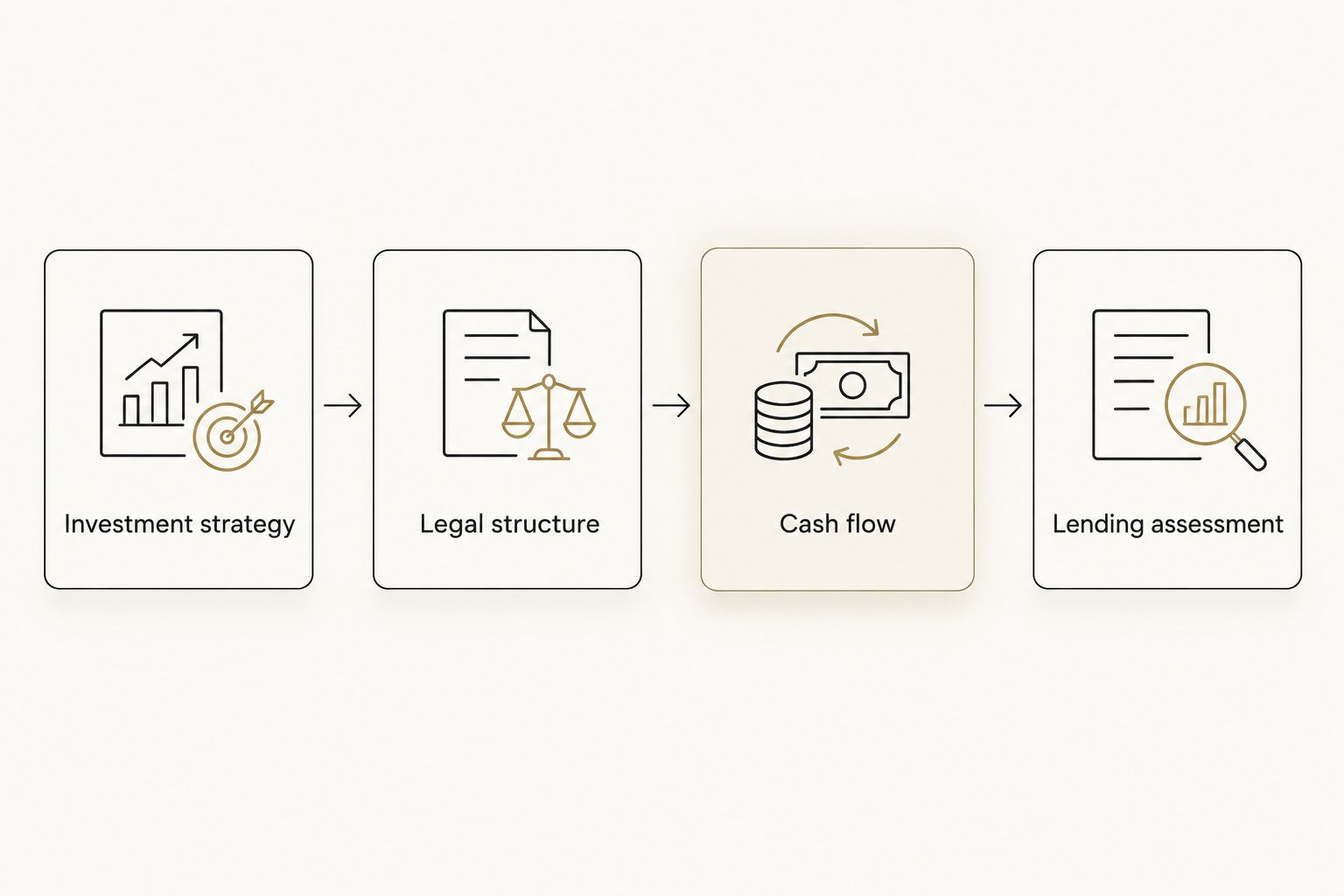
Investment strategy
Ask your financial adviser whether the property fits the fund’s retirement objectives and risk profile. Review the implications for all members, including anyone approaching retirement or already drawing benefits.
A written strategy should explain the investment decision, not simply state that property is permitted. Consider what happens if the tenant leaves or a member needs benefits paid.
Legal structure
Ask your solicitor to confirm the purchaser’s name, trustee arrangements, holding trust requirements and the correct signing sequence. State and territory duty treatment also needs consideration before documents are executed.
Do not assume a contract can be transferred into the correct structure later without consequences. Resolve those details before signing.
Cash flow
Prepare a fund-level budget covering rent, contributions, repayments, insurance, rates, maintenance and administration. Include a vacancy scenario and unexpected repairs without assuming future contributions will always arrive as planned.
Separate the property’s apparent rental return from the fund’s ability to meet every obligation. A valuable asset does not pay an expense until cash is available.
Lending assessment
Confirm that the proposed lender accepts the property, fund structure and borrowing arrangement. Have the relevant advisers review any guarantees and related-party loan terms.
Do not assume approval for a personal home loan establishes eligibility for SMSF borrowing. The borrower, security structure and assessment requirements differ.
Your lending adviser’s role is distinct from deciding whether an SMSF investment is right for you. Mortgage Pros is best for borrowers seeking home loan broking, not SMSF investment, tax or legal advice. Confirm the scope of assistance you need before proceeding.
Discuss your property borrowing plans
Explain your borrowing goals and clarify the lending assistance you need before committing to a purchase.
How is SMSF investment property taxed?
A complying SMSF generally pays 15% tax on taxable income in accumulation phase, including net rental income. That is a tax rate, not a guaranteed investment return, and deductions and other tax rules affect the final outcome.
For an eligible capital gain on an asset held for at least 12 months, the fund generally receives a one-third capital gains discount. With the 15% accumulation-phase rate, that produces an effective 10% rate on the eligible gain before considering capital losses and other adjustments.
These are general Australian tax settings reflected in ATO guidance, not a calculation for your fund. For your 2026 assessment, ask your tax adviser to check accumulation and retirement-phase interests, any exempt current pension income and non-arm’s-length income rules.
A personally owned investment property’s loss is not the same as a loss inside an SMSF. You cannot deduct the SMSF’s rental loss against your personal salary. The fund and the member are separate taxpayers.
Can I renovate a property bought with an SMSF loan?
An LRBA distinguishes between maintaining or repairing an asset and improving it. Borrowed money can be used for permitted repairs and maintenance, but not to improve the acquired asset.
Using other fund money for improvements requires further analysis, particularly where the work changes the asset’s character. Obtain advice before approving work rather than relying on the builder’s description of the project.
This matters when comparing a ready-to-rent property with a renovation project. A lower-quality property can introduce funding and compliance questions that do not appear in the purchase contract.
Can I live in the property after I retire?
Retirement does not automatically permit you to occupy residential property still owned by your SMSF. The fund’s ownership and investment restrictions remain relevant even when a member has met a condition of release.
A later transfer out of the fund is a separate transaction requiring advice about benefit-payment rules, valuation, tax and duty. Do not buy on the assumption that retirement converts the property into your home.
FAQ
Can I use my SMSF to buy an investment property in Australia?
Yes, an SMSF can buy an investment property if the transaction complies with superannuation law and the fund’s investment strategy. Residential property cannot provide personal accommodation for members or their relatives.
Can I rent my SMSF property to my children?
No, you cannot rent an SMSF-owned residential property to your children, even at market rent. Related-party residential use conflicts with the relevant SMSF investment restrictions.
Can my SMSF buy an investment property I already own?
An SMSF generally cannot acquire your personally owned residential investment property because you are a related party. Qualifying business real property has a separate exception that requires professional assessment.
Do I need an SMSF loan if the fund can pay outright?
No, an SMSF does not need a loan when it has sufficient money to complete a permitted purchase outright. Trustees still need to assess liquidity, diversification and future fund obligations.
Can I claim an SMSF property loss against my salary?
No, an SMSF property loss cannot be deducted against your personal salary. The fund’s income, deductions and losses are dealt with within the fund’s tax position.
Can my medical practice rent premises from my SMSF?
A medical practice can lease qualifying business real property from a related SMSF if the arrangement satisfies the relevant rules. Obtain advice on property use, market rent and the written lease before proceeding.
Is an SMSF property purchase the same as the First Home Super Saver scheme?
No, an SMSF property purchase is an investment owned by the super fund. The First Home Super Saver scheme concerns the release of eligible voluntary contributions and associated earnings to help an eligible person buy their own home.
One last thing
The key decision is not whether your super can fund the deposit; it is whether the fund can responsibly own the property for your retirement. Start with the investment and legal structure, then assess borrowing.
For a 2026 purchase, ask each adviser to confirm their responsibilities before you sign. Contact Mortgage Pros today to discuss your property borrowing plans, and arrange separate SMSF investment, tax and legal advice before committing fund money.
This article provides general information, not personal financial, tax or legal advice. Seek advice that considers your fund and personal circumstances.
Related guides
- Investment property loan income requirements
- Investment property loan approval timing
- First Home Super Saver scheme and deposit planning