

Best overall: a variable refinance that reduces total costs without extending your remaining term. Best for borrowers holding savings: an offset-linked refinance. Best for repayment certainty: a fixed-rate refinance. The best refinance home loan deals in 2026 match your borrowing needs, not just an advertised rate.
- The best refinance home loan deals reduce total costs over your intended holding period, not just the advertised rate.
- Mortgage Pros provides refinancing advice for home owners and investors comparing home loan options.
- Offset-linked refinancing suits borrowers who keep savings accessible; fixed-rate refinancing prioritises repayment certainty.
- Compare switching costs and your remaining loan term before accepting a refinance offer.
Why this matters
A lower repayment does not automatically mean a better refinance. Extending the loan term can reduce the scheduled payment while increasing the time you spend paying interest. Switching expenses also affect whether a lower rate produces a worthwhile saving.
Mortgage Pros provides refinance home loan advice for home owners and investors comparing loan options. You can use Mortgage Pros to discuss refinancing, equity and your borrowing circumstances before selecting a structure.
For a 2026 refinance review, start with your current balance, remaining term, repayment type and reason for switching. Those details establish the baseline. Compare new offers against that baseline rather than against a headline alone.
What makes the best refinance home loan deals?
Judge each refinance against these criteria before comparing features:
- Total cost: Include interest, ongoing fees and switching expenses over the period you expect to keep the loan.
- Remaining term: Compare offers using your existing remaining term first, so a longer repayment schedule does not disguise the result.
- Useful features: Choose an offset account, redraw or repayment flexibility only when the feature supports how you manage money.
- Eligibility: Check how the lender assesses income, expenses, existing debts, property value and the loan purpose.
- Exit flexibility: Understand fixed-rate break costs, discharge requirements and restrictions on extra repayments.
- Borrowing purpose: Separate a straightforward refinance from extra borrowing, investment changes or debt consolidation.
For your 2026 comparison, ask for costs over 12 months, 3 years and 5 years. These are comparison windows, not predictions about rates. They help you assess how upfront switching expenses interact with the time you expect to retain the loan.
Use the same balance and term across each calculation. When an offer includes additional borrowing, compare that separately; otherwise, the refinance and the new debt become difficult to distinguish.
Refinance options at a glance
This ranking compares loan structures rather than named lender offers. Each option has a different job, so the best choice depends on what you need the refinance to achieve.
| Rank and option | Best for | Standout feature | Key limitation |
|---|---|---|---|
| 1. Cost-focused variable refinance | Borrowers prioritising lower total borrowing costs | Variable-rate structure assessed against the existing remaining term | Repayments change when the applicable rate changes |
| 2. Offset-linked variable refinance | Borrowers keeping accessible savings | Eligible offset balances reduce the balance used to calculate interest | Account costs and offset conditions need checking |
| 3. Fixed-rate refinance | Borrowers prioritising repayment certainty | Rate certainty during the agreed fixed period | Early changes can trigger break costs |
| 4. Split-loan refinance | Borrowers balancing certainty and flexibility | Separate fixed and variable portions | Both portions need their own cost and feature checks |
| 5. Investment-purpose refinance | Property investors reviewing debt structure | Review of borrowing purpose, repayments and loan accounts | Tax treatment depends on the use of borrowed funds |
1. Cost-focused variable refinance: best for lower total costs
A cost-focused variable refinance replaces your existing loan with a variable-rate loan assessed on overall borrowing costs. Its purpose is straightforward: improve the cost of your current debt without relying on a longer term to make repayments look smaller.
Compare the proposed loan with your current loan using the same balance and remaining term. Include fees and switching expenses. A lower advertised rate is useful only when the whole calculation supports the change.
Cost-focused variable refinance pros:
- Keeps the comparison focused on the cost of your existing debt.
- Avoids making unused features the centre of the decision.
- Gives you a clear basis for comparing competing variable-rate offers.
Cost-focused variable refinance cons:
- Variable rates do not provide repayment certainty.
- A feature-light loan is unsuitable if you need an offset or other specific functionality.
- Switching expenses can outweigh the benefit over a short holding period.
Best for: Borrowers whose main objective is reducing total costs while preserving their repayment timetable.
Ask whether the proposed saving depends on an introductory rate or conditions you must keep meeting. Check the ongoing arrangement, not just the opening period.
Verdict: Hold until the comparison shows a lower total cost after switching expenses, using your remaining term.
2. Offset-linked variable refinance: best for accessible savings
An offset-linked refinance pairs an eligible home loan with an account whose balance reduces the loan balance used to calculate interest. Your money remains in the linked account rather than becoming a direct repayment of principal.
This structure suits borrowers who retain savings for emergencies, upcoming expenses or regular cash management. Its value depends on the balance you actually maintain and the lender's offset terms.
Offset-linked variable refinance pros:
- Keeps savings accessible while reducing interest on the eligible loan balance.
- Supports borrowers who regularly hold cash between expenses.
- Separates available cash from the loan principal.
Offset-linked variable refinance cons:
- Associated fees or a different loan rate can reduce the benefit.
- A low or frequently depleted account balance provides less offset benefit.
- Offset eligibility and account conditions vary between loans.
Best for: Borrowers who keep a meaningful cash balance and want access to those funds.
For a 2026 comparison, use your expected account balance across ordinary spending cycles, not a temporary high balance. Ask whether the account provides full or partial offset and which loan portion it applies to.
Do not treat redraw as identical to offset. Redraw involves accessing eligible extra loan repayments under the lender's rules; offset money sits in a separate linked account.
Verdict: Hold until the expected interest benefit justifies the loan and account costs.
3. Fixed-rate refinance: best for repayment certainty
A fixed-rate refinance sets the interest rate for an agreed period. It gives you a defined rate during that period, which supports budgeting when repayment predictability matters more than responding to rate changes.
The fixed period is not the same as the full loan term. Check what happens when the fixed period ends and how the lender calculates repayments under the proposed structure.
Fixed-rate refinance pros:
- Provides rate certainty during the agreed fixed period.
- Makes scheduled repayments easier to plan where the repayment arrangement remains unchanged.
- Reduces exposure to variable-rate increases during that period.
Fixed-rate refinance cons:
- Breaking or changing the loan early can trigger break costs.
- Extra repayments and account features can be restricted.
- The fixed rate does not fall when variable rates fall.
Best for: Borrowers who prioritise a predictable repayment commitment and do not expect major loan changes during the fixed period.
Check plans to sell, refinance again or make substantial extra repayments before fixing. Those plans matter more than trying to predict the next rate movement.
In your 2026 review, ask for the extra-repayment rules, early-exit conditions and end-of-fixed-period arrangements in writing. Certainty during the fixed period should not obscure what happens afterwards.
Verdict: Hold until the fixed period fits your plans and the restrictions are acceptable.
4. Split-loan refinance: best for balancing certainty and flexibility
A split-loan refinance divides borrowing into fixed and variable portions. The fixed portion provides rate certainty for its agreed period; the variable portion retains exposure to rate changes and the features specified in its contract.
Choose the split around how you expect to use the loan. The variable portion needs to accommodate any intended extra repayments or offset arrangement, subject to the lender's conditions.
Split-loan refinance pros:
- Combines fixed-rate certainty with a variable-rate component.
- Lets you assess different features for different portions of the debt.
- Avoids placing the whole balance under fixed-rate restrictions.
Split-loan refinance cons:
- Separate portions make account management and comparisons more involved.
- The fixed portion still carries its own restrictions and potential break costs.
- Fees and offset access require checking across the complete arrangement.
Best for: Borrowers who want some rate certainty while retaining a variable component for their cash-management plans.
Do not choose a split simply because it sounds like a compromise. Start with the amount you expect to repay early or offset, then assess how the proposed portions support that plan.
Compare the combined cost with an entirely variable or entirely fixed alternative. Splitting the loan changes its structure; it does not automatically lower its cost.
Verdict: Hold until both portions have a clear purpose and the combined costs are acceptable.
5. Investment-purpose refinance: best for property investors
An investment-purpose refinance reviews an investment loan against your rental-property borrowing needs. The decision includes repayment structure, account separation and the purpose of any additional borrowing, not just the interest rate.
Mortgage Pros helps property owners and investors with refinancing and equity arrangements. For investment borrowing, coordinate the loan discussion with tax advice before changing accounts or using released funds.
Investment-purpose refinance pros:
- Creates an opportunity to review whether the loan still matches the property's borrowing purpose.
- Supports a clearer assessment of existing debt and proposed additional borrowing.
- Brings repayment structure and account organisation into the comparison.
Investment-purpose refinance cons:
- Refinancing does not make additional borrowing tax-deductible by itself.
- Mixing private and investment uses complicates loan records and tax treatment.
- Extra borrowing increases debt and requires a separate affordability assessment.
Best for: Investors reviewing an existing property loan or considering additional borrowing for a defined purpose.
The Australian Taxation Office's general approach links interest deductibility to the use of borrowed funds, not simply the property securing the loan. Get advice on your circumstances before moving money between loan accounts.
Verdict: Hold until the borrowing purpose, account structure and tax implications are clear.
How the options are ranked
The default ranking puts total-cost reduction first, then separates the main use cases: accessible savings, repayment certainty, mixed flexibility and investment borrowing. It follows the criteria above rather than predicting rates or assuming every borrower needs the same features.
Your circumstances change the order. An offset-linked refinance belongs first when accessible savings are central to your plan; a fixed-rate refinance belongs first when repayment certainty is the priority.
Check the offer before you apply
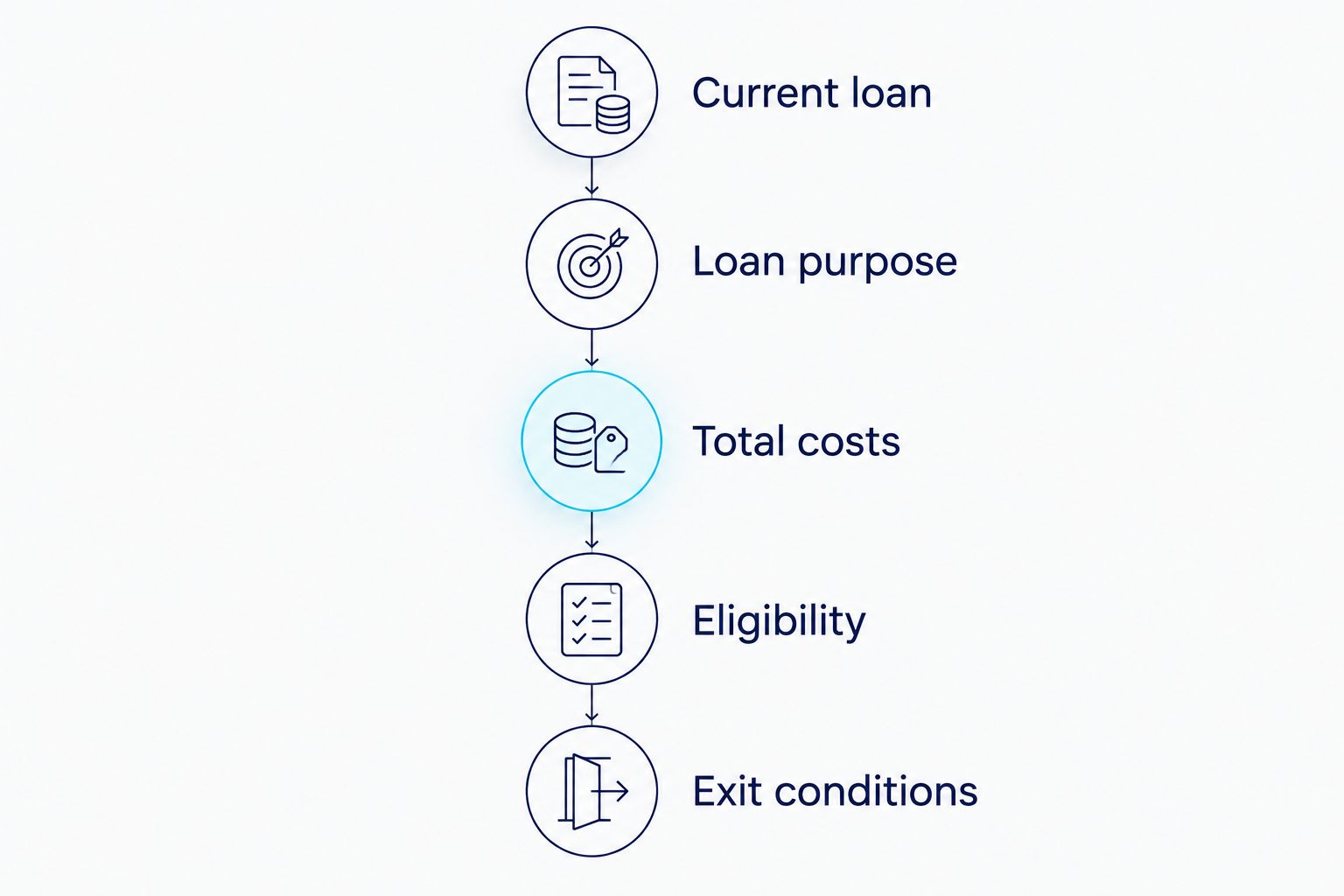
Use this sequence to turn a refinance comparison into a decision:
- Current loan: Record your balance, remaining term, rate, fees and existing features.
- Loan purpose: State whether you are replacing debt only or requesting additional borrowing.
- Total costs: Compare interest, ongoing fees and switching expenses on consistent assumptions.
- Eligibility: Check income evidence, liabilities, property valuation requirements and lender conditions.
- Exit conditions: Confirm existing discharge costs, any fixed-rate break costs and the proposed loan's restrictions.
The application decision comes after these checks. Approval and the lender's valuation determine whether the proposed arrangement proceeds on the terms you expect.
Before proceeding, ask for a written comparison that explains both the benefit and the trade-offs. Mortgage Pros can help you assess refinancing options against your current loan and borrowing needs.
Review your refinancing options
Discuss your current home loan, borrowing goals and refinance structure.
Which refinance option should you choose?
Start with a cost-focused variable refinance if your main goal is reducing borrowing costs. Keep the remaining term consistent, then assess whether offset access, fixed-rate certainty or a split structure better serves your needs.
The best refinance home loan deals in 2026 are the offers that pass your own cost and suitability checks. Do not accept a longer term, unnecessary extra borrowing or restrictive conditions solely to obtain a smaller scheduled repayment.
FAQ
What’s the best refinance home loan deal in 2026?
The best refinance home loan deal is the eligible offer that meets your needs and reduces total costs over your intended holding period. Compare the same balance and remaining term, including switching expenses and ongoing fees.
Is a lower interest rate always a better refinance deal?
No, a lower interest rate does not always produce a better overall refinance. Fees, switching expenses, a longer term and unsuitable restrictions can change the result.
Should I choose a fixed or variable refinance?
Choose a fixed-rate refinance when rate certainty fits your plans, and assess variable refinancing when flexibility is the priority. Check extra-repayment rules and potential fixed-rate break costs before deciding.
Is an offset account better than redraw?
An offset account and redraw serve different purposes, so neither is automatically better. Offset keeps funds in a separate linked account; redraw provides access to eligible extra repayments under the lender’s rules.
Can I refinance and borrow more against my property?
Refinancing can include additional borrowing when the lender approves the proposed arrangement. Available equity alone does not establish eligibility; the lender also assesses your ability to repay and its lending requirements.
Does refinancing restart my home loan term?
Refinancing does not require you to accept a new full-length term. Compare offers against your existing remaining term first, and assess the total-cost effect of any proposed extension.
What should property investors check before refinancing?
Property investors should check borrowing purpose, repayment structure, account separation and the use of any additional funds. Obtain tax advice before combining private and investment borrowing or changing how loan funds are used.
One last thing
Compare the loan you already have before replacing it. Ask your current lender to review its terms, then assess that response against refinance offers using the same balance, remaining term and features.
A better existing-loan arrangement avoids the need to switch. If refinancing still wins after costs and conditions, you have a clearer reason to proceed.