
Engineers’ home loans are mortgages assessed against your income, deposit and liabilities to finance a home purchase or refinance. This 2026 guide explains how to compare home loans for engineers when your earnings include salary, project contracts, overtime or income from your own consultancy.
- Choose home loans for engineers by accepted income, deposit requirements and repayment flexibility, not occupation labels.
- Mortgage Pros suits borrowers seeking mortgage broking support for a home purchase or refinance.
- Contract engineers should separate recurring earnings from reimbursements before estimating borrowing capacity.
- Compare fixed, variable and split home loans against your cash flow and plans, not the advertised rate alone.
Why home loans matter for engineers
Your engineering qualification does not replace a lender’s assessment of repayment capacity. A permanent employee, a project contractor and a consulting business owner can earn similar amounts but need different evidence to support an application.
The distinction matters when your income includes site allowances, overtime, bonuses or payments through a company. Start with how a lender will assess your earnings, then compare the loan. An attractive product is irrelevant if the application relies on income the lender will not accept.
Mortgage Pros is best suited to borrowers seeking mortgage broking support rather than approaching a lender alone. A broker can help with the application process, but the lender still decides whether to approve the loan.
How to prepare your engineering home loan application
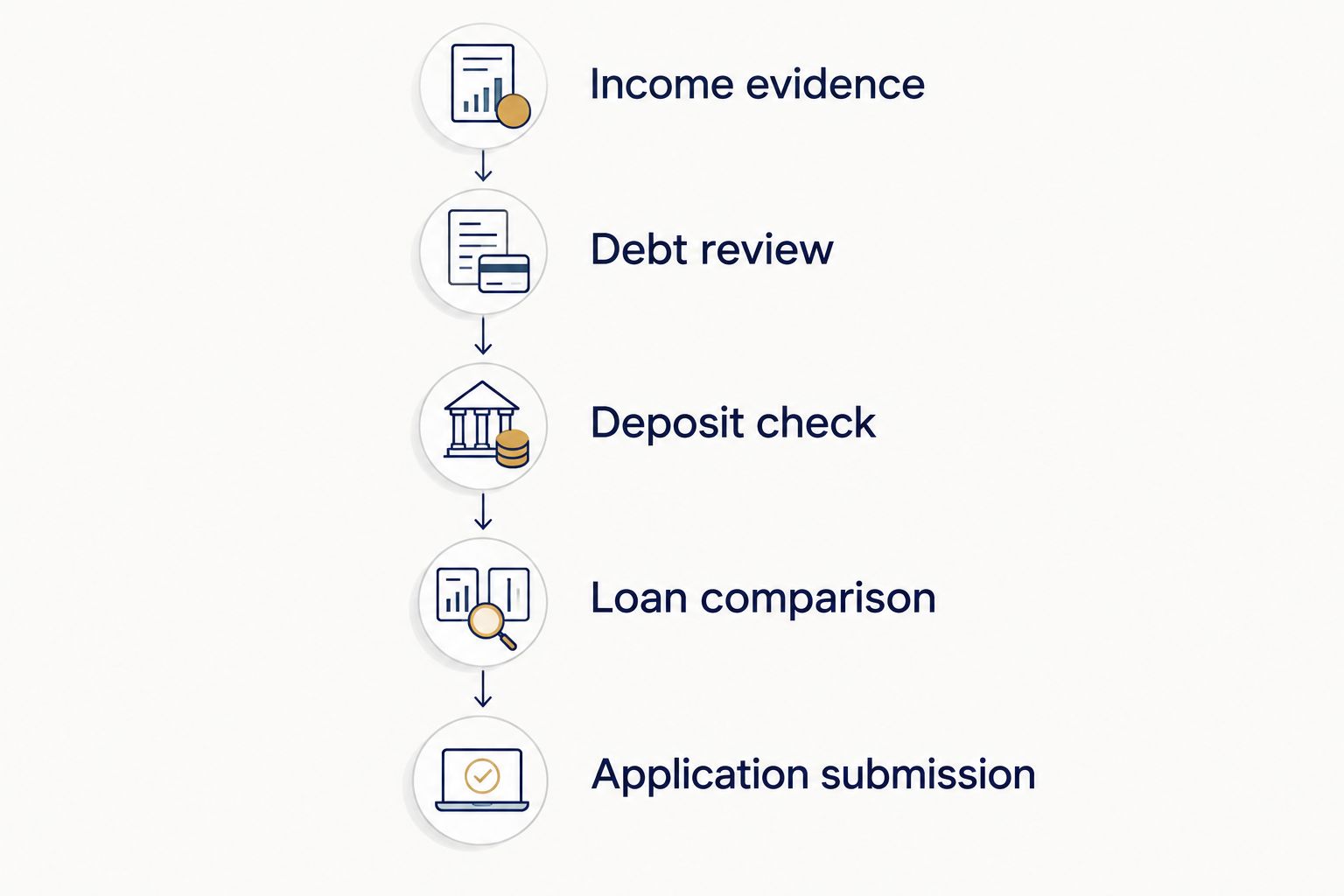
For a 2026 application, build your evidence around your current employment arrangement and financial position. Use these checkpoints in order: Income evidence, Debt review, Deposit check, Loan comparison and Application submission.
1. Identify your employment and income structure
Start by writing down who pays you, how you are employed and which payments recur. You can do this yourself using your employment contract, payslips and bank statements; no loan application is required.
Do not assume that working on projects makes you self-employed. An engineer employed by a consulting firm has a different evidence trail from an engineer invoicing clients through a business. Describe the legal arrangement accurately before asking how much you can borrow.
For variable earnings, distinguish payment for work from reimbursement of expenses. A lender’s treatment of overtime, bonuses and allowances depends on its policy and your evidence, so your total payslip amount is not automatically your assessable income.
- Record whether you are permanent, casual, fixed-term or self-employed.
- Separate base salary, overtime, bonuses, allowances and reimbursements.
- Gather contracts showing employment terms and any end date.
- Explain recent changes in employer, role or business structure.
2. Calculate a repayment budget before borrowing capacity
Build a household budget from your actual spending and existing commitments. Include the costs of owning the property, not just the proposed mortgage repayment. Council rates, insurance, maintenance and strata levies belong in that calculation where applicable.
Then test your budget without relying on your highest earning period. If overtime or project work pays for essential expenses, identify what happens when that income stops. A lender’s maximum borrowing figure is not your personal spending target.
An online repayment calculator helps you compare scenarios, but it does not approve income or assess a property. For a 2026 purchase, update the inputs when your deposit, debts or employment position changes.
- Review transaction statements rather than estimating living expenses.
- Include credit cards, personal loans and study-related debt.
- Separate essential commitments from spending you can reduce.
- Test repayments using base income and a higher interest-rate scenario.
- Keep a cash reserve outside your purchase expenses.
3. Assemble evidence that explains your earnings
Create a document folder yourself before requesting an assessment. Salaried engineers should start with employment and income records; self-employed engineers should prepare personal and business financial records relevant to the borrowing structure.
For contract work, make the timeline easy to follow. Match contracts with invoices or payslips and the corresponding receipts. Explain gaps rather than leaving an assessor to infer why your earnings changed.
Mortgage Pros provides home loan advice and approval support, giving borrowers an alternative to managing the process alone. Ask which evidence the proposed lender needs before submitting, rather than assuming every lender accepts the same documents.
- Collect current identification and employment documents.
- Match income records to deposits in your bank account.
- Prepare relevant tax returns and business financial statements if self-employed.
- Document contract renewals and explanations for income gaps.
- Ask how unusual allowances or recent business changes will be assessed.
4. Check your deposit, equity and security position
Calculate how much cash remains after purchase expenses and your emergency reserve. Your savings balance is not necessarily the amount you can contribute to the property itself.
Loan-to-value ratio, or LVR, compares the loan with the property value accepted by the lender. An 80% LVR means the loan represents 80% of that value; the remaining 20% contribution must come from other funds or equity, before allowing for transaction costs. The lender’s valuation can differ from the purchase price.
Lenders mortgage insurance generally applies to standard loans above 80% LVR, although lender rules and exceptions vary. It protects the lender, not you. Do not assume an engineering qualification automatically qualifies you for an insurance waiver or another professional concession.
- Separate your deposit from duty, legal expenses and other purchase costs.
- Ask which valuation the lender will use to calculate LVR.
- Confirm any occupation-based concession against written eligibility criteria.
- Check whether a guarantor arrangement changes the security requirements.
- Obtain independent legal advice before involving a family guarantor.
5. Match loan features to your cash flow
List the functions you need before comparing products. A variable loan supports changing repayment plans subject to its terms, while a fixed loan provides rate certainty during the fixed period but restricts flexibility. A split loan combines fixed and variable portions without removing either portion’s conditions.
If you receive irregular project income, compare an offset account with redraw carefully. A 100% offset account applies the eligible account balance against the linked loan balance when calculating interest. Redraw gives access to eligible extra repayments under the lender’s rules; it is not the same arrangement.
The guide to offset home loan accounts explains another part of this comparison. For a 2026 decision, read the current terms rather than relying on a feature name alone.
- Identify whether certainty or repayment flexibility matters more.
- Check extra-repayment restrictions and fixed-rate break-cost conditions.
- Confirm which loan portion an offset account links to.
- Compare ongoing fees alongside the features you will actually use.
- Seek tax advice before changing debt linked to an investment property.
6. Compare lender fit before lodging an application
Prepare a shortlist using the same income, deposit and property assumptions for each option. A comparison is not useful if one estimate includes all overtime and another excludes it.
Ask how each lender treats your employment arrangement before focusing on rates. A contractor with a recent renewal, a business owner retaining profits and an employee on probation present different assessment questions. Request an explanation of any conditions attached to an indicative borrowing figure.
A broker reduces the work of comparing and organising an application, but a broker’s lender panel is not the entire market. Ask Mortgage Pros about lender access, remuneration and the reasons for a recommendation so you understand both the service and its limits.
- Compare assessments using consistent financial information.
- Ask which income components each lender accepts.
- Check employment-history and contract requirements.
- Read the comparison rate and its stated assumptions.
- Avoid lodging multiple applications simply to test eligibility.
7. Protect your position through approval and settlement
Treat pre-approval as a conditional assessment, not a promise that every property will qualify. The lender still needs to assess the proposed security and confirm that the application meets its requirements.
Before signing a purchase contract, ask your conveyancer or solicitor about finance conditions and contractual obligations. Keep your broker or lender informed of employment changes, new debts or reduced savings. A loan assessment based on outdated information does not protect your purchase.
After settlement, check that repayments, account links and any offset arrangement match the approved structure. Keep the loan documents somewhere accessible so you can review the terms when your work or household finances change.
- Confirm the conditions and expiry of any pre-approval.
- Obtain legal advice on the purchase contract before committing.
- Tell the lender about material financial or employment changes.
- Confirm formal approval and settlement requirements in writing.
- Check repayment instructions and linked accounts after settlement.
Compare loan structures for engineers
There is no single engineering mortgage structure that suits every borrower. Use this table to match the loan’s main benefit with the restriction you would need to accept. Product terms still require individual checking.
| Option | Best for | Main benefit | Key limitation |
|---|---|---|---|
| Basic variable loan | Borrowers prioritising a straightforward structure | Variable repayments and extra-payment flexibility, subject to terms | Repayments change when the rate changes; offset access is not automatic |
| Variable loan with offset | Borrowers holding savings or irregular income between payments | Eligible savings reduce the balance used to calculate interest | Fees and account conditions can outweigh the benefit of a small balance |
| Fixed-rate loan | Borrowers prioritising rate certainty during a defined period | The rate remains fixed for the agreed period | Extra-repayment limits and break costs restrict changes |
| Split loan | Borrowers wanting certainty on part of their debt | Combines fixed and variable portions | Adds complexity, and fixed-portion restrictions still apply |
Choose the structure around your cash flow, not your occupation title. An engineer expecting a career break has different needs from an engineer retaining substantial savings between consulting projects.
Discuss your home loan application
Ask about income evidence, lender requirements and a loan structure suited to your circumstances.
Common mistakes engineers make
Treating a professional title as approval
A qualification does not establish serviceability or guarantee special lending terms. Confirm any professional eligibility criteria in writing and keep the standard income, debt and deposit assessment separate.
Counting every allowance as usable income
An expense reimbursement and a recurring work allowance serve different purposes. Identify each payment correctly and ask how the lender assesses it before building your purchase budget around it.
Assuming contract renewals explain themselves
A history of project work needs a clear evidence trail. Present contract dates, receipts and gaps together so the lender can assess the arrangement rather than reconcile disconnected documents.
Mixing business cash with personal deposit funds
Money in a consulting business account is not automatically available for a personal property purchase without consequences. Ask your accountant about business obligations and tax treatment before moving funds or committing them to settlement.
FAQ
What are the best home loans for engineers in 2026?
The best home loan for an engineer is one that accepts their income structure and suits their repayment needs. Compare lender eligibility, total loan costs, deposit requirements and flexibility before choosing a product.
Do engineers automatically qualify for an LMI waiver?
No, an engineering qualification does not automatically establish eligibility for an LMI waiver. Any concession depends on the lender’s current criteria and the individual application.
Can a contract engineer apply for a home loan?
A contract engineer can apply for a home loan, but approval depends on the lender’s assessment of income, employment history, debts and security. Prepare contracts and evidence of payments so the arrangement is clear.
How do self-employed engineers prove income for a mortgage?
Self-employed engineers need documents that support their personal and business income. The exact requirements depend on the lender and application, so confirm the document list before lodging.
Will a lender include engineering overtime and site allowances?
A lender includes overtime or allowances only where they meet its assessment requirements. Separate recurring earnings from reimbursements and provide evidence showing the nature and history of each payment.
Is an offset account better than redraw for an engineer?
An offset account is not automatically better than redraw; the right choice depends on fees, access rules and how you hold savings. Investment-related borrowing also needs tax advice because the treatment of withdrawals and redraw can differ.
Should an engineer use a broker or apply directly to a bank?
Use a broker if you want help comparing lenders and preparing an application; apply directly if you want to manage the process with a particular bank. A broker’s panel does not cover every lender, while a bank assesses its own products.
One last thing
Explain the income, not just the job title. A short summary connecting your employment arrangement, recurring earnings and supporting documents is more useful than assuming an assessor understands how your engineering work is paid.
For your 2026 application, contact Mortgage Pros today to discuss your income evidence, deposit position and next steps. Bring the documents that explain your circumstances, not just a borrowing figure from a calculator.
Related guides