

Best starting point for established, fully documented income: Commonwealth Bank. Best alternative-documentation shortlist: Pepper Money. Best specialist-credit shortlist: Liberty. Best first comparison for refinancing: your existing lender. This 2026 guide ranks application routes, not guaranteed approvals: the right lender depends on how you prove income, your credit history and the property securing the loan.
- The best lenders for self-employed home loans depend on income evidence, credit history and the property being financed.
- Commonwealth Bank belongs on a full-doc shortlist; Pepper Money belongs on an alternative-documentation shortlist.
- Consider Liberty when your application needs specialist assessment rather than a standard lending route.
- Mortgage Pros provides mortgage broking advice, not lending or guaranteed approval.
Mortgage Pros helps borrowers secure and manage home loans. Mortgage Pros is a mortgage broker for borrowers who need home loan advice and approval support. A broker and a lender play different roles: the broker helps assess and arrange the application; the lender decides whether to approve it.
Why this matters
Self-employed borrowers need to establish both business performance and personal repayment capacity. Turnover alone does not show how much income is available to service a mortgage, and a business bank balance is not the same as regular personal income.
The best application route in 2026 starts with your documents. Choosing a lender before understanding those documents risks comparing loans you cannot qualify for or overlooking a suitable assessment method.
There is no universal winning lender for every business owner. Treat the recommendations below as a shortlist organised by application type, then confirm current requirements before submitting an application.
What makes the best self-employed home loan lender?
Assess these criteria before comparing lender names:
- Income evidence: Does the lender accept the documents you can supply, and do those documents substantiate your income?
- Income calculation: How does the lender assess salary, business profits, distributions and expenses within your business structure?
- Credit assessment: Does the application fit standard credit requirements, or does it need specialist assessment?
- Security and equity: Does the property meet lending requirements, and is your deposit or existing equity sufficient?
- Loan suitability: Do the repayment structure, offset arrangements and other features suit how you manage cash flow?
- Total obligations: Does the assessment account for business debts, personal debts, tax commitments and living expenses?
Choose the documentation route before choosing the lender. A convenient loan feature does not fix an application that fails the lender's income assessment.
Self-employed lenders at a glance
This comparison separates distinct use cases. It does not claim that any lender accepts every applicant within a category, offers the lowest borrowing costs or approves applications faster.
| Lender or option | Best for | Standout assessment route | Key limitation |
|---|---|---|---|
| Commonwealth Bank | Established income with full financial records | Mainstream home lending supported by documented income | Your income and application must satisfy standard lending assessment |
| Pepper Money | Borrowers needing alternative income documentation | Specialist lending with alternative-documentation options | Alternative documents still need to substantiate repayment capacity |
| Liberty | Applications needing specialist credit assessment | Specialist home lending for circumstances outside a straightforward bank application | Complex circumstances remain subject to assessment and supporting evidence |
| Your existing lender | An initial refinancing comparison | Comparing your current arrangement with a proposed replacement | Familiarity does not establish that the existing loan is the best fit |
No lender's position in this table is an approval prediction. In 2026, confirm the applicable product, eligibility conditions and evidence requirements for your circumstances.
1. Commonwealth Bank: best shortlist for fully documented income
Commonwealth Bank is a mainstream home loan lender. Start here when your financial records provide a clear account of business income and your personal ability to meet repayments.
The recommendation is about application fit, not a claim that Commonwealth Bank ranks first on every loan feature. Other mainstream lenders also deserve comparison when you have complete records.
What to establish before applying
Make sure your tax returns, financial statements and current business performance tell a consistent story. If the business earns revenue through a company or trust, distinguish the entity's earnings from the income available to you personally.
Mainstream assessments commonly request financial records covering 2 years, although requirements differ by lender and application. Do not assume that supplying a particular number of returns automatically establishes eligibility.
Commonwealth Bank pros:
- A mainstream lending route suits a straightforward, fully documented application.
- Tax and financial records provide a clear basis for explaining business income.
- You can compare the proposed loan with other mainstream home loans using the same evidence pack.
Commonwealth Bank cons:
- Incomplete records make the full-documentation route harder to assess.
- A strong recent trading period does not establish that all income will count.
- A mainstream application still needs to satisfy credit, security and repayment requirements.
Best for: Established self-employed borrowers with complete financial records and clearly explainable income.
Verdict: Hold Commonwealth Bank on your shortlist until the income assessment and loan structure are confirmed.
2. Pepper Money: best shortlist for alternative documentation
Pepper Money is a specialist lender with alternative-documentation home loan options. This route is relevant when you need to substantiate self-employed income using evidence other than a conventional full-documentation package.
Alternative documentation is not an exemption from proving affordability. The lender still needs evidence that supports the income declared and the proposed repayments.
What to establish before applying
Identify the documentation accepted for the particular loan before preparing the application. Depending on the assessment route, alternative evidence includes documents such as business activity statements, business bank statements or an accountant's declaration.
Do not treat those documents as interchangeable. A declaration summarises information; transaction records and business activity statements show different aspects of trading performance.
Pepper Money pros:
- Alternative-documentation options provide a separate route from a conventional full-doc application.
- Business records can help substantiate income when a standard evidence package does not fit.
- A specialist assessment route lets you compare options beyond mainstream banks.
Pepper Money cons:
- Alternative documentation does not remove income verification.
- Accepted evidence depends on the product and your circumstances.
- A loan that fits the documentation still needs to fit your repayment capacity and property.
Best for: Self-employed borrowers whose income needs an alternative-documentation assessment.
Verdict: Hold Pepper Money on your shortlist until the required evidence and complete loan terms are clear.
3. Liberty: best shortlist for specialist credit assessment
Liberty is a specialist home loan lender. Include Liberty in your comparison when your circumstances need assessment beyond a straightforward mainstream application.
Keep documentation issues separate from credit issues. Missing financial records and an adverse credit history are different problems, and one lending route does not automatically resolve both.
What to establish before applying
Explain the complication precisely. Relevant issues include the nature of a credit event, outstanding obligations, an unusual income structure or the way your business and personal finances interact.
Provide supporting records rather than relying on a verbal explanation. A specialist lender still assesses whether the proposed mortgage is suitable and repayable.
Liberty pros:
- Specialist home lending gives you another assessment route to compare.
- You can present circumstances that need individual explanation rather than treating every application as standard.
- A separate specialist shortlist helps distinguish credit complexity from ordinary loan-feature preferences.
Liberty cons:
- Specialist lending does not mean guaranteed acceptance of adverse credit.
- Complex applications still require documents and explanations.
- An available lending route is not automatically the right long-term loan structure.
Best for: Borrowers whose application needs specialist assessment because of credit or other non-standard circumstances.
Verdict: Hold Liberty on your shortlist until the specific complication has been assessed.
4. Your existing lender: best first comparison for refinancing
Your existing lender is the starting comparison when you already have a mortgage. Review the current loan before deciding whether replacing it addresses the problem you want to solve.
For a self-employed borrower, refinancing also means understanding the assessment attached to the proposed change. An existing customer relationship does not establish eligibility for extra borrowing or a different loan arrangement.
What to establish before applying
Write down the objective: changing loan features, adjusting repayments, accessing equity or restructuring debt. Then compare the existing arrangement with the proposed replacement on that objective.
Keep the comparison separate from the approval decision. A different loan can look suitable on paper while still requiring an income assessment you have not prepared for.
Your existing lender pros:
- The current loan gives you a concrete baseline for comparison.
- Reviewing the existing arrangement helps clarify whether refinancing solves a genuine problem.
- You can distinguish a loan-feature change from a request for additional borrowing.
Your existing lender cons:
- Familiarity does not prove that the loan remains suitable.
- Additional borrowing remains subject to assessment.
- Reviewing only the existing lender leaves external alternatives unexamined.
Best for: Self-employed homeowners beginning a refinancing review.
Verdict: Hold your existing lender as the baseline, but skip a refinancing decision based on familiarity alone.
Prepare your application before choosing a lender
Use this sequence to turn a lender shortlist into an application plan. It applies whether you approach a bank, a specialist lender or Mortgage Pros for home loan advice.
Define the goal
Specify whether you are buying a home, refinancing or seeking additional borrowing. Separate the amount needed for the property transaction from any other purpose, and explain the intended use clearly.
Gather records
Collect the financial evidence relevant to your business structure. This includes tax records, business financial statements, transaction records and details of current liabilities, as applicable.
Explain changes
Identify differences between previous financial records and current trading. Explain changes in ownership, income sources, business structure or obligations with supporting documents.
Check suitability
Compare the proposed repayments and loan features with your household and business commitments. Confirm the documentation route before submitting an application, rather than discovering a mismatch afterwards.
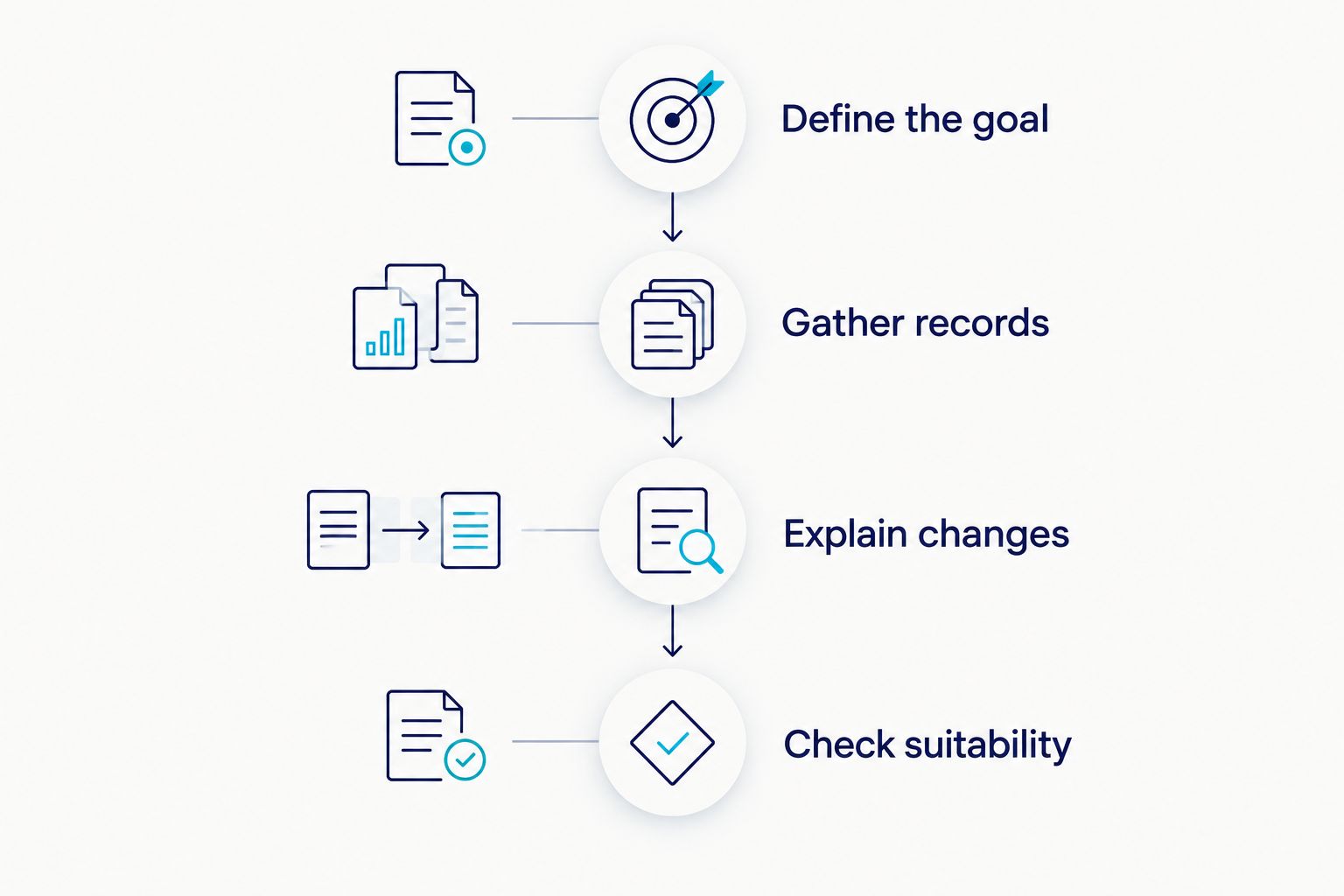
A useful 2026 application pack explains the financial position rather than merely collecting paperwork. Make the links between business earnings, personal income and existing commitments easy to follow.
Discuss your home loan options
Get mortgage broking advice on your borrowing goals and the evidence supporting your application.
Check equity without confusing it with approval
Loan-to-value ratio, or LVR, expresses the loan as a percentage of the property's assessed value. The lender's valuation matters; your preferred purchase figure or estimate of market value does not determine the assessment.
ASIC's MoneySmart guidance explains that lenders mortgage insurance is usually required when borrowing more than 80% of a property's value. A 20% deposit corresponds to an 80% LVR before purchase costs, assuming the purchase amount and assessed value match.
That threshold is not an approval rule, and exceptions exist. You still need to establish repayment capacity, and purchase costs need their own funding plan.
How the shortlist is ranked
This guide ranks lenders by the application route they represent: mainstream full documentation, alternative documentation, specialist credit assessment and an existing-loan comparison. It does not use a proprietary testing score or claim a market-wide winner.
The key category distinction is supported by lenders' public descriptions of their home lending: Commonwealth Bank's mainstream home loans, Pepper Money's alternative-documentation options and Liberty's specialist home lending. Confirm current lender requirements for your 2026 application rather than treating this shortlist as a credit decision.
Which lender should you choose?
Start with a mainstream comparison when your financial records clearly support your income. Commonwealth Bank is one starting point, not a reason to exclude other banks.
Choose an alternative-documentation comparison when the evidence format is the obstacle. Choose specialist credit assessment when the application has a complication that needs individual explanation. For refinancing, establish your existing loan as the baseline first.
Mortgage Pros can help with home loan advice and approval support. The useful next move is to identify the assessment route your evidence supports, then compare suitable loans within that route.
FAQ
What’s the best lender for a self-employed home loan in Australia?
The best lender is the one whose assessment requirements fit your income evidence, credit history and property. Compare Commonwealth Bank for a mainstream full-doc route, Pepper Money for alternative documentation and Liberty for specialist assessment, without treating any as guaranteed approval.
Can I get a home loan if I’m self-employed?
Yes, self-employed borrowers can obtain home loans when they meet the lender’s requirements. You need to substantiate income, explain existing commitments and demonstrate repayment capacity.
Is an alt-doc home loan a no-documentation loan?
No, an alt-doc home loan still requires evidence supporting your income and repayment capacity. Confirm the accepted documents for the particular lender and product before applying.
Is Pepper Money better than Commonwealth Bank for business owners?
Neither lender is automatically better for every business owner. Pepper Money belongs on an alternative-documentation shortlist, while Commonwealth Bank is a mainstream option to compare when you have complete financial records.
Can Liberty approve a loan after a bank declines it?
A bank decline does not establish whether Liberty will approve an application. The reason for the decline and Liberty’s assessment requirements determine whether a specialist application is appropriate.
How many years of financial records do self-employed borrowers need?
Mainstream assessments commonly request records covering 2 years, but the requirement varies by lender and application. Confirm the relevant documentation route before assuming a shorter history prevents you from applying.
Does a large deposit guarantee home loan approval?
No, a large deposit does not replace an income and repayment assessment. The lender also considers credit history, existing commitments and the property offered as security.
Is Mortgage Pros a lender?
No, Mortgage Pros is a mortgage broking firm. It helps borrowers secure and manage home loans, including refinancing and equity arrangements; the lender makes the approval decision.
One last thing
Taxable profit and assessable borrowing income are not necessarily identical. Lenders assess income under their own rules, so explain the financial records rather than assuming the figure on a tax return answers every lending question.
Before choosing a lender in 2026, ask one practical question: what evidence supports the income being used to assess this mortgage? A clear answer gives you a stronger basis for comparing loans than a lender name alone.