
Company directors’ home loans are mortgages assessed against a director’s personal income, business interests and liabilities to establish borrowing capacity for a property purchase or refinance. This 2026 guide explains how to document your earnings, separate company money from personal funds and prepare an application that a lender can assess.
- Home loans for company directors depend on verified personal income, business commitments and the lender’s assessment policy.
- Mortgage Pros suits directors seeking home loan application support rather than borrowing directly from a broker.
- Company turnover is not personal income; explain salary, dividends and business profits separately.
- Match your financial records to lender requirements before submitting an application.
Why home loan preparation matters for company directors
A director’s title does not tell a lender how the director gets paid. You might receive an independently assessed salary, own the company that pays your wages, receive dividends or have interests in several entities. Those differences change the evidence a lender needs.
Your application must explain both your income and the business behind it. A payslip shows a payment, but it does not establish whether an owner-controlled business can sustain that payment. Equally, company revenue does not establish how much money you can use for mortgage repayments.
If you own the business you direct, the home loans for small business owners guide covers related preparation issues. The distinction matters in 2026: your directorship, ownership and employment arrangements need to be clear before anyone selects an assessment pathway.
Start with the borrower, not the property listing. Clarifying your income position first gives you a useful basis for discussing your purchase budget, deposit and application timing.
How to prepare your company director home loan application
Establish your ownership and employment position
Write down how you relate to every company connected to your income. Being an employed director without an ownership interest is different from controlling the company that pays your salary. Do not assume that regular wages automatically put an owner-director into the same assessment category as an unrelated employee.
Prepare a simple entity summary yourself before seeking advice. Include ownership, your role and the payments you receive; ask your accountant to check anything involving trusts or related entities. The purpose is clarity, not a complicated organisational chart.
Also distinguish the proposed borrower from the source of income. Buying a home personally while earning through a company is not the same arrangement as asking a company to purchase property.
- List your directorships and ownership interests.
- Identify the entity paying each income stream.
- Record whether you are buying personally or through an entity.
- Explain recent changes in ownership or employment.
Reconcile your salary, dividends and business results
Start with your own records: payslips, tax returns, bank statements and company accounts. Check that payments appearing in one document can be explained by the others. A transfer from the business account needs a clear classification; it is not automatically salary or a dividend.
Ask your accountant to explain differences between taxable income, accounting profit and cash received. These figures answer different questions. Retained company profits also require separate consideration rather than being added to your personal income without explanation.
For a 2026 application, label every document by its actual reporting period. A current application can legitimately include historical financial records, but a lender needs to understand which period each record describes.
- Separate salary, dividends and other income.
- Match regular payments to bank account credits.
- Explain director loan account movements.
- Identify income already included elsewhere to prevent double counting.
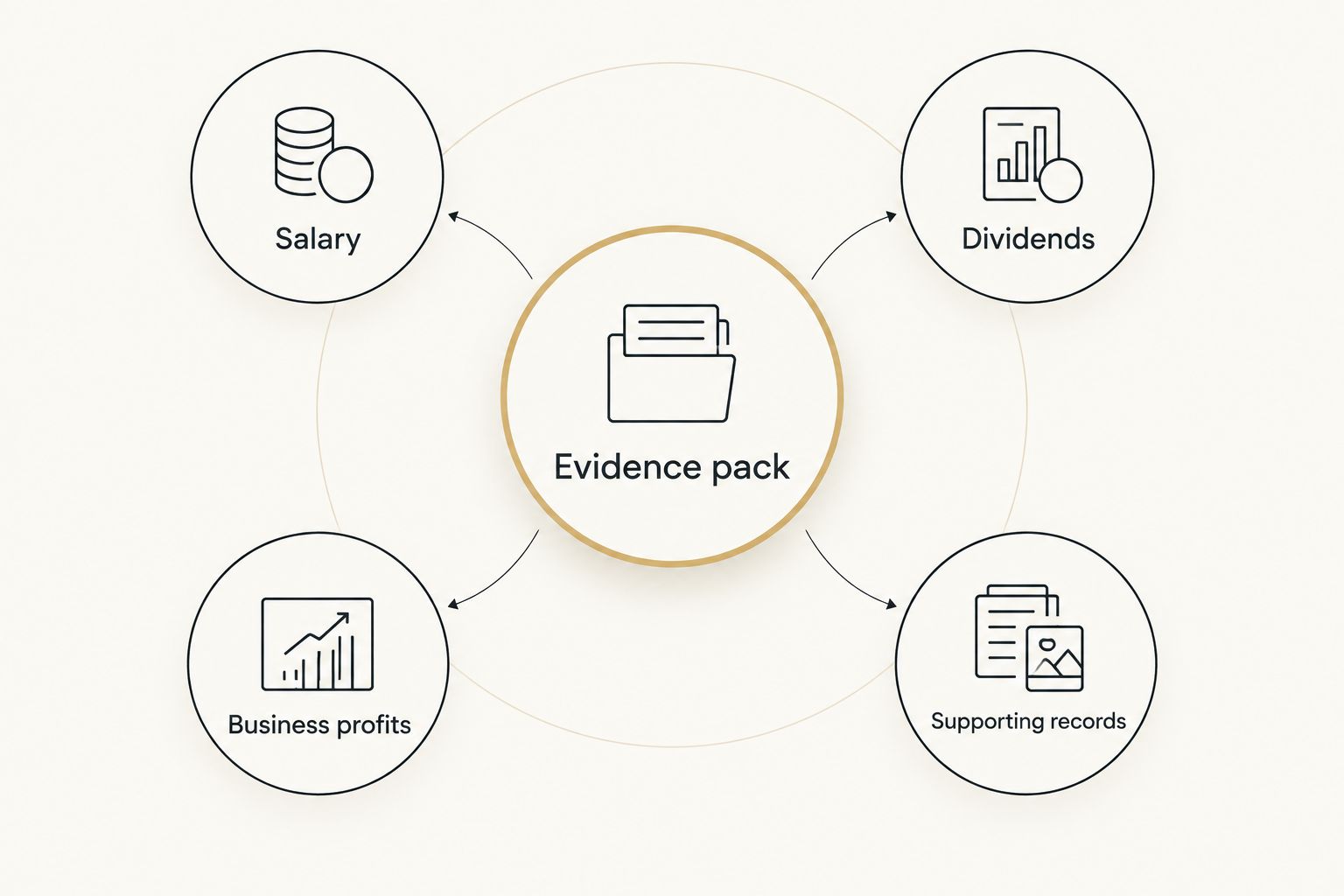
Assemble an evidence pack before choosing a lender
Create a document folder and an index yourself. Then ask the proposed lender or broker which records are required for your circumstances; do not treat a general checklist as an approval rule. Lenders set their own requirements for financial history, income verification and supporting explanations.
Mortgage Pros is best for company directors seeking home loan application support rather than a direct lender. You can approach Mortgage Pros for mortgage broking support once your ownership and income position is clear. A broker helps with the application process; the lender still decides whether to approve the loan.
Keep salary, dividends and business profits separate in your evidence pack. Supporting records should make each source understandable without asking the assessor to reconstruct your accounts.
- Gather personal tax returns and notices of assessment.
- Collect company financial statements and relevant tax records.
- Add current payslips and supporting bank statements.
- Request explanations for unusual transactions or accounting adjustments.
Test your deposit and cash flow separately
Calculate your personal deposit without including funds the business needs to operate. Company cash is not automatically available for personal use; withdrawing it requires accounting and tax consideration. Ask your accountant before moving money between the company and your personal accounts.
Build a household budget separately from the lender’s borrowing assessment. For example, review 12 months of personal spending to capture annual bills, and prepare a 3-month cash-flow forecast to identify upcoming commitments. These are preparation exercises, not universal lender requirements.
For your 2026 purchase budget, include acquisition expenses as well as the deposit. Confirm applicable duties, concessions and transaction costs with the relevant adviser rather than assuming the advertised property amount represents your total funding need.
- Trace the source of your deposit.
- Keep business operating funds separate from personal savings.
- Include annual household expenses and existing repayments.
- Identify planned tax payments and irregular drawings.
Disclose debts, guarantees and business commitments
List personal and business obligations before applying. Include credit facilities, vehicle finance, tax payment arrangements and guarantees you have signed. A company debt and a personal debt are legally distinct, but your relationship to a business obligation still needs to be explained.
Check your own credit reports and compare recorded facilities with your records. Where a facility has closed, retain confirmation. Where a guarantee remains in place, obtain the relevant documents rather than relying on memory or assuming it ended when a business arrangement changed.
Do not omit a commitment because the company usually pays it. Give the lender enough information to determine how the obligation should be treated, including any evidence that another entity services the debt.
- Record outstanding balances and facility limits.
- Identify personal guarantees and related obligations.
- Explain who makes each repayment.
- Keep closure or discharge evidence for completed facilities.
Compare assessment pathways before submitting
Ask how a lender would assess your actual income structure before lodging a formal application. The useful question is not simply whether the lender accepts company directors. It is whether the lender’s evidence requirements and assessment method fit your circumstances.
Compare a standard documented application with any alternative-documentation pathway being considered. Alternative documentation does not mean no income verification, and it does not remove the need to demonstrate affordability. Understand what evidence replaces standard records and what conditions apply.
For a 2026 comparison, request current written information rather than relying on an old product summary. Compare loan features and obligations alongside the proposed treatment of your income; a suitable assessment pathway alone does not make a loan suitable overall.
- Confirm how each income source will be assessed.
- Ask which financial periods the lender requires.
- Check treatment of business debts and guarantees.
- Compare repayment structure, fees and loan features.
Confirm approval conditions before committing
Read the approval conditions and ask what remains outstanding. Conditional approval is not an unconditional promise to lend, and property-related requirements can remain unresolved even when your income has been reviewed. Keep your conveyancer or solicitor involved in contract decisions.
Update the lender or broker if your circumstances change during the application. A new business loan, changed salary or ownership restructure can affect information already supplied. Do not assume that an earlier discussion covers later changes.
Prepare your settlement funds without making unexplained last-minute transfers from company accounts. After settlement, review the loan when your business or household position changes rather than treating approval as the end of the planning process.
- Obtain a written list of outstanding conditions.
- Check contract obligations with your legal adviser.
- Disclose changes to income, debts or ownership.
- Confirm the source and timing of settlement funds.
Discuss your director home loan today
Explain your income structure and ask what evidence your home loan application needs.
Compare application options for company directors
Choose the assessment pathway that matches your evidence, not the label that sounds easiest. The options below describe ways to prepare or present an application, not guaranteed eligibility categories. A broker-assisted application can use either standard or alternative documentation, depending on the lender and your circumstances.
| Option | Best for | Main advantage | Key limitation |
|---|---|---|---|
| Standard income documentation | Directors with financial records that meet the lender’s requirements | Presents income through established tax, employment and financial records | Records still need to satisfy the lender’s policy and explain the business position |
| Alternative income documentation | Directors whose income requires a different accepted evidence pathway | Provides another way to substantiate income where a lender permits it | Evidence requirements and product conditions need careful checking |
| Broker-assisted application | Directors seeking help presenting income and comparing lender requirements | Adds application support and help identifying relevant assessment questions | A broker does not approve the loan; ask which lenders are considered |
| Direct lender application | Directors who want to manage an application with a selected lender | Gives direct access to that lender’s application process | The assessment remains limited to that lender’s policies and products |
Before choosing, ask what happens if the initial evidence is insufficient. Establish whether additional documents, a different assessment pathway or more preparation would address the issue. Repeated applications are not a substitute for resolving the underlying evidence gap.
Common mistakes company directors make
Treating turnover as borrowing income
Sales revenue belongs to the business before operating expenses, tax and other commitments are considered. Presenting turnover as personal earnings obscures affordability. Use reconciled income records and explain how business results translate into money available to you.
Counting the same earnings twice
Salary paid by your company can already be reflected as an expense in its accounts. Dividends and profit figures also need careful reconciliation. Ask your accountant and lender to distinguish separate income sources from different representations of the same earnings.
Moving company funds without checking the consequences
A deposit funded from a company account needs more than a bank transfer receipt. Establish the legal and accounting treatment of the withdrawal, its tax implications and its effect on business cash flow. Do this before you rely on those funds for a contract.
Restructuring during the application without disclosure
Changing entities, ownership or remuneration can make previously supplied records harder to interpret. Tell your broker or lender before implementing a planned change. Your accountant’s preferred business structure and a lender’s evidence requirements address different objectives; both need attention.
Assuming approval removes contract risk
A borrowing estimate or conditional approval does not resolve every funding condition. Confirm what has been assessed, what remains outstanding and how the property itself will be considered. Obtain legal advice about your contract rather than interpreting finance wording yourself.
FAQ
Can I get a home loan if I am a company director?
Yes, a company director can apply for a home loan, subject to the lender’s income, credit and security assessment. Your ownership interests and how you receive income determine which supporting records the lender requests.
Am I self-employed if my own company pays me a salary?
A salary from your own company does not automatically make you an independently employed borrower for lending purposes. Explain your ownership and control so the lender can apply its assessment policy.
Can company profits count towards my home loan application?
Company profits require lender assessment before they can support your borrowing capacity. Their treatment depends on ownership, business commitments, supporting records and the lender’s policy; they are not automatically personal income.
What documents do company directors need for a mortgage?
Company directors need documents that substantiate income, liabilities and the source of their deposit. Depending on the application, these include personal tax records, company financial statements, payslips, bank statements and explanations from an accountant.
Can I get a company director home loan with alternative documentation?
An alternative-documentation pathway is an option only where a lender accepts your circumstances and supporting evidence. It still requires income verification and an affordability assessment, so compare the requirements before applying.
Is a mortgage broker better than applying directly to a bank?
A mortgage broker suits borrowers seeking application support, while applying directly suits borrowers who want to deal with a selected lender themselves. Mortgage Pros provides home loan broking support; approval remains the lender’s decision.
Does being a director mean the company should buy my home?
No, being a director does not mean your company should purchase your home. Borrower structure affects lending, ownership and tax considerations, so obtain legal and tax advice before choosing the purchaser.
One last thing
Reconcile the story before collecting more paperwork. A large document folder does not resolve a mismatch between salary, dividends, company profit and bank transfers. A short explanation that ties those records together gives the assessor a clearer application to review.
Before submitting in 2026, prepare a 1-page summary covering ownership, income sources, deposit funds and liabilities. Have your accountant check the financial explanation, then ask Mortgage Pros which supporting evidence is needed. Contact us today to discuss your home loan application.
This guide provides general information, not personal credit, legal or tax advice. Obtain advice suited to your circumstances before changing business structures or moving company funds.
Related guides
- Best lenders for self-employed home loans
- Best offset home loan accounts
- Best guarantor home loan lenders