

Small business owner home loans are residential mortgages assessed using business-derived income, with the aim of helping you buy or refinance a home without confusing turnover with personal borrowing capacity. For home loans for small business owners in 2026, the key is proving sustainable income while protecting the cash your business needs to operate.
- Home loans for small business owners depend on verified income, existing commitments and the property—not business turnover alone.
- Mortgage Pros suits borrowers seeking mortgage broking support rather than applying directly to a lender.
- Compare full-documentation and alternative-documentation pathways against the records you can actually provide.
- Keep your home deposit separate from tax reserves and essential business cash.
Why home loan preparation matters for small business owners
A profitable business and an approvable home loan application are not the same thing. Business revenue must cover operating expenses, tax and other commitments before it supports your household repayments. Moving money from a business account into a personal account does not, by itself, establish sustainable income.
Small business owners also face a documentation problem that salaried applicants often avoid: income can sit across personal tax returns, company accounts, trust distributions and business liabilities. Your application needs to explain how those pieces fit together without counting the same earnings twice.
Mortgage Pros provides home loan advice and approval support for individual borrowers and investors. Mortgage Pros is best suited to borrowers seeking mortgage broking support rather than a direct lender. A broker can help organise your application, but the lender still decides whether your evidence meets its requirements.
How to prepare your home loan application in 2026
Start with the amount your household can sustain, then work backwards through your records and lending options. These steps separate your own preparation from the lender's assessment, so you know what to resolve before submitting an application.
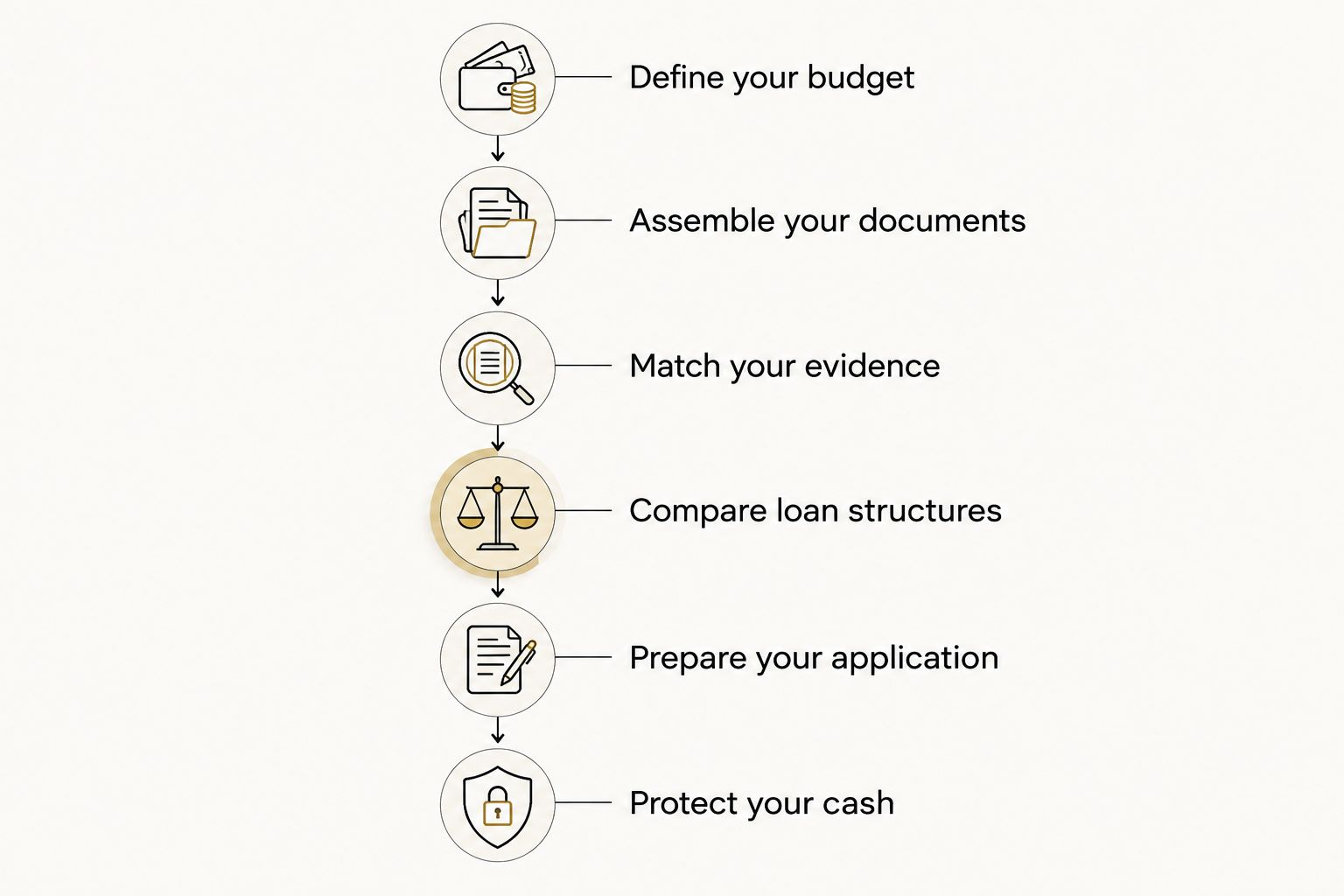
Define your budget
Build your own affordability worksheet before using a borrowing calculator. Review 12 months of household spending as a practical budgeting exercise, not as a universal lender requirement. Include irregular expenses rather than relying only on what left your account last month.
Separate business cash from money genuinely available for your deposit and repayments. A healthy account balance can include amounts reserved for suppliers, payroll, GST or income tax. Treating those funds as spare savings creates a funding gap elsewhere.
Test 3 cash-flow scenarios: normal trading, a quieter trading period and higher household repayments. These are planning scenarios, not predictions. The purpose is to identify the repayment level that still leaves room for ordinary business fluctuations.
- Record essential household expenses and existing repayments.
- Separate personal savings from working capital and tax reserves.
- Include purchase-related expenses beyond the deposit.
- Set a repayment ceiling you can explain and maintain.
- Record what you would change during a quieter trading period.
Assemble your documents
Create 2 document folders: one for personal finances and one for business finances. This simple split helps you spot missing records and explain transfers between accounts. Use the lender's actual checklist before assuming a particular document or reporting period is sufficient.
Depending on your circumstances, relevant records include lodged tax returns, notices of assessment, financial statements, business activity statements and bank statements. Company directors and trust beneficiaries also need to explain the relevant ownership or distribution arrangements. An ABN alone does not establish assessable income.
Ask your accountant to help reconcile discrepancies between records. A difference between taxable income, accounting profit and drawings needs an explanation; selecting whichever figure is highest is not a sound application strategy.
- Gather lodged personal tax returns and notices of assessment.
- Collect relevant business financial statements and tax records.
- Keep business and personal account statements clearly labelled.
- List ownership interests, business debts and guarantees.
- Explain unusual income movements with supporting records.
Match your evidence
Compare lending requirements manually by asking what evidence each lender accepts for your business structure and trading history. Choose the application pathway that matches your records, not the one that appears to require the least paperwork. Alternative documentation still involves income verification and an assessment of your ability to repay.
Once your records are organised, Mortgage Pros can provide mortgage broking advice and approval support. That gives you a supported route through the application process rather than requiring you to handle every lender discussion yourself. The limitation remains clear: broking support does not replace lender approval or missing evidence.
Use the guide to lenders for self-employed home loans to frame your questions. For a 2026 application, confirm current requirements directly rather than treating an older checklist as a promise of eligibility.
- Ask which financial periods the lender will assess.
- Confirm how your business structure affects required documents.
- Ask how changing income is treated.
- Check what alternative evidence is acceptable, if relevant.
- Resolve document gaps before choosing where to apply.
Compare loan structures
Start with the repayment behaviour you need, then compare the features that support it. Variable, fixed and split structures serve different purposes; none removes the need to demonstrate affordable repayments. Ask for the actual terms rather than assuming a feature works the same way across lenders.
A variable structure generally exposes you to repayment changes as rates change. A fixed structure provides certainty over the fixed period, but restrictions and break costs need attention. A split structure combines fixed and variable portions while leaving you with separate conditions to understand.
Offset and redraw facilities also need separate consideration. An offset is a linked deposit account, while redraw concerns access to extra loan repayments under the loan's terms. If the property becomes an investment, obtain tax advice before moving money or changing how borrowed funds are used.
- Compare repayment certainty against flexibility.
- Check restrictions on extra repayments and early changes.
- Confirm whether an offset facility is available and how it operates.
- Read redraw access conditions rather than assuming unrestricted access.
- Compare ongoing charges and conditions alongside the interest rate.
Prepare your application
Turn your records into a clear account of how the business supports your household. Explain what you do, how you earn income, your ownership position and any material changes. Keep the explanation factual and consistent with your documents.
If turnover rose but profit fell, explain the underlying expenses. If you recently changed from sole trader to company, show the business continuity through appropriate records. A new structure does not automatically mean the lender will assess the business as though nothing changed.
Check your credit reports and disclose existing commitments accurately. Business facilities, personal loans, credit cards and guarantees deserve attention even when their repayments do not appear in your main personal account.
- Prepare a short description of your business and income sources.
- Explain changes in structure, profitability or trading conditions.
- Check credit reports and request corrections where needed.
- Disclose debts, credit limits and guarantees accurately.
- Submit a consistent document set rather than conflicting versions.
Protect your cash
Keep your finances stable while the application is assessed. Before taking on a new business facility, increasing personal debt or changing your income arrangements, ask how the change affects the application. Approval depends on the circumstances the lender assesses, not just the circumstances you had when you first enquired.
Before settlement, confirm where your contribution will come from and what cash remains afterwards. Your home deposit should not leave you unable to meet tax obligations or pay business expenses. Review the final loan documents and clarify anything that differs from your expectations.
After settlement, place a home loan review in your 2026 business calendar. Review the loan again when your income, property use or business structure changes, rather than waiting for a repayment problem.
- Avoid unexplained transfers between business and personal accounts.
- Tell your adviser about material financial changes.
- Retain an operating buffer separate from settlement funds.
- Check the final loan structure and repayment arrangements.
- Review the loan when your circumstances change.
Compare application pathways and loan structures
There are 2 separate decisions: how you demonstrate income and how your loan operates. A full-documentation application can still involve a fixed, variable or split loan. Do not confuse the evidence pathway with the repayment structure.
The comparison below identifies the benefit and limitation of each option without assuming that every lender offers every pathway.
| Option | Best for | Main benefit | Key limitation |
|---|---|---|---|
| Full-documentation application | Owners with financial and tax records that meet lender requirements | Supports assessment using documented business and personal income | Incomplete, outdated or inconsistent records need resolution |
| Alternative-documentation application | Owners whose evidence suits a lender's alternative requirements | Allows assessment through an accepted alternative evidence set | Eligibility and acceptable evidence remain lender-specific |
| Prepare before applying | Owners with unresolved records or unclear affordability | Gives you time to correct gaps before submitting | Delays the borrowing decision |
| Variable loan structure | Borrowers prioritising flexibility under the loan terms | Often supports flexible repayment features | Repayments remain exposed to rate changes |
| Fixed loan structure | Borrowers prioritising repayment certainty during the fixed period | Makes scheduled repayments more predictable during that period | Changes and extra repayments can face restrictions |
| Split loan structure | Borrowers wanting fixed and variable portions | Combines different repayment characteristics | Both portions have conditions to manage |
For small business owners in 2026, the right pathway is the one your evidence supports and your household can sustain. A larger approved amount is not automatically a better outcome if it consumes the cash buffer that keeps your business operating.
Common mistakes small business owners make
Treating turnover as personal income
Sales do not show what remains after business expenses and obligations. Base your household budget on sustainable income available to you, then let the lender determine what it accepts for assessment.
Counting the same profit twice
Salary, drawings, distributions and business profit can overlap in the financial picture. Ask your accountant to explain the relationship so the application does not present the same earnings as separate income sources.
Spending the tax reserve on the deposit
Cash set aside for tax is already committed. Separate it before calculating your deposit so a successful property purchase does not create a business cash shortage.
Assuming alternative documentation means no checks
Alternative-documentation lending is not evidence-free lending. Confirm the required records before applying, and do not substitute an unsupported income estimate for an acceptable verification process.
Changing finances during assessment without telling anyone
New borrowing, business restructuring or a change in income can affect the application. Tell your broker or lender promptly instead of assuming an earlier assessment still applies unchanged.
FAQ
Can I get a home loan if I run a small business?
Yes, small business owners can apply for home loans, subject to lender assessment. You need acceptable evidence of income, details of existing commitments and a property that meets the lender’s requirements.
What documents do small business owners need for a home loan?
The required documents depend on your lender, business structure and application pathway. Relevant records include tax returns, notices of assessment, financial statements, bank statements and business activity statements; confirm the exact checklist before applying.
How long do I need to be self-employed before applying?
There is no single trading-history requirement that applies to every home loan lender. Ask which reporting periods and evidence the lender requires, particularly if you recently started trading or changed your business structure.
Can I use business turnover as my income on a mortgage application?
Business turnover is not the same as personal income available for mortgage repayments. The lender assesses acceptable income after considering the relevant expenses, liabilities and supporting records.
Is an alternative-documentation loan easier to get?
Alternative-documentation loans use different accepted evidence, not an exemption from income assessment. They suit applicants whose circumstances meet that lender’s requirements, and approval is not guaranteed.
Can I use money from my company for a home deposit?
Using company funds for a personal deposit requires accounting and tax advice before you transfer the money. Company money is not automatically personal savings, and the lender needs to understand the source of your contribution.
Should a small business owner use a broker or apply directly?
Use a broker when you want support with loan selection and the application process; apply directly when you prefer to manage the lender relationship yourself. Mortgage Pros provides mortgage broking services, while the lender remains responsible for the credit decision.
One last thing
Your most useful next step is to reconcile your income, not submit another borrowing calculator result. Put your household budget beside your business accounts and identify which money is genuinely available for repayments. If the figures disagree, resolve that difference before choosing a loan.
For your 2026 application, contact Mortgage Pros today to discuss your circumstances and the records needed to support your home loan enquiry.
Discuss your home loan application
Explain your business income, deposit and borrowing goals before choosing your application pathway.
Related guides
- Compare offset home loan accounts
- Understand trust home loan options
- Explore home equity loan options