
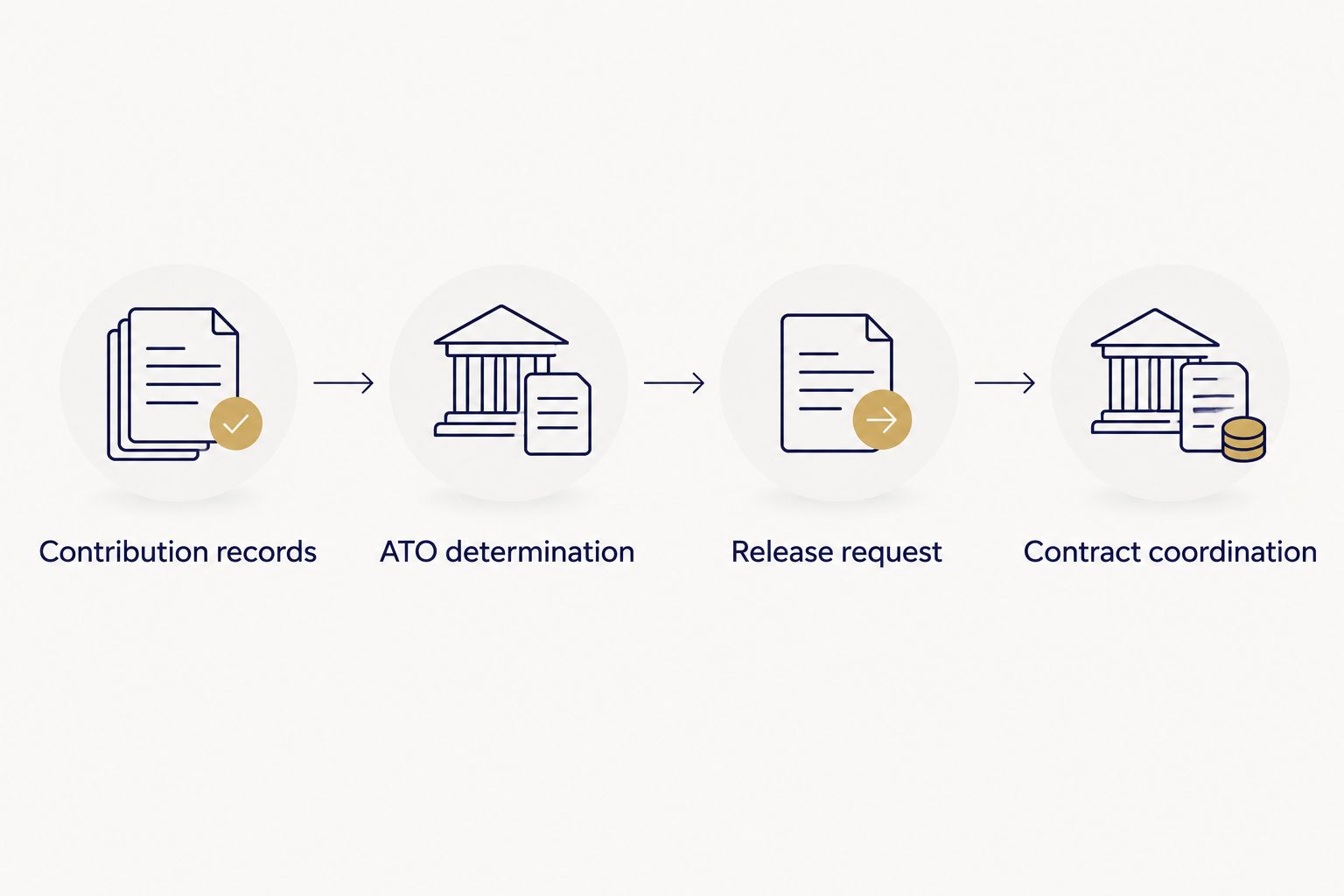
Instead of manually tracking super contributions and hoping the money reaches your conveyancer in time, use the first home super saver scheme to buy a house through a staged workflow: check eligibility, obtain an ATO determination, request release and coordinate your deposit. Mortgage Pros can help you connect that deposit plan with your home loan application, while the ATO administers the scheme.
- Use the first home super saver scheme to buy a house by coordinating eligible contributions, ATO release and loan approval.
- Mortgage Pros supports home loan planning; the ATO determines and releases eligible FHSS savings.
- Request an ATO determination before signing, and keep accessible cash for any earlier contract deposit.
- Only eligible voluntary super contributions count; compulsory employer contributions do not.
Why this matters
Super savings are not an immediately accessible contract deposit. The First Home Super Saver scheme, or FHSS, lets eligible first home buyers release eligible voluntary super contributions and associated earnings for a home purchase. It does not let you withdraw your entire super balance.
For a 2026 purchase, follow the Australian Taxation Office’s FHSS guidance on eligibility, contribution limits, determinations and release deadlines. Separately, your lender assesses your income, debts, deposit evidence and ability to repay the loan. An ATO determination is not home loan approval.
Mortgage Pros is best suited to first home buyers who want mortgage broking support alongside their FHSS deposit planning. The benefit is coordinating the borrowing side of the purchase; the limitation is that a broker cannot approve an ATO release or replace personal tax advice.
Keep the tax decision and the mortgage decision connected, but separate. A contribution that suits your tax position still needs to fit your purchase timetable and cash requirements.
Before you start
- Access and records: Have myGov access linked to the ATO, your super fund contribution history, identification and your proposed purchase timetable. Separate voluntary contributions from compulsory employer super.
- Eligibility and advice: You must be at least 18 when requesting an FHSS determination and generally must not have previously owned property in Australia. Previous ownership includes investment property and vacant land; an ATO financial-hardship exception requires separate assessment.
- The timing gotcha: Your contract deposit can fall due before released super reaches your bank account. Agree on the deposit arrangements with your conveyancer before signing, rather than assuming FHSS funds will arrive first.
You must also intend to occupy the property as soon as practicable and live there for at least 6 months within the first 12 months after moving becomes practicable. This is a home-purchase pathway, not a way to fund a property intended solely as an investment.
Contribution records and deposit target
Set your contribution boundary
- Define the purchase cash requirement. List the contract deposit, the remaining settlement contribution and transaction costs separately. Your lender or broker should confirm the evidence required for each source of funds.
- Identify eligible contributions. FHSS covers eligible voluntary contributions, including salary sacrifice and eligible personal contributions. Compulsory employer contributions do not count.
- Apply the FHSS limits. Up to $15,000 of eligible contributions from any financial year can count towards the scheme, subject to a $50,000 total contribution limit per person. These are contribution limits, not a promise of the cash you will receive.
- Check the separate super contribution caps. FHSS limits do not replace the normal concessional and non-concessional contribution rules. Ask your tax adviser about employer contributions, deductions and any other contributions before adding money.
Expected result: You have a contribution ledger showing payment dates, contribution types and the amount potentially eligible for FHSS. Your deposit plan also identifies money that must remain accessible outside super.
For your 2026 plan, use the financial year in which the super fund receives each contribution. A payroll deduction near the end of June does not establish that the fund received the contribution before the financial year ended. Confirm receipt directly with the fund.
Compare contribution methods
The contribution method affects the release calculation and your tax position. Neither method is automatically best for every borrower.
| Contribution method | Best for | Benefit | Limitation |
|---|---|---|---|
| Eligible concessional contributions | Borrowers whose tax advice supports salary sacrifice or deductible personal contributions | Can combine deposit saving with concessional super tax treatment | Generally, only 85% of eligible contributions enters the FHSS release calculation, plus associated earnings |
| Eligible non-concessional contributions | Borrowers contributing eligible after-tax savings without claiming a deduction | Generally, 100% of eligible contributions enters the FHSS release calculation, plus associated earnings | Does not provide the same contribution deduction; normal contribution rules still apply |
Associated earnings are calculated under the FHSS rules, rather than simply matching the actual investment return shown on your super statement. Do not substitute your fund balance or investment performance for an ATO determination.
ATO determination and release request
Confirm the releasable amount
- Sign in to myGov, open your linked Australian Taxation Office service and go to Super, then Manage, then First home saver.
- Request an FHSS determination using your eligible contribution records. Reconcile the contribution details with your fund records before submitting.
- Read the determination and check the contribution amounts, contribution types and associated earnings. Resolve discrepancies before requesting release.
- Save the determination with your mortgage application documents. Ask your lender how the eventual released funds must be evidenced.
Expected result: You have an ATO-calculated maximum release amount, rather than an estimate based on your super balance.
Obtain the determination before signing a contract. This conservative sequence keeps the release decision ahead of the purchase commitment. Under the rules applying to a 2026 purchase, a determination must be made before ownership transfers; requesting it earlier avoids leaving a critical requirement until settlement.
A determination does not move money. You still need to submit the separate release request, and the determination amount is not necessarily the net amount deposited into your bank account after withholding.
Request and reconcile the release
- Confirm your intended purchase timing with your conveyancer and mortgage broker before submitting the release request.
- Use the FHSS section of ATO online services to request release. Check your bank details and the information used for tax withholding.
- Retain the release confirmation and monitor your ATO correspondence. Do not treat a submitted request as cleared funds.
- When the payment arrives, reconcile the deposit against the ATO release documentation and retain the bank statement for your lender.
Expected result: You can distinguish the amount approved for release, tax withheld and cash actually received. Your lender can assess the deposit using evidence rather than an expected transfer.
The assessable FHSS released amount must be included in the relevant tax return, with a 30% tax offset applying under the scheme rules. Ask your tax adviser which income year applies and whether withholding matches your circumstances.
Contract and settlement coordination
Connect the release to your purchase
- Set the signing sequence. Ideally, obtain your determination and establish the release plan before committing to a property. Have your conveyancer review the contract and deposit deadline.
- Check the contract window. You can enter an eligible contract from 90 days before requesting release until 12 months after the release request. The ATO can extend the period after the release request by a further 12 months under its FHSS extension arrangements.
- Notify the ATO. Generally, notify the ATO within 28 days of entering the contract. If you signed before requesting release, notify the ATO within 28 days of the release request.
- Complete the lender’s deposit checks. Supply the released-funds statement, bank evidence and any other requested savings records. Keep your conveyancer informed about the money available for settlement.
Expected result: Your contract, ATO notifications and lender evidence follow a coordinated timetable. You know which funds cover the contract deposit and which funds remain for settlement.
Use a written checklist for your 2026 purchase. Record actual dates from the contract and ATO correspondence, not dates remembered from a conversation. A lender’s approval conditions and an ATO deadline are separate obligations; completing one does not satisfy the other.
Buying together: coordinate separate FHSS releases
Buying with a partner creates a second workflow: coordinate separate FHSS records with a shared contract. Eligibility is assessed individually, so one purchaser’s previous ownership does not automatically determine the other purchaser’s eligibility.
- Each eligible purchaser checks their own contribution history and requests their own determination.
- Each eligible purchaser submits their own release request and retains their own ATO correspondence.
- Combine only the expected net cash amounts in the household deposit plan. Keep accessible savings separately identified.
- Give your conveyancer and lender a consolidated funding schedule, while preserving the documents supporting each purchaser’s contribution.
Expected result: Your shared deposit plan has a clear source for every contribution, without assuming one person’s approval covers both buyers.
This arrangement helps eligible buyers combine their released savings, but it also introduces separate processing and notification obligations. Do not promise a shared contract deposit based on both releases arriving together.
For a joint purchase in 2026, nominate one shared calendar for contract and settlement tasks. Each buyer must still manage their own ATO obligations and verify the details in their own account.
Troubleshooting
Your contribution is missing from the determination
Check the fund’s receipt date and contribution classification against your payroll or bank records. A payment leaving your account is not proof that the fund received and allocated it. Resolve the discrepancy with the fund and ATO before relying on the amount.
Your released cash is lower than your super contributions
Check whether the contributions were concessional, whether any amounts were ineligible and how much tax was withheld. The FHSS release calculation is not a dollar-for-dollar withdrawal of all money contributed. Rebuild your deposit plan using the net cash received.
You have already signed the contract
Check whether you already hold an FHSS determination, the contract date, the release-request date and the ownership-transfer date. The 90-day pre-request contract window matters. Contact the ATO and your conveyancer immediately rather than assuming signing has either disqualified you or secured your release.
Your deposit is due before the release arrives
Tell your conveyancer immediately and discuss the contractual options before the deadline. Do not assume your lender will advance the loan early or that a seller must accept a late deposit. Accessible savings and agreed contract terms need to cover this timing gap.
The purchase does not proceed
An FHSS release is not unrestricted spending money. Check the ATO’s extension, recontribution and FHSS tax rules before using it elsewhere. Keep records of the failed purchase and obtain tax advice about the action and notification required for your situation.
Customise your home loan workflow
Treat FHSS as one deposit source, not the whole approval strategy. Before choosing a property, ask your broker to check borrowing capacity, how the lender treats your savings evidence and the cash needed outside the loan.
Mortgage Pros can help you connect those home loan requirements with your purchase plan. For doctors, dentists and surgeons, include your employment structure and income documents in that discussion; specialist mortgage advice does not remove FHSS eligibility or tax requirements.
Choose the next step according to your actual constraint. If you have sufficient income but limited accessible savings, focus on deposit timing. If your deposit is ready but borrowing capacity is uncertain, resolve the loan assessment before committing to a contract.
Plan your first home loan today
Discuss your deposit sources, borrowing capacity and purchase timetable with Mortgage Pros.
FAQ
Can I use the first home super saver scheme to buy a house in 2026?
Yes, eligible first home buyers can use the FHSS scheme to release eligible voluntary super contributions and associated earnings for a home purchase. You must satisfy the ATO’s eligibility, release, contract and occupancy requirements.
Can I withdraw my compulsory employer super for a deposit?
No, compulsory employer super contributions are not eligible for FHSS release. The scheme covers eligible voluntary contributions, subject to its limits and release calculation.
How much can I contribute under the FHSS scheme?
The FHSS scheme can count up to $15,000 of eligible contributions per financial year and $50,000 in total per person. Normal super contribution caps also apply, and the net release depends on contribution type, associated earnings and withholding.
Should I request an FHSS determination before signing a contract?
Yes, requesting your determination before signing is the safer workflow. For a 2026 purchase, the determination must be made before ownership transfers, and separate timing rules govern the release request and contract.
Can I request FHSS release after signing a contract?
Yes, an eligible contract can be entered into up to 90 days before the release request. You must also meet the determination and ownership-transfer requirements, so check your exact dates with the ATO before relying on this pathway.
Can my partner and I both use FHSS for the same home?
Yes, both purchasers can use FHSS if each independently qualifies. Each person needs their own determination, release request and supporting records.
Does an FHSS determination mean my mortgage is approved?
No, an FHSS determination calculates your maximum releasable amount under the scheme. Your lender separately assesses borrowing capacity, deposit evidence, the property and its loan requirements.
What happens if I release FHSS savings but do not buy?
You must follow the ATO’s rules for an extension, eligible recontribution or FHSS tax. Do not treat the released money as unrestricted cash; check your notification deadlines and obtain personal tax advice.
One last thing
The deposit written into your contract and the deposit assessed by your lender are not necessarily due at the same time. That distinction is easy to miss when your savings sit in super rather than your bank account.
Before signing, ask your conveyancer to identify the contractual payment deadlines and ask your broker to identify the lender’s funding requirements. Put both beside your ATO release plan. Contact Mortgage Pros today to discuss the home loan side before your purchase timetable becomes a binding commitment.
Related guides