

Home loans for teachers are mortgages assessed against your teaching income, employment arrangements and finances to fund a property purchase or refinance. This 2026 guide explains how to document permanent, contract or casual teaching income, compare loan structures and prepare an application without assuming your occupation guarantees approval.
- Compare home loans for teachers by income assessment, deposit requirements and loan features—not occupation-based promises.
- Mortgage Pros is best for teachers seeking mortgage broking advice rather than a single lender’s product information.
- Document contract renewals, casual teaching income and ongoing commitments before requesting a borrowing assessment.
- Choose fixed, variable or split lending around your repayment needs, not an advertised headline alone.
Why home loans matter for teachers
Your employment label does not tell a lender everything about your income. A permanent classroom teacher, a teacher on successive contracts and a casual relief teacher can have different evidence available, even when their work is consistent.
The right application explains how your income continues—not just what your latest payslip shows. A contract end date, unpaid school-holiday period or planned parental leave needs clear context. Present those details before choosing a lender, rather than explaining them after an application stalls.
Mortgage Pros provides mortgage broking services for borrowers seeking home loan advice and approval support. For teachers comparing home loans in 2026, the starting point is a documented income assessment, not a promise of special treatment.
A teaching role does not automatically establish eligibility for a lower deposit, a lenders mortgage insurance waiver or a particular borrowing amount. Ask for the exact eligibility requirements behind any occupation-based offer before relying on it.
How to prepare your teacher home loan application
1. Document your teaching income and employment
Start by collecting your employment documents yourself. Separate guaranteed salary from income that depends on additional duties, extra shifts or a contract renewal; this gives the lender a clearer basis for its assessment.
For permanent employment, provide evidence of your current role and pay. For fixed-term teaching, show the current contract and relevant employment history. For casual relief work, organise records that show actual earnings across teaching and non-teaching periods rather than extrapolating your busiest week.
Do not present an expected renewal as a signed contract. If your school has provided written confirmation about future work, keep that separate from your existing employment agreement so the distinction remains clear.
Prepare these documents before requesting an assessment:
- Current payslips and your employment contract or appointment letter.
- Relevant income statements and bank records showing salary deposits.
- Previous contracts or renewal letters where they explain continuity.
- Separate evidence of allowances, tutoring income or additional duties.
- Written details of planned leave, reduced hours or an upcoming role change.
2. Calculate your deposit and borrowing position
Build a simple household budget before using a borrowing calculator. Record actual spending, existing repayments, dependants and available savings; a calculator estimate is not a lending decision.
Your loan-to-value ratio, or LVR, compares the loan amount with the property's value. An 80% LVR means borrowing 80% of that value; the remaining 20% is equity or deposit before purchase costs. At a 90% LVR, that portion becomes 10%, but the lender still needs to assess the application and property.
Lenders mortgage insurance commonly applies above 80% LVR, although exemptions and lender policies differ. It protects the lender, not the borrower. Do not assume a teacher-specific exemption exists or applies to your circumstances.
For a 2026 purchase, keep acquisition expenses and emergency savings separate from the deposit. Using every available dollar at settlement leaves no buffer for repairs, moving expenses or a gap in teaching income.
Complete these checks:
- Separate deposit savings from purchase expenses and emergency funds.
- List credit cards, personal loans, HELP debt and other commitments.
- Record ongoing household spending using recent transactions.
- Calculate LVR using the relevant property value and proposed borrowing.
- Test your household budget against higher repayments and reduced income.
3. Match lender policy to your employment circumstances
You can contact lenders directly and ask how they assess your employment arrangement. Give each lender the same facts: employment type, contract dates, income components, deposit and existing debts. Keep written notes so you compare answers consistently.
Ask specific questions. Will the lender consider your current fixed-term contract? What evidence supports casual teaching income? How does planned parental leave affect the assessment? A general statement that teachers are eligible does not answer those questions.
For a broker-assisted route, ask Mortgage Pros to assess your home loan circumstances and explain which lender requirements need attention. Use advice to identify a suitable application path, not to treat approval as assured. The lender retains the lending decision.
Before choosing where to apply:
- Confirm how the lender assesses your exact employment arrangement.
- Ask which income components the lender will include.
- Establish what additional evidence is required before submission.
- Request an explanation of the proposed loan's benefits and limitations.
- Disclose foreseeable employment changes before an application proceeds.
4. Choose features that fit your teaching household
Start with how you will use the loan. A variable loan generally gives more flexibility around additional repayments, while a fixed loan provides repayment certainty during its fixed period. Restrictions and fees differ between products, so check the actual terms.
An offset account links an eligible transaction account to a home loan and reduces the balance used to calculate interest. Redraw provides access to eligible additional repayments, subject to the lender's rules. They are not interchangeable, particularly if your future plans include renting out the property; seek tax advice before moving money for that purpose.
If you save part of each pay for school-holiday spending or leave, examine how accessible that money needs to remain. The guide to offset home loan accounts explains a feature to assess alongside repayment flexibility.
Compare these practical details:
- Whether additional repayments are permitted and whether limits apply.
- Whether an offset account is available for the chosen loan.
- Redraw access rules and any restrictions on withdrawing funds.
- What happens when a fixed period ends.
- Whether account features justify their associated fees for your usage.
5. Obtain pre-approval and check the property conditions
Organise your documents and request a lending assessment before making a purchase commitment. Pre-approval gives you a conditional borrowing position; it does not guarantee final approval for every property or every change in circumstances.
Read the conditions rather than relying on the approval label. The lender can still need a satisfactory valuation, updated documents and confirmation that your finances have not materially changed. An employment change between pre-approval and settlement deserves immediate disclosure.
Ask your conveyancer or solicitor to explain the contract before signing. Auction and private-sale conditions differ, and a finance clause is a legal matter—not a substitute for understanding your obligations.
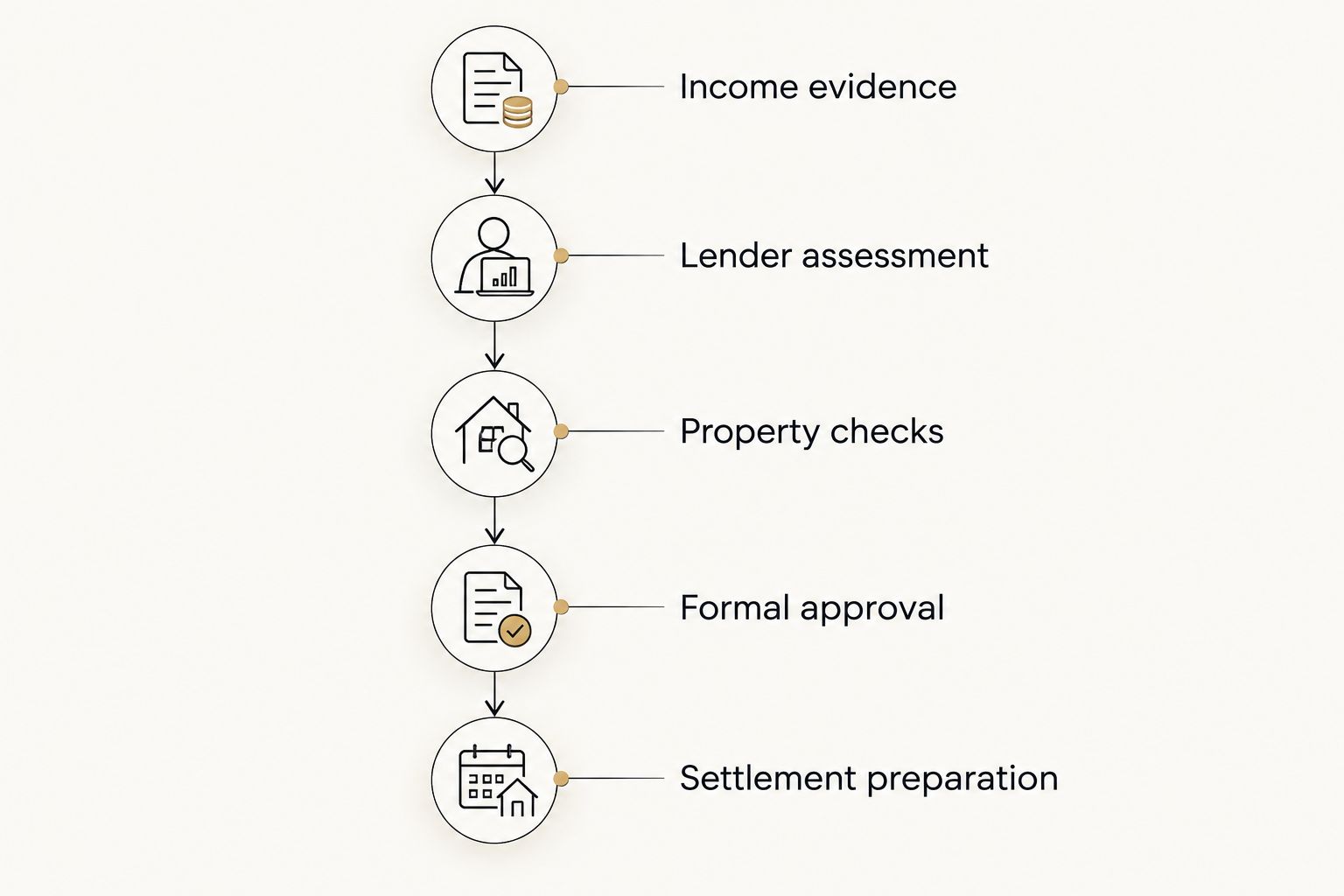
Use a clear application sequence for your 2026 purchase:
- Income evidence: organise employment and financial documents.
- Lender assessment: confirm the proposed borrowing and outstanding conditions.
- Property checks: investigate the property and obtain legal advice.
- Formal approval: satisfy the lender's remaining requirements.
- Settlement preparation: follow your lender's and conveyancer's instructions.
This sequence keeps the lending decision separate from the property decision. Both need attention before you commit; a suitable loan does not establish that a particular property is suitable.
6. Review the loan when your circumstances change
Once the loan settles, keep reviewing it against your household needs. A move from casual teaching to permanent employment, a leadership appointment or a return from parental leave changes the information available for a future assessment.
Start with your current lender's loan statements and terms. Identify the interest rate, remaining term, fees and features you actually use. Then compare alternatives using the same remaining term so a longer repayment schedule does not disguise a weaker outcome.
Refinancing requires a fresh assessment and can involve discharge, application or fixed-rate break costs. A lower repayment alone does not establish that refinancing improves your position, particularly when the loan term increases.
Keep these review tasks on your checklist:
- Check loan suitability after a material income or household change.
- Review the loan before a fixed period expires.
- Compare total borrowing costs, not just the repayment amount.
- Confirm refinancing expenses before agreeing to switch.
- Preserve a savings buffer rather than directing every dollar into repayments.
Compare home loan options for teachers
The best structure depends on your cash flow and need for certainty—not your job title. For your 2026 comparison, use the same borrowing amount, repayment type and loan term across options wherever possible.
The options below are structures to investigate, not recommendations for every teacher. A guarantor arrangement addresses security and deposit constraints; it does not replace an assessment of your ability to repay.
| Option | Best for | Main benefit | Key limitation |
|---|---|---|---|
| Variable-rate loan | Teachers prioritising repayment flexibility | Often permits flexible additional repayments; features depend on the product | Repayments can rise when the interest rate rises |
| Fixed-rate loan | Teachers prioritising repayment certainty during a defined period | Keeps the fixed portion's rate unchanged during that period | Extra repayment limits and break costs can apply |
| Split loan | Teachers wanting some certainty and some flexibility | Combines fixed and variable portions | Requires decisions about the split and separate feature restrictions |
| Loan with an offset account | Teachers holding savings they need to access | Eligible savings reduce the balance used to calculate interest | Fees, eligibility and offset coverage differ by product |
| Guarantor arrangement | Borrowers exploring family-provided additional security | A guarantee can support the security position | Exposes the guarantor to financial risk and requires lender approval |
Ask for a written explanation of why a proposed structure fits your circumstances. If the explanation focuses only on an interest rate, request the missing detail about flexibility, fees and future changes.
Common mistakes teachers make with home loans
Treating teaching as an automatic lending concession
Your occupation is not an approval. Check the actual criteria for any proposed concession, including employment requirements, deposit conditions and property restrictions. Do not build your purchase budget around an unconfirmed exception.
Annualising the busiest casual teaching period
A strong run of relief work does not explain the whole income pattern. Present the available earnings history, including gaps, rather than assuming every school week produces the same pay. Let the lender confirm its assessment method.
Leaving contract or leave changes until the last minute
An expiring contract or upcoming unpaid leave can affect the application. Disclose the timing early and provide supporting documents; do not assume the lender will interpret school employment arrangements without explanation.
Confusing pre-approval with permission to buy anything
Pre-approval remains subject to conditions, including the property assessment. Confirm what remains outstanding before signing a contract, and ask your legal adviser how the purchase terms protect—or expose—you if finance does not proceed.
Choosing repayment certainty without checking restrictions
A fixed rate can suit a predictable household budget, but it needs to fit your plans. Check the consequences of extra repayments, refinancing or selling before the fixed period ends, especially if a school move or relocation is foreseeable.
FAQ
What’s the best home loan for teachers in Australia?
The best home loan for a teacher matches the lender’s income assessment rules with the borrower’s deposit, commitments and required features. Compare employment eligibility first, then assess loan structure, fees and repayment flexibility.
Can a casual relief teacher get a home loan?
Casual relief teachers can be considered for home loans, subject to lender policy and an assessment of their finances. Provide earnings records that show the income pattern, including periods without teaching work, and ask what history the lender requires.
Can I apply for a home loan while on a teaching contract?
You can apply while on a teaching contract, but approval depends on the lender’s assessment. Supply the current contract, relevant employment history and any written renewal evidence without presenting an expected renewal as guaranteed income.
Do teachers automatically qualify for a lenders mortgage insurance waiver?
Being a teacher does not automatically establish eligibility for a lenders mortgage insurance waiver. Confirm the specific lender’s current eligibility requirements before including any waiver in your borrowing plans.
Does my HELP debt affect a teacher home loan application?
HELP debt is relevant to a home loan assessment because associated repayment obligations affect your finances. Disclose the debt and provide the information the lender requests rather than relying solely on your gross salary.
Is an offset account better than redraw for teachers?
An offset account is not automatically better than redraw; the right choice depends on access needs, product terms and fees. Consider how you hold savings for leave or irregular expenses, and seek tax advice if the property might later become an investment.
Can Mortgage Pros help me compare home loans for teachers?
Mortgage Pros provides mortgage broking advice and approval support for individual borrowers. Ask for an assessment of your teaching income, deposit and loan requirements; any recommendation remains subject to your circumstances and lender approval.
One last thing
A larger deposit does not fix an unexplained income pattern. Before you spend another school break inspecting properties, make sure your documents explain how you earn, what changes are coming and how repayments fit your budget.
For your 2026 application, ask Mortgage Pros to review your position before you commit to a property. Bring your employment documents, savings records and existing loan details so the discussion produces a clear next step.
Discuss your home loan today
Request an assessment of your teaching income, deposit and home loan requirements.
Related guides