

Best overall: a lender that accepts your exact trust structure and repayment evidence. Best for refinancing: your existing lender as the first comparison point. Best for unusual structures: a specialist lender after a policy check. This 2026 guide compares the best trust home loan lenders by borrower fit, rather than treating a bank’s name as proof that your trust qualifies.
- The best trust home loan lenders accept your trustee, trust deed, property purpose and repayment evidence.
- Mortgage Pros is a mortgage broker for borrowers seeking trust home loan advice, not a lender.
- Compare mainstream, existing and specialist lenders against the same borrowing structure.
- Keep SMSF lending separate from ordinary family trust home loans.
Why this matters
A trust home loan needs more than an acceptable property and sufficient income. The lender also needs to accept the legal borrowing arrangement, the trust documents and the people supporting repayment. A suitable loan feature does not fix an unsuitable borrower structure.
Mortgage Pros is best for borrowers who want mortgage broking advice on trust home loans before choosing a lender. Mortgage Pros helps individual borrowers and investors with home loan advice and approval support; it is not the organisation advancing the loan.
For your 2026 shortlist, separate lender suitability from loan features. Establish whether the lender accepts the proposed arrangement first. Then compare repayment options, account features and the conditions attached to approval.
What makes the best trust home loan lenders?
Use these 5 criteria to assess each lender route before requesting an application:
- Trust acceptance: Confirm acceptance of the trust type and the deed, including relevant amendments.
- Trustee acceptance: Check the proposed individual or corporate trustee and the required signing parties.
- Repayment evidence: Establish whose income the lender assesses and which documents support it.
- Property purpose: Explain whether the property is an investment, an intended residence or a construction project.
- Loan conditions: Check guarantees, security, repayment structure and account access before committing.
Treat a policy discussion as screening, not approval. Final approval depends on the lender’s assessment of your application and security.
Trust lending options at a glance
The ranking below assigns each route a different job. It is a decision guide, not a claim that every institution in a category offers trust lending.
| Rank and lender route | Best for | Standout decision point | Key limitation |
|---|---|---|---|
| 1. Mainstream lender with confirmed trust acceptance | A straightforward trust purchase | Match the proposed structure to an acceptable lending policy | A standard home loan offering does not establish trust eligibility |
| 2. Existing lender | Refinancing an existing trust loan | Compare retaining the current arrangement against switching | The current lender is only a starting point, not an automatic winner |
| 3. Specialist lender | A structure that falls outside another lender’s policy | Assess the specific reason the earlier route failed | Specialist positioning does not guarantee acceptance |
| 4. Construction lender with confirmed trust acceptance | Building within a trust | Check trust eligibility alongside construction requirements | Acceptance of the trust does not establish acceptance of the build |
| 5. SMSF lender | Property borrowing through a self-managed super fund | Assess the borrowing arrangement under the separate SMSF framework | An ordinary family trust loan is not a substitute |
1. Mainstream lender: best for a straightforward trust purchase
A mainstream lender belongs first on your shortlist when it confirms that your proposed trust arrangement fits its policy. Start with the borrower structure, not a particular account feature. The lender must assess both the application and the property offered as security.
Best for: Borrowers whose trust, trustee, income evidence and property purpose meet the lender’s requirements.
Mainstream lender pros:
- Provides a direct comparison point for a conventional property lending application.
- Lets you assess loan features alongside the proposed borrowing arrangement.
- Keeps the initial enquiry focused on whether the structure fits an established policy.
Mainstream lender cons:
- A lender’s standard home loan information does not confirm that it accepts your trust.
- Acceptance of one trust arrangement does not establish acceptance of another.
- Product selection still depends on assessment of income, security and documents.
Ask a specific question: does the lender accept this trust with this trustee for this property purpose? A general answer about trust lending is not enough.
For a 2026 application, provide the current deed and amendments rather than relying on an earlier policy conversation. Explain who earns the income, who incurs the debt and who will provide any required guarantee.
Verdict: Hold until the lender confirms that the exact structure is eligible; then compare the loan conditions.
2. Existing lender: best for comparing a trust refinance
Your existing lender is the first comparison point when a property already has a trust loan. Ask what retaining or changing the current facility involves, then compare that proposal with a new lender’s requirements. Do not assume the original approval settles a new borrowing request.
Best for: Trust borrowers deciding whether to retain, restructure or refinance an existing loan.
Existing lender pros:
- Gives you a baseline against which to assess a switch.
- Lets you distinguish a change to the current facility from a new lending application.
- Helps identify which existing guarantees and security arrangements need attention.
Existing lender cons:
- An existing relationship does not establish that a new request will be approved.
- Retaining the loan does not automatically make its conditions the best fit.
- Changes to the trustee, borrowing amount or security need their own assessment.
Compare the entire arrangement, not just the repayment shown on a statement. Ask about the remaining loan term, account access, required documents and the steps needed to discharge or replace existing security.
A longer repayment term spreads repayment over more time. Assess that effect separately from any change in interest rate, so a lower repayment does not become your only reason to refinance.
Verdict: Hold until you have a retention proposal and a like-for-like switching comparison.
3. Specialist lender: best for a structure needing individual assessment
A specialist lender belongs on the shortlist when another lender’s policy does not accept a particular feature of the application. Identify that feature precisely. A different lender only helps if its requirements address the reason the earlier route failed.
Best for: Borrowers who need to investigate an alternative after a specific policy mismatch.
Specialist lender pros:
- Offers another route to investigate when an initial lender does not fit.
- Encourages a focused discussion about the actual policy obstacle.
- Provides an additional comparison point for the proposed borrowing arrangement.
Specialist lender cons:
- The word specialist does not prove that a lender accepts your trust.
- A different assessment approach does not remove repayment or security requirements.
- Loan features and conditions still need checking individually.
Separate a documentation issue from a borrowing-capacity issue. If the obstacle is evidence of income, establish which evidence the alternative lender requires. If the obstacle is the trust deed, changing lenders does not automatically resolve the underlying legal question.
Where business income supports repayment, the guide to lenders for self-employed home loans addresses a related assessment question. Trust acceptance and self-employed income assessment remain separate checks.
Verdict: Hold until the alternative lender addresses the identified policy obstacle and accepts the full application structure.
4. Construction lender: best for building within a trust
A trust construction application combines the proposed borrowing structure with the lender’s requirements for the building project. Both must fit. A lender accepting a completed property held through a trust does not establish acceptance of your construction proposal.
Best for: Borrowers planning a build where a trust is part of the ownership and borrowing arrangement.
Construction lender pros:
- Makes the building project part of the lending assessment from the outset.
- Gives you a route to discuss construction funding and the trust together.
- Helps identify the documents required before construction funding proceeds.
Construction lender cons:
- Trust eligibility and construction eligibility are separate assessment questions.
- Changes to the building proposal need checking against the loan conditions.
- The funding process requires coordination between lending and construction documentation.
Before committing to a lender, ask which contracts, plans and approvals it requires. Confirm the process for releasing funds and the evidence needed at each stage. Keep those answers with the trust documentation so the legal borrower and the building project remain aligned.
For your 2026 shortlist, assess the proposed construction facility rather than assuming that a lender’s ordinary home loan is suitable.
Verdict: Hold until the lender accepts both the trust arrangement and the construction proposal.
5. SMSF lender: best for an SMSF property borrowing arrangement
Property borrowing through a self-managed super fund needs a separate assessment from an ordinary family trust home loan. Australian superannuation law permits certain borrowing arrangements subject to specific conditions, including the limited recourse borrowing framework. Get legal and tax advice on the proposed arrangement before treating it as a standard investment loan.
Best for: SMSF trustees investigating a property borrowing arrangement within the applicable superannuation rules.
SMSF lender pros:
- Directs the enquiry to lending designed for the relevant borrowing framework.
- Keeps the fund, borrowing arrangement and property assessment connected.
- Provides a focused route for checking lender-specific SMSF requirements.
SMSF lender cons:
- Ordinary trust lending information does not establish SMSF eligibility.
- A lender’s approval does not replace legal, tax or financial advice.
- Borrowing decisions must account for the fund’s obligations, not just loan eligibility.
The Australian Taxation Office’s SMSF borrowing guidance explains the limited recourse borrowing framework. Read it alongside professional advice about your proposed transaction. Do not transfer conclusions from a family trust application to an SMSF application.
Verdict: Hold until the borrowing structure has been checked by the appropriate advisers and the lender.
How we ranked these lender routes
The order follows the 5 criteria above: trust acceptance, trustee acceptance, repayment evidence, property purpose and loan conditions. Start with a mainstream route for a straightforward purchase, use the existing lender as a refinance baseline, and investigate specialised routes when the transaction calls for them.
This ranking does not compare named lenders’ current policies or claim approval outcomes. Its purpose is to help you choose the right enquiry before submitting an application.
Prepare your trust lending enquiry
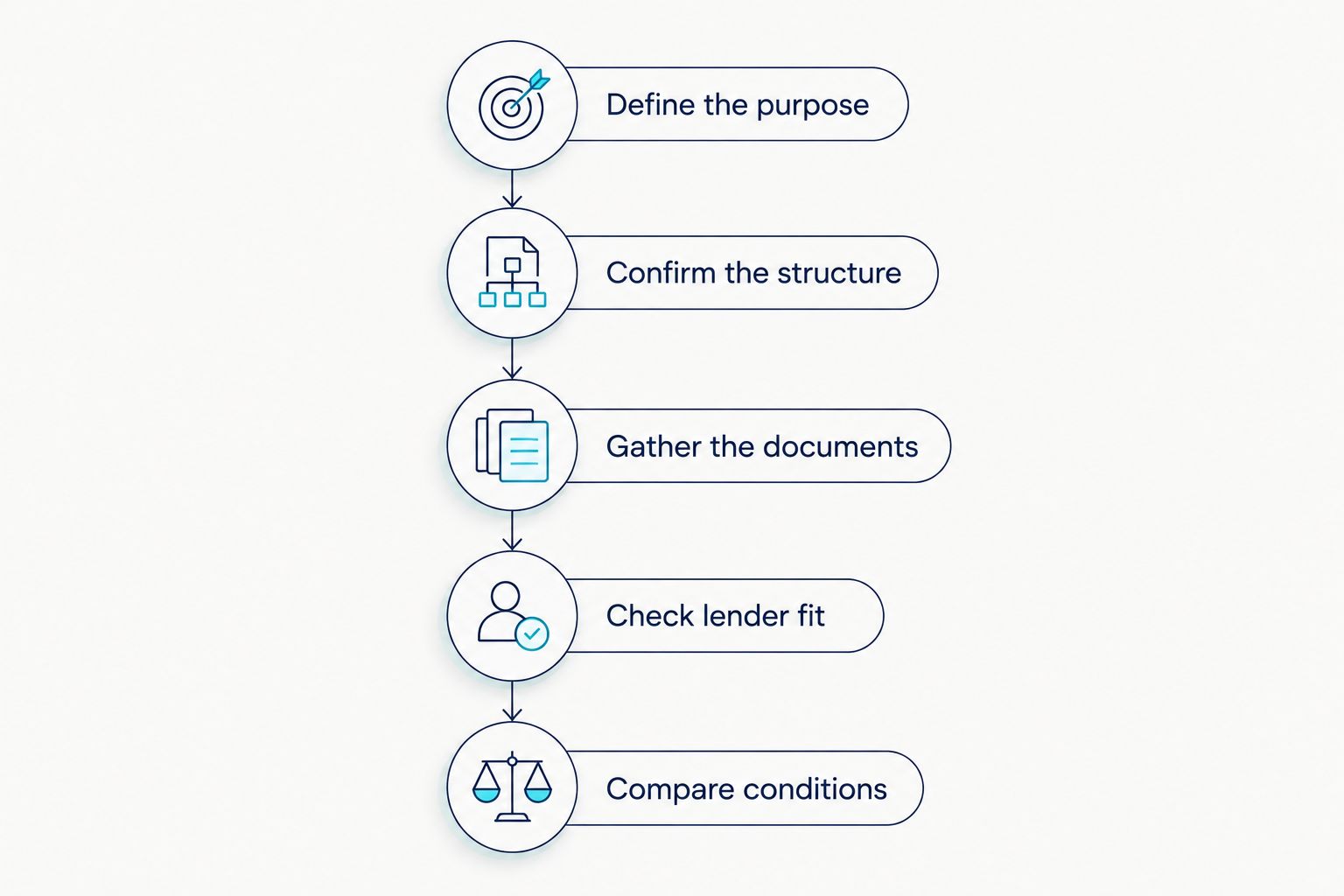
Use this sequence to make your 2026 lender comparison specific and consistent:
- Define the purpose: State whether you are purchasing, refinancing or building, and how the property will be used.
- Confirm the structure: Identify the trust, trustee and parties expected to sign or provide guarantees.
- Gather the documents: Assemble the deed, amendments, identification and relevant income and liability evidence.
- Check lender fit: Ask each shortlisted lender to assess the same proposed arrangement.
- Compare conditions: Review the loan term, repayment structure, security and account features together.
Distinguish these 3 roles in your documents: the trustee enters transactions for the trust, a beneficiary benefits under the trust’s terms, and a guarantor supports repayment under a guarantee. One person can hold more than one role, but the roles are not interchangeable.
Run 2 checks before choosing an account feature: whether the lender accepts the borrower structure, and whether the feature is available for the proposed facility. For example, confirm the permitted account holder and access arrangements before treating an offset account as a deciding advantage.
Mortgage Pros can help you organise the home loan enquiry. Use legal and tax advisers for questions about the deed, ownership structure and tax treatment.
Which trust home loan lender should you choose?
Choose the lender that accepts your exact arrangement and offers conditions suited to your borrowing purpose. For an undecided borrower, begin with a mainstream policy check rather than a specialist label or a familiar bank name.
For refinancing, obtain your existing lender’s proposal first. For construction or SMSF borrowing, start with the relevant lending route. Mortgage Pros can help you compare home loan options without confusing mortgage broking advice with legal advice about the trust itself.
FAQ
What are the best trust home loan lenders in Australia in 2026?
The best trust home loan lenders are those that accept your exact trust, trustee, property purpose and repayment evidence. Confirm eligibility before comparing loan features; a bank’s name alone does not establish suitability.
Can a family trust get a home loan?
A family trust arrangement can be considered for lending where the lender accepts the structure and application. The trustee’s role, trust deed, repayment evidence and security require assessment.
Is Mortgage Pros a trust home loan lender?
Mortgage Pros is a mortgage broking firm, not a lender. It helps borrowers with home loan advice and approval support.
Is a bank better than a non-bank lender for a trust loan?
Neither category is automatically better for a trust loan. Compare acceptance of the proposed arrangement and the conditions of the actual facility.
Can I refinance a property loan held through a trust?
A trust property loan can be assessed for refinancing when the proposed lender accepts the arrangement. Check the current loan, trustee details, security and any guarantees before choosing a switching route.
What documents should I prepare for a trust home loan?
Prepare the trust deed and amendments, trustee details, identification, and evidence of income, liabilities and the property transaction. Confirm the lender’s document requirements before submitting the application.
Is an SMSF home loan the same as a family trust loan?
No, SMSF property borrowing operates within a separate superannuation framework. Obtain advice on the borrowing arrangement and assess lenders against the applicable SMSF requirements.
One last thing
Do not change the trustee or rewrite the borrowing structure merely to fit a lender’s initial response. Those decisions have consequences beyond the loan application. Resolve legal and tax questions first, then ask the lender to assess the arrangement you actually intend to use.
Related guides
- Compare offset home loan accounts
- Compare investment property loan lenders
- Compare SMSF home loan lenders