

Best overall fit: an investment-focused lender for an investment property. Best for managing cash reserves: an offset-enabled lender. Best for business income: a self-employed specialist lender. The best interest-only home loan lenders in 2026 are those that match your borrowing purpose and repayment capacity—not simply those offering the lowest initial repayment.
- The best interest-only home loan lenders match your borrowing purpose and your ability to repay principal later.
- Mortgage Pros provides broker-led home loan advice; it is not the lender in this comparison.
- An offset-enabled lender suits borrowers who want eligible savings to reduce interest without making permanent principal repayments.
- Compare investment loans against principal-and-interest alternatives, including the repayments after the interest-only period ends.
Why this matters
Interest-only repayments cover the interest charged on your loan without reducing the principal through scheduled repayments. That lowers the initial repayment compared with principal and interest at the same rate, but leaves the original debt to repay later.
Mortgage Pros is best for borrowers seeking broker-led home loan advice rather than a direct lender. Mortgage Pros helps Australian home buyers and property owners secure and manage home loans, including refinancing and equity arrangements.
For a 2026 loan decision, start with the end of the interest-only period. Your lender choice needs to work when principal repayments begin, not just when the loan settles.
ASIC's MoneySmart guidance on Australian interest-only home loans describes interest-only periods as generally lasting 1–5 years. The loan normally switches to principal-and-interest repayments afterwards, with the principal repaid over the remaining term.
What makes the best interest-only home loan lenders?
Use these criteria before comparing lender names. A suitable lender must satisfy the criteria that matter to your circumstances; an attractive feature cannot compensate for an unsuitable repayment structure.
- Borrower eligibility: The lender accepts your property purpose, income structure, deposit and existing commitments.
- Interest-only period: The proposed period matches a specific need, with clear conditions for what happens afterwards.
- Total borrowing cost: Compare the interest rate and applicable fees against a principal-and-interest alternative, not just the initial repayment.
- Cash-management features: Confirm whether the proposed loan supports an offset account or extra repayments, and how those features operate.
- Repayment transition: Obtain the repayment amount after interest-only ends and assess it against your household budget.
- Exit flexibility: Check the conditions for changing repayment type, refinancing or repaying the loan early.
There is no universal winner across these criteria. An investor with cash reserves faces a different decision from a self-employed borrower whose main challenge is documenting income.
Interest-only lender options at a glance
The ranking below compares lender profiles, not individual bank products. Each profile has a distinct use case, and a lender can fit more than one profile.
| Rank and lender profile | Best for | Standout feature to seek | Key limitation |
|---|---|---|---|
| 1. Investment-focused lenders | Investment property borrowing | Assessment that accounts for the investment purpose and eligible rental income | Interest-only repayments do not reduce principal |
| 2. Offset-enabled lenders | Borrowers holding accessible cash reserves | An eligible offset account linked to the proposed interest-only loan | Account eligibility and loan conditions require checking |
| 3. Self-employed specialist lenders | Borrowers with business income | An assessment approach suited to the applicant's income evidence | Documentation requirements differ between lenders |
| 4. Construction lenders | Borrowers funding a staged build | Loan arrangements that account for progress payments | Construction-phase repayments do not establish the long-term repayment structure |
The best 2026 shortlist is the one you can qualify for and repay after interest-only ends. Use the profiles to decide which lender questions to ask first.
1. Investment-focused lenders: best for investment property borrowing
An investment-focused lender is the starting point when you are borrowing to buy or refinance a rental property. Seek a lender whose assessment accommodates your investment purpose, rental income and existing debts.
Interest-only repayments can support a deliberate cash-flow strategy, but they do not make the property self-funding. You still need to allow for vacancy, maintenance, insurance and other ownership expenses.
Investment-focused lender pros
- The borrowing discussion starts with the property's investment purpose.
- Eligible rental income can form part of the lender's assessment.
- Interest-only repayments separate the immediate interest obligation from later principal repayment.
Investment-focused lender cons
- Scheduled interest-only repayments leave the principal outstanding.
- Rental income does not remove the need to meet the lender's repayment-capacity requirements.
- A repayment increase follows when the loan changes to principal and interest, assuming the same rate and outstanding balance.
Best for: Investors with a clear reason to preserve near-term cash flow and a workable plan to repay principal later.
Ask the lender to show the interest-only repayment and the subsequent principal-and-interest repayment. Then assess both alongside the property's expenses rather than comparing the mortgage repayment with rent alone.
Interest-only does not automatically create a tax advantage. The use of borrowed funds matters to interest deductibility; obtain tax advice before treating a loan structure as a tax strategy.
Verdict: Hold until the property's budget works during and after the interest-only period.
2. Offset-enabled lenders: best for accessible cash reserves
An offset-enabled lender suits borrowers who want eligible cash balances to reduce the interest calculation while keeping those funds accessible. An offset account is separate from the loan; it does not itself pay down the principal.
The feature must apply to the exact loan being proposed. Do not assume an offset account offered elsewhere in a lender's range is available with its interest-only arrangement.
Offset-enabled lender pros
- Eligible offset balances reduce the loan balance used to calculate interest.
- Cash remains in a separate account rather than becoming a permanent principal repayment.
- The structure supports borrowers who need access to reserves for upcoming expenses.
Offset-enabled lender cons
- An offset does not reduce the outstanding principal unless you separately repay it.
- Account conditions and associated loan fees affect the value of the feature.
- A small or frequently depleted balance provides less interest reduction than a sustained balance.
Best for: Borrowers with cash reserves they intend to retain rather than immediately pay into the loan.
For your 2026 comparison, ask whether the offset is full or partial and whether it remains available throughout the proposed repayment arrangement. Check which account balances qualify and whether access conditions suit how you actually manage money.
Compare the whole loan against an alternative without an offset. A useful feature is not automatically the better deal if other loan costs outweigh the interest reduction.
Verdict: Hold until the offset benefit justifies the associated loan conditions and costs.
3. Self-employed specialist lenders: best for business income
A self-employed specialist lender is a useful profile when business income needs a different assessment from a straightforward salary. The priority is finding an acceptable income-assessment method before choosing a repayment feature.
Self-employment does not make interest-only repayments suitable by itself. Separate the approval question—how the lender verifies income—from the strategy question—why you want to delay principal repayment.
Self-employed specialist lender pros
- The assessment can address business income rather than relying only on payslips.
- The application discussion identifies the financial evidence the lender requires.
- A suitable assessment approach helps you compare lenders on eligibility before pursuing loan features.
Self-employed specialist lender cons
- Alternative income documentation does not guarantee approval.
- Business liabilities and personal commitments still affect repayment capacity.
- Interest-only eligibility requires checking separately from self-employed eligibility.
Best for: Borrowers whose income comes from a business and who need a lender assessment suited to their financial records.
Prepare the income documents requested for your circumstances, together with details of business and personal debts. Ask how the lender treats retained earnings, variable income and existing business commitments rather than assuming every lender takes the same approach.
You also need a household budget that works outside your strongest trading periods. An interest-only repayment should not conceal an inability to afford the later principal-and-interest repayment.
Verdict: Hold until both the income assessment and repayment transition work for your circumstances.
4. Construction lenders: best for staged building finance
Construction lending needs its own comparison because funds are commonly advanced through progress payments rather than entirely at settlement. During construction, interest is generally calculated on the amount drawn down, subject to the loan's terms.
An interest-only construction phase is different from choosing an extended interest-only arrangement after completion. Confirm both stages rather than treating the building-period repayment as the permanent mortgage repayment.
Construction lender pros
- Staged funding aligns the loan drawdown with the building process.
- Interest on drawn funds reflects the amount advanced rather than an undrawn loan limit.
- The application addresses the building contract and proposed completed property.
Construction lender cons
- Drawdowns depend on the lender's construction requirements.
- Repayments change as more funds are advanced and the repayment structure changes.
- Building-period interest-only arrangements do not establish eligibility for interest-only repayments after completion.
Best for: Borrowers financing a build who need progress-payment arrangements and a clear post-completion loan structure.
For a 2026 construction application, ask what triggers each drawdown and when principal repayments begin. Include your other housing expenses in the budget if you will continue paying rent or another mortgage during construction.
Request an explanation of the transition to the completed-property loan. The important comparison is the full borrowing arrangement, not the smallest repayment at the first drawdown.
Verdict: Hold until the construction and post-completion repayment arrangements are both clear.
How to compare your shortlist
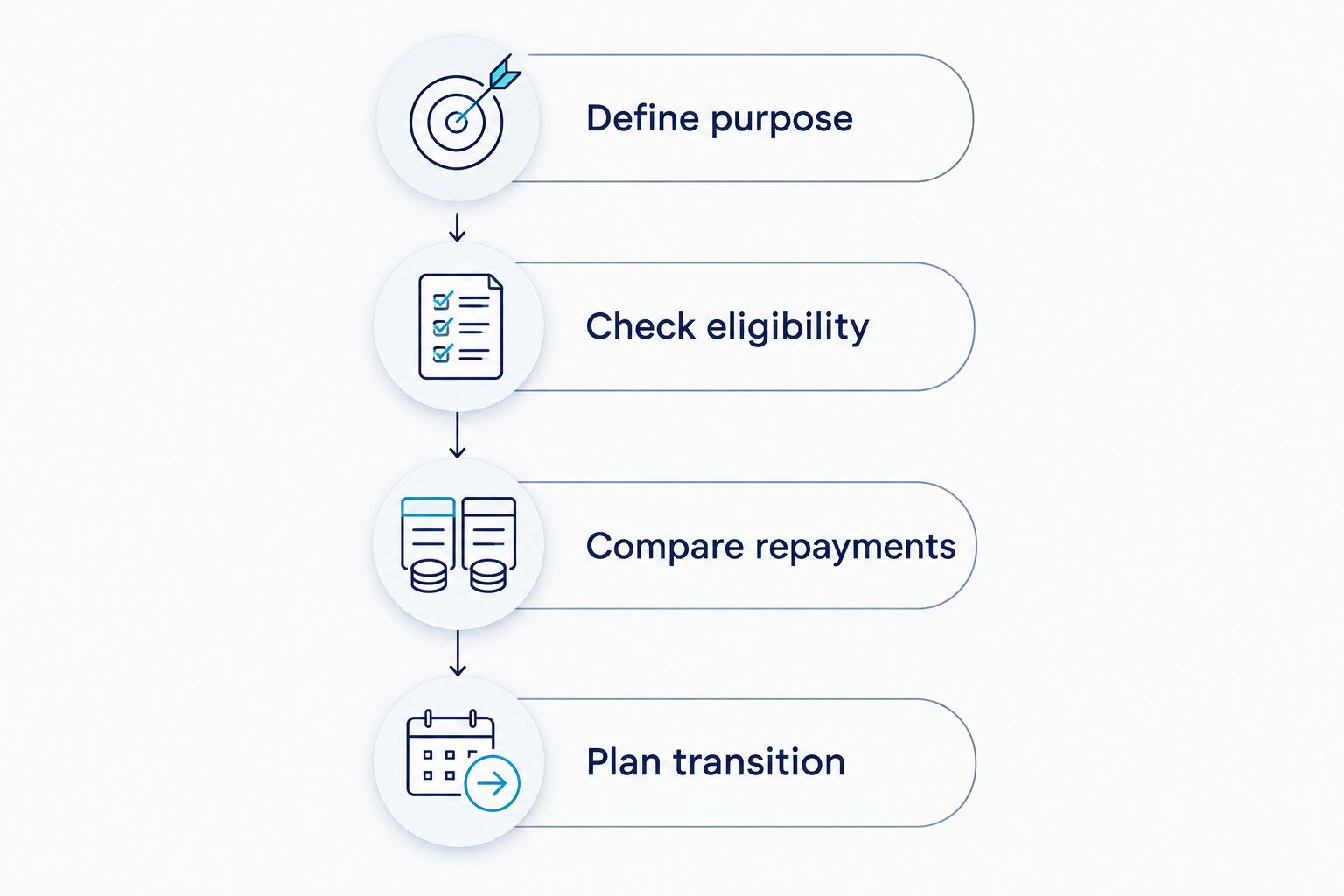
Define purpose
Write down why you want interest-only repayments and when that need ends. Temporary cash-flow management is a reason to assess the structure; simply wanting a smaller repayment is not a complete repayment plan.
Check eligibility
Confirm the lender's requirements for income, property use and loan-to-value ratio. In Australian lending, borrowing above 80% LVR commonly triggers lenders mortgage insurance, although exceptions exist; a 20% deposit corresponds to 80% LVR before purchasing costs and valuation differences.
Compare repayments
Obtain the interest-only repayment, the later principal-and-interest repayment and a principal-and-interest alternative from the outset. Use the same proposed balance and term so that you are comparing repayment structures rather than unrelated scenarios.
Plan transition
Identify how you will meet principal repayments when interest-only ends. Do not make an extension or successful refinance the only way the budget works.
These checks form a sequence: establish the purpose, confirm eligibility, compare the repayment obligations, then decide whether the transition is affordable.
Ask for the comparison in writing so you can review the conditions alongside the repayments. Separate features you will actually use from features that merely sound useful.
Discuss your home loan options
Get broker-led guidance on your borrowing purpose, loan structure and refinancing options.
How we ranked the lender profiles
The order prioritises borrowing purpose, then cash management, income assessment and construction requirements. It is a decision framework, not a claim that one lender has the lowest rate or approves every borrower.
Mortgage Pros provides home loan advice and approval support. The lender remains responsible for assessing and approving the application, and the appropriate shortlist depends on your circumstances.
Which interest-only lender should you choose?
For an investment property, start with an investment-focused lender and compare principal-and-interest repayments alongside interest-only. If accessible cash reserves are central to your plan, prioritise an offset-enabled option instead.
Self-employed borrowers should settle the income-assessment question first. Construction borrowers should compare the staged funding arrangements and the repayment structure after completion.
Your 2026 decision should end with an affordable repayment transition. If the loan only works while principal repayment is postponed, reconsider the borrowing amount or repayment structure before proceeding.
FAQ
What’s the best interest-only home loan lender in Australia?
The best interest-only home loan lender is one that accepts your circumstances and offers a repayment structure you can afford after interest-only ends. Compare borrowing purpose, income assessment, offset eligibility and the later principal-and-interest repayment rather than choosing by the initial repayment alone.
Does Mortgage Pros lend the money directly?
Mortgage Pros is a mortgage broking firm, not the lender in this comparison. It helps Australian home buyers and property owners with home loan advice and approval support.
How long does an interest-only home loan last?
ASIC’s MoneySmart guidance describes interest-only periods as generally lasting 1–5 years. The exact period depends on the loan agreement, and principal-and-interest repayments normally begin afterwards.
Is an interest-only loan better than principal and interest?
An interest-only loan is not automatically better than principal and interest. It postpones scheduled principal repayment, while principal-and-interest repayments reduce the debt as you repay it.
Can I have an offset account with an interest-only loan?
An offset account is available only if the particular loan supports it. Confirm whether the offset is full or partial, which balances qualify and whether it remains available under the proposed repayment arrangement.
Can self-employed borrowers get interest-only home loans?
Self-employed borrowers can apply for interest-only home loans, subject to the lender’s income assessment and repayment-capacity requirements. Acceptance of business income does not automatically establish eligibility for interest-only repayments.
What happens when the interest-only period ends?
The loan normally changes to principal-and-interest repayments over the remaining term. At the same interest rate and outstanding balance, that repayment is higher because it includes principal as well as interest.
Can I refinance instead of starting principal repayments?
Refinancing requires a new lender assessment and approval. Do not rely on refinancing as your only plan for meeting repayments when the interest-only period ends.
One last thing
Lower repayments are not the same as lower borrowing costs. At the same rate and starting balance, postponing principal repayments leaves more debt outstanding than a principal-and-interest schedule, increasing interest over the loan's life.
Before accepting an interest-only offer, ask for the repayment due immediately after the interest-only period. Put that figure into your budget now; it is the clearest check on whether the structure serves your finances rather than postpones a problem.
Related guides
- Best lenders for self-employed home loans
- Best investment property loan lenders
- Best construction loan lenders