

Best overall for flexibility: a variable home loan with an offset account. Best for repayment certainty: a fixed-rate home loan. Best budget shortlist: a basic variable home loan, subject to its total cost. This guide compares the best first home buyer home loan options in Australia for 2026, including low-deposit and guarantor arrangements.
- The best first home buyer home loan options depend on your deposit, repayment budget and need for flexibility.
- Variable loans with offset accounts suit buyers who will keep savings available after settlement.
- Fixed-rate loans suit repayment certainty; split loans combine fixed and variable portions.
- Low-deposit and guarantor arrangements address deposit barriers, not your ability to afford repayments.
- Mortgage Pros suits first home buyers seeking mortgage broking advice and approval support.
Mortgage Pros helps home buyers compare home loans and understand approval requirements. Choose the loan structure first, then compare lenders offering that structure. A lender name alone does not tell you whether the loan fits your finances.
Why this matters
Your deposit and your loan structure solve different problems. A deposit helps you qualify; the structure determines how repayments, savings and future changes work after settlement.
For your 2026 purchase, compare borrowing eligibility separately from ongoing affordability. A loan that gets you into a property still needs to leave room for ownership costs and unexpected expenses. Government assistance and lender approval are also separate assessments: eligibility for one does not guarantee the other.
What makes the best first home buyer home loan options?
Judge each option against these criteria before comparing lenders:
- Affordable repayments: Assess repayments alongside living expenses, property costs and a savings buffer.
- Deposit suitability: Check the required deposit, acceptable evidence of savings and treatment of purchase expenses.
- Total loan cost: Compare the interest rate, comparison rate and fees rather than an advertised rate alone.
- Useful flexibility: Prioritise offset, redraw or extra repayments only when you will use them.
- Approval fit: Match lender requirements to your employment, income, debts and chosen property.
- Exit restrictions: Understand fixed-rate break costs, refinancing conditions and any guarantee-release requirements.
A 20% deposit generally corresponds to an 80% loan-to-value ratio, before considering other borrowing arrangements. Lenders mortgage insurance often becomes relevant above that level, although exemptions and guarantee arrangements exist. Purchase expenses still need a separate allowance.
First home buyer loan options at a glance
These are loan structures and borrowing arrangements, not a lender leaderboard. Some overlap: a low-deposit loan can also have a variable rate, while a guarantor arrangement can support different repayment structures.
| Option | Best for | Standout feature | Key limitation |
|---|---|---|---|
| Variable loan with offset | Buyers retaining accessible savings | Eligible savings reduce the balance used to calculate interest | Repayments can change; features can carry fees |
| Basic variable loan | Buyers prioritising a simpler loan | Fewer features to assess and manage | Usually fewer savings-management features |
| Fixed-rate loan | Buyers needing repayment certainty | Rate certainty during the fixed period | Restrictions on extra repayments and early exit |
| Split loan | Buyers balancing certainty and flexibility | Separate fixed and variable portions | More components and restrictions to manage |
| Low-deposit home loan options | Buyers with limited deposit savings | A path to borrowing with a smaller deposit | Higher borrowing and possible mortgage insurance |
| Guarantor home loan arrangements | Buyers with suitable family support | Additional security can address a deposit shortfall | Financial risk extends to the guarantor |
1. Variable loan with offset: best for accessible savings
A variable home loan with an offset account suits buyers who want savings available while reducing interest. With a 100% offset account, the eligible account balance offsets the loan balance used to calculate interest; it does not reduce the outstanding principal itself.
The variable rate can change, so repayments are not locked. Check whether the particular loan offers a full or partial offset and which accounts qualify.
Variable loan with offset pros:
- Keeps eligible savings accessible in a separate account.
- Reduces interest while money remains in the offset account.
- Often supports extra repayments, subject to lender terms.
Variable loan with offset cons:
- Rate changes can increase required repayments.
- Fees or a different rate can outweigh the offset benefit.
- A small offset balance delivers a smaller interest saving.
Best for: First home buyers who expect to retain savings after settlement and value access to that money.
Verdict: Buy if you will use the offset account consistently and its benefit exceeds the additional cost. Without that balance, a simpler loan deserves equal consideration.
2. Basic variable loan: best for a simpler borrowing setup
A basic variable home loan focuses on borrowing and repayments rather than a wider feature package. It is the budget shortlist, not an automatic lowest-cost winner: compare the actual rate and fees against alternatives.
Check its redraw and extra-repayment conditions individually. The word basic does not establish which features a lender includes.
Basic variable loan pros:
- Provides a simpler structure to understand and manage.
- Avoids choosing features you do not expect to use.
- Allows you to compare a straightforward alternative with offset loans.
Basic variable loan cons:
- Often lacks an offset account.
- Variable repayments remain exposed to rate changes.
- Redraw access depends on the loan terms.
Best for: Buyers who prioritise simplicity and do not expect to maintain substantial accessible savings.
Verdict: Buy if the basic variable loan has the better total cost for your expected use. Do not assume fewer features always means a better deal.
3. Fixed-rate loan: best for repayment certainty
A fixed-rate home loan keeps the interest rate unchanged during an agreed fixed period. That gives you a defined repayment commitment during that period, rather than certainty for the entire loan term.
When the fixed period ends, the loan moves to the lender's applicable arrangements unless you choose another available option. Plan that review before the fixed period expires.
Fixed-rate loan pros:
- Makes repayments easier to budget during the fixed period.
- Protects the fixed portion from rate increases during that period.
- Suits borrowers who prioritise certainty over flexibility.
Fixed-rate loan cons:
- Rate falls do not automatically reduce the fixed rate.
- Extra repayments and offset access can be restricted.
- Breaking the fixed arrangement can trigger break costs.
Best for: Buyers who need predictable repayments and do not expect to sell, refinance or make substantial extra repayments during the fixed period.
Verdict: Buy if repayment certainty matters more than flexibility. Treat a fixed rate as a budgeting choice, not a prediction of where rates will move in 2026.
4. Split loan: best for balancing certainty and flexibility
A split home loan divides your borrowing into fixed and variable portions. The fixed portion provides rate certainty for its agreed period; the variable portion retains the flexibility available under its own terms.
The split should reflect how you intend to manage the loan. Consider where extra repayments will go and whether eligible savings can offset the variable portion.
Split loan pros:
- Combines fixed-rate certainty with variable-rate flexibility.
- Keeps part of the borrowing available for flexible repayment strategies.
- Allows the structure to reflect different financial priorities.
Split loan cons:
- The variable portion remains exposed to rate increases.
- Fixed-rate restrictions still apply to the fixed portion.
- Separate loan portions add administration and potentially fees.
Best for: Buyers who want some predictable repayments without fixing all their borrowing.
Verdict: Buy if each portion serves a clear purpose. Hold if you cannot explain why the proposed split matches your savings and repayment plans.
5. Low-deposit loan: best for a smaller deposit
A low-deposit home loan allows borrowing with a smaller contribution towards the purchase. Approval still depends on income, expenses, credit history, property acceptability and the lender's requirements.
Lenders mortgage insurance or an eligible guarantee arrangement can affect the assessment. Lenders mortgage insurance protects the lender, not the borrower, and does not remove your responsibility to repay the loan.
Low-deposit loan pros:
- Addresses a deposit barrier without requiring a traditional larger deposit.
- Gives eligible borrowers another purchase pathway to assess.
- Can be considered alongside applicable home buyer assistance.
Low-deposit loan cons:
- A smaller deposit means more borrowing for the same purchase.
- Mortgage insurance or other lending conditions can apply.
- Less initial equity leaves a smaller buffer against falling property values.
Best for: Buyers whose income supports repayments but whose deposit savings are limited.
Verdict: Hold until the full repayment commitment and purchase expenses are confirmed. A smaller deposit should not become a reason to stretch your budget.
6. Guarantor arrangement: best for suitable family support
A guarantor arrangement uses an eligible guarantor's security to support the borrower's home loan. The guarantee can address a deposit shortfall, but the borrower must still satisfy repayment and approval requirements.
The guarantee's scope matters. Confirm what is secured, the guarantor's exposure and the lender's conditions for releasing the guarantee.
Guarantor arrangement pros:
- Provides another pathway when deposit savings are insufficient.
- Can help address mortgage insurance requirements, depending on the arrangement.
- Gives borrowers an option to assess alongside continued saving.
Guarantor arrangement cons:
- Places the guarantor's finances and secured property at risk.
- Can affect the guarantor's own borrowing decisions.
- Release requires lender approval and is not automatic.
Best for: Buyers with suitable family support and a guarantor who understands the legal and financial commitment.
Verdict: Hold until the guarantor receives independent legal advice and the release conditions are clear. Family support does not make the obligation risk-free.
How to choose your loan structure
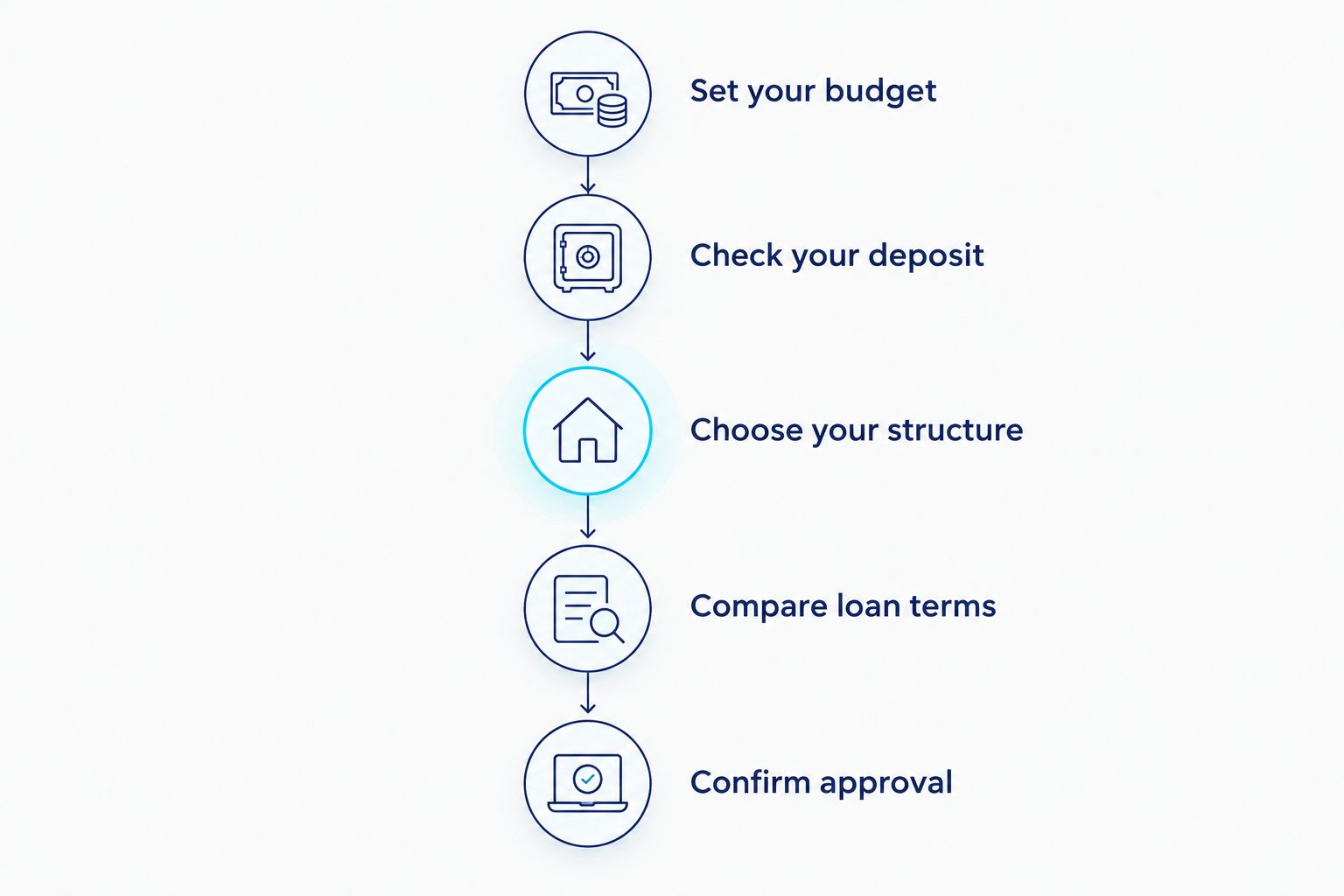
Use this sequence for a 2026 purchase before narrowing the lender shortlist. Mortgage Pros can help you compare home loan requirements against your borrowing circumstances.
- Set your budget: Allow for repayments, purchase expenses, ongoing ownership costs and an emergency buffer.
- Check your deposit: Separate the money available for the property from money needed for other expenses.
- Choose your structure: Decide whether accessible savings, repayment certainty or deposit support matters most.
- Compare loan terms: Review rates, fees, restrictions and approval requirements for that structure.
- Confirm approval: Understand the conditions attached to any approval before making a binding commitment.
Pre-approval is not unconditional approval. The property and your financial circumstances still need to satisfy the lender's conditions.
Assess offset and redraw separately. Offset holds savings in an eligible separate account; redraw provides access to qualifying extra repayments already made into the loan, subject to lender conditions. Similar access does not make them the same arrangement.
Compare your first home loan options
Get mortgage broking advice on loan structures, deposit requirements and approval support.
How these options are ranked
This 2026 ranking prioritises a distinct borrower need for each option: accessible savings, simplicity, certainty, balance, deposit flexibility or family support. It is not a ranking of current lender rates or individual loan products.
The default recommendation favours flexibility for buyers who will retain savings. Low-deposit and guarantor arrangements rank as deposit solutions, not substitutes for an affordable repayment plan.
Which first home buyer loan should you choose?
Start with a variable loan with offset if you will retain accessible savings after settlement. Compare it directly with a basic variable loan and check whether the offset benefit justifies the difference in total cost.
Choose fixed repayments when budget certainty is your priority, or assess a split loan when you need both certainty and flexibility. If the deposit is the obstacle, review low-deposit and guarantor arrangements without increasing your purchase budget beyond comfortable repayments.
Mortgage Pros suits first home buyers who want mortgage broking advice and approval support. The service helps you assess borrowing options; the lender makes the approval decision.
FAQ
What’s the best first home buyer home loan option in 2026?
A variable home loan with offset is the starting shortlist for buyers who will keep accessible savings after settlement. Fixed-rate, basic variable, low-deposit and guarantor options suit different priorities, so compare the structure against your budget and deposit.
Is an offset home loan better than a basic variable loan?
An offset home loan is better when the interest benefit from your eligible savings outweighs any additional loan cost. A basic variable loan deserves consideration when you will hold little money in offset or do not need the feature.
Should a first home buyer choose a fixed or variable rate?
Choose fixed for repayment certainty during the fixed period and variable for flexibility under the loan’s terms. A split loan combines both, but the fixed portion still carries its own restrictions.
Do I need a 20% deposit to buy my first home?
A 20% deposit is not required for every first home loan. Low-deposit lending and eligible guarantee arrangements provide other pathways, but lender approval, purchase expenses and repayment affordability still apply.
Does lenders mortgage insurance protect me if I cannot repay?
Lenders mortgage insurance protects the lender, not you. It does not cancel your repayment obligation or replace a financial buffer.
Can a guarantor help me get a first home loan?
A suitable guarantor can help address deposit or security requirements. You still need to meet the lender’s repayment assessment, and the guarantor needs independent legal advice about the guarantee’s risks.
What does a first home buyer home loan cost?
The cost depends on the amount borrowed, interest rate, loan term and applicable fees. Compare the actual loan terms and repayment schedule rather than treating an advertised rate as the full cost.
Can Mortgage Pros help me compare first home buyer loans?
Mortgage Pros provides mortgage broking advice and approval support for home buyers. Ask for a comparison that addresses your deposit, income, preferred loan structure and repayment budget.
One last thing
Reaching an equity milestone does not automatically release a guarantor. The lender must assess and approve the release under its requirements, so agree on the review process before signing the arrangement.
For a 2026 purchase, keep the same discipline across every option: understand how you enter the loan, how you manage it and how you exit. This guide provides general information, not personal financial advice.
Related guides