
Best overall: a lender whose line of credit matches your borrowing purpose and repayment plan. Best for a defined expense: a separate equity loan. Best for keeping savings accessible: a home loan with an offset account. The best line of credit home loan lenders in 2026 are not automatically the best choice for every homeowner; compare the lending structure before choosing the lender.
- The best line of credit home loan lenders match your purpose, access requirements and repayment discipline.
- Mortgage Pros provides home loan advice; it is a mortgage broker, not a line of credit lender.
- A separate equity loan suits a defined expense; an offset account keeps savings separate from borrowing.
- Compare home equity access, repayment requirements and security before choosing a lender.
Why this matters
A line of credit secured against your home gives you access to an approved borrowing limit. You draw funds when needed, subject to the loan agreement, rather than receiving the entire limit as a single advance. Interest generally applies to the amount drawn, but fees and repayment requirements depend on the contract.
The attraction is flexibility. The risk is carrying debt without a clear reduction plan, while your property remains security for the borrowing.
Mortgage Pros helps home buyers and property owners secure and manage home loans, including refinancing and equity arrangements. Mortgage Pros is best for borrowers seeking home loan advice and approval support, rather than a direct lender application.
For a 2026 comparison, start with what you need the money to do. Repeated access, a single planned expense and staged building payments call for different loan structures.
What makes the best line of credit home loan lender?
Use these criteria before considering a lender name. A familiar bank does not resolve a mismatch between the facility and your borrowing needs.
- Purpose fit: The lender must accept the intended use of the funds. Explain whether you are borrowing for personal expenses, investment or property work.
- Access rules: Check how you draw funds, whether repaid amounts become accessible again and what conditions restrict access.
- Repayment requirements: Understand minimum payments, principal reduction requirements and what happens at any review or expiry point.
- Security and equity: Establish which property secures the borrowing and how the lender assesses its value and existing debt.
- Total borrowing cost: Compare interest, fees and the effect of leaving the balance outstanding. Do not judge the facility on its headline rate alone.
- Debt separation: Keep different borrowing purposes identifiable, particularly when investment and personal expenditure are involved.
Ask for these terms in writing. An explanation of how a facility usually works is not a substitute for the agreement you will sign.
Lending structures at a glance
This ranking separates borrowing needs, not bank brands. It places a line of credit first for repeat borrowing, then shows when another structure is the better fit. Use the table to decide which type of lender or facility belongs on your shortlist.
| Ranked option | Best for | Standout feature | Key limitation |
|---|---|---|---|
| Lender offering a secured line of credit | Repeated, uneven borrowing needs | Draw funds within an approved limit | Flexible access does not create a debt reduction plan |
| Lender offering a separate equity loan | A defined expense or investment purpose | A distinct loan balance and repayment arrangement | Further borrowing needs another assessment or an agreed access feature |
| Lender offering a home loan with offset | Keeping your own savings accessible | Eligible savings reduce the balance used to calculate interest | An offset account does not create additional borrowing capacity |
| Lender offering a home loan with redraw | Accessing eligible extra repayments | Access to money paid ahead into the loan | Access depends on the lender's redraw rules |
| Lender offering a construction loan | Building work requiring staged payments | Drawdowns linked to construction progress | Funds are tied to the approved project and drawdown process |
1. Secured line of credit: best for repeated borrowing needs
A secured line of credit lets you draw against an approved limit as expenses arise. It suits a borrowing pattern that is irregular but planned, rather than a single expense with a known amount. The lender's agreement determines access, repayments and review conditions.
For your 2026 shortlist, ask how the lender expects the balance to reduce. A facility that feels convenient during drawdown can become difficult to manage when borrowing repeatedly replaces repayments.
Secured line of credit pros:
- Access funds as eligible expenses arise rather than drawing everything upfront.
- Reuse repaid funds where the agreement permits it.
- Match borrowing more closely to the timing of expenditure.
Secured line of credit cons:
- Repeated withdrawals make it harder to maintain a declining balance.
- Your home is exposed to the consequences of default.
- Access and repayment conditions require close attention to the contract.
Best for: Borrowers with recurring funding needs, reliable income and a written repayment plan.
Before selecting a lender, explain the expected withdrawals and how each will be repaid. Also ask what happens if the lender reviews the facility or your financial circumstances change.
Verdict: Choose a secured line of credit for planned repeat borrowing; skip it as a permanent supplement to household income.
2. Separate equity loan: best for a defined expense
A separate equity loan uses property equity as security for additional borrowing, subject to approval. Keeping that borrowing in a distinct loan account makes the balance and purpose easier to identify. It is a stronger starting point when you know what the funds will pay for.
Compare lenders on the proposed loan split, repayment structure and treatment of your existing mortgage. Confirm whether accessing equity requires refinancing the existing loan or whether the lender offers another suitable arrangement.
Separate equity loan pros:
- Keeps a defined borrowing purpose separate from the original mortgage.
- Makes the additional debt easier to track.
- Supports a scheduled principal repayment arrangement where agreed.
Separate equity loan cons:
- Additional lending remains subject to valuation and repayment assessment.
- A new expense does not automatically create a right to borrow more.
- Extending the repayment term can prolong the debt.
Best for: Borrowers funding a known expense or keeping an investment-related borrowing purpose identifiable.
Equity is not the same as borrowing capacity. A lender assesses whether you can service the proposed debt as well as whether the property provides acceptable security.
Verdict: Choose a separate equity loan when the expense is defined and a clear repayment schedule matters more than repeat access.
3. Home loan with offset: best for accessible savings
An offset account is a separate account linked to an eligible home loan. Its balance reduces the loan balance used to calculate interest under the product's terms. Unlike a line of credit, it gives you access to your own deposited money rather than additional borrowed funds.
This distinction matters when your real goal is a cash buffer. You do not need a new borrowing facility simply to keep savings available for emergencies or upcoming expenses.
Home loan with offset pros:
- Keeps savings accessible in a separate account.
- Reduces interest calculations while eligible funds remain deposited.
- Separates everyday cash from the mortgage balance.
Home loan with offset cons:
- Provides no additional borrowing limit.
- The benefit falls when you withdraw savings.
- Account eligibility and product conditions vary between lenders.
Best for: Homeowners who already have savings and want access without paying those funds directly into the mortgage.
For a 2026 comparison, check whether the offset arrangement applies to the loan you intend to use. Ask which accounts qualify and how the lender calculates the offset benefit.
Verdict: Choose an offset account for accessible savings; skip it as a substitute for approved equity borrowing.
4. Home loan with redraw: best for eligible extra repayments
Redraw gives you access to eligible additional repayments made into a home loan, subject to lender rules. It is not a separate revolving credit limit. The amount accessible depends on the loan and how the lender treats repayments made ahead of schedule.
Redraw suits borrowers who want extra repayments to reduce their loan balance while retaining conditional access. Before relying on it, check the access process rather than assuming redraw works like a transaction account.
Home loan with redraw pros:
- Extra repayments reduce the outstanding loan balance.
- Eligible funds remain accessible under the agreement.
- Keeps debt reduction and conditional access within the loan.
Home loan with redraw cons:
- The lender's conditions govern access.
- Available redraw is not identical to cash held in a separate account.
- Redrawing for a different purpose can complicate tax record-keeping.
Best for: Borrowers making extra repayments who do not need a separate, ongoing borrowing limit.
Ask how redraw changes as the loan progresses, and what restrictions apply to your loan type. If funds will be used for investment, speak with a tax adviser before mixing personal and investment transactions.
Verdict: Choose redraw for eligible extra repayments; skip it when you need access independent of lender redraw conditions.
5. Construction loan: best for staged building payments
A construction loan releases funds in stages under an approved building arrangement. The lender assesses the project and controls drawdowns according to its requirements. That structure differs from a general line of credit intended for repeated withdrawals.
For substantial building work, begin with the payment schedule and supporting documents. A lender needs to understand the project, not simply the amount of equity in your property.
Construction loan pros:
- Aligns funding with approved stages of construction.
- Links drawdowns to a documented project.
- Provides a purpose-specific structure for building expenditure.
Construction loan cons:
- Requires project documentation and lender approval.
- Drawdowns follow the agreed process rather than unrestricted access.
- Variations require attention to funding and approval conditions.
Best for: Borrowers whose building project involves staged payments under a construction contract.
A general equity loan remains a separate option for other property expenses. Do not assume that either structure fits until the lender has assessed the actual work and payment requirements.
Verdict: Choose a construction loan for an approved staged building project; skip it for unrelated ongoing spending.
How this ranking works
The ranking prioritises purpose fit, access rules and repayment discipline. A secured line of credit leads for recurring borrowing because repeat access is its defining function. Each alternative then takes a separate use-case slot rather than competing for an unsupported overall winner.
Mortgage Pros provides mortgage broking services, not the credit facility itself. Its role is advice and approval support; the lender determines approval and the contractual terms.
There is also a boundary to that advice. Mortgage structuring does not replace personalised tax or legal advice, especially where investment borrowing or a guarantor is involved.
How to compare your lender shortlist
In 2026, compare lenders against the same borrowing purpose and access requirements. Otherwise, you risk comparing a revolving facility with an ordinary mortgage as though they deliver the same result.
Define the purpose
Write down what the funds will pay for and whether the spending is recurring or finite. Separate personal expenditure from investment-related uses before discussing loan structure.
Check the equity
Identify the property's assessed value and existing secured debt. The lender's valuation and lending criteria determine how much equity it accepts as security.
Test repayments
Assess the additional debt alongside your existing mortgage, living expenses and other commitments. Include a plan to reduce principal, not just meet the minimum payment.
Confirm access
Get the drawdown, redraw, review and repayment rules in writing. Confirm which property is security and what happens when the facility changes or closes.
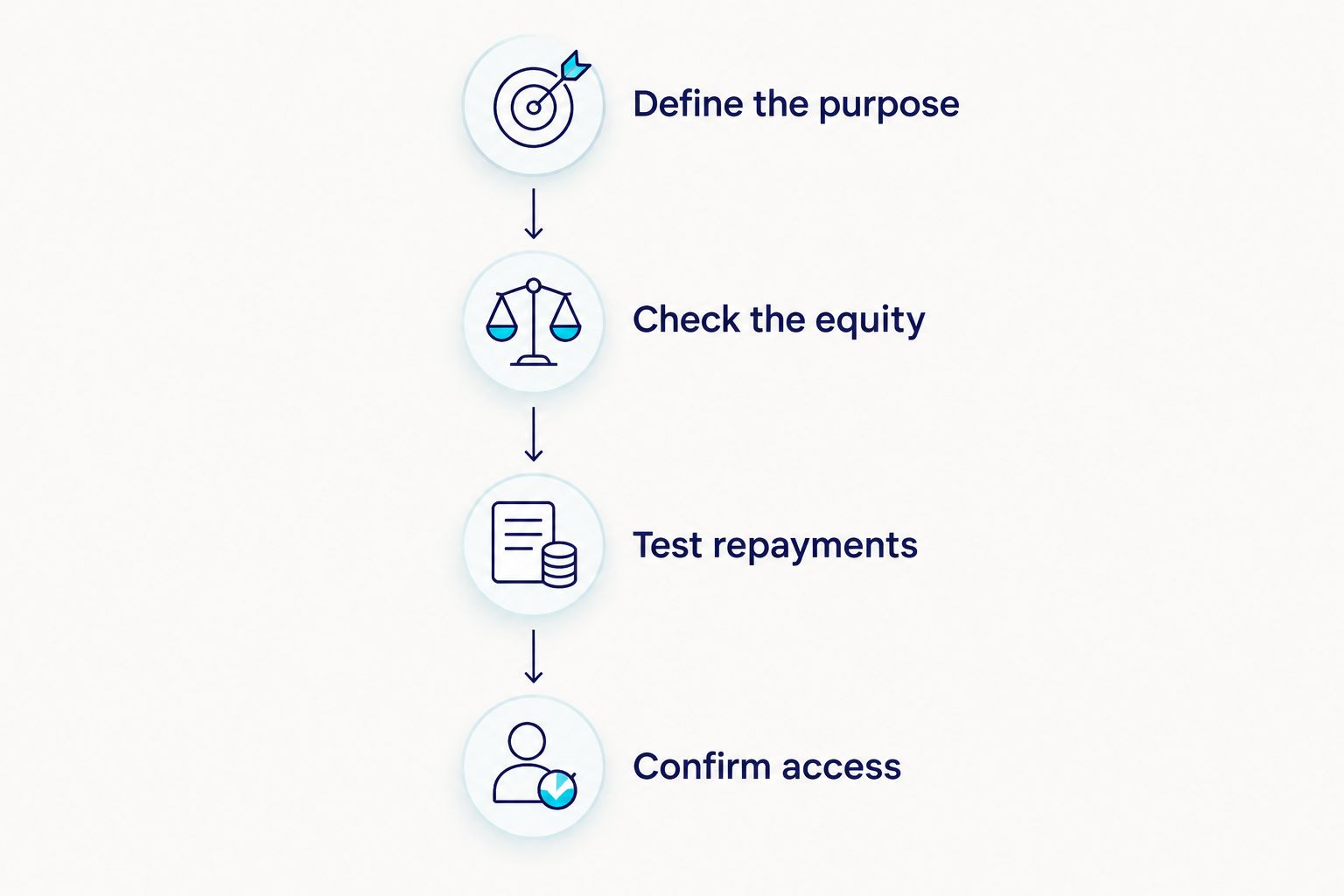
Use the same checklist for every proposal. Ask the lender or broker to explain any difference that changes how you access funds or repay the debt.
Discuss your equity borrowing options
Ask Mortgage Pros about loan structure, refinancing and approval support.
Which borrowing option should you choose?
For a defined expense, start by comparing a separate equity loan rather than defaulting to a line of credit. It gives the discussion a clear purpose and repayment focus.
For repeated expenses, assess a secured line of credit against a written borrowing and repayment plan. For accessible savings, compare offset accounts. For eligible extra repayments, examine redraw conditions. For staged building work, discuss construction finance.
The best line of credit home loan lenders in 2026 are those whose written terms fit your circumstances. Choose the structure first, then compare lenders offering it; a brand name alone cannot answer that decision.
FAQ
What’s the best line of credit home loan lender in Australia?
The best lender is the one whose approved facility matches your borrowing purpose, access needs and repayment capacity. Compare written conditions rather than choosing on brand recognition alone.
Is Mortgage Pros a line of credit lender?
Mortgage Pros is a mortgage broking firm, not a lender. It helps borrowers with home loan advice and approval support, including refinancing and equity arrangements.
Is a line of credit better than an equity loan?
A line of credit suits repeated access, while a separate equity loan suits a defined borrowing purpose. The better structure depends on how you will use the funds and reduce the debt.
Can I use an offset account instead of a line of credit?
An offset account is an alternative when you need access to your own savings, not additional borrowing. A line of credit provides borrowed funds within an approved limit; an offset account does not.
Does having equity guarantee approval?
Having equity does not guarantee loan approval. The lender also assesses income, expenses, existing commitments, the property and its lending criteria.
Is redraw the same as a line of credit?
Redraw is not the same as a line of credit. Redraw provides access to eligible extra repayments under lender rules, while a line of credit permits borrowing within an approved facility limit.
Can I use a home loan line of credit for investments?
Investment use depends on the lender’s approved purpose and facility terms. Keep borrowing purposes identifiable and obtain tax advice before mixing personal and investment expenditure.
What should I compare before applying in 2026?
Compare the borrowing purpose, security, access rules, repayment requirements, interest and fees. Also ask how the facility is reviewed and what happens if your financial circumstances change.
One last thing
The security does not determine the tax treatment of borrowed money. Borrowing against your home does not, by itself, make interest deductible; the use of the funds matters.
Before drawing for an investment, discuss the account structure and records with your tax adviser. Separating purposes at the start is clearer than trying to reconstruct mixed transactions later.
Related guides
- Compare home equity loan options
- Understand offset home loan accounts
- Review refinance home loan deals
- Compare construction loan lenders