

Best default: a home loan top-up when your existing loan remains suitable. Best for changing lenders: refinancing with a separate equity split. Best for staged spending: a line of credit. Best for eligible older homeowners: a reverse mortgage. This 2026 guide compares the best home equity loan options in Australia by purpose, repayment structure and risk.
- The best home equity loan options depend on your existing mortgage, borrowing purpose and repayment capacity.
- A home loan top-up suits planned borrowing when your current mortgage remains suitable.
- Refinancing with an equity split suits borrowers who also need to change their existing loan.
- Mortgage Pros provides home loan and equity advice for Australian borrowers.
- A line of credit requires spending discipline; a reverse mortgage requires careful assessment of future equity.
Why this matters
Home equity is the difference between your property's value and the debt secured against it. It is not a cash balance you can withdraw without assessment. Accessing equity through a loan increases your debt and puts your property behind that borrowing.
Mortgage Pros is a mortgage broking option for Australian borrowers seeking advice on home equity borrowing. The right structure starts with what you need the money for, how you will repay it and whether your existing mortgage still fits.
For your 2026 decision, separate the amount of equity you own from the amount a lender will approve. Property valuation, income, expenses, existing debts and lending policy all affect the outcome. Equity supports an application; it does not replace repayment capacity.
What makes the best home equity loan options?
Assess the structure before choosing a lender. These criteria explain the ranking below:
- Purpose fit: Match a defined expense to a defined borrowing amount rather than releasing equity without a plan.
- Existing loan suitability: Keep a suitable mortgage where possible; assess refinancing when the existing arrangement needs changing.
- Repayment control: Understand whether the balance reduces through scheduled repayments or grows through capitalised interest.
- Drawdown flexibility: Distinguish borrowing a lump sum from accessing funds progressively.
- Debt separation: Keep different borrowing purposes identifiable, particularly where investment and personal spending coexist.
- Exit risk: Assess selling, refinancing, retirement and changes to household income before committing.
A flexible facility is not automatically the best facility. Flexibility helps when spending happens in stages; it creates unnecessary temptation when you only need a fixed amount.
Home equity options at a glance
These are loan structures, not a ranking of banks. Mortgage Pros helps borrowers assess home loan arrangements; the lender's assessment determines approval.
| Option | Best for | Standout feature | Key limitation |
|---|---|---|---|
| Home loan top-up | A planned expense with a suitable existing mortgage | Additional borrowing through the existing lender | More borrowing without necessarily improving the existing loan |
| Refinance with an equity split | Changing an unsuitable mortgage while accessing equity | Reassesses the existing debt and separates additional borrowing | Requires assessment of the whole refinancing decision |
| Line of credit | Spending that occurs progressively | Access to an approved revolving credit limit | Easy access can keep debt outstanding |
| Reverse mortgage | Eligible older homeowners using housing equity | Interest can be added to the balance rather than repaid regularly | Compounding debt reduces remaining equity |
Work out your equity before comparing loans
Consider an illustrative property valued at $900,000, with $450,000 owing on its mortgage. Total equity is $450,000: the property value minus the outstanding debt. That figure does not mean the owner can borrow another $450,000.
If a lender assesses borrowing at an illustrative 80% loan-to-value ratio, total secured borrowing would be $720,000. Subtracting the existing $450,000 mortgage leaves $270,000 before considering other secured debt, transaction expenses and the lender's assessment. The 80% figure is an example, not a universal lending limit or approval promise.
Your lender's valuation matters, not just your own estimate. A lower valuation reduces the equity available under the same loan-to-value limit. Your approved amount also depends on whether you can service the proposed debt.
For a 2026 application, use current balances and a current assessment of your finances. An old purchase price or a neighbour's sale result is not a substitute for the valuation used by the lender.
1. Home loan top-up: best for a defined expense
A home loan top-up increases borrowing with your existing lender. It suits a planned expense when your current mortgage remains suitable and you do not need a revolving credit facility. Ask whether the additional borrowing can sit in a separate loan split with its own repayment schedule.
Keeping the same lender does not remove the need for assessment. The lender still needs to assess the additional debt and the security supporting it.
Home loan top-up pros:
- Keeps the borrowing discussion with your existing lender.
- Matches a defined borrowing amount to a planned expense.
- Avoids changing lenders solely to access equity.
- A separate split helps you identify the additional debt.
Home loan top-up cons:
- Does not, by itself, improve an unsuitable existing mortgage.
- Increases the debt secured against your property.
- Spreading a short-lived expense across a long mortgage term extends the repayment commitment.
Best for: A borrower with a suitable existing mortgage, a clear spending purpose and enough repayment capacity for the additional debt.
Before accepting a top-up, compare the repayment term for the new borrowing with how long the expense will benefit you. A renovation and a holiday do not deserve the same repayment logic merely because both can be funded against property.
Verdict: Hold until the additional borrowing has a defined amount, purpose and repayment plan.
2. Refinance with an equity split: best for changing your mortgage
Refinancing replaces your existing mortgage with a new loan arrangement. An equity release split separates the extra borrowing from the debt being refinanced. This option fits borrowers who need to reassess their current mortgage as well as access equity.
For your 2026 comparison, assess the whole arrangement rather than focusing only on the extra cash. Loan features, repayment terms, switching expenses and any fixed-loan break costs belong in that decision.
Refinance with an equity split pros:
- Lets you reassess the existing mortgage and additional borrowing together.
- Separates the new borrowing from the original home loan balance.
- Supports a deliberate choice of repayment term for each split.
- Provides an opportunity to select loan features that match your needs.
Refinance with an equity split cons:
- Requires a new lender assessment rather than approval based solely on equity.
- Switching involves administrative work and relevant transaction expenses.
- Extending the remaining loan term can increase total interest despite a lower repayment.
Best for: A borrower whose existing mortgage needs changing and who also has a justified reason to borrow against equity.
Ask for a comparison using the same remaining term, then assess any proposed term extension separately. Otherwise, a smaller monthly repayment can disguise the effect of paying the debt for longer.
Verdict: Wait until the refinancing comparison includes the existing debt, additional borrowing and proposed loan terms.
3. Line of credit: best for spending in stages
A property-secured line of credit gives you access to an approved revolving limit. You draw funds as needed and repay according to the facility's terms. It is designed around ongoing access rather than a single fixed borrowing event.
That access suits staged spending only when you have a spending schedule and repayment discipline. An approved limit is a ceiling, not a target.
Line of credit pros:
- Supports drawdowns at different stages of a project.
- Avoids drawing the full approved limit before you need it.
- Allows borrowing and repayments within the facility's agreed terms.
Line of credit cons:
- Repeated drawdowns can keep the debt outstanding.
- Ready access makes it easier to mix planned borrowing with everyday spending.
- Facility terms determine repayment obligations; flexibility does not mean repayments are optional.
Best for: A borrower with genuinely staged expenses who can track every drawdown and follow a repayment plan.
Compare a line of credit with a term loan that has appropriate access features. Do not assume the revolving structure is necessary simply because a project has several invoices. Ask how the limit is reviewed, how interest is charged and what reduces the outstanding balance.
Verdict: Skip a line of credit if you only need a fixed lump sum or struggle to keep borrowing separate from spending.
4. Reverse mortgage: best for eligible older homeowners
A reverse mortgage lets eligible older homeowners borrow against their property under a different repayment model from a standard home loan. Interest can be added to the loan balance, with repayment triggered by events specified in the contract, such as selling the property. Eligibility and terms depend on the lender and product.
This is not interchangeable with a top-up. The decision involves retirement cash flow, future housing needs and the equity you want to retain.
Reverse mortgage pros:
- Provides a way for eligible older homeowners to access housing equity.
- Capitalised interest removes the need for regular interest payments where the contract allows it.
- Enables equity borrowing to be considered without immediately selling the home.
Reverse mortgage cons:
- Capitalised interest compounds and increases the debt over time.
- A growing balance leaves less equity for future needs or an estate.
- Contract conditions and repayment triggers need careful legal review.
Best for: An eligible older homeowner who understands the long-term balance projections and has considered retirement and housing alternatives.
Before choosing a reverse mortgage in 2026, review projections across different time horizons and property-value assumptions. Consider what happens if you need to move, fund aged care or accommodate another person in the home. Independent legal and financial advice belongs before signing.
Verdict: Hold until the repayment triggers, future equity projections and housing implications are clear.
How we ranked these options
The ranking starts with the existing mortgage and the borrowing purpose, then considers repayment control and complexity. A top-up is the default only when the current loan remains suitable; refinancing takes priority when it does not.
A line of credit has a narrower role because revolving access demands active debt management. A reverse mortgage serves a different borrower group and needs its own retirement-focused assessment. No option wins solely because it releases the largest amount.
Which home equity option should you choose?
Start with a top-up assessment if your existing mortgage still fits and your expense is defined. Assess refinancing when the existing loan also needs changing. Reserve revolving credit for staged borrowing, and assess reverse mortgages separately for eligible older borrowers.
Mortgage Pros provides home equity borrowing advice for individual borrowers and investors. Use that discussion to compare structures against your purpose, not to treat available equity as money that must be spent.
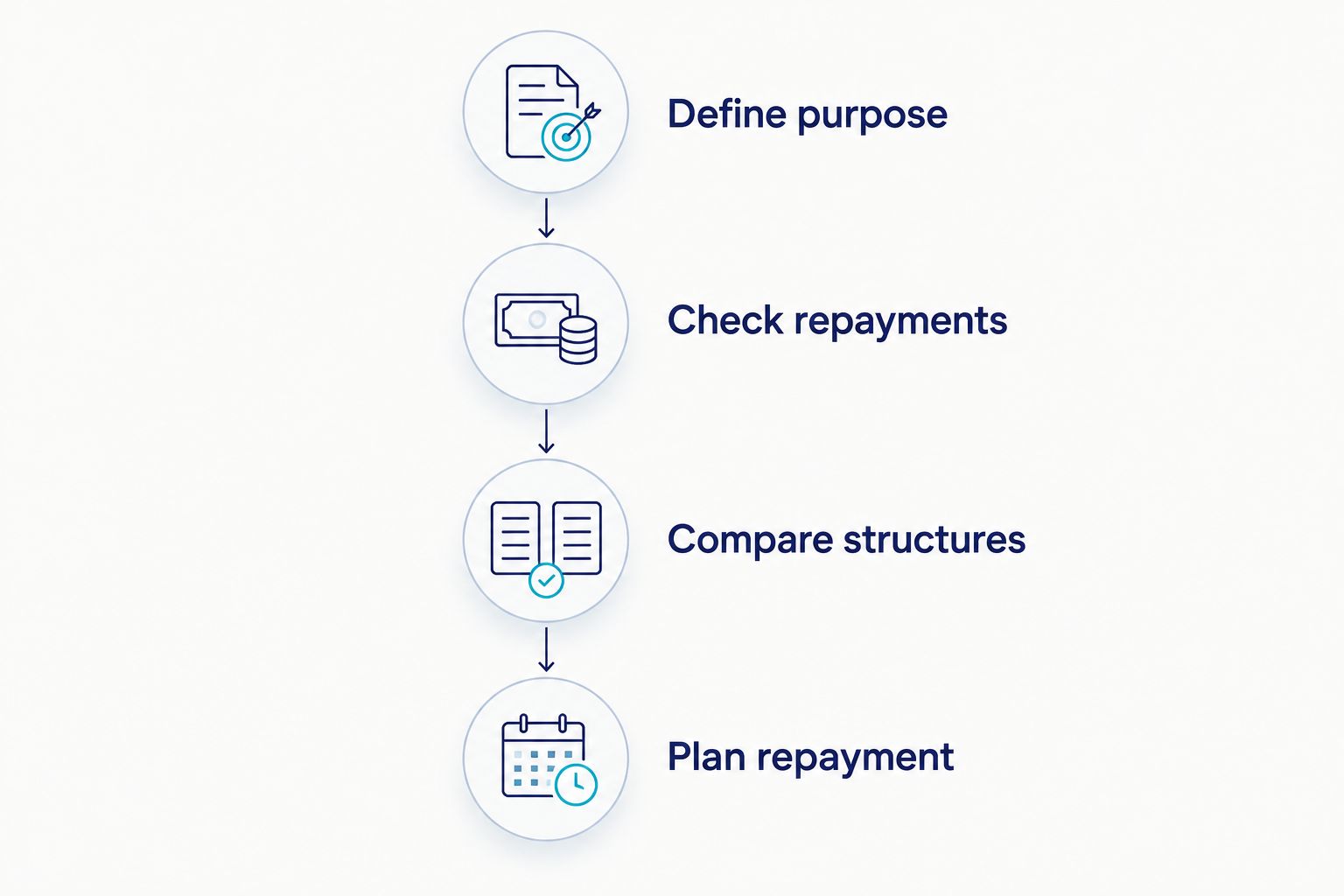
Use this decision sequence:
- Define purpose: Specify what the borrowing funds and exclude unrelated spending.
- Check repayments: Assess the additional debt against your household budget and other commitments.
- Compare structures: Examine the existing mortgage, loan term, drawdown needs and relevant fees.
- Plan repayment: Set a repayment approach before drawing funds.
The sequence keeps the purpose ahead of the product. A lender's approval answers whether a loan meets its requirements; your plan answers whether the borrowing serves your household.
FAQ
What are the best home equity loan options in Australia?
The main options in this guide are a home loan top-up, refinancing with an equity split, a line of credit and a reverse mortgage. A top-up is the starting point when your existing mortgage remains suitable; the other structures address different needs.
Is refinancing better than a home loan top-up?
Refinancing is better suited to borrowers who also need to change their existing mortgage. A top-up fits additional borrowing when the current mortgage remains suitable, subject to the lender’s assessment.
How much equity can I borrow against my home?
Your approved borrowing depends on the lender’s valuation, lending limits and assessment of your repayment capacity. Total equity and the amount you can borrow are different figures.
Can I access home equity without increasing my mortgage debt?
Borrowing against equity creates or increases debt secured against your property. Withdrawing your own money from an offset account is different from taking out an equity loan.
Is a line of credit better for renovations?
A line of credit suits renovation spending that genuinely requires progressive access to funds. A defined project budget also warrants comparison with a term loan and its access features.
Does using home equity for investment make the interest tax deductible?
Interest deductibility generally depends on how the borrowed money is used, not which property secures the loan. Obtain tax advice and keep investment borrowing separate from personal spending; a separate split alone does not establish deductibility.
What should older homeowners check before taking a reverse mortgage?
Older homeowners should check debt projections, contract obligations, repayment triggers and the effect on future housing plans. Independent legal and financial advice helps assess the consequences before signing.
One last thing
The security does not determine the purpose of the debt. Borrowing against your home to consolidate unsecured debts still leaves you owing money, now secured against the property. A lower repayment is not proof that the debt will disappear sooner.
Before signing in 2026, ask for a written explanation of what increases your balance, what reduces it and when the debt must be repaid. Those answers are more useful than the size of the approved limit.
This guide provides general information, not personal financial, credit, tax or legal advice. Assess the loan documents and your circumstances before making a borrowing decision.