
Choose Mortgage Pros if you want mortgage broking guidance and lender comparison, particularly for a medical career; choose CommBank if you have selected that bank and want to arrange your home loan directly. This 2026 comparison explains the difference between choosing an adviser and choosing a lender.
- Mortgage Pros vs CommBank is a mortgage broker versus direct lender decision, not a comparison of two banks.
- Mortgage Pros is best for borrowers seeking home loan guidance, particularly doctors, dentists and surgeons.
- CommBank is best for borrowers who have selected its home loan and prefer dealing directly with the bank.
- Compare written loan terms, borrowing requirements and total costs before choosing either route.
Why this matters
A mortgage broker and a bank occupy different positions in your home loan application. Mortgage Pros provides mortgage broking services; CommBank provides lending and banking services. The lender assesses and decides whether to approve the loan, regardless of how you apply.
Choose the advice route before choosing the loan. If you are still deciding which lender suits your circumstances, a direct bank conversation answers a narrower question than a broker conversation. If you have already assessed alternatives and selected CommBank, direct contact keeps the application discussion with that bank.
Neither route makes an unsuitable loan suitable. Your income, existing commitments, deposit, property and proposed loan structure still need to satisfy the lender's requirements.
At a glance
Use this table to separate service differences from loan differences. In 2026, the useful comparison is who helps you choose, who assesses your application and who manages the resulting loan.
| Dimension | Mortgage Pros | CommBank |
|---|---|---|
| Best for | Borrowers seeking broker guidance before selecting a lender | Borrowers who have selected CommBank and prefer direct banking |
| Comparison scope | Broker-led consideration of available lender options | Discussion of CommBank's own lending options |
| Standout feature | Home loan specialisation for doctors, dentists and surgeons | Direct relationship with the bank providing the loan |
| Existing banking relationship | Separate mortgage broking relationship | Direct route for customers wanting their existing bank |
| Application control | Helps borrowers prepare and manage the application | Assesses applications for its own loans |
| Loan features | Helps assess features against your circumstances | Explains features of its own loan options |
| Pricing model | Broker remuneration and lender loan costs need separate review | Direct lender loan costs need review |
| Approval certainty | Advice and support do not guarantee approval | Direct application does not guarantee approval |
Mortgage Pros is better for choosing between lenders
Mortgage Pros is best for borrowers who need home loan guidance before choosing a lender. A broker conversation starts with your circumstances and considers lending options available through the broker. That is a different task from asking one bank which of its loans fits.
The advantage matters when you need to understand how income, debts, a guarantor or an equity release affects your options. Ask the broker to explain the recommendation, the alternatives considered and the reasons an option was excluded.
The limitation is equally important: a broker comparison is not automatically a comparison of every loan in Australia. Ask which lenders are considered and whether any relevant options sit outside that scope. Do not assume that CommBank is available through a particular broker without confirming it.
CommBank's direct route is narrower by design. It suits you when the remaining question is which CommBank loan to choose, rather than which lender to approach.
Mortgage Pros offers an explicit medical-borrower focus
The mortgage broking firm's stated specialisation is home loans for doctors, dentists and surgeons. That makes it a relevant starting point when you want advice framed around a medical career rather than a general banking enquiry.
For your 2026 enquiry, explain your employment arrangement before discussing a borrowing figure. Salary, contract work, practice ownership and other income sources require different supporting information; ask how the proposed lender will assess your actual circumstances.
The guide to home loan lenders for doctors is a useful next step if that is your main comparison question. Use it to prepare questions, not as a substitute for an individual assessment.
Specialist guidance is not an approval promise. A medical qualification does not remove the need to assess repayments, existing liabilities and the property. Equally, this comparison does not establish that a direct CommBank application is unsuitable for a medical professional.
CommBank wins when you have already chosen the bank
CommBank is the better route for a borrower who has assessed the alternatives, selected a CommBank home loan and wants to deal directly with the lender. You discuss the bank's requirements with the organisation that will assess the application.
That is a genuine advantage if you do not need another adviser to help select a lender. It also keeps the conversation focused on the bank's own products, documents and loan administration.
The trade-off is the same narrow scope that makes the route straightforward. A CommBank discussion is not a lender-market comparison. If you want to know whether another lender treats your circumstances differently, you need a separate comparison.
Do not confuse a familiar bank with a completed assessment. An existing banking relationship does not establish that its home loan is the best fit, or that your application will be approved.
CommBank is the direct route for an existing banking preference
If keeping your home loan relationship with CommBank is an explicit priority, approaching CommBank directly fits that preference. You avoid adding a separate broker relationship simply to reach a decision you have already made.
Before treating that convenience as decisive, identify what you actually value. Is it dealing directly with the lender, understanding the bank's processes or managing banking relationships together? Those are service preferences, not proof of a better loan outcome.
A broker relationship has a different purpose: helping you assess the lending decision and supporting the application. It does not replace the lender's role in administering the loan.
Choose direct banking for a deliberate preference, not an untested assumption. Ask the bank to explain the proposed loan in writing, then assess it against your repayment plans and likely changes in circumstances.
Neither route has a universal application-speed advantage
A broker supports the application; the lender makes the credit decision. Going directly to CommBank removes a separate broker relationship, but that alone does not establish a faster approval time.
Likewise, broker assistance does not establish that an application will move faster. Documents, the property, lender assessment and requests for further information all affect the process.
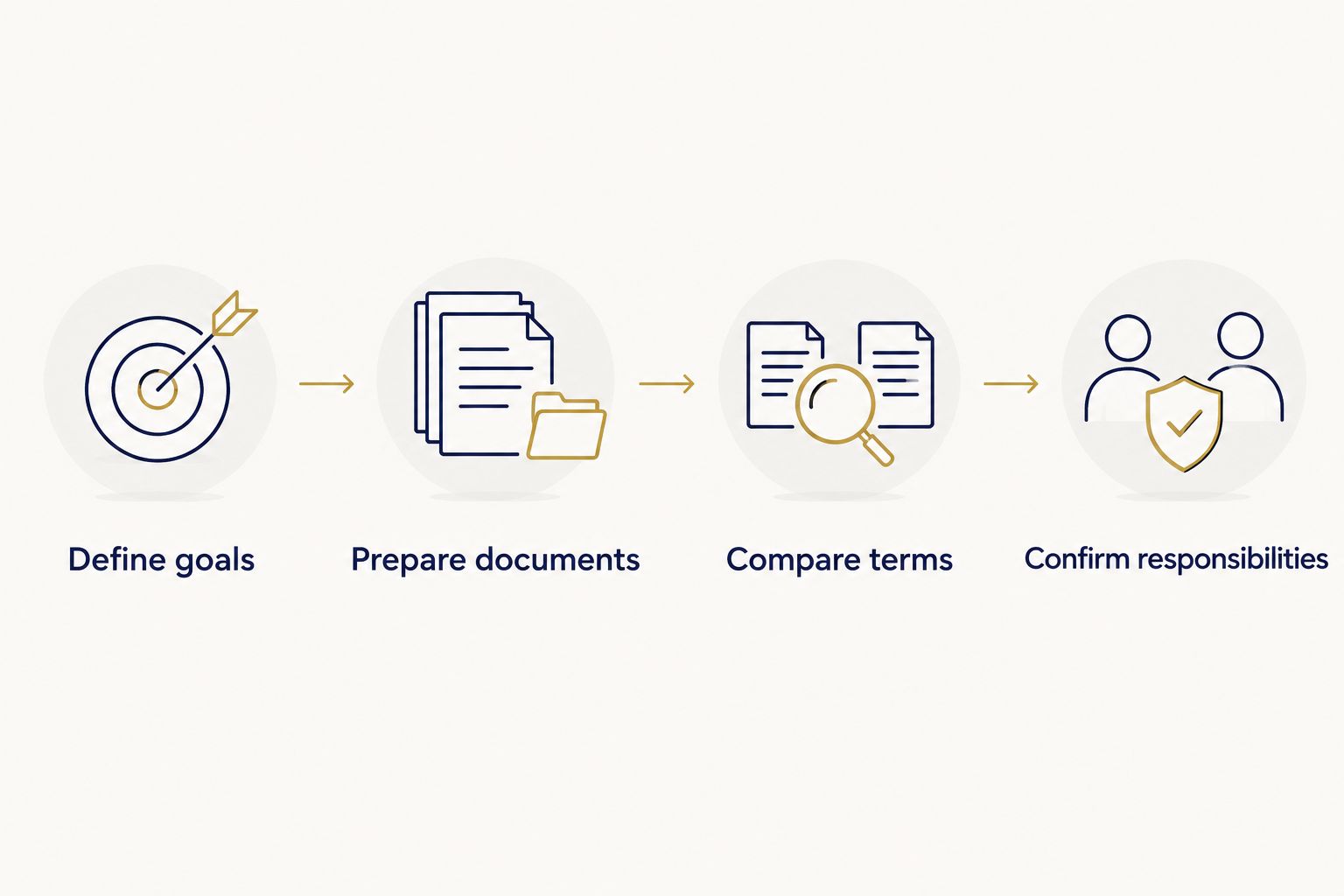
Prepare your enquiry in this order:
- Define goals: explain whether you are buying, refinancing, investing or accessing equity.
- Prepare documents: ask what evidence is required for your income and financial position.
- Compare terms: review the proposed structure, conditions and costs in writing.
- Confirm responsibilities: establish who submits documents, answers questions and communicates decisions.
If a property purchase has a deadline, disclose it immediately. Ask which parts of the assessment remain outstanding and avoid treating an initial borrowing discussion as unconditional approval.
Loan features are a tie until you compare actual offers
Neither a broker relationship nor a direct bank relationship is a loan feature. Offset arrangements, repayment flexibility, redraw access and fixed or variable structures belong to the particular loan you select.
A broker can help you assess features across the options considered. CommBank can explain the features and conditions of its own proposed loan. You still need to determine whether those features suit how you manage money.
For example, if you expect to keep savings available, ask how the proposed loan treats those funds. If you expect to make extra repayments, ask about restrictions. If you expect to sell or refinance, ask what costs or conditions become relevant.
Compare matching scenarios, not feature lists. Use the same loan amount, repayment basis and intended structure when assessing alternatives. Otherwise, a difference in the quote can reflect a difference in your instructions rather than a better offer.
Pricing: separate the advice arrangement from the loan
For a 2026 comparison, request written information about both the service arrangement and the proposed loan. The broker route and the direct bank route involve different relationships; neither label tells you the final cost.
The broker route needs remuneration explained
Ask how the broker is paid, whether any borrower-paid charges apply and which disclosures explain the arrangement. Review the proposed lender's costs separately rather than treating the advice relationship as the whole transaction.
Also ask what support continues after settlement. Clear responsibilities help you assess the service without assuming that every future loan question is included.
The direct bank route needs the full loan terms
Ask CommBank to explain the proposed loan's interest structure, applicable charges and conditions. Going directly does not, by itself, prove that a loan is cheaper than one arranged through a broker.
For either route, compare projected costs over 1 year, 3 years and 5 years, using consistent assumptions. These are comparison periods, not predictions: variable rates and your circumstances can change.
Predictability versus flexibility comes from the loan structure, not the application channel. Ask what happens if you repay early, change repayment patterns, refinance or need access to funds. A loan that looks suitable at settlement still needs to fit your likely next steps.
Final verdict: choose advice or direct banking deliberately
Choose Mortgage Pros if you need help selecting a lender
Best for: a doctor, dentist, surgeon or other borrower seeking guided lender selection. Choose the broker route when you want your circumstances assessed before committing to a bank, or need support with refinancing, equity or a guarantor arrangement.
Its strongest fit is the borrower whose main question remains, “Which lending option suits my situation?” The limitation is that you must still understand the comparison's scope and review the recommended loan yourself.
Choose CommBank if you want a direct lender relationship
Best for: a borrower who has selected CommBank after comparing alternatives. Choose the direct route when your priority is discussing that bank's loan and application requirements without a separate broker relationship.
Its strongest fit is the borrower whose lender decision is already made. The limitation is that the direct conversation does not answer whether another lender is better suited.
For your 2026 decision, select the route that answers your unresolved question. Then judge the written loan offer on its own terms.
| Dimension | Winner |
|---|---|
| Help choosing between lenders | Mortgage Pros |
| Explicit medical-borrower specialisation | Mortgage Pros |
| Direct lender relationship | CommBank |
| Preference for existing CommBank banking | CommBank |
| Application speed or approval certainty | Neither has an established advantage |
| Loan features | Tie until actual offers are compared |
| Total cost | Compare written offers; no universal winner |
Discuss your home loan today
Explain your borrowing goals and ask which lending options fit your circumstances.
FAQ
Is Mortgage Pros better than CommBank for a home loan?
Mortgage Pros is the better fit when you want broker guidance before choosing a lender; CommBank is the better fit when you have selected its loan and want direct banking. Compare the actual loan terms separately from the service relationship.
Is CommBank a mortgage broker?
No. CommBank is a bank and home loan lender. A direct enquiry concerns its own lending options rather than a broker-led comparison of available lenders.
Which option is better for a doctor buying a home?
The broker route is a relevant starting point because the firm’s stated specialisation includes doctors, dentists and surgeons. Ask how the proposed lender will assess your employment and income; specialisation does not guarantee approval.
Will I get approved faster by applying directly to CommBank?
A direct application does not establish a faster approval time. Assessment depends on the application, supporting documents, property and lender requirements, so ask about your specific deadline.
Does using a broker guarantee a cheaper home loan?
No. Compare written loan terms and ask how the broker is remunerated. The application channel alone does not establish the total cost of borrowing.
Can a mortgage broker help with refinancing or a guarantor arrangement?
Yes, the firm’s stated mortgage broking services include refinancing, equity and guarantor arrangements. Ask what assessment and supporting documents your particular arrangement requires.
What should I ask before choosing a broker or bank?
Ask which options will be considered, who assesses the application, what costs apply and who handles follow-up questions. Request the proposed loan structure and conditions in writing before deciding.
One last thing
The most useful question is not “Who will lend me the most?” Ask, “What would make this loan unsuitable for my next move?” A planned sale, change in employment, practice purchase or investment decision can change which conditions matter.
Contact us today with your goal, current commitments and likely next change. Start with the decision you need help making, not just a borrowing figure.
Related guides