
Yes, you can apply to top up your home loan for renovations if your lender accepts the work, you have enough usable equity and you can afford the larger loan. Approval is not automatic: the additional borrowing increases your debt, and spreading renovation repayments over your remaining mortgage term increases the interest you pay.
- Can I top up my home loan for renovations? Yes, subject to equity, affordability and lender approval.
- Usable equity is not the same as your property’s value minus your mortgage balance.
- Compare a home loan top-up with refinancing, redraw and construction finance before committing.
- Mortgage Pros provides home loan advice for borrowers assessing renovation borrowing.
Can I top up my home loan for renovations?
You can request additional borrowing against your home, but your lender must approve both the lending amount and the renovation purpose. Having paid down your mortgage helps; it does not replace an affordability assessment.
Start with your current loan balance, the proposed renovation scope and a realistic funding request. The guide to how much equity you can release from your home explains the distinction between equity you own and equity a lender will let you borrow against.
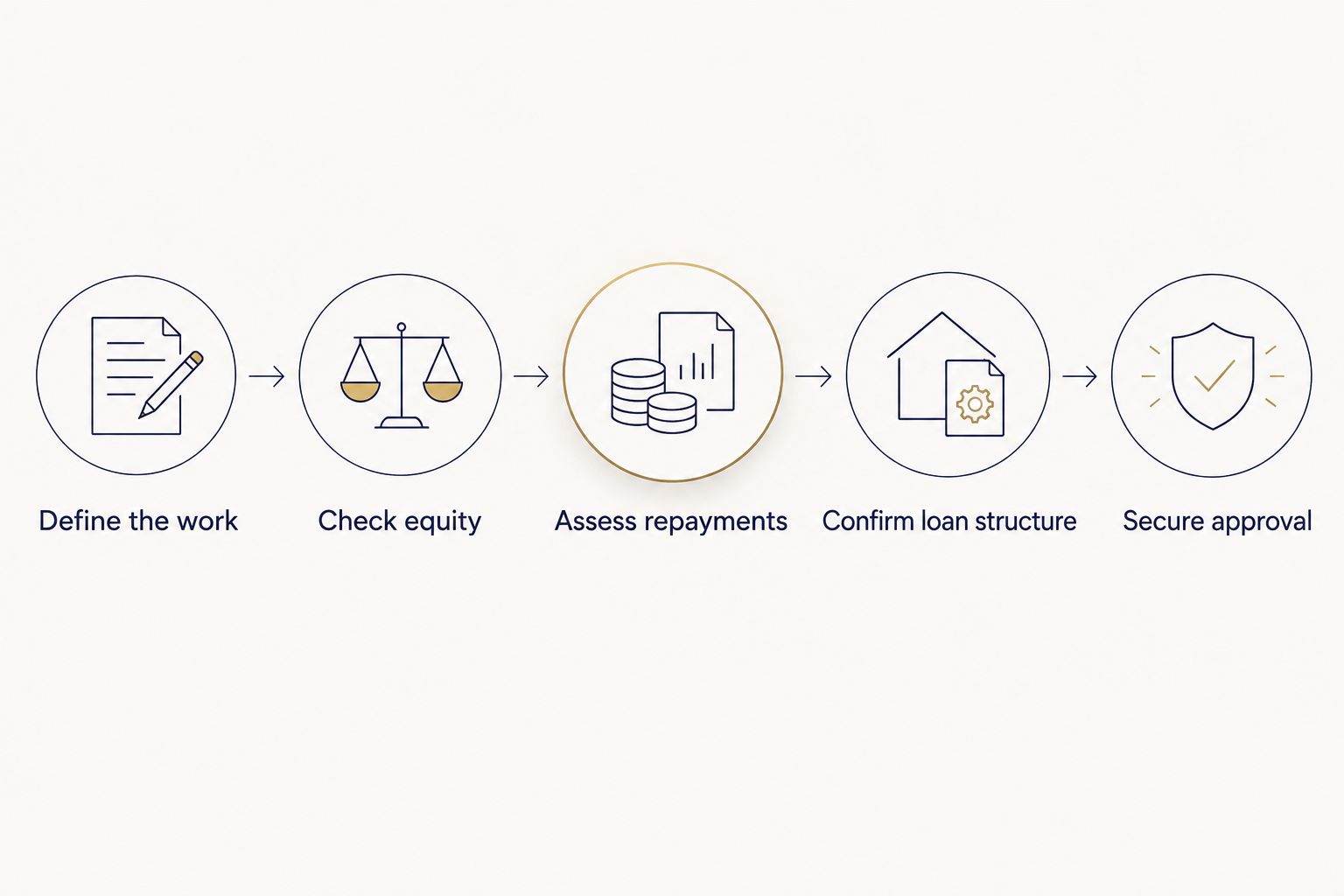
The application generally follows this sequence:
- Define the work. Separate essential repairs from optional improvements and obtain written quotes.
- Check equity. Ask what property value and maximum lending limit the lender will use.
- Assess repayments. Provide current income, expenses and debt details for the larger loan assessment.
- Confirm loan structure. Check the term, repayment arrangement and conditions for releasing funds.
- Secure approval. Obtain formal approval and confirm access to the money before making commitments that depend on finance.
A top-up is additional lending, not permission to withdraw any increase in your property's value. Your lender's assessment determines the amount available.
Why this matters
A renovation improves your home, but the borrowing remains secured against it. If you cannot meet the repayments, your home is at risk.
For a renovation planned in 2026, the decision is not simply whether your lender will lend more. You also need a repayment plan that leaves room for household expenses, changes in income and unexpected building work.
Borrowing approval is a limit, not a spending target. Base your application on the work you need and repayments you can sustain, rather than the largest amount available.
How much renovation funding can you access?
Your total equity is your property's value minus the debt secured against it. Usable equity is the amount your lender allows you to access after applying its lending limits and other requirements.
These are different calculations. A property valuation above your loan balance does not mean the entire difference is available for renovations.
Your lender considers:
- The property value it accepts for lending purposes.
- Your existing mortgage and any other lending secured against the property.
- Its permitted loan-to-value ratio for your circumstances.
- The amount your income and expenses support.
- Whether the proposed works require a different lending arrangement.
Ask whether the assessment uses the property's current condition or an expected completed value. Do not assume an unbuilt extension will count towards the security value for an ordinary top-up.
For your 2026 application, use a current loan statement and updated renovation quotes. An older estimate of your home's value is not a lending decision.
Which renovation funding option fits your project?
A home loan top-up is one route, not the default answer for every project. Compare how each option releases money, changes your mortgage and affects repayment discipline.
| Option | Best for | Main benefit | Main limitation |
|---|---|---|---|
| Home loan top-up | Borrowers seeking extra funds through their existing lender | Keeps the funding request with the current lender | Requires approval and increases secured debt |
| Refinancing with extra borrowing | Borrowers reviewing the whole mortgage as well as renovation funding | Allows the existing loan and additional borrowing to be assessed together | Requires a new application and a review of switching conditions |
| Available redraw | Borrowers with accessible extra repayments already made | Uses funds available under the existing loan's redraw terms | Access is subject to loan rules and increases the outstanding balance when withdrawn |
| Construction lending | Projects involving building stages and lender-controlled payments | Can align funding releases with approved construction stages | Requires project documentation and compliance with release conditions |
Home loan top-up: keep the focus on the extra debt
A top-up suits a discussion with your existing lender when the proposed renovation fits its lending rules. It avoids assuming that changing lenders is necessary just because you need additional funds.
The drawback is that keeping the same lender does not prove the overall loan remains suitable. Review the revised repayments, term and conditions, including whether the additional borrowing can sit in a separate split.
Refinancing: assess the whole mortgage
Refinancing combines a review of your existing mortgage with a request for renovation funding. It is relevant when you want to compare lenders or change your loan structure.
Do not judge refinancing by the new repayment alone. A longer term can reduce the scheduled repayment while extending how long you carry the debt; compare the total repayment obligation and switching conditions.
Redraw: check access before relying on it
Redraw is different from applying for a top-up because it relates to extra repayments already made on an eligible loan. Your available balance and access conditions depend on your loan contract.
Using redraw increases the outstanding loan balance compared with leaving the extra repayments untouched. If the property is rented or might become an investment, obtain tax advice before withdrawing money for private renovations.
Construction lending: match the funding to the build
Structural work, extensions and substantial building projects need an early conversation about construction lending. The lender determines whether an ordinary top-up is acceptable or whether staged funding is required.
Construction finance introduces additional documentation and payment controls. Confirm how deposits, progress claims and variations will be handled before signing a building contract that depends on borrowed funds.
Why renovation top-up approval varies
The same renovation budget does not produce the same lending outcome for every borrower. These factors shape the assessment:
- Usable equity: The lender's accepted valuation and lending limit determine the security available for additional borrowing.
- Income evidence: Salary, business income and variable earnings require evidence that meets the lender's assessment rules.
- Existing commitments: Other loans, credit facilities and household expenses affect your capacity to repay.
- Renovation scope: Cosmetic improvements and structural building work present different documentation and funding questions.
- Current loan conditions: Fixed-rate arrangements, existing splits and repayment terms affect how additional lending can be structured.
- Property and loan purpose: Your intended use of the property matters when discussing loan features, records and tax advice.
For a 2026 assessment, disclose changes in employment, dependants and debts rather than relying on the circumstances recorded in your original application. The lender needs to assess your position now.
What should you prepare before applying?
Prepare a clear explanation of what you want to build, how you intend to pay for it and what repayments your household can manage. Supporting documents should tell the same story as your application.
Have these ready for the initial discussion:
- Your current home loan balance and loan structure.
- Recent income evidence appropriate to your employment or business arrangements.
- Details of regular expenses and other financial commitments.
- Written renovation quotes with a clear scope and exclusions.
- Building plans, approvals or contracts where relevant to the proposed work.
- An explanation of how you will fund variations or work outside the approved scope.
Check whether quotes include the work needed to complete the project, not just the visible renovation. Ask the builder to identify exclusions before deciding how much to borrow.
Avoid treating conditional approval as confirmation that funds are ready. Ask which conditions remain outstanding and how the money becomes accessible.
Can doctors use variable income for a renovation top-up?
Doctors can ask a lender to assess their income for additional borrowing, but professional status does not replace the affordability assessment. Overtime, on-call payments, locum earnings and private-practice income need documentation appropriate to the income source.
If your earnings combine hospital employment and private work, identify each source separately. Avoid assuming the lender will accept every payment shown in your bank account as ongoing income.
Mortgage Pros is best suited to doctors seeking specialist home loan advice. Its mortgage broking service is relevant when you need help assessing how additional borrowing fits your existing loan; the lender still controls approval and the funding conditions.
For a 2026 renovation application, explain upcoming employment changes alongside current earnings. A proposed contract and an established income history answer different assessment questions.
How do you avoid paying renovation debt for too long?
Match the repayment plan to the renovation borrowing, not just the remaining mortgage term. Ask for a comparison showing the effect of repaying the additional amount sooner rather than carrying it for the full loan term.
A separate loan split can help you track the renovation debt, subject to the lender's available structure. It does not reduce interest by itself; the repayment amount and time taken to clear the balance matter.
Before accepting the loan, ask:
- What will the required repayments be after the top-up?
- Will the existing mortgage term change?
- Can the renovation borrowing be tracked separately?
- What restrictions apply to additional repayments?
- What happens if the renovation scope changes after approval?
Keep a written record of the answers. A manageable repayment needs to remain manageable after you include ordinary household spending, not just on the application worksheet.
FAQ
Can I top up my home loan for renovations in 2026?
Yes, you can apply to top up your home loan for renovations in 2026, subject to lender approval, usable equity and affordability. The lender also needs to accept the renovation purpose and funding arrangement.
Do I need equity to increase my mortgage for renovations?
You need sufficient security within the lender’s permitted lending limits to increase your mortgage for renovations. Total equity is not the same as usable equity, and your income must also support the larger loan.
Is a home loan top-up better than refinancing for renovations?
Neither option is automatically better: a top-up uses your current lender, while refinancing reviews the whole mortgage with a new lending application. Compare the term, repayment obligation, loan conditions and suitability for the proposed work.
Can I use redraw instead of applying for a renovation loan?
You can use available redraw for renovations if your loan terms permit access. Withdrawing extra repayments increases your outstanding loan balance, and private use of redraw can have tax implications for an investment loan.
Will a renovation top-up increase my repayments?
Additional borrowing increases your debt and can increase your required repayments. Ask for a written repayment comparison because the outcome also depends on the loan term and structure.
Can I fund an extension with a home loan top-up?
An extension needs lender approval, and the lender determines whether a top-up or construction lending arrangement is appropriate. Confirm documentation and payment-release requirements before making commitments that depend on finance.
Can Mortgage Pros help me assess renovation borrowing?
Mortgage Pros provides mortgage broking advice for home owners, including refinancing and equity arrangements. Ask for an assessment of your existing loan, additional borrowing needs and repayment structure; approval remains the lender’s decision.
One last thing
A renovation quote and a loan approval solve different problems. The quote describes the work; the approval sets the borrowing conditions, and neither guarantees that every project variation is funded.
For renovations starting in 2026, settle the funding structure before committing to work that relies on borrowed money. Contact Mortgage Pros today through the contact us page to discuss your existing mortgage, renovation scope and repayment plan.
Related guides
- Is refinancing worth it?
- How much deposit do I need for a construction loan?
- Can doctors use overtime and on-call pay for a home loan?