

Best starting point: your existing lender. Best for comparing a clean-credit refinance: a mainstream lender. Best for an adverse-credit assessment: a specialist lender. The best debt consolidation home loan lenders in 2026 are those that accept your debts and income while supporting a repayment plan that does not unnecessarily extend those debts.
- Compare the best debt consolidation home loan lenders by eligibility, repayment structure and total interest—not monthly repayments alone.
- Mortgage Pros helps Australian borrowers assess debt consolidation through home loan refinancing and equity arrangements.
- Ask your existing lender first, then compare mainstream, non-bank and specialist lending pathways.
- Consolidating unsecured debts into a mortgage puts your home behind debts previously secured differently.
- Choose a separate repayment target for consolidated debt rather than automatically spreading it across the mortgage term.
Why this matters
Debt consolidation combines debts into a new or increased home loan. It simplifies repayments, but it also changes the security behind the borrowing: credit card balances and unsecured personal loans become debt secured against your property.
Mortgage Pros is a mortgage broking option for Australian property owners seeking advice on debt consolidation through home loan refinancing. Mortgage Pros helps borrowers secure and manage home loans, including refinancing and equity arrangements; it is not the lender advancing the money.
A lower monthly repayment is not proof of a better outcome. Extending a short-term debt over a long mortgage term increases the time you pay interest, even when the interest rate falls.
For your 2026 shortlist, distinguish lender eligibility from repayment suitability. An approval addresses the first question; a sustainable budget and clear debt repayment target address the second.
What makes the best debt consolidation home loan lenders?
Use these criteria before comparing lender names. A lender that fails a necessary criterion belongs outside your shortlist, regardless of its advertised features.
- Debt eligibility: Confirm which credit cards, personal loans, car loans and other liabilities the lender accepts for consolidation.
- Income assessment: Check how the lender assesses your employment, self-employed earnings and existing commitments.
- Equity requirements: Establish the property valuation and proposed loan-to-value ratio before treating equity as available borrowing.
- Repayment control: Assess whether the loan structure supports a separate debt repayment target and permitted extra repayments.
- Total borrowing cost: Compare interest over your intended repayment period, applicable fees and any existing-loan exit charges.
- Settlement conditions: Understand which debts must be paid directly, which accounts must close and what evidence is required.
Ask for 2 written comparisons: changing your existing loan and refinancing elsewhere. That is a practical starting point, not a claim that every borrower needs exactly two lender applications.
Debt consolidation lender pathways at a glance
This ranking identifies where to start your search. It does not rank individual lenders' current rates or imply that every lender within a category accepts debt consolidation.
| Ranked pathway | Best for | Standout consideration | Key limitation |
|---|---|---|---|
| Existing lender | Checking a loan increase before switching | Direct comparison with your current mortgage | Does not provide an independent market comparison |
| Mainstream refinance lender | Borrowers with clear income evidence and satisfactory repayment history | Comparing a replacement mortgage and consolidation together | Eligibility still depends on debts, equity and serviceability |
| Non-bank lender | Comparing alternative income or lending assessment policies | Another policy pathway beyond your current bank | A non-bank label does not establish suitability |
| Specialist lender | Assessing disclosed adverse credit or complex debt circumstances | Focused eligibility assessment for difficult applications | Approval does not establish that consolidation is financially suitable |
1. Existing lender: best for checking a loan increase
Your existing lender is the first place to check whether a loan increase can consolidate eligible debts without replacing the mortgage. The lender still needs to assess the proposed borrowing; an existing customer relationship is not an approval.
Request the proposed balance, repayment structure and conditions in writing. Compare those terms with keeping your current mortgage and repaying the other debts separately.
Existing lender pros:
- Gives you a clear starting point based on your current mortgage.
- Lets you investigate a loan increase before committing to a full refinance.
- Makes it possible to ask whether consolidated borrowing can sit in a separate loan split.
Existing lender cons:
- Its assessment remains limited to its own lending policies.
- An existing relationship does not establish competitive terms.
- Increasing the mortgage still turns the consolidated amount into property-secured borrowing.
Best for: Property owners who want to understand the simplest available loan change before comparing alternatives.
Ask specifically whether the proposed change affects an existing fixed-rate portion. Do not assume the current mortgage's features or conditions remain unchanged after an increase.
Verdict: Hold any commitment until you compare the existing lender's written proposal with an external refinance option.
2. Mainstream refinance lender: best for a clean-credit comparison
A mainstream refinance lender assesses a replacement home loan that includes the mortgage balance and eligible debts being consolidated. This pathway suits a comparison where income documentation and repayment history are straightforward.
Compare the whole replacement loan, not just the additional borrowing. A change that improves one debt can still leave the overall mortgage less suitable.
Mainstream refinance lender pros:
- Supports a direct comparison between your current mortgage and a replacement loan.
- Lets you assess debt consolidation alongside the broader mortgage structure.
- Provides an opportunity to review repayment features rather than carrying forward old arrangements automatically.
Mainstream refinance lender cons:
- Clear income evidence does not guarantee serviceability approval.
- The lender's policy can exclude particular debts or debt circumstances.
- Replacing the whole mortgage introduces settlement requirements and potential switching charges.
Best for: Borrowers with satisfactory repayment histories who want to compare consolidation within a full refinance.
Use the best refinance home loan deals guide to frame the broader comparison. For a 2026 decision, assess the proposed repayment period and conditions alongside the headline rate.
Verdict: Hold until the refinance improves your repayment plan after switching costs and consolidation conditions are included.
3. Non-bank lender: best for comparing alternative assessment policies
A non-bank lender provides another lending pathway outside a conventional bank application. The useful distinction is its specific assessment policy—not the fact that it is a non-bank.
For example, a self-employed borrower needs to establish which income documents a lender accepts and how it assesses those earnings. Do not assume every non-bank accepts alternative documentation or difficult credit histories.
Non-bank lender pros:
- Broadens the comparison beyond your existing bank.
- Gives you another opportunity to match income evidence with lending policy.
- Allows comparison of loan structures and repayment conditions across different providers.
Non-bank lender cons:
- Assessment policies differ between individual lenders.
- Alternative documentation does not remove affordability checks.
- Features and repayment restrictions need checking individually.
Best for: Borrowers whose income evidence needs a closer policy comparison than a standard lender shortlist provides.
Ask the broker to explain the exact policy difference that makes a proposed lender relevant. A useful answer identifies your income or debt circumstance and connects it to an eligibility requirement.
Verdict: Skip a non-bank recommendation based only on the lender category; assess the actual policy match.
4. Specialist lender: best for assessing adverse-credit circumstances
A specialist lending assessment is a pathway to investigate when disclosed credit issues or complex debts affect standard eligibility. It is not a promise that a lender will overlook missed payments, defaults or affordability concerns.
Provide the dates, balances and circumstances of any credit issues accurately. A lender needs the complete position, not a version of the application that leaves difficult debts unexplained.
Specialist lender pros:
- Provides a focused pathway for discussing complex credit circumstances.
- Helps distinguish an eligibility obstacle from a documentation problem.
- Allows assessment of consolidation alongside an explicit debt-reduction plan.
Specialist lender cons:
- Approval does not resolve the behaviour or cash-flow problem behind accumulating debt.
- Consolidation exposes your property to the borrowing being added.
- A plan dependent on later refinancing is uncertain because future approval is a separate assessment.
Best for: Borrowers who need an assessment of disclosed adverse credit rather than a standard clean-credit comparison.
If repayments are already unaffordable, discuss hardship assistance with existing creditors and seek financial counselling before adding debt to your mortgage. Borrowing more is not the only response to repayment pressure.
Verdict: Wait until affordability, alternatives and property risk have been assessed before committing to specialist lending.
How these pathways rank
The order starts with your current mortgage, moves to a broader refinance comparison, then considers alternative and specialist assessment pathways. It follows the criteria above: eligibility, income assessment, equity, repayment control, total cost and settlement conditions.
There is no universal winner for every Australian borrower in 2026. A lender belongs on your shortlist only when its actual policy and proposed loan structure fit your circumstances.
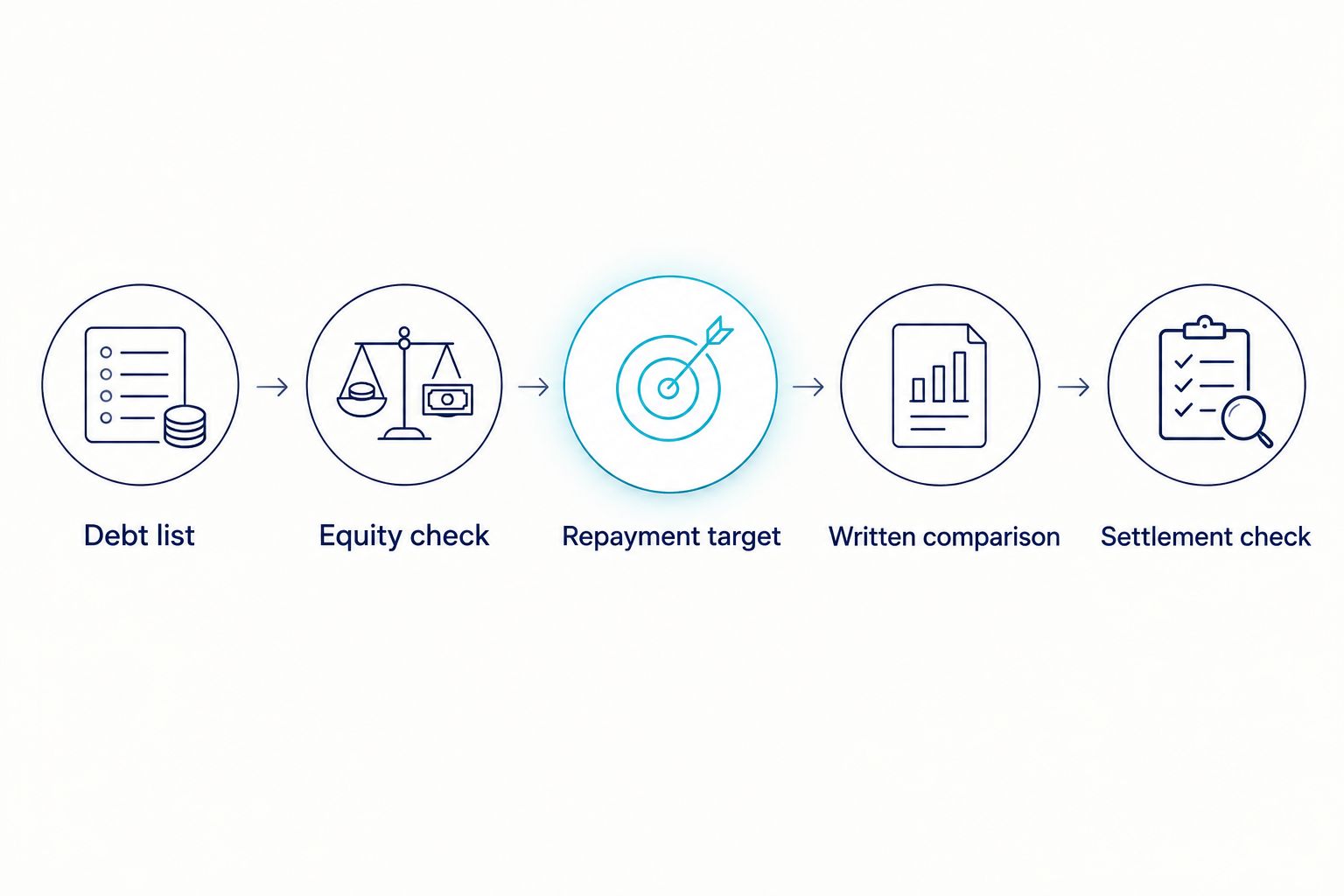
How to compare your shortlist before applying
Debt list
Build 1 debt list containing every balance, repayment, remaining term and account limit. Include liabilities you do not intend to consolidate, because they still affect the overall affordability picture.
Separate personal debts from business or investment borrowing. Moving them into one facility does not remove their original purpose or the need for appropriate tax advice.
Equity check
Calculate the proposed mortgage balance after consolidation and compare it with the lender's property valuation. Your estimate of the property's value is not the lender's assessment.
Equity measures the difference between property value and secured debt. It is not a guarantee that you can borrow that entire difference.
Repayment target
Set a repayment target for the consolidated amount before choosing the loan structure. Ask whether a separate split can make that target easier to track.
Compare 3 repayment measures: the required monthly payment, the planned extra payment and the intended debt-clearance date. These are planning checks, not lender thresholds.
Written comparison
Ask for a written comparison that covers the existing mortgage, proposed mortgage and debts being repaid. Check the proposed term, applicable fees, repayment conditions and the effect of retaining or closing credit accounts.
For your 2026 comparison, use the same debt repayment target across proposals. Otherwise, a longer term can make one option look cheaper simply by delaying repayment.
Settlement check
Confirm how each debt will be paid and which accounts must close or have their limits reduced. Keep settlement and closure confirmations so you can reconcile the outcome against your debt list.
Do not treat an approval as evidence that the old accounts have been cleared. Settlement and account closure are separate things to verify.
Which debt consolidation lender should you choose?
Start with your existing lender, then compare a mainstream refinance proposal if your circumstances suit that assessment. Move to a non-bank or specialist pathway only when a specific policy difference makes it relevant.
Mortgage Pros can help Australian borrowers assess refinancing and equity arrangements. The decision still needs to separate three questions: can you qualify, can you afford the repayments, and does consolidation improve the plan for clearing your debts?
If your only improvement is a smaller monthly repayment created by a longer term, reassess the structure. Payment relief and faster debt reduction are different goals.
Discuss your debt consolidation options
Review refinancing, equity and repayment considerations with a mortgage broker.
FAQ
What’s the best debt consolidation home loan lender in Australia?
The best lender is the one whose eligibility rules and repayment structure fit your debts, income and equity. Start with your existing lender, then compare relevant refinance options rather than choosing from a general brand ranking.
Can I consolidate credit cards into my home loan?
Credit card debt can be consolidated into a home loan when the lender accepts the debt and approves the borrowing. The amount becomes secured against your property, and account closure or limit reduction can be a settlement condition.
Is debt consolidation better than keeping my loans separate?
Debt consolidation is better only when the repayment structure and overall borrowing outcome suit your circumstances. Compare total interest over your intended repayment period and recognise the change from unsecured debt to property-secured debt.
Can I get a debt consolidation mortgage with bad credit?
Adverse credit does not produce one universal answer; eligibility depends on the lender’s policy and your complete financial position. Disclose credit issues accurately and assess hardship assistance or financial counselling if repayments are already unaffordable.
Do I need equity to consolidate debt into my mortgage?
A mortgage increase or refinance must meet the lender’s property-security requirements. Available equity is one part of the assessment, alongside income, existing commitments and the proposed loan balance.
Will a lower repayment save me money?
A lower repayment does not establish a saving. Spreading consolidated debts over a longer period can increase total interest, so compare proposals using the same intended debt-clearance date.
Should I use a mortgage broker for debt consolidation?
A mortgage broker helps you compare lending policies and loan structures against your circumstances. Mortgage Pros assists Australian borrowers with home loan refinancing and equity arrangements; the lender makes the credit decision.
One last thing
Treat unused credit limits as part of the decision, not an afterthought. Clearing a credit card balance does not close the account, remove its limit or prevent the balance from building again.
Before signing a 2026 consolidation proposal, decide which accounts you will retain and why. The useful outcome is a mortgage structure paired with a plan that prevents the cleared debts from returning.
Related guides
- Best home equity loan options
- Best lenders for self-employed home loans
- Best offset home loan accounts