
There is no single average LMI cost by deposit size: the premium depends on the lender, insurer, loan amount and application. For a standard Australian home loan, a deposit below 20% generally puts lenders mortgage insurance on the checklist; the table below shows the deposit-to-loan benchmarks, not a universal premium schedule for 2026.
- LMI cost by deposit size needs a lender-specific quote, not a universal percentage.
- A 5% deposit means 95% LVR before fees, assuming the lender valuation matches the purchase price.
- A 20% deposit generally avoids LMI on a standard home loan; lender conditions still apply.
- Mortgage Pros helps doctors compare home loan requirements before deciding how much deposit to contribute.
Doctors should check eligibility for a profession-based LMI waiver before using a standard low-deposit estimate. The guide to whether a no-LMI loan beats saving a bigger deposit for doctors explains that separate decision.
Deposit size and LMI: the benchmark table
Loan-to-value ratio, or LVR, measures your loan against the lender’s accepted property value. A deposit percentage translates directly into an LVR only when the purchase price and accepted valuation match, and the deposit excludes purchasing costs.
| Deposit benchmark | Starting LVR before financed costs | Standard LMI position | What you need to establish |
|---|---|---|---|
| Overall | Depends on your loan and valuation | No universal premium or average applies | Obtain an application-specific quote |
| 5% deposit | 95% LVR | Generally within the range where LMI applies | Whether the lender accepts the application and how the premium is funded |
| 10% deposit | 90% LVR | Generally within the range where LMI applies | The premium for that loan amount and borrower profile |
| 15% deposit | 85% LVR | Generally within the range where LMI applies | Whether extra savings change the quoted premium or lending terms |
| 20% deposit | 80% LVR | Generally outside the standard LMI requirement | The accepted valuation and any financed costs |
| More than 20% deposit | Below 80% LVR | Generally outside the standard LMI requirement | Whether the loan structure introduces other requirements |
The 5% deposit benchmark has the highest LVR at 95%; the 20% deposit benchmark reduces it to 80%, the usual dividing line for standard LMI requirements. These figures establish borrowing proportions, not the size of an insurance bill.
Methodology and scope: This 2026 table uses deposit-to-LVR arithmetic and the general Australian LMI framework described in ASIC’s Moneysmart guidance on buying a house: LMI generally applies when borrowing more than 80% of the property’s value. It is not a lender premium survey and does not establish premiums, approval eligibility or profession-specific exemptions.
Why this matters
LMI protects the lender against loss if you default and the property sale does not cover the debt. It does not protect your repayments or remove your responsibility for the loan.
Your deposit decision therefore affects more than the insurance requirement. It also changes your borrowing, cash remaining after settlement and exposure to ongoing repayments.
For doctors, dentists and surgeons, checking professional lending criteria belongs before the deposit decision. A standard LMI calculation does not establish whether a particular borrower qualifies for a waiver.
How to use these benchmarks
Compare the same loan scenario
Use the same property, loan purpose, repayment structure and borrower details when requesting deposit comparisons. Otherwise, a different premium or lending decision cannot be attributed to the deposit alone.
Ask for the base loan amount and the amount after any financed premium or fees. A comparison that mixes those figures does not compare like with like.
Test the next deposit threshold
If you are comparing a 10% deposit with a 15% deposit, request both scenarios rather than assuming the premium falls proportionately. The corresponding starting LVRs are 90% and 85%, but that arithmetic does not determine an insurer’s premium schedule.
Use a written quote to establish the benefit of contributing more cash. Keep the quote date and assumptions with your comparison.
Check the valuation before relying on 80% LVR
A 20% deposit against the purchase price does not guarantee an 80% LVR against the lender’s valuation. A lower accepted valuation changes the calculation.
Before making a purchase commitment, establish how your lender assesses the property and what happens if the valuation is lower than expected. Ask your broker to explain any additional cash requirement.
Check an exemption before increasing your deposit
A profession-based waiver and a larger deposit are different ways to address an LMI requirement. Neither establishes that the loan is affordable or that the application will be approved.
Mortgage Pros suits doctors seeking home loan advice before committing more savings to a deposit. Request a comparison that separates waiver eligibility, borrowing capacity and cash needed at settlement.
What changes an LMI quote?
Deposit size matters because it affects LVR, but it is not a complete pricing formula. A percentage-only calculator cannot settle your final application terms.
For a useful 2026 comparison, have the lender or broker identify the assumptions behind each quote:
- Loan amount: The amount borrowed, not just the deposit percentage.
- Accepted valuation: The property value used to calculate LVR.
- Loan purpose: Whether you are buying a home to live in or an investment property.
- Application details: The borrowers, income evidence and loan structure being assessed.
- Premium treatment: Whether you pay the premium separately or seek to add it to the loan.
- Exemption basis: Whether a professional waiver, guarantee arrangement or other exception applies.
Lender and insurer criteria determine how these details affect the outcome. Do not treat one borrower’s quote as a benchmark for another borrower simply because both have a 10% deposit.
Deposit percentage is not your total cash requirement
Your deposit is the amount contributing towards the property purchase, not every dollar you need to complete it. Keep purchasing costs and your retained savings separate when planning the application.
Transfer duty where applicable, conveyancing, inspections and settlement adjustments can affect the cash you need. Their treatment depends on your circumstances and location; they are not included in the deposit percentages above.
Use these definitions consistently:
- Purchase deposit: Your contribution towards the property purchase.
- Buying costs: Expenses associated with the transaction.
- Cash reserve: Savings you retain rather than contribute.
- Financed costs: Approved costs added to the borrowing.
A savings balance described as a 20% deposit can produce a different loan structure if part of that balance must cover buying costs. Ask for a settlement funds breakdown, not just an LVR estimate.
Compare the deposit strategies, not just the premium
The following options address different priorities. None is automatically the best choice because it avoids LMI.
| Strategy | Best for | Main benefit | Main limitation |
|---|---|---|---|
| Larger deposit | Borrowers prioritising lower borrowing | Reduces the base loan and LVR | Uses more savings that would otherwise remain accessible |
| Smaller deposit with LMI | Borrowers assessing a purchase before reaching a larger deposit | Allows a lower personal contribution where approved | Adds an insurance cost that protects the lender |
| Professional LMI waiver | Eligible medical borrowers | Removes the LMI requirement under qualifying lender terms | Eligibility and the wider loan terms still need assessment |
| Guarantor arrangement | Borrowers considering family-supported security | Can change the security supporting the application | Creates obligations and risk for the guarantor |
A larger deposit reduces the amount you borrow, but leaves less cash outside the loan. A smaller deposit preserves more of your savings, but increases borrowing and can introduce LMI.
A waiver removes one cost; it does not prove that the interest rate, fees or repayment structure suit you. A guarantor arrangement requires separate consideration of the guarantor’s exposure, rather than treating family support as a cost-free substitute for savings.
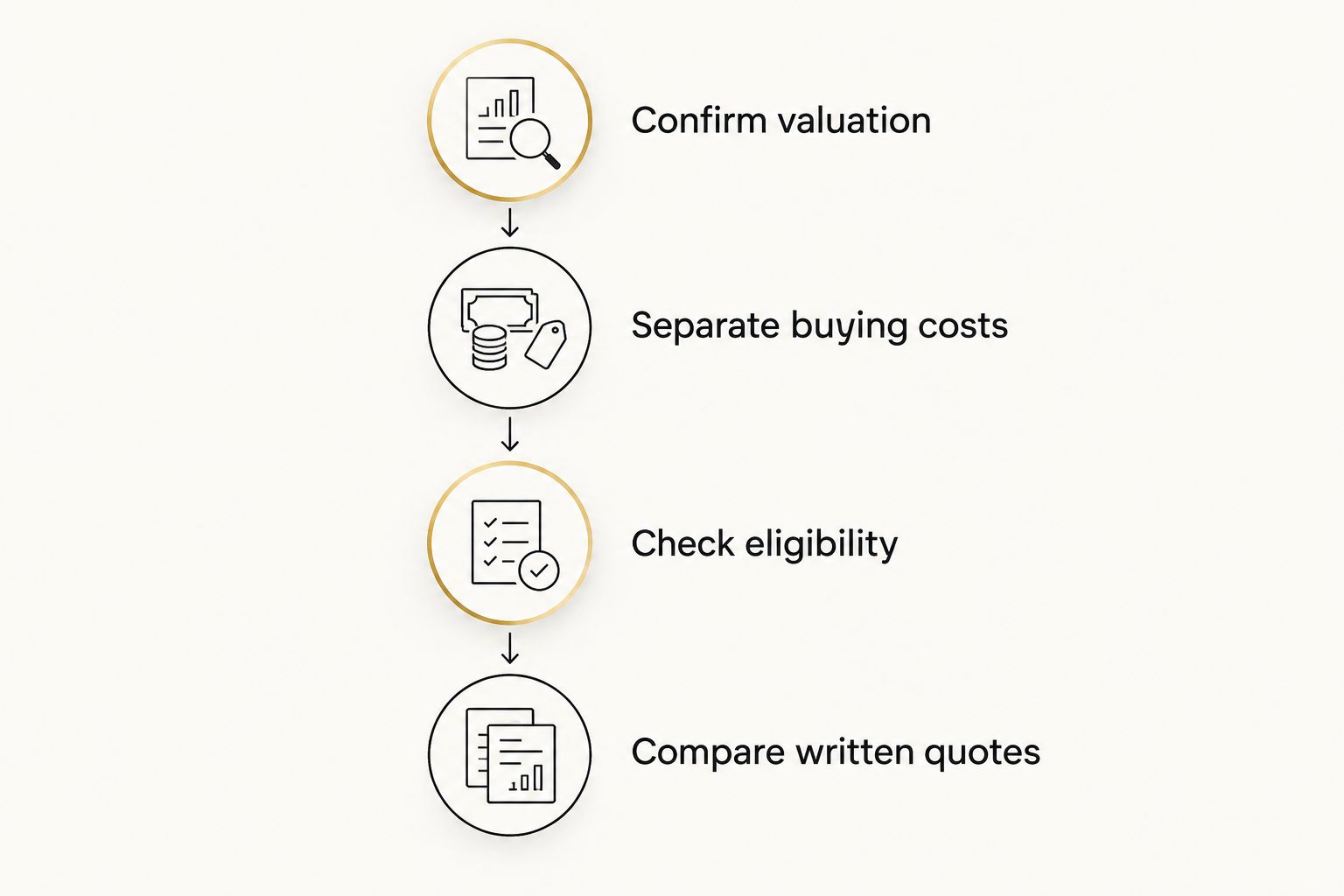
A practical quote-checking process for 2026
Use this sequence before choosing how much cash to contribute. Keep the answers together so you can compare proposals without relying on headline deposit percentages.
Confirm valuation
Ask which property value the lender will use and when that value will be established. Make clear whether the quote assumes the purchase price and valuation are equal.
Separate buying costs
Identify the cash allocated to the purchase deposit, transaction costs and retained savings. This establishes the deposit actually available for the LVR calculation.
Check eligibility
Ask whether the application fits standard lending criteria or a specific exemption. Doctors with changing employment or several income sources should establish how the lender assesses those earnings.
Compare written quotes
Request the premium treatment, base borrowing and total proposed loan for each deposit scenario. Record which details remain subject to property assessment or application approval.
For medical borrowers, choosing a broker also means checking how complex income will be presented. Read how to choose a doctor mortgage broker for complex income before requesting a deposit comparison.
Mortgage Pros provides mortgage broking services, including home loan advice for doctors. Ask for the deposit options to be assessed alongside your employment, property and borrowing requirements.
Discuss your deposit options today
Ask Mortgage Pros to assess your home loan requirements and explain the next application steps.
FAQ
How much is LMI with a 5% deposit?
A 5% deposit does not determine a universal LMI premium. It corresponds to 95% LVR before financed costs when the purchase price matches the accepted valuation; request a quote for your loan and application.
Does a 10% deposit mean I pay 10% in LMI?
No. A 10% deposit describes your contribution towards the property, not an insurance rate. It corresponds to 90% starting LVR under matching purchase-price and valuation assumptions.
Will a 15% deposit avoid lenders mortgage insurance?
A 15% deposit generally does not avoid LMI on a standard loan because it corresponds to 85% starting LVR. A lender-approved exemption changes that position, so establish eligibility separately.
Does a 20% deposit always avoid LMI?
A 20% deposit generally avoids LMI on a standard home loan when it produces an LVR of 80% or less. A lower lender valuation or additional financed costs can change that calculation.
Can doctors get a home loan without LMI?
Eligible doctors can qualify for profession-based LMI waivers under participating lender criteria. Being a doctor does not automatically establish eligibility, borrowing capacity or approval.
Can I add the LMI premium to my home loan?
Some lenders permit an LMI premium to be added to the loan, subject to their lending limits and approval. Adding it increases borrowing and means interest applies to that additional debt.
Does LMI protect me if I cannot make repayments?
No. LMI protects the lender against a covered loss, not the borrower against missed repayments. You remain responsible for your loan obligations.
Should I save a bigger deposit or apply now?
Compare written loan scenarios before choosing. Assess the proposed borrowing, LMI treatment, settlement funds and retained cash rather than deciding from the deposit percentage alone.
One last thing
An LMI waiver is not a repayment buffer. Even when a lender removes the insurance requirement, your loan still needs to fit your income and expenses.
For your 2026 application, ask Mortgage Pros to compare the deposit options before you commit additional savings. Contact us today to discuss your home loan requirements.
This article provides general information, not personal financial advice. Loan approval, LMI treatment and exemptions depend on lender criteria and your circumstances.
Related guides
- Best home loan lenders for doctors
- Can dentists qualify for a home loan with no LMI?
- First Home Super Saver Scheme to deposit workflow