
A no-LMI loan is better for a doctor than saving a bigger deposit when the repayments are affordable, eligibility is confirmed and buying leaves enough cash for purchase costs and emergencies. A bigger deposit is better when reducing debt and repayment pressure matters more than buying sooner; an LMI waiver removes an insurance charge, not the interest on the extra money borrowed.
- Is a no-LMI loan better for doctors than a bigger deposit? Only when affordability and cash reserves support buying sooner.
- A doctor home loan with an LMI waiver still requires lender approval and a sustainable repayment plan.
- Saving a bigger deposit reduces borrowing but delays your purchase; future property prices are uncertain.
- Mortgage Pros helps medical borrowers assess home loans; compare the full loan, not just the LMI waiver.
Is a no-LMI loan better for doctors than a bigger deposit?
Neither option wins automatically: choose the arrangement that supports affordable repayments without exhausting your savings. For your 2026 decision, compare the same property budget and loan features under both approaches before deciding whether to buy now or wait.
Start with the eligibility questions in this guide to home loan lenders for doctors, then assess the financial trade-offs below. An occupation-based concession is only useful if the underlying loan suits your circumstances.
| Decision point | No-LMI loan with a smaller deposit | Saving a bigger deposit |
|---|---|---|
| Best for | Eligible doctors whose repayments are affordable and who want to retain cash or buy sooner | Doctors who prioritise lower borrowing and can comfortably delay buying |
| Main advantage | Avoids LMI without necessarily reaching the usual deposit threshold | Reduces the amount borrowed for the same property |
| Main disadvantage | More borrowing means more interest if the rate, term and repayment pattern are otherwise identical | Requires more saving time and potentially a longer period paying rent |
| Cash reserves | Retaining savings helps only if you deliberately keep a buffer | Putting more cash into the purchase leaves less accessible cash |
| Approval | Depends on the lender's professional eligibility and credit assessment | Still depends on income, expenses, debts and property assessment |
| Key check | Whether the full loan terms justify borrowing more | Whether the saving delay and reduced cash reserves suit your plans |
Why this matters
Lenders mortgage insurance generally protects the lender, not you, if you default and the property sale does not cover the debt. Avoiding that insurance does not remove your responsibility to repay the loan.
In Australian home lending, borrowing above 80% loan-to-value ratio, or LVR, commonly triggers an LMI requirement unless an exemption or other arrangement applies. A 20% deposit is therefore a common reference point, but purchase costs sit outside that deposit calculation.
For a doctor comparing options in 2026, the distinction is straightforward: a waiver changes an insurance requirement, while a larger deposit changes the debt itself. Treat these as separate benefits rather than interchangeable ways to make a loan affordable.
No-LMI loan: best for eligible doctors ready to buy
A no-LMI arrangement suits an eligible doctor who can service the borrowing, cover purchase costs and retain an emergency reserve. It removes a deposit-related obstacle without requiring you to put every available dollar into the property.
That flexibility matters if buying with a larger deposit would leave you short of accessible savings. A home purchase brings expenses beyond the deposit, including conveyancing, inspections, moving and any applicable transfer duty.
The drawback is the larger loan balance. Holding the interest rate, loan term and repayment pattern constant, borrowing more means paying more interest and making larger required principal-and-interest repayments.
Choose a no-LMI arrangement because the complete loan works, not because the waiver sounds like an automatic saving. Ask the lender or broker to confirm the eligible occupation, registration requirements, borrowing limits and property restrictions before relying on the concession.
A doctor's job title alone does not establish approval. The lender still assesses the application, including income, existing commitments, living expenses and the proposed security property.
Bigger deposit: best for doctors prioritising lower debt
Saving a bigger deposit suits a doctor who wants a smaller loan and has a workable reason to delay buying. For an unchanged property purchase amount, contributing more of your own money reduces the borrowing required.
Lower borrowing also reduces the interest charged when the other loan conditions remain equal. That gives you a clear benefit without depending on future house-price growth or an eventual refinance.
The trade-off is time. Continuing to save can mean continuing to pay rent, while the property you eventually buy and its purchase amount remain uncertain.
A bigger deposit is not automatically the safer choice if it consumes your emergency savings. Set aside your cash reserve before deciding how much of your savings belongs in the deposit. Money committed to the purchase is not the same as money you can immediately access for an unexpected expense.
If your finances are tight even after increasing the deposit, reconsider the property budget. A deposit strategy cannot fix an unaffordable purchase.
Why the better option varies between doctors
The right 2026 choice depends on your borrowing position rather than your profession alone. Focus on these factors:
- Income assessment: Establish which parts of your salary, overtime, on-call work or other earnings the lender will accept.
- Existing commitments: Account for other loans, credit facilities, dependants and ongoing household expenses.
- Cash reserves: Separate the deposit from purchase costs, emergencies and known upcoming expenses.
- Loan conditions: Compare the interest structure, fees, repayment flexibility and any offset or redraw arrangements.
- Purchase timing: Weigh your reason for buying now against the practical consequences of waiting.
- Property assessment: Confirm that the property and the lender's valuation support the intended borrowing.
Medical income deserves particular attention. Read how overtime and on-call pay affect a doctor's home loan before assuming every part of your payslip will support the application.
How do you compare buying now with saving longer?
Use a consistent comparison rather than placing a smaller current purchase beside a larger future purchase. You need to see what changes because of the deposit decision, not because the property budget or loan features changed.
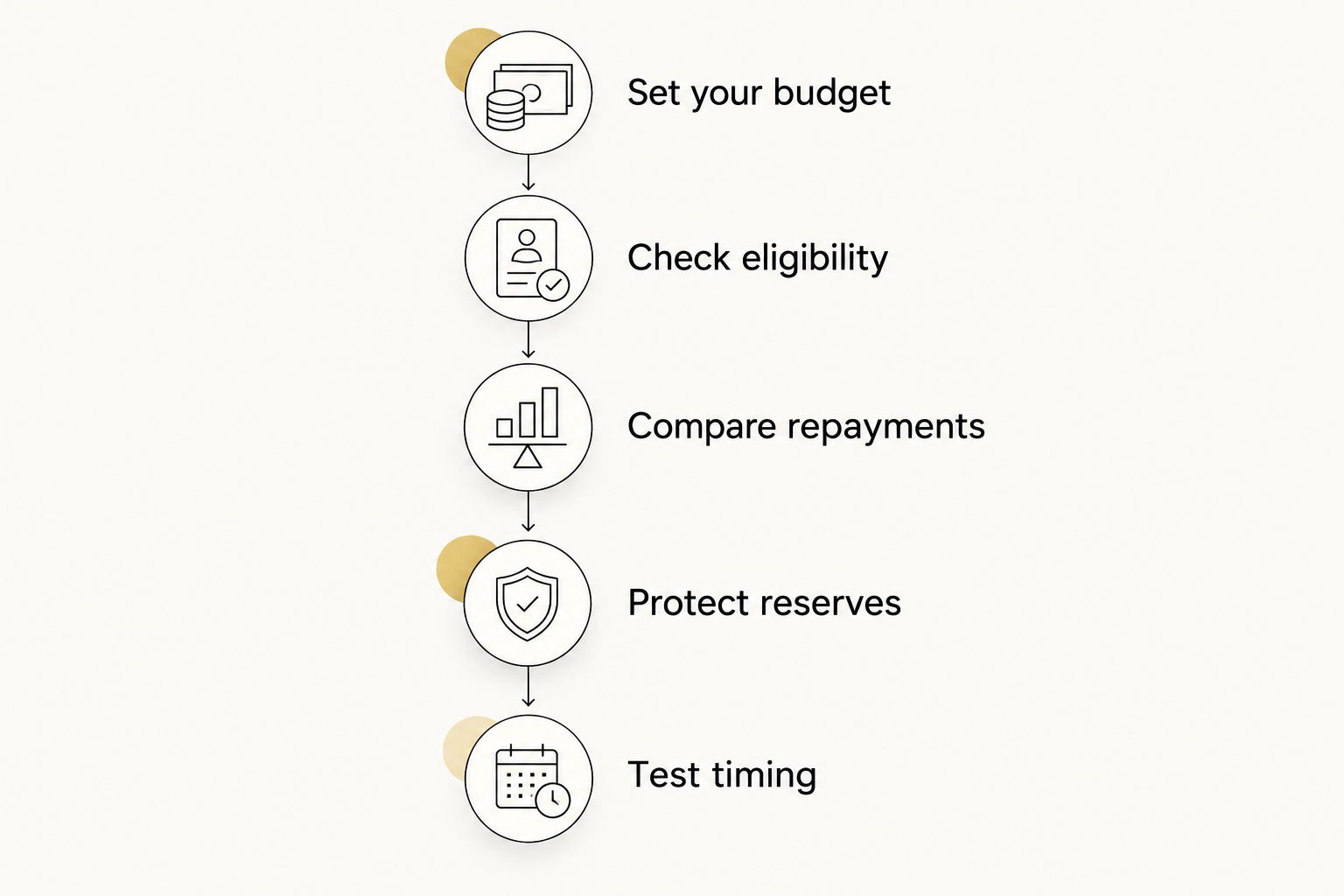
1. Set your budget
Choose a property budget that reflects what you can repay comfortably, not simply the maximum a lender is prepared to approve. List your normal living expenses and known future commitments before deciding what repayment fits.
Keep the initial property budget consistent across both scenarios. Then consider separately how you would respond if suitable properties become more or less expensive while you save.
2. Check eligibility
Ask for confirmation that your professional status, employment arrangements and proposed property meet the lender's waiver criteria. Identify any conditions attached to that confirmation.
Also establish how the lender will assess your income. If you are changing roles or moving between salaried and self-employed work, explain that before selecting a borrowing strategy.
3. Compare repayments
Request repayment comparisons using the same repayment type and loan term. If the proposed interest rates or features differ, make those differences explicit rather than attributing every change to the deposit.
Review both the regular repayment and the total interest calculation. A lower repayment achieved through a longer term is not the same outcome as a lower repayment achieved through less debt.
4. Protect reserves
Separate savings into purchase contributions, transaction costs and money retained after settlement. Do not count the same cash as both your deposit and your emergency reserve.
Consider how you would cover an income interruption or an unexpected property expense. An unused borrowing limit is not a substitute for an accessible cash buffer.
5. Test timing
Compare buying now with saving longer, including rent during the waiting period and the extra savings you can realistically accumulate. Treat future property movements and future loan approval as uncertain, not guaranteed benefits.
Update the comparison when your income, purchase budget or lender conditions change. A decision prepared early in 2026 needs checking again if the underlying assumptions no longer apply.
What should you ask a doctor mortgage broker?
Mortgage Pros is best suited to medical borrowers seeking home-loan advice and approval support. A broker's assessment should connect your income evidence, deposit position and property plans rather than treating the LMI waiver as the whole recommendation.
Bring your income documents, savings records and details of existing commitments to the discussion. Explain any planned leave, job change or shift into private practice that affects the repayment budget.
Ask for clear answers to these questions:
- Which lenders will consider my professional circumstances for an LMI waiver?
- What income has each lender accepted for the assessment?
- How does contributing a larger deposit change the proposed loan terms?
- What cash will remain after settlement and purchase costs?
- Which conditions must be satisfied before approval and settlement?
- What is the alternative if the valuation or eligibility assessment changes?
The value of advice is a suitable borrowing plan, not a promise that a particular concession will apply. Request a comparison that shows both options and explains why the recommended approach fits your circumstances.
Discuss your doctor home loan today
Ask for a comparison of LMI-waiver eligibility, repayments and cash retained after purchase.
Can a doctor avoid LMI with less than a 20% deposit?
A 20% deposit is not always required to avoid LMI: eligible doctors can qualify for professional LMI-waiver arrangements with participating lenders. Eligibility and acceptable borrowing depend on the lender and the application.
Do not commit to a purchase on the assumption that your occupation guarantees the waiver. Confirm both the concession and your borrowing position first.
Does a bigger deposit still help if LMI is waived?
A 20% deposit still reduces borrowing compared with a smaller deposit on the same property, even when LMI is waived. The insurance exemption does not cancel the financial effect of borrowing less.
Whether you should contribute that much depends on your retained cash, loan conditions and repayment priorities. Compare the benefit of lower debt against the need for accessible savings.
Should you wait for property prices to fall in 2026?
Do not base the deposit decision on a predicted property-price fall in 2026. Your savings position and affordable repayment budget are assessable now; the purchase amount of a future property is not assured.
Choose a waiting strategy because it improves your financial position or suits your plans. Reassess the actual properties and loan options when you are ready.
FAQ
Is a no-LMI loan better for doctors than a bigger deposit?
A no-LMI loan is better when you qualify, can comfortably afford the repayments and retain adequate cash after buying. A bigger deposit is better when reducing borrowing matters more than purchasing sooner.
Does an LMI waiver mean the lender guarantees my approval?
No, an LMI waiver does not guarantee loan approval. The lender still assesses your income, expenses, debts, credit position and proposed property.
Does lenders mortgage insurance protect me if I cannot repay?
Lenders mortgage insurance protects the lender, not the borrower. Avoiding LMI does not remove your obligation to repay the home loan.
Can I keep some savings instead of putting everything into my deposit?
Yes, you can plan to retain savings, subject to meeting the lender’s contribution and approval requirements. Separate purchase costs and emergency money from the amount you intend to contribute.
Does a no-LMI doctor loan always have the best terms?
No, an LMI waiver does not establish that a loan has the best overall terms. Compare the interest structure, fees, features and repayments with other suitable options.
Should I count all my overtime towards affordability?
Do not assume a lender will accept all your overtime income. Ask how the income is assessed and build your household budget around earnings you can reasonably rely on.
Can Mortgage Pros help compare buying now with saving longer?
Mortgage Pros provides home-loan advice and approval support for medical borrowers. Ask for an assessment of your income, LMI-waiver eligibility and deposit options before deciding when to buy.
One last thing
A lender's valuation and your agreed purchase amount are not necessarily the same. A lower valuation can change the deposit required, even when an LMI waiver is available.
Ask what happens if the valuation is lower before you commit to the purchase. Contact Mortgage Pros today to discuss your doctor home loan and compare buying with a smaller deposit against saving longer.
Related guides
- How to choose a doctor mortgage broker for complex income
- How locum doctors can document income for a home loan
- Offset home loan accounts