
Best overall: the lender that accepts your income and fits your borrowing needs. Best for branch access: shortlist Commonwealth Bank. Best for an online banking preference: shortlist Macquarie Bank. This 2026 guide compares five lender options for accountants and explains how Mortgage Pros can help you assess home loan suitability.
- The best home loan lenders for accountants depend on income assessment, deposit requirements and loan features—not your job title alone.
- Shortlist Commonwealth Bank for branch access and Macquarie Bank for an online banking preference.
- Assess NAB when comparing business banking alongside a home loan; professional eligibility still needs separate confirmation.
- Mortgage Pros suits accountants seeking mortgage broking support rather than choosing a lender by headline rate alone.
Why this matters
Your accounting qualification does not determine how much a lender will approve. Employment structure, existing debts, property security and the lender’s assessment of your income shape the application.
An employed accountant and an accounting practice owner can need different lending assessments. Choosing the best home loan lenders for accountants in 2026 means matching the application to the lender before choosing the loan features.
Mortgage Pros is a mortgage broking option for accountants who want help comparing home loans and preparing an application. It is not a lender, and lender approval remains a separate decision.
What makes the best home loan lender for accountants?
Use these criteria before treating any bank as your preferred option:
- Income assessment: The lender must accept the evidence supporting your salary, business income or other income you want included.
- Professional eligibility: Confirm whether your qualification, professional membership and employment meet any profession-based lending criteria.
- Deposit and security: Compare the required deposit, valuation treatment and any lenders mortgage insurance requirements.
- Loan features: Check the actual rules for offset accounts, redraw, extra repayments and fixed-rate borrowing.
- Total loan cost: Compare interest, fees and switching costs together—not the advertised interest rate in isolation.
- Application and servicing: Choose an assessment process and ongoing banking arrangement that fit how you manage your finances.
For a 2026 application, ask for the policy that applies to your circumstances now. A colleague’s earlier approval is not evidence that the same lender will accept your application.
Home loan lenders for accountants at a glance
The shortlist below assigns each lender a different reason to investigate it. The order is a decision guide, not a claim that one bank offers better approval outcomes or borrowing terms than another.
| Lender | Best for | Standout reason to assess | Key limitation |
|---|---|---|---|
| Commonwealth Bank | Borrowers prioritising branch access | Home lending within a branch-based banking relationship | Branch access does not establish accountant-specific eligibility |
| NAB | Accounting practice owners comparing personal and business banking | Business banking and home lending within the same banking group | Business banking arrangements do not establish home loan approval |
| ANZ | Existing ANZ customers assessing their current bank | Comparing a home loan alongside an established banking relationship | Familiarity does not prove the loan is the best fit |
| Westpac | Borrowers evaluating a refinance proposal | A lender option to compare against the existing mortgage | Switching needs a full cost and feature comparison |
| Macquarie Bank | Borrowers preferring online banking | A home lending option with an online banking focus | Not the same fit as a branch-led banking preference |
1. Commonwealth Bank: best to shortlist for branch access
Commonwealth Bank provides home loans and branch-based banking. It belongs on your shortlist if you want an in-person banking option alongside your mortgage arrangements.
For an accountant, the next question is income treatment. Ask how the proposed application will account for your salary, variable earnings or business income rather than assuming that professional status resolves the assessment.
Commonwealth Bank pros:
- Provides a branch-based banking option.
- Lets you assess home lending alongside everyday banking.
- Gives borrowers who value in-person banking a clear reason to investigate it.
Commonwealth Bank cons:
- Branch convenience does not demonstrate a better loan outcome.
- Your qualification alone does not establish eligibility for special lending treatment.
- The selected loan’s features and conditions still require comparison.
Best for: Accountants who place practical value on branch access.
Ask which interactions can take place in a branch and which require a separate lending appointment or process. Convenience only matters if it applies to the tasks you actually need completed.
Verdict: Hold until the income assessment and proposed loan fit your needs.
2. NAB: best to assess for an accounting practice owner
NAB provides business banking and home loans. That makes it a relevant bank to assess when you own an accounting practice and want to compare your personal mortgage alongside business banking arrangements.
The connection is organisational convenience, not automatic approval. Your business finances and personal borrowing still need to support the home loan application under the applicable lending criteria.
NAB pros:
- Offers business banking as well as home lending.
- Gives practice owners an option to assess both banking needs together.
- Provides a relevant comparison when business ownership shapes your income evidence.
NAB cons:
- A business banking relationship does not establish home loan eligibility.
- Business turnover is not interchangeable with personal assessable income.
- Combining banking arrangements can make it easier to overlook alternatives.
Best for: Accounting practice owners comparing business banking and personal borrowing together.
Ask which financial records are required and how income will be calculated. Explain changes in ownership, business structure or earnings before the application progresses; those details affect the information needed for assessment.
Verdict: Hold until the business income assessment is clear.
3. ANZ: best to assess for an existing banking relationship
ANZ provides home lending and everyday banking. If you already bank with ANZ, it is a sensible starting point for comparing how a mortgage would sit within your existing arrangements.
Starting there does not mean finishing there. An established banking relationship is useful context, but the home loan still needs to compete on suitability, features and total cost.
ANZ pros:
- Lets existing customers assess a home loan alongside familiar banking arrangements.
- Provides a direct comparison with the cost of moving to another lender.
- Gives you a clear starting point for gathering a proposal.
ANZ cons:
- An existing account does not establish borrowing capacity.
- Familiar banking does not prove better mortgage terms.
- Staying with one bank without comparison narrows your decision unnecessarily.
Best for: Existing ANZ customers who want to assess their current bank before considering a move.
For a 2026 comparison, request the terms for the specific loan under consideration. Check whether your required features are included and identify any conditions attached to them.
Verdict: Hold until an alternative proposal confirms whether staying makes sense.
4. Westpac: best to assess as a refinance alternative
Westpac provides home loans and is an option to include when comparing a refinance. Its role in this shortlist is to give an existing borrower another lender to assess against the current mortgage.
A refinance is a replacement loan, not just a rate adjustment. Assess the outstanding balance, proposed term, switching costs and features before deciding whether the move improves your position.
Westpac pros:
- Provides a home lending option for a refinance comparison.
- Gives you an alternative proposal to assess against your existing lender.
- Offers a reason to review the whole loan rather than focusing only on repayments.
Westpac cons:
- Refinancing introduces a new lending assessment.
- Switching costs can reduce the benefit of changing lenders.
- Extending the remaining term can increase total interest despite lower repayments.
Best for: Accountants with an existing mortgage who are comparing a replacement loan.
Ask for comparisons using the same remaining loan term wherever possible. Otherwise, a repayment reduction can reflect a longer repayment schedule rather than a better borrowing arrangement.
Verdict: Hold until the refinance improves the complete loan position.
5. Macquarie Bank: best to shortlist for online banking
Macquarie Bank provides home loans and online banking. It belongs on your shortlist if you prefer managing your banking digitally rather than choosing a lender for its branch network.
Assess the loan separately from the banking experience. Digital access does not answer questions about income eligibility, offset arrangements or the conditions applying to the selected mortgage.
Macquarie Bank pros:
- Suits a comparison centred on online banking.
- Provides another home lending option beyond the major-bank shortlist.
- Gives digital-first borrowers a distinct servicing preference to evaluate.
Macquarie Bank cons:
- Does not serve the same preference as branch-led banking.
- Online convenience does not demonstrate better lending terms.
- The application still needs to meet the lender’s assessment requirements.
Best for: Accountants who prefer online banking and do not choose their lender for branch access.
Check how you would obtain help with loan changes, account access and repayment questions. The right banking channel is the one that supports your actual needs after settlement.
Verdict: Hold until both the loan terms and servicing arrangements fit.
How the shortlist is ranked
Each lender has a distinct assessment slot: branch access, practice-owner banking, an existing relationship, refinancing or online banking. None of those characteristics establishes the cheapest loan or the easiest approval.
Use the earlier criteria to turn the shortlist into a decision. Income acceptance comes before convenience; a suitable loan comes before banking familiarity.
Check accountant eligibility before choosing a lender
Professional lending treatment and ordinary home loan eligibility are separate questions. Do not assume that every accountant, qualification or employment arrangement receives the same treatment.
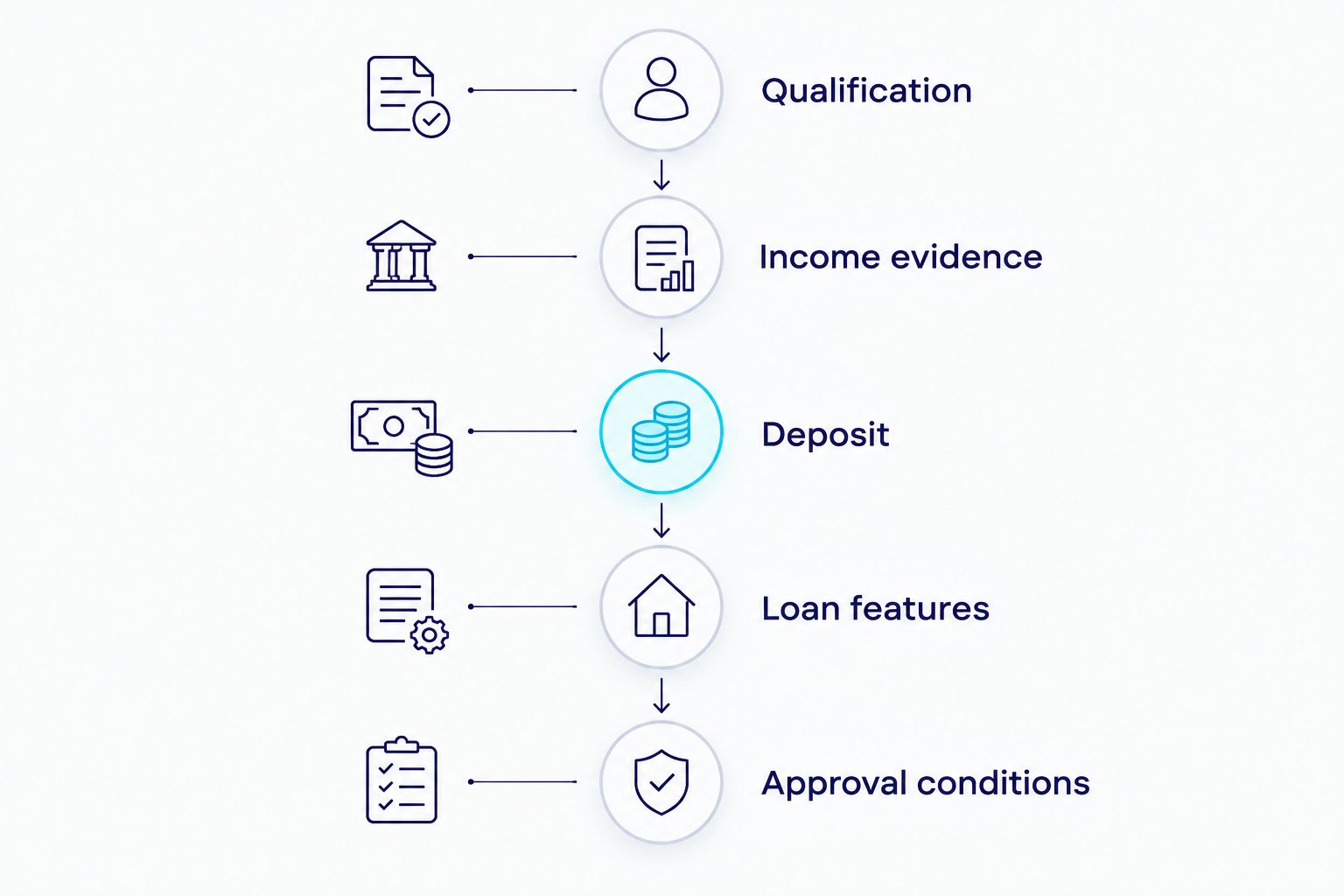
Before submitting a 2026 application, work through these checks:
- Qualification: Identify the qualification and professional membership you hold.
- Income evidence: Confirm the documents required for the income you want assessed.
- Deposit: Establish your available funds and the lender’s security requirements.
- Loan features: Confirm the features you need and their conditions.
- Approval conditions: Identify what remains subject to assessment before committing.
This sequence prevents a useful-sounding professional offer from distracting you from a basic eligibility problem. An insurance concession, where available and applicable, does not remove the lender’s income assessment.
Understand deposit, LVR and mortgage insurance
Loan-to-value ratio, or LVR, expresses the loan as a percentage of the property’s lender-assessed value. Calculate it by dividing the loan amount by that value and multiplying by 100%.
ASIC’s Moneysmart guidance explains that lenders mortgage insurance is usually required when borrowing more than 80% of the property’s value. A 20% deposit is the corresponding deposit benchmark, but purchase costs and the lender’s valuation still need separate consideration.
Lenders mortgage insurance protects the lender, not you. For accountants considering professional lending arrangements in 2026, confirm any exception directly for the proposed application rather than treating that general benchmark as a guaranteed outcome.
Do not use every available dollar simply to reach a deposit threshold. Account separately for transaction costs and the cash buffer you intend to retain after settlement.
Which home loan lender should you choose?
Choose the lender that accepts your documented income, supports the property purchase and provides the features you will use. Start with Commonwealth Bank for branch access, NAB for practice-owner banking, ANZ for an existing relationship, Westpac for a refinance comparison or Macquarie Bank for an online banking preference.
If you remain undecided, Mortgage Pros can help you compare home loan options and prepare for approval assessment. Bring your employment details, income evidence, current debts, deposit position and property plans so the comparison addresses your circumstances.
Compare your home loan options
Discuss your income, deposit and borrowing plans with a mortgage broker.
FAQ
What are the best home loan lenders for accountants in 2026?
The best lender is the one whose income assessment, deposit requirements and loan features fit your application. Commonwealth Bank, NAB, ANZ, Westpac and Macquarie Bank are options to assess for different banking needs, not guaranteed approval outcomes.
Do accountants automatically qualify for waived lenders mortgage insurance?
No—an accounting job title does not automatically establish eligibility for waived lenders mortgage insurance. Confirm the lender’s current professional criteria, qualification requirements and conditions for your application.
Is NAB better than Commonwealth Bank for an accountant?
Neither bank is automatically better because you are an accountant. NAB is relevant when comparing business banking alongside a home loan, while Commonwealth Bank is relevant when branch access matters; income assessment and loan terms decide the final fit.
Can a self-employed accountant apply for a home loan?
Yes, a self-employed accountant can apply for a home loan. Approval depends on the lender’s assessment, including acceptable income evidence, existing commitments and the proposed property security.
Should I use a mortgage broker or apply directly to a bank?
Use a broker if you want help comparing lenders and preparing the application; apply directly if you prefer to assess a bank yourself. Mortgage Pros provides mortgage broking services, while the lender makes the approval decision.
Does an LMI waiver mean I can borrow more?
An LMI waiver does not establish your borrowing capacity. The lender still assesses income, expenses, debts and the proposed loan separately.
Is refinancing worthwhile if my repayment falls?
A lower repayment alone does not establish that refinancing is worthwhile. Compare switching costs, features and total interest using the same remaining term wherever possible.
One last thing
Ask the lender or broker to separate eligibility, borrowing capacity and loan suitability in the recommendation. These answer different questions: whether you qualify, how much the lender will consider lending and whether the proposed loan meets your needs.
For your 2026 decision, do not accept an answer to one as proof of the other two. A professional concession is useful only when the complete borrowing arrangement works for you.