
Best overall: a lender whose dentist-specific policy matches your circumstances. Best for practice owners: a lender that accepts your self-employed income. Best budget option for existing borrowers: a refinance lender that improves total loan costs. This 2026 guide ranks lender types by borrower need, so you can compare policy fit before choosing a bank.
- The best home loan lenders for dentists match income structure, deposit and property plans—not just occupation.
- Mortgage Pros provides home loan advice and approval support; it is a mortgage broker, not a lender.
- Compare dentist eligibility, lenders mortgage insurance, income assessment and loan features before applying.
- For refinancing, compare total loan costs and the remaining term, not repayments alone.
Why this matters
A salaried dentist and a dental practice owner can have different borrowing applications despite working in the same profession. Employment structure, business debts, deposit size and property purpose determine which lending policies deserve your attention.
For dentists comparing home loans, Mortgage Pros provides mortgage broking rather than direct lending. You can discuss your circumstances with Mortgage Pros before choosing which lender to approach.
Do not treat an occupational benefit as an approval guarantee. A lender still assesses the application, the proposed security and your ability to repay. Your first task is to identify a suitable policy; your second is to compare the loan attached to it.
What makes the best home loan lenders for dentists?
Use these criteria to assess a lender in 2026. A profession-based offer is useful only when the complete application fits.
- Professional eligibility: Confirm that the policy explicitly covers your dental occupation, registration status and employment arrangement.
- Income assessment: Check how the lender treats salary, variable earnings, contracting income, business profits and existing business commitments.
- Deposit and LMI treatment: Establish the permitted loan-to-value ratio, any lenders mortgage insurance requirements and the conditions attached to an exemption.
- Affordability: Compare the proposed repayments with your household budget, existing debts and the lender's assessment requirements.
- Useful loan features: Decide whether you need an offset account, redraw, extra repayments or separate loan splits, then check the product conditions.
- Total loan costs: Compare interest, fees and switching expenses over the same loan amount and term. A lower repayment is not enough evidence of a better loan.
Separate eligibility from attractiveness. A lender can accept your application without offering the structure you want; an appealing product is irrelevant if its income policy excludes your circumstances.
Dentist home loan options at a glance
These are lender-policy categories, not endorsements of named banks. The ranking gives you a starting point for comparison, with a distinct use case for each option.
| Rank and lender type | Best for | Standout assessment focus | Key limitation |
|---|---|---|---|
| 1. Dentist-policy lender | Profession-based eligibility | Whether your dental occupation qualifies for specific lending treatment | Professional status does not replace affordability assessment |
| 2. Self-employed-income lender | Dental practice owners | How business income and commitments enter the application | Documentation and income interpretation require close attention |
| 3. PAYG-income lender | Salaried dentists | How employment income supports borrowing capacity | Variable earnings need separate confirmation |
| 4. Equity-access lender | Existing owners funding another property | Security, usable equity and repayment capacity | Property equity is not the same as available borrowing |
| 5. Refinance lender | Borrowers reviewing an existing mortgage | Whether switching improves the complete loan arrangement | A longer term can disguise a weaker outcome |
1. Dentist-policy lender: best for profession-based eligibility
A dentist-policy lender is the first category to investigate when your occupation could affect deposit or LMI treatment. Ask whether the lender's current policy includes your exact circumstances rather than relying on a broad reference to healthcare professionals.
Check professional registration, employment type, property purpose and any borrowing restrictions. For a 2026 application, request the current requirements before arranging your purchase around a particular benefit.
Dentist-policy lender pros:
- Gives you a clear route to investigate profession-based eligibility.
- Lets you compare any occupational benefit against ordinary lending terms.
- Helps identify whether deposit treatment is relevant to your application.
Dentist-policy lender cons:
- An occupational policy does not guarantee approval.
- Eligibility alone does not establish that the complete loan is the best fit.
- Requirements need checking against your own employment and property plans.
Best for: A dentist whose main question is whether professional eligibility changes the deposit or mortgage insurance position.
Ask for a plain explanation of the benefit and its conditions. If the lender offers an LMI waiver, distinguish that from a reduction in the debt: a waiver concerns insurance, not the amount you must repay.
Verdict: Hold until the dentist-specific eligibility and full loan terms are confirmed. Start here, but do not choose on the profession label alone.
2. Self-employed-income lender: best for dental practice owners
A self-employed-income lender is the relevant category when your borrowing depends on income from a dental practice. The central question is how the lender assesses that income—not whether the practice appears busy or successful.
Prepare business and personal financial records together. Ask how the lender treats salary, distributions, retained profits and business debts, and identify which amounts it will accept for the application.
Self-employed-income lender pros:
- Focuses the comparison on the income supporting your loan.
- Allows you to discuss business commitments before choosing a product.
- Helps separate household borrowing needs from practice finances.
Self-employed-income lender cons:
- Business income assessment adds detail to the application.
- A recent ownership or structure change needs explanation.
- Personal and business obligations must both be understood.
Best for: Practice owners and self-employed dentists whose income is not adequately described by a payslip alone.
Do not assume turnover equals personal borrowing income. Revenue, expenses, profit and money available to the borrower are different concepts. A useful lender comparison shows which income figures support the proposed mortgage and why.
Ask your accountant to help explain the financial records where necessary. Clear records support assessment; they do not replace the lender's decision.
Verdict: Hold until the lender's income calculation is clear. Choose the assessment that accurately reflects your circumstances, not the largest unexplained borrowing estimate.
3. PAYG-income lender: best for salaried dentists
A PAYG-income lender is the straightforward comparison category for dentists paid as employees. Start with base salary, then identify any additional income you want included in the application.
Separate regular pay from bonuses, overtime or other variable earnings. Ask what supporting evidence the lender requires and how it assesses each component before relying on the total for your property budget.
PAYG-income lender pros:
- Keeps the assessment centred on employment income.
- Provides a clear starting point for organising income documents.
- Lets you compare standard loans alongside any eligible professional policy.
PAYG-income lender cons:
- Variable earnings require their own assessment.
- A recent employment change needs discussion before application.
- A simple income structure does not remove other eligibility requirements.
Best for: Employed dentists seeking a home loan supported mainly by salary.
Check how your employment arrangement is classified. Receiving regular payments does not, by itself, establish that the lender will assess you as an employee rather than a contractor or self-employed applicant.
Once the income position is clear, compare loan features against how you manage cash. An offset account deserves attention if you intend to hold savings against the mortgage, but confirm associated fees and whether the account provides a full or partial offset.
Verdict: Hold until salary and variable-income treatment are confirmed. Do not pay for features you do not plan to use.
4. Equity-access lender: best for an additional property
An equity-access lender is relevant when you already own property and want to use equity towards another purchase. The assessment combines your existing security position with your ability to repay the proposed additional borrowing.
Equity is the property's value minus the debt secured against it. Usable equity is a separate question: the lender's valuation, permitted LVR and affordability assessment determine the borrowing arrangement it will consider.
Equity-access lender pros:
- Connects the next purchase with your existing property position.
- Encourages a clear review of current and proposed debts.
- Creates an opportunity to discuss separate loan purposes and security arrangements.
Equity-access lender cons:
- A higher property value does not guarantee more borrowing capacity.
- Additional borrowing creates additional repayment obligations.
- Security choices can complicate a later sale or refinance.
Best for: Property-owning dentists planning another purchase rather than seeking a first mortgage.
Ask whether the proposed structure ties multiple properties together as security. Understand what happens if you later sell one property, change lenders or repay a loan split.
For investment borrowing, obtain tax advice about loan purpose and record-keeping before moving funds. The lender's approval and the tax treatment of the borrowing are separate matters.
Verdict: Hold until valuation, affordability and security structure are clear. Do not substitute an equity estimate for an assessed borrowing plan.
5. Refinance lender: best for reviewing an existing mortgage
A refinance lender is the relevant category when you already have a home loan and want a better arrangement. Compare the replacement mortgage with your existing loan on the same balance and remaining term.
In 2026, assess refinancing against your current goals: repayment flexibility, loan structure, interest costs or access to equity. Switching lenders is a process, not proof of an improvement.
Refinance lender pros:
- Provides an opportunity to reassess whether the loan still fits.
- Allows you to compare features alongside interest and fees.
- Can separate a straightforward loan review from additional borrowing plans.
Refinance lender cons:
- Switching expenses belong in the comparison.
- A new application requires assessment.
- Restarting a longer loan term can reduce repayments without reducing total interest.
Best for: Dentists with an existing mortgage who can define the outcome they want from refinancing.
Ask for two comparisons: the proposed loan over your existing remaining term, and any alternative term being suggested. That exposes whether repayment changes come from the loan terms or simply from spreading the debt over longer.
Also check discharge requirements and any applicable break costs before committing. Do not add equity release to a refinance application without examining the additional debt separately.
Verdict: Skip a refinance justified only by lower monthly repayments. Proceed only when the complete comparison supports your objective.
How to shortlist lenders in 2026
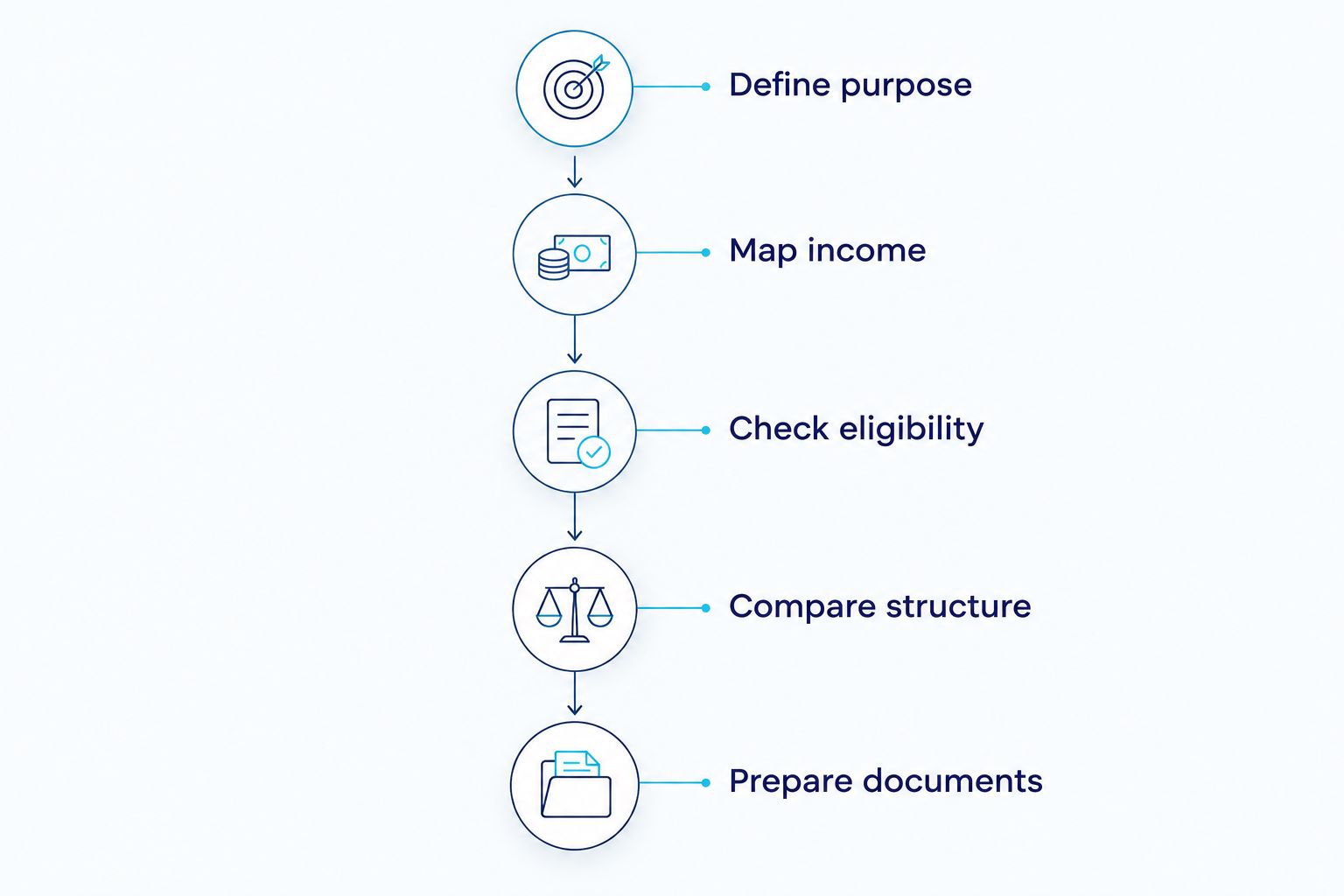
Use this sequence before submitting an application. Mortgage Pros helps individual borrowers and investors with home loan advice and approval support; use the discussion to clarify which policies match your circumstances.
- Define purpose: Identify whether you are buying, refinancing or accessing equity, and whether the property is for occupation or investment.
- Map income: Separate salary, variable earnings and business income. List existing personal and business commitments.
- Check eligibility: Confirm the relevant professional, employment, deposit and property requirements.
- Compare structure: Review the same loan amount and term, then examine features, fees and security arrangements.
- Prepare documents: Assemble the evidence required for the selected assessment before applying.
Keep your shortlist focused on policies that fit. Comparing unrelated products creates more work without answering the approval question.
Understand LVR before comparing deposit requirements
Loan-to-value ratio describes the loan as a percentage of the property's assessed value. An 80% LVR means the loan equals 80% of that value; a 90% LVR means it equals 90%.
A 20% deposit corresponds to 80% LVR only when the purchase price and assessed value match and purchase costs are covered separately. Keep transaction expenses outside your deposit calculation.
Moneysmart's guidance on lenders mortgage insurance describes LMI as usually applying when borrowing exceeds 80% of the property's value. LMI protects the lender, not the borrower. For your 2026 application, confirm the selected lender's requirements and any applicable professional exemption.
How the lender types are ranked
The ranking follows policy fit first, then income assessment, deposit treatment, affordability, features and total loan costs. It is a decision framework, not a claim that one bank approves every dentist.
A salaried borrower starts with different evidence from a practice owner. An existing homeowner also needs to distinguish refinancing from additional borrowing. Move directly to the category matching your application rather than treating the order as a universal leaderboard.
Which lender should you choose?
Start with dentist-specific eligibility, then compare the best-fitting ordinary lending alternative. That gives you a useful default without assuming an occupational policy is automatically better.
For a 2026 decision, choose the lender whose confirmed income assessment, deposit requirements and loan structure support your actual plans. Mortgage Pros provides mortgage broking support for that comparison; the lender makes the credit decision.
Discuss your home loan options
Clarify your income, deposit and borrowing purpose before choosing a lender.
FAQ
What’s the best home loan lender for dentists in Australia?
The best lender is the one whose confirmed policy fits your income, deposit and property plans. Start by checking dentist-specific eligibility, then compare suitable alternatives on the same loan amount and term.
Do dentists automatically qualify for an LMI waiver?
No. Confirm whether the lender offers a relevant waiver and whether your occupation, registration, employment arrangement and proposed loan meet its conditions.
Is a mortgage broker the same as a home loan lender?
No. Mortgage Pros provides mortgage broking, home loan advice and approval support; it does not directly lend the mortgage funds. The lender assesses the application and makes the credit decision.
Can a self-employed dentist apply for a home loan?
Yes, self-employed dentists can apply for home loans. The lender assesses the supporting financial records, accepted income and commitments before deciding whether to approve the application.
Does a dentist need a 20% deposit?
A 20% deposit is not a universal requirement for dentists. The required deposit depends on the lender’s policy, assessed property value, permitted LVR and any applicable mortgage insurance treatment.
Should I refinance just to get a lower repayment?
No. Compare interest, fees, switching expenses and the remaining loan term before deciding. A longer repayment period can lower monthly repayments without improving the total interest outcome.
Can I use home equity to buy another property?
Home equity can support another purchase when the lender accepts the security and additional borrowing. Available borrowing depends on valuation, permitted LVR and repayment capacity—not equity alone.
One last thing
An LMI waiver does not make a larger mortgage smaller. Treat any professional benefit as one part of the decision, then check the repayment obligation it leaves you with.
Before accepting a loan, ask for the proposed balance, term, repayment structure and security arrangement in one clear summary. That is the comparison you need when two attractive offers point towards different financial commitments.