
Best overall: a lender whose income assessment matches how you are paid. Best for casual employees: a PAYG assessment that recognises documented variable earnings. Best for fixed-term employees: a contract assessment that considers employment continuity. The best home loan lenders for casual and contract workers in 2026 are not one universal shortlist; this guide ranks the assessment routes you should compare before applying.
- The best home loan lenders for casual and contract workers match income assessment to your employment structure.
- Casual employees should compare how lenders assess variable PAYG earnings, not just the employment label.
- Fixed-term employees and self-employed contractors need different evidence; a contract alone does not establish borrowing capacity.
- Mortgage Pros helps borrowers compare home loan options, including doctors with complex employment arrangements.
Why this matters
A casual employee, a salaried contractor and a self-employed consultant can all describe their work as contracting. Their home loan applications are not interchangeable. Your first decision is the correct income assessment, not the lender's name.
Mortgage Pros is a mortgage broking firm, not a lender. Mortgage Pros is best for borrowers seeking home loan guidance, particularly doctors with complex income arrangements.
For your 2026 application, separate employment status from income reliability. A signed contract explains the arrangement, while payslips, tax records and bank credits help establish what you actually earn. Lenders also assess expenses, existing debts, the deposit and the property.
What makes the best lender for casual or contract income?
Use these criteria before comparing loan features:
- Employment classification: Does the assessment fit PAYG employment, self-employment or a combination?
- Recognised income: Which earnings count, and how does the lender treat variable hours, allowances and overtime?
- Continuity evidence: What establishes an ongoing earning pattern across employers, assignments or contract renewals?
- Document requirements: Can you supply the evidence required for the assessment route?
- Whole-loan suitability: Do repayments, features and conditions suit your circumstances after income eligibility is established?
An attractive loan is not a useful recommendation if the lender cannot accept your income evidence. Equally, accepting casual work does not make a lender suitable for every casual borrower.
Assessment routes at a glance for 2026
This is a ranked decision guide, not a claim that one bank approves every employment arrangement. Start with the row matching your income structure; the order is not a prediction of approval.
| Rank and assessment route | Best for | Main strength | Key limitation |
|---|---|---|---|
| 1. Casual PAYG assessment | Employees paid variable hours through payroll | Connects payslips with an ongoing earnings pattern | Recent high earnings do not establish sustainable income alone |
| 2. Fixed-term PAYG assessment | Employees working under a dated employment contract | Separates contract expiry from employment history | A signed contract does not guarantee renewal |
| 3. Combined-income assessment | Borrowers with concurrent jobs or employment sources | Considers each documented income stream | Every source needs assessment; hours must remain sustainable |
| 4. Self-employed contractor assessment | Borrowers invoicing through an ABN or business | Uses evidence appropriate to business income | Business receipts are not the same as personal income |
1. Casual PAYG assessment: best for variable roster income
A casual PAYG assessment suits employees who receive payslips but do not work identical hours each pay period. Your task is to show the relationship between recent earnings, earlier earnings and the work you expect to continue doing.
Ask prospective lenders how they establish assessable income from your particular records. Do not assume that the latest payslip, your highest roster or a quoted hourly rate determines borrowing capacity.
Casual PAYG assessment pros:
- Payslips show earnings and payroll deductions.
- Year-to-date figures help put recent shifts into context.
- Bank credits provide another record of salary received.
Casual PAYG assessment cons:
- A busy roster does not establish an ongoing work pattern.
- Gaps or substantial changes need explanation.
- Different income components require separate consideration.
Best for: Casual employees with documented payroll earnings and an explainable work history.
Prepare your employment commencement details, recent payslips and relevant earlier income records. If you changed employers but stayed in the same occupation, document that sequence rather than presenting the newest job in isolation.
Verdict: Choose this route for casual payroll income; skip assessments that incorrectly classify you as self-employed.
2. Fixed-term PAYG assessment: best for salaried contracts
A fixed-term PAYG assessment suits employees whose employment has a stated end date. The application needs to explain both the current contract and the history surrounding it, including renewals or related employment where relevant.
This distinction matters for doctors working through hospital contracts. A contract end date is a fact to address, not a reason to describe the role as permanent.
Fixed-term PAYG assessment pros:
- The employment contract records the role and agreed remuneration.
- Payslips help confirm that contracted employment has commenced.
- Earlier contracts can document continuity between appointments.
Fixed-term PAYG assessment cons:
- Renewal is not guaranteed by previous renewals.
- An unstarted contract is different from established payroll earnings.
- Changes in duties or hours need a clear explanation.
Best for: Salaried employees with a dated contract and evidence explaining their employment history.
For a 2026 application, provide the actual contract dates and disclose any known changes. Ask how the proposed lender treats the remaining term, probation and previous contracts before submitting an application.
Verdict: Choose this route for PAYG contracts; wait to apply until material questions about employment dates are resolved.
3. Combined-income assessment: best for concurrent employment
A combined-income assessment suits borrowers earning through more than one employment source. Examples include a regular hospital position alongside casual shifts, or separate payroll roles with different employers.
List each source separately before calculating a total. This makes overlapping periods, variable earnings and differences between guaranteed and additional work easier to assess.
Combined-income assessment pros:
- Separate records make each employment source visible.
- A clear income schedule reduces double-counting errors.
- Employment history helps explain how roles fit together.
Combined-income assessment cons:
- Each source needs its own supporting evidence.
- Holding several jobs does not establish that all earnings will continue.
- Heavy combined hours raise questions about sustainability.
Best for: Borrowers with concurrent employment whose income cannot be understood from one payslip.
For medical borrowers, distinguish employment income from invoiced locum work. The guide to documenting locum doctor income for a home loan explains this supporting topic in more detail.
Verdict: Choose this route when several genuine income sources support your application; skip simply adding every recent payment together.
4. Self-employed contractor assessment: best for invoiced work
A self-employed contractor assessment suits borrowers earning through a business rather than solely through employee payroll. An ABN, invoices and business bank deposits describe a different evidence trail from PAYG payslips.
The central question is not just what the business receives. It is what the financial records establish about income available to support your personal loan repayments.
Self-employed contractor assessment pros:
- Business records reflect the way you actually earn.
- Contracts help explain the source of invoiced work.
- Tax and financial records place receipts alongside business expenses.
Self-employed contractor assessment cons:
- Turnover is not interchangeable with personal income.
- Business structures add documentation requirements.
- A large invoice does not establish recurring earnings.
Best for: Contractors invoicing clients through a sole trader arrangement, company or other business structure.
Have your broker identify the required financial evidence before choosing a lender. Alternative documentation is not permission to omit liabilities, inflate earnings or describe business revenue as salary.
Verdict: Choose this route for genuine business income; skip PAYG assumptions that do not match your records.
How these routes are ranked
The ranking starts with employment classification, then considers recognised income, continuity and documentation. Loan suitability remains essential, but it comes after establishing which assessment fits your circumstances.
These routes are alternatives, not a quality ladder. A self-employed contractor does not become a stronger applicant by trying to fit a casual employee assessment. Mortgage Pros can help connect the evidence you hold with an appropriate home loan enquiry.
Build an application a lender can understand
For a 2026 application, organise the evidence before requesting a borrowing figure. Use this sequence to prevent avoidable inconsistencies between your employment description and supporting records.
Classify income
Separate PAYG earnings from business income. Identify casual employment, fixed-term employment and concurrent roles without changing the labels to make the application appear simpler.
Gather evidence
Collect the payslips, contracts, bank statements and tax or business records relevant to each source. Ask which periods and documents the proposed lender requires rather than relying on a generic checklist.
Explain continuity
Write a short factual employment timeline. Include changes of employer, contract renewals and gaps, with documents supporting the explanation where available.
Check commitments
List existing loans, credit facilities and regular expenses. Income assessment is only part of borrowing capacity; do not leave debts out because you intend to repay them later.
Confirm suitability
Compare the proposed assessment with the loan's features and repayment obligations. Ask what remains outstanding before pre-approval or formal approval can be considered.
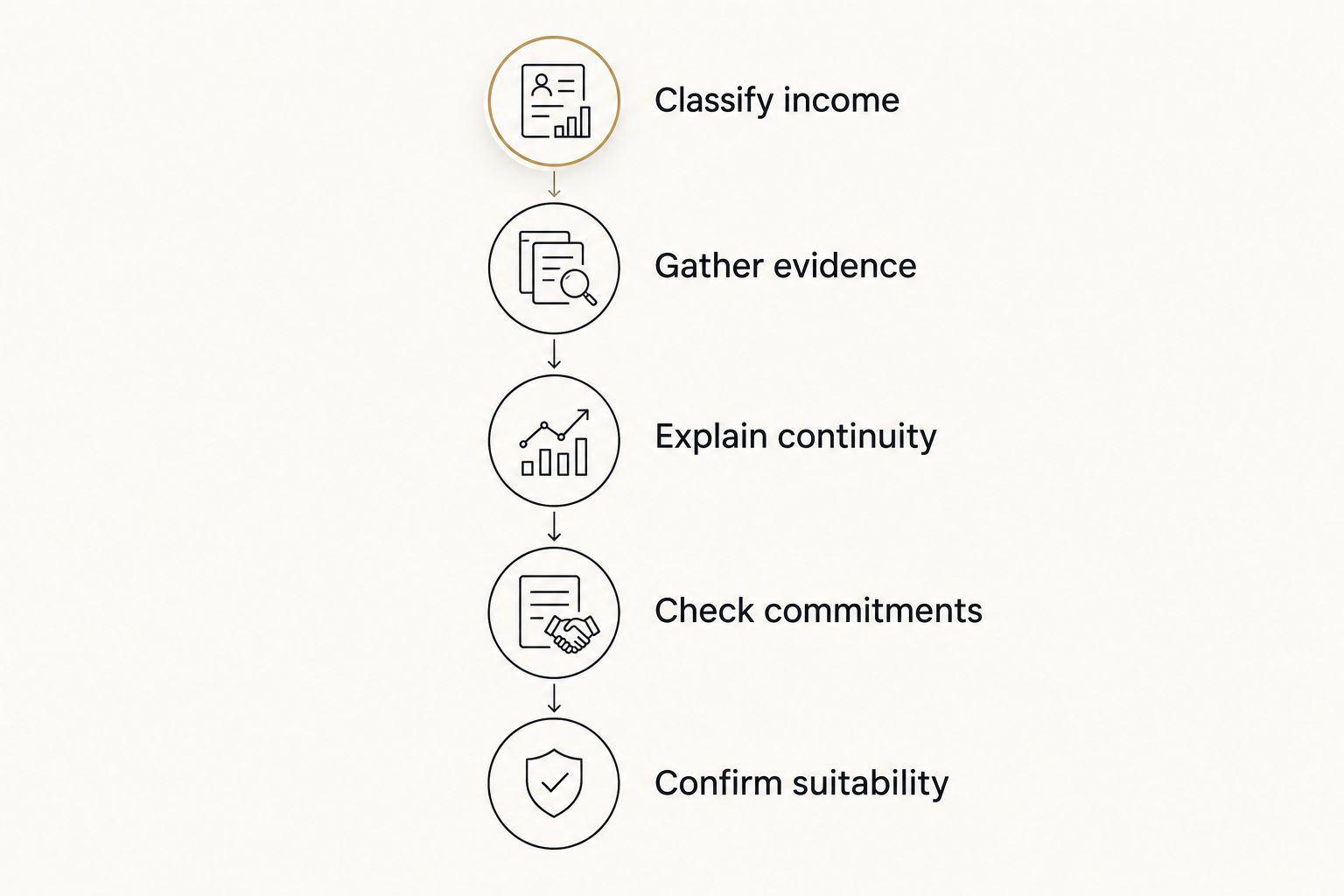
Bring these records to the first conversation. A useful lender recommendation explains how your income will be assessed and what evidence remains outstanding, rather than offering reassurance based only on your occupation.
Discuss your employment income today
Ask Mortgage Pros about home loan options for casual, contract or mixed income.
Compare income figures on the same basis
A year contains 12 months and 52 weeks for standard annualisation calculations; fortnightly income is commonly annualised across 26 fortnights. These are arithmetic conversions, not promises about how a lender will assess variable earnings.
Check whether each figure represents gross income, net salary received or business receipts. Mixing those measures produces a misleading comparison even when the arithmetic is correct.
Ask the broker or lender:
- Which income components have been included?
- What evidence period supports the calculation?
- Have overlapping payslips or year-to-date amounts been counted twice?
- How have unpaid breaks and employment changes been treated?
- Does the estimate depend on income that has not started?
Your maximum roster is not automatically your sustainable annual income. For your own repayment planning, also consider how you would manage quieter periods without assuming additional shifts will appear.
Which lender route should you choose?
Default to the assessment matching your actual employment arrangement. Start with casual PAYG for rostered employee earnings, fixed-term PAYG for salaried contracts, combined-income assessment for concurrent roles, and self-employed assessment for invoiced business work.
For doctors combining hospital employment with other work, request a breakdown of each income stream before deciding where to apply. Mortgage Pros provides home loan guidance for doctors and other borrowers; an occupation alone does not establish approval.
In 2026, a useful shortlist should explain why each lender fits your evidence. Ask for that explanation before authorising an application, and confirm the requirements that apply to your circumstances.
FAQ
What’s the best home loan lender for a casual worker?
The best lender is one whose income assessment accepts your documented employment circumstances and offers a suitable loan. Compare how variable earnings are assessed before choosing by lender name or loan features.
Can I get a home loan while working on a fixed-term contract?
A fixed-term contract does not automatically prevent a home loan application. The lender still needs to assess your income, employment circumstances, expenses, debts and the proposed property.
Is a PAYG contractor the same as a self-employed contractor?
No. A PAYG employee receives payroll income, while a self-employed contractor earns through a business arrangement. Identify the correct structure before choosing the supporting documents or assessment route.
Can I use income from two casual jobs for a home loan?
Ask the proposed lender to assess both documented income sources. Do not assume every payment will count; each role’s history, continuity and combined workload need consideration.
Do doctors on contracts need a different application approach?
Doctors should identify whether each income source is salaried employment, casual payroll work or business income. Hospital contracts and locum work do not necessarily follow the same documentation route.
Does a bigger deposit guarantee approval with casual income?
No, a bigger deposit does not guarantee approval. It does not replace the lender’s assessment of repayment capacity, income evidence and other application requirements.
Should I wait until my contract is renewed before applying?
Check the proposed lender’s requirements before deciding to wait. A renewal changes the evidence available, but the right timing depends on your complete employment and financial circumstances.
One last thing
The word contractor is not an income category by itself. Before comparing lenders, write down who pays you, whether tax is withheld through payroll and whether you invoice through a business.
That distinction gives your enquiry a clear starting point. Contact us today with your employment details and ask which assessment route fits before submitting a home loan application.
Related guides
- Can doctors use overtime and on-call pay for a home loan?
- Can doctors get a home loan during probation?
- Best lenders for self-employed home loans