
Best overall: a fixed–variable split that preserves access to your savings. Best for irregular surplus income: a variable-heavy split. Best for repayment certainty: a fixed-heavy split. The best split loan lenders in 2026 are those whose lending criteria, offset arrangements and fixed-loan restrictions suit your circumstances—not simply those with a familiar name.
- Compare the best split loan lenders by loan structure, offset access and fixed-loan restrictions—not brand alone.
- Mortgage Pros provides home loan advice for borrowers comparing split loan structures.
- Choose a variable-heavy split when accessible savings and extra repayments matter most.
- Choose a fixed-heavy split when repayment certainty matters more than repayment flexibility.
- Ask for written terms covering both loan portions before choosing a lender.
Why this matters
A split home loan divides your borrowing into separate portions, usually fixed and variable. The fixed portion provides interest-rate certainty for its agreed term; the variable portion retains exposure to rate changes and the features attached to that account.
Mortgage Pros is a home loan advice option for borrowers who want help comparing fixed and variable portions. You can contact the team to discuss your borrowing circumstances before choosing a split.
For doctors, dentists and surgeons, the decision also involves income assessment. A suitable structure still needs a lender that accepts your employment arrangements and assesses your income appropriately. Splitting the balance does not replace the lender's credit assessment.
What makes the best split loan lenders?
Use these criteria before considering a lender's position on any shortlist:
- Income assessment: The lender's requirements must fit your employment, contracting or business income.
- Offset access: Confirm which portion supports an offset account and how the account operates.
- Extra repayments: Check restrictions separately for the fixed and variable portions.
- Exit flexibility: Understand what happens if you sell, refinance or repay the fixed portion early.
- Split control: Confirm the permitted structure, account administration and process for changing it.
- End-of-term arrangements: Know what happens when the fixed period expires and what instructions you must provide.
For a 2026 application, request current written terms rather than relying on an old comparison. Features belong to the specific loan product, not automatically to every home loan offered by that lender.
Split loan options at a glance
The ranking below compares structures, not unverified lender offers. Each option solves a different borrowing problem; none guarantees approval or a lower total interest bill.
| Ranked option | Best for | Standout benefit | Key limitation |
|---|---|---|---|
| Balanced fixed–variable split | Borrowers with competing certainty and flexibility needs | Keeps meaningful portions under both arrangements | An equal division can ignore your actual cash requirements |
| Variable-heavy split | Borrowers expecting extra repayments or holding accessible savings | Leaves more borrowing outside fixed-loan restrictions | More of your balance remains exposed to variable-rate changes |
| Fixed-heavy split | Borrowers prioritising repayment certainty | Fixes the interest rate on more of the balance | Leaves less borrowing available for flexible repayment arrangements |
A 50% fixed and 50% variable structure divides borrowing equally. A 100% fixed loan has no variable portion, while a 100% variable loan has no fixed portion; neither is a fixed–variable split.
1. Balanced split: best for competing borrowing priorities
A balanced split gives fixed and variable borrowing a meaningful role in your home loan. It is a starting point when you want some repayment certainty but also expect to retain savings or make additional repayments.
Balanced does not necessarily mean equal. Choose the allocation after reviewing your cash buffer, expected surplus income and plans for the property—not because an even division looks tidy.
Balanced split pros
- Fixes the interest rate on part of the borrowing.
- Retains a variable portion for the features your chosen product allows.
- Avoids placing the entire balance under fixed-loan repayment restrictions.
- Gives you separate portions to review when the fixed term ends.
Balanced split cons
- The variable portion still responds to interest-rate changes.
- Fixed-loan restrictions still apply to the fixed portion.
- Separate accounts require attention to repayments and account terms.
Best for: Borrowers who need both certainty and flexibility without making either the sole priority.
Ask prospective lenders to explain how repayments work across the two accounts. Also check whether an offset account can be linked to the variable portion and whether changing the allocation requires a new assessment.
Verdict: Buy only after the allocation matches your savings and repayment plans; skip an automatic equal split.
2. Variable-heavy split: best for extra repayment flexibility
A variable-heavy split places the larger share of borrowing in the variable portion. It suits a comparison focused on accessible savings, additional repayments and flexibility rather than fixing most of the balance.
This structure deserves attention if your surplus income varies. For a medical borrower, the relevant question is how much money you can reliably retain after tax, living expenses and professional commitments—not simply the size of your latest payslip.
Variable-heavy split pros
- Leaves more borrowing outside the fixed portion's repayment restrictions.
- Supports a larger role for an eligible offset arrangement.
- Retains some fixed-rate certainty without fixing most of the debt.
- Aligns the comparison with expected savings and additional repayments.
Variable-heavy split cons
- A larger share of the loan remains exposed to variable-rate increases.
- Offset and redraw arrangements still depend on the selected product.
- Flexibility does not remove restrictions on the fixed portion.
Best for: Borrowers who expect to build savings or make additional repayments while retaining some fixed-rate protection.
When comparing lenders in 2026, ask what happens if your savings exceed the variable balance. An offset arrangement generally cannot reduce interest below the interest payable on its linked loan account.
Do not assume redraw provides the same access or account treatment as an offset. Read the applicable terms before relying on either feature.
Verdict: Buy when repayment flexibility is your priority; skip if variable repayment changes would strain your budget.
3. Fixed-heavy split: best for repayment certainty
A fixed-heavy split places the larger share of borrowing under a fixed interest rate for the agreed period. The smaller variable portion preserves some flexibility without leaving most of the loan exposed to variable-rate changes.
This structure is a budgeting choice, not a prediction that interest rates will rise. Its value comes from knowing the interest-rate arrangement on more of your debt during the fixed term.
Fixed-heavy split pros
- Provides fixed-rate certainty across more of the borrowing.
- Retains a variable portion rather than fixing the entire balance.
- Separates your flexible repayment allocation from the fixed allocation.
- Gives borrowers with stable plans a structure to assess against their budget.
Fixed-heavy split cons
- More borrowing is subject to fixed-loan restrictions.
- Early repayment, refinancing or selling can trigger break costs under the contract.
- A smaller variable portion limits the borrowing against which a linked offset can operate.
Best for: Borrowers who prioritise predictable repayments and do not expect major changes during the fixed period.
Review your property plans before choosing this structure in 2026. A planned sale, relocation or substantial repayment deserves explicit discussion before you fix most of the balance.
Ask for an explanation of how break costs are calculated and when they apply. A future break-cost amount cannot be treated as a fixed figure today because the calculation depends on the contract and circumstances at the time.
Verdict: Buy for a defined budgeting need; wait if your property or refinancing plans remain unsettled.
Which lenders should you ask for a split loan quote?
Commonwealth Bank, NAB, Westpac and ANZ are names to include in a lender discussion, not an evidence-based ranking of current offers. Request confirmation of the exact product, split availability and conditions before treating any lender as a suitable candidate.
Ask every candidate to assess the same borrowing scenario. Comparing different balances, repayment types or loan terms makes it harder to identify which offer fits your needs.
Your written comparison should identify:
- The fixed and variable allocation being assessed.
- The proposed fixed period and overall loan term.
- Repayment requirements for each portion.
- Offset eligibility and redraw conditions.
- Additional repayment restrictions and early-exit conditions.
- The lender's income documentation requirements.
Do not choose a lender because it appears first in a generic list. Choose after confirming eligibility and the account features you will actually use.
How to choose your split before applying
A useful split starts with your cash requirements and property plans. Follow this sequence before asking a broker or lender to prepare an application.
Define your buffer
Separate emergency savings from money already committed to tax, a purchase or another expense. Only treat funds as available for your mortgage strategy when you can genuinely retain them.
Forecast extra repayments
Identify the additional repayments you reasonably expect to make during the fixed period. Then check whether the variable portion and the fixed product's permitted repayments accommodate that plan.
Check property plans
Discuss any intended sale, renovation, equity release or refinance. A fixed period that conflicts with a known transaction introduces an avoidable decision later.
Confirm lender rules
Request written confirmation of offset links, repayment limits and what happens at fixed-term expiry. Ask whether changing the split involves a new application or other requirements.
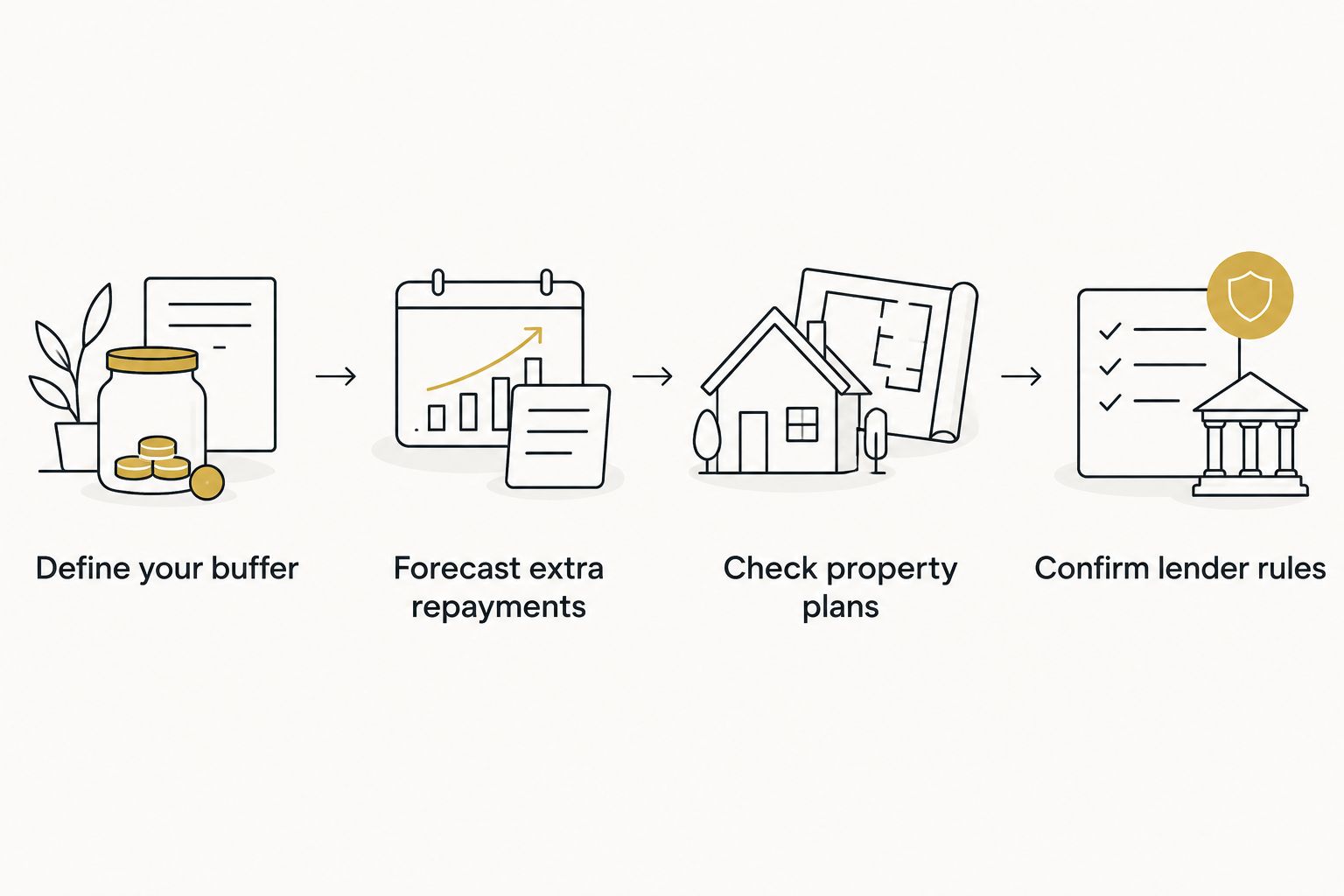
This process helps turn a general preference into an application brief. Mortgage Pros can discuss your home loan needs and approval requirements alongside the split structure.
Discuss your split loan options
Explain your income, savings and property plans before choosing a fixed–variable allocation.
What medical borrowers should check
For doctors comparing split loans in 2026, income assessment and loan structure are separate decisions. Confirm what the lender requires for salary, overtime, on-call payments, locum work or private-practice income where relevant to your application.
An expected future increase in earnings is not the same as income accepted in a credit assessment. Prepare evidence for the income you want considered and ask how each component will be treated.
Mortgage Pros specialises in home loans for doctors, dentists and surgeons. Discuss your employment arrangements as well as your preferred fixed–variable allocation; choosing a split does not establish eligibility for a professional lending policy.
How these options are ranked
The balanced split is the default starting point because it keeps both certainty and flexibility in the discussion. The variable-heavy and fixed-heavy options then address borrowers with a clearer priority.
This is a structure-based buying guide, not a claim that a particular lender has the strongest current offer. The criteria are income suitability, savings access, additional repayments, exit flexibility and fixed-term expiry arrangements.
Which split loan should you choose?
Start with a balanced split assessment, then adjust it to your expected savings and property plans. Choose a variable-heavy structure when flexibility is the main requirement; choose a fixed-heavy structure when defined-term repayment certainty matters more.
For your 2026 comparison, ask for the same scenario across suitable lenders and review both portions together. A strong feature on one account does not cancel an unsuitable restriction on the other.
FAQ
What’s the best split loan lender in Australia?
The best split loan lender is the one whose credit criteria and product conditions fit your circumstances. Compare the same borrowing scenario across suitable lenders, including offset access, extra repayments and fixed-loan exit conditions.
Is a split home loan better than a fully variable loan?
A split home loan suits borrowers who want some fixed-rate certainty while retaining a variable portion. A fully variable loan leaves the entire balance exposed to variable-rate changes and avoids a fixed portion’s restrictions.
Should I split my home loan equally?
An equal split is not automatically the right choice. Set the allocation after reviewing accessible savings, expected extra repayments, budgeting needs and property plans.
Can I have an offset account with a split home loan?
An offset account can be available with an eligible portion of a split home loan. Confirm which account it links to and read the specific product conditions rather than assuming both portions support it.
Can I refinance the fixed portion before it expires?
Refinancing before a fixed period expires can trigger break costs under the loan contract. Request a current payout figure and compare the consequences before proceeding.
Can doctors apply for split home loans?
Doctors can apply for split home loans subject to lender eligibility and credit assessment. The lender still needs to assess the applicant’s income, expenses, debts and supporting documents.
What happens when the fixed part of a split loan ends?
The loan contract determines what happens when the fixed period ends. Review the lender’s expiry notice and discuss the available arrangements before the expiry date.
One last thing
Your variable portion and your savings plan need to work together. A large cash balance does not automatically offset interest on the fixed portion just because both loans sit with the same lender.
Before signing, ask the lender to show exactly which account receives the offset benefit. Contact Mortgage Pros today to discuss a split home loan around your income, cash buffer and property plans.
Related guides
- Best offset home loan accounts
- Refinancing before your fixed-rate term ends
- Choosing a doctor mortgage broker for complex income