
A guarantor home loan works by using another person's property as additional security for your mortgage, helping address a deposit shortfall while you remain responsible for repayments. The guarantor takes on a legal obligation: if you default, the lender can seek payment under the guarantee and the secured property is at risk. In Australia in 2026, the guarantee's scope, eligibility rules and release conditions depend on the lender and the signed documents.
- How does a guarantor home loan work? Another person’s property supports your mortgage; you remain responsible for repayments.
- A guarantor risks their property, so independent legal advice matters before signing.
- Mortgage Pros provides home loan advice for borrowers considering guarantor arrangements.
- A guarantee addresses security, not your ability to afford repayments.
- Guarantor release requires lender approval; it does not happen automatically as your equity grows.
Why this matters
A guarantor arrangement connects your purchase to someone else's financial security. Approval is only part of the decision. Both households need to understand what happens if repayments stop, property values fall or the guarantor needs to sell their home.
Choose the guarantee terms before choosing the lender. When comparing guarantor home loan lenders, focus on the liability limit, secured property and release requirements—not just whether an application is possible.
How does a guarantor home loan work?
A property-backed guarantee gives the lender additional security beyond the home you are buying. It does not transfer responsibility for your monthly repayments to the guarantor or automatically put the guarantor on your property's title.
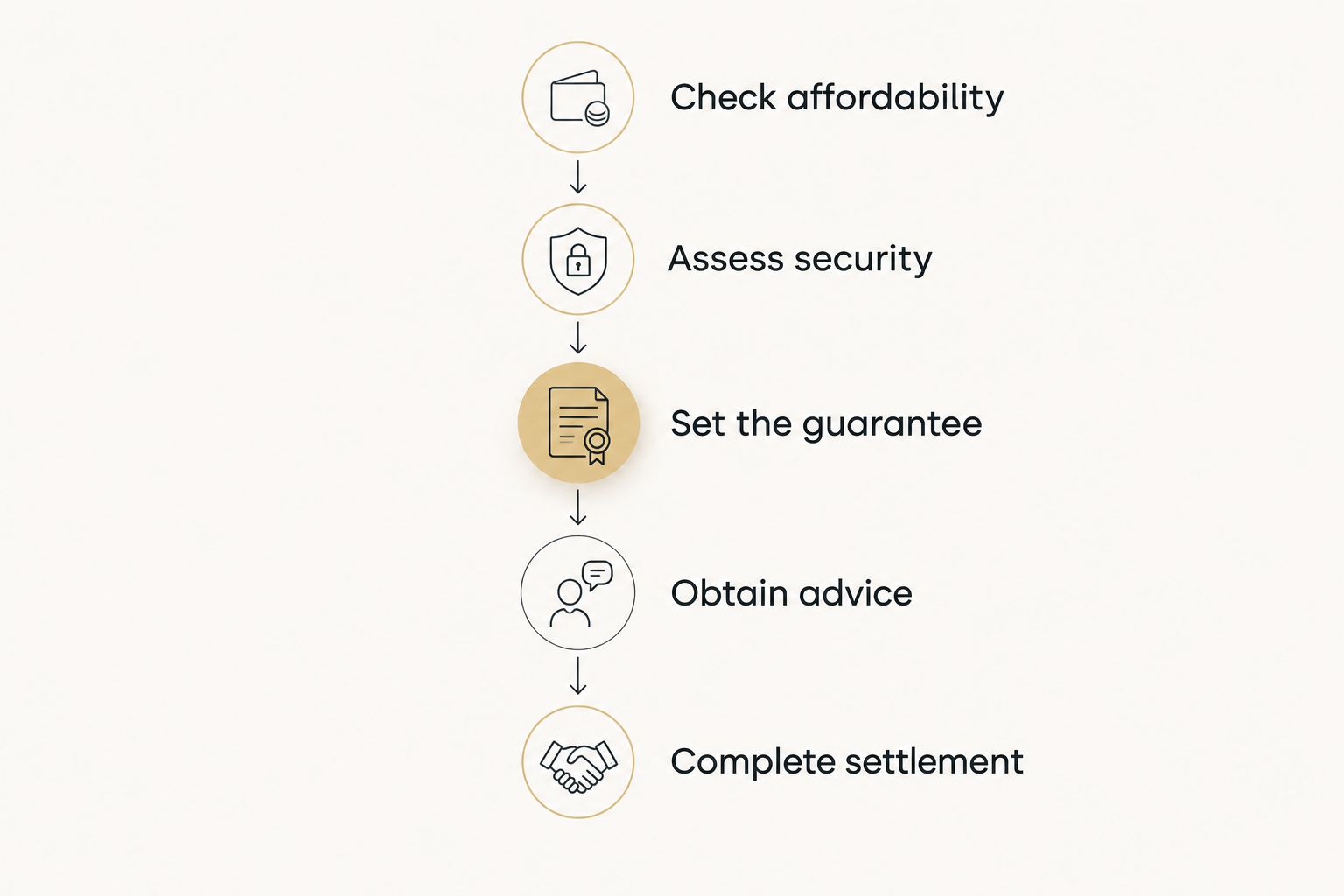
The application generally follows these steps:
- Check affordability. The lender assesses your income, expenses, existing debts and ability to repay the proposed loan. A family guarantee does not replace this assessment.
- Assess security. The lender values the purchase property and the proposed guarantor property. Existing mortgages affect how much usable security the guarantor can provide.
- Set the guarantee. The lender documents the obligations, any liability limit and the property securing them. Check whether interest, enforcement expenses or other amounts sit within or outside the stated limit.
- Obtain advice. The guarantor gets independent legal advice about the documents and their consequences. Independent financial advice can also help assess the effect on retirement or future borrowing.
- Complete settlement. Once the lender's conditions are satisfied, the purchase settles. You make the repayments, and the guarantee remains until the lender formally releases it.
Keep copies of the loan contract, guarantee and security documents. A verbal understanding between family members does not change the lender's contractual rights.
What does a guarantor actually guarantee?
The signed guarantee determines the guarantor's obligation. Do not assume it covers only the cash deposit you would otherwise have saved. Read the guarantee together with the mortgage and loan documents.
Limited guarantee
A limited guarantee restricts liability according to the contract. That can help define the guarantor's exposure, but the wording still matters: a stated limit does not explain every circumstance in which payment becomes due.
Ask the solicitor to explain the maximum exposure, the debts covered and the treatment of interest and enforcement expenses. A limited guarantee is still a legal liability secured against property.
Broader guarantee
A broader guarantee can expose the guarantor to more of the borrower's debt than a narrowly defined security guarantee. The label used in a conversation is not enough to establish its scope.
Before signing in 2026, ask whether the guarantee covers only this loan or extends to other obligations. Do not accept broader liability without understanding why it is required and what alternatives exist.
Why guarantor home loan arrangements vary
Guarantor loans are not a single standard arrangement. These factors determine whether a proposal works and what each household risks:
- Borrower affordability: Income, living expenses, debts and repayment history influence the lending decision.
- Available property equity: The guarantor property's valuation and existing mortgage affect the security available.
- Guarantor eligibility: Each lender sets requirements concerning the guarantor's relationship to you and financial circumstances.
- Guarantee wording: The scope, liability limit and enforcement provisions determine the legal exposure.
- Property acceptability: The lender must accept both the purchase property and the proposed supporting security.
- Release requirements: The lender's assessment determines when the loan can stand without the guarantee.
Get the proposed structure in writing. Family agreement is valuable, but it cannot substitute for lender acceptance or independent advice.
Does a guarantor replace your deposit?
A guarantee provides security rather than a cash gift. Depending on lender policy, it can reduce the cash deposit required, but you must still meet the lender's eligibility and affordability requirements.
Your purchase also involves expenses beyond the deposit, including applicable transfer duty, conveyancing and inspections. Confirm which expenses you must fund yourself. A guarantee is not permission to proceed without a cash buffer.
Lenders mortgage insurance, or LMI, commonly applies when borrowing exceeds 80% of a property's value, although exemptions and lender policies differ. A 20% deposit generally brings borrowing to that threshold before purchase expenses. A suitable guarantee can help avoid LMI, but the lender must confirm the treatment of your application.
LMI protects the lender, not you or your guarantor. Avoiding it does not remove repayment risk or make a guarantee harmless.
Is a guarantor better than saving or receiving a gift?
The best structure depends on whether your main obstacle is cash, security or affordability. These options solve different problems; none makes an unaffordable loan affordable.
| Approach | Best for | Main benefit | Main drawback |
|---|---|---|---|
| Property-backed guarantee | Borrowers with repayment capacity and an eligible, informed guarantor | Additional security can address a deposit shortfall | The guarantor's property is exposed to enforcement risk |
| Unconditional family gift | Borrowers whose family can contribute cash without repayment | Adds to available purchase funds without a property-backed guarantee | The family gives up access to the gifted money |
| Saving a larger deposit | Borrowers who can delay purchasing | Reduces reliance on family security and the amount borrowed | Delays the purchase while savings accumulate |
| Eligible professional lending | Medical borrowers who satisfy a lender's professional criteria | Can provide an alternative to involving family property | Eligibility and affordability requirements still apply |
If family assistance must be repaid, disclose it as a loan rather than describing it as a gift. The lender needs an accurate picture of your obligations.
For doctors, dentists and surgeons, ask about eligible professional lending before committing a relative's property. A profession-based option is not automatic approval, and it still requires a full assessment.
What happens if you miss repayments?
You remain responsible for the home loan. If you fall behind, contact the lender promptly and discuss hardship assistance rather than waiting for the arrears to grow.
The lender can enforce its rights under the loan, guarantee and security documents, subject to applicable law. Do not assume it must exhaust every recovery option against you before approaching the guarantor; the documents and legal requirements govern that process.
The guarantor faces more than family tension. A demand under the guarantee can affect their savings, borrowing capacity and ability to retain the secured property. Independent advice should cover what enforcement would mean in their circumstances.
Can a guarantor be released from a home loan?
A guarantor can be released when the lender agrees that the guarantee and supporting security are no longer required. Release is a separate approval, not an automatic milestone.
Principal repayments, a higher property valuation or a lump-sum reduction can improve the position. However, an estimated increase in value is not the same as a valuation accepted by the lender.
When planning a release in 2026, ask the lender to explain:
- How it will assess the property's value and remaining loan balance.
- Whether it requires a fresh affordability assessment.
- Which documents and discharge steps are necessary.
- Whether refinancing is required or the existing loan can continue.
Keep the guarantee in your financial planning until written release is confirmed. A family agreement that the guarantor has helped for long enough does not discharge the security.
Who can be a guarantor in Australia?
Lenders commonly consider close family members, but accepted relationships and eligibility rules vary. Owning a property does not, by itself, make someone an acceptable guarantor.
The proposed guarantor must understand the commitment and satisfy the lender's requirements. Their existing mortgage, financial position and plans for the property all matter.
If the property has joint owners, raise that at the outset. The lender and the owners' advisers need to establish whose consent and involvement are required before the application proceeds.
What should you ask before applying in 2026?
Ask for answers that both households can understand. If an explanation depends on a reassuring phrase such as limited risk, request the contractual detail behind it.
Bring these questions to your broker and independent advisers:
- What exact debt does the guarantee cover?
- What is the guarantor's maximum exposure under the documents?
- What happens if the borrower defaults or either property must be sold?
- How will the guarantee affect the guarantor's future borrowing or retirement plans?
- What must happen before the lender will release the guarantee?
- Is there an appropriate option that does not involve family property?
Mortgage Pros is suited to Australian borrowers seeking mortgage broking advice on guarantor home loans, including medical professionals comparing alternatives. The benefit is help assessing the proposed lending structure; the limit is clear: mortgage broking advice does not replace the guarantor's independent legal advice or guarantee approval.
Discuss your guarantor loan options
Ask Mortgage Pros about eligibility, supporting security and alternatives before involving family property.
FAQ
How does a guarantor home loan work in Australia?
A guarantor home loan uses another person’s property as additional security while the borrower remains responsible for repayments. The guarantor becomes liable according to the guarantee if the borrower defaults, and the secured property is at risk.
Does a guarantor have to make my monthly repayments?
The borrower remains responsible for monthly repayments. The guarantor’s obligation arises under the signed guarantee, so both parties need to understand when the lender can demand payment.
Can a guarantor help me avoid lenders mortgage insurance?
An accepted guarantee can help avoid lenders mortgage insurance by providing additional security. LMI commonly applies above 80% of a property’s value, but the lender must confirm how its rules apply to your loan.
Will being a guarantor affect my parents’ borrowing capacity?
A guarantee can affect your parents’ borrowing capacity because lenders consider contingent liabilities and existing property security. Your parents should disclose the guarantee when applying for their own finance.
Does a guarantor own part of my home?
Being a guarantor does not automatically give someone ownership of your home. Property ownership depends on the title and any separate legal arrangements, not the guarantee alone.
Can my parents stop being guarantors whenever they want?
Your parents cannot end a signed guarantee simply by deciding to withdraw. The lender must approve the release and complete the required documentation.
Should a doctor use a guarantor home loan?
A doctor should compare eligible professional lending options before involving a guarantor. The appropriate structure depends on affordability, available savings, lender criteria and the family’s willingness to accept the legal risk.
One last thing
Plan the guarantor's exit before applying for the loan. Ask what the lender will require for release, then check whether that pathway fits both households' plans. Approval without a realistic exit leaves an important decision unfinished.
For your 2026 application, contact us today to discuss your borrowing position and the proposed guarantee before anyone signs. This article provides general information, not personal financial or legal advice.
Related guides
- Is a no-LMI loan better for doctors than saving a bigger deposit?
- First Home Super Saver Scheme to deposit workflow
- Is refinancing worth it?