
Yes, you can get a home loan with bad credit in Australia, but approval depends on the credit issue, your current finances and the lender’s criteria. In 2026, a paid default or an isolated missed repayment does not automatically rule you out; you still need to demonstrate that you can afford the proposed loan.
- Can I get a home loan with bad credit? Yes, but approval depends on lender criteria and affordability.
- Check your credit reports before applying; a paid default does not disappear immediately.
- Compare applying now with improving your repayment history first, rather than submitting applications to multiple lenders.
- Mortgage Pros provides home loan advice for borrowers who want help preparing an application.
Why this matters
The right next step is a credit assessment, not another loan application. A lender needs to understand what happened, whether the problem is resolved and whether your current budget supports the repayments. A credit score alone does not answer those questions.
Before applying, contact Mortgage Pros to discuss your home loan circumstances. Bring your credit reports and supporting documents so the conversation addresses the actual issue rather than a general description of bad credit.
Can I get a home loan with bad credit in Australia?
Yes. Australian lenders assess home loan applications against their own credit policies, so an issue that falls outside one lender’s criteria does not necessarily fall outside every lender’s criteria. However, an application still needs to meet affordability and other lending requirements.
Bad credit is not a single lending category. An overdue account that remains unpaid presents a different situation from an old, paid default followed by consistent repayments. Recent financial difficulty also needs a different explanation from an incorrect entry on your credit report.
Use the following comparison to decide what to investigate, not as a promise that a particular pathway will secure approval.
| Pathway | Best for | Main advantage | Main limitation |
|---|---|---|---|
| Mainstream lender assessment | Borrowers whose credit history fits the lender’s policy | Tests whether a standard home loan is suitable | Credit issues can fall outside policy |
| Specialist lender assessment | Borrowers whose circumstances need a different credit policy | Provides another assessment pathway | Loan terms and conditions need careful comparison |
| Prepare before applying | Borrowers with unresolved debts or unstable repayments | Gives you time to address the underlying problem | Delays your purchase or refinance |
| Credit report correction | Borrowers with inaccurate information on their file | Addresses errors before a lender assesses them | Does not remove accurate negative information |
Choose a pathway based on your documented circumstances, not a lender’s advertising or an online score. Ask what information is needed for an initial assessment and whether that stage involves a credit enquiry.
What does bad credit mean for a home loan application?
A lender looks beyond the label. Your report can contain repayment history, defaults, credit enquiries and public-record information, while your application supplies income, expenses, assets and liabilities.
Missed repayments
Repayment history shows how you have managed credit accounts. Under Australia’s credit reporting framework, repayment history information generally remains on your credit report for 2 years. An isolated missed payment needs to be considered alongside its timing, cause and the repayments that followed.
Check that your account statements agree with the report. If you believe a payment was recorded incorrectly, gather evidence before requesting a correction.
Defaults
A default is different from an ordinary late payment. Default information generally remains on an Australian credit report for 5 years, including when the debt is subsequently paid; the record should reflect the payment status.
Paying the debt addresses the outstanding obligation, but it does not erase an accurate listing. Keep the settlement confirmation and check that the reporting has been updated correctly.
Credit enquiries
Applications for credit can leave enquiries on your report. Credit enquiry information generally remains for 5 years, so applying repeatedly is not a useful way to discover which lender might accept your circumstances.
The Office of the Australian Information Commissioner’s consumer credit reporting guidance explains these retention periods. For a 2026 application, use the dates and information on your own reports rather than assuming that an old account has already disappeared.
Bankruptcy and other serious credit events
Bankruptcy, insolvency arrangements and court-related information need individual assessment. Do not assume that the retention periods for ordinary defaults apply to every type of record.
Tell your adviser about the event before an application is prepared. Supply the relevant documents and dates so the lender can assess the correct circumstances.
Why home loan eligibility varies with bad credit
Lenders do not assess credit history in isolation. These factors help explain why applicants with similar credit scores can receive different decisions:
- Type of issue: A repayment delay, a default and a bankruptcy record are different events, not interchangeable versions of bad credit.
- Recency and pattern: A recent sequence of missed payments tells a different story from an isolated older problem.
- Resolution: Evidence that a debt has been paid or an error corrected helps establish the current position.
- Income and expenses: Your proposed repayments must fit your financial circumstances, including existing commitments and living costs.
- Deposit or equity: The amount you need to borrow relative to the property’s value affects the application, but does not replace affordability checks.
- Lender policy: Each lender sets acceptance criteria, including how it treats particular credit events and supporting evidence.
A larger deposit does not cancel out an unaffordable loan. Equally, a strong income does not make an unresolved default irrelevant. Prepare evidence for the whole application rather than trying to compensate for every weakness with one strong feature.
How do I prepare a bad-credit home loan application?
For a 2026 application, prepare the evidence before choosing where to apply. The following sequence separates report problems from borrowing-capacity problems and helps you avoid an application built on incomplete information.
1. Check reports
Obtain your credit reports and read the account details, payment records, enquiries and default dates. Reports can differ between credit reporting bodies, so do not rely solely on the score displayed in a banking app.
Identify which entries are accurate and which need investigation. Record the creditor, account status and supporting documents for each issue.
2. Correct errors
Dispute inaccurate information through the relevant credit provider or credit reporting body. Keep copies of your correspondence and the evidence supporting the correction request.
ASIC’s Moneysmart guidance on credit repair explains that you can seek corrections yourself without paying a credit repair company. Accurate negative information is not removable simply because it makes borrowing harder.
3. Document recovery
Prepare a factual explanation of what caused the problem and what changed. Attach evidence such as payment confirmations, updated account statements or documents showing the end of a temporary income interruption.
Keep the explanation specific. A lender needs to assess the account history and current position, not a lengthy personal narrative without supporting records.
4. Review affordability
Bring together income evidence, existing debt balances, credit limits and actual living expenses. Include commitments that continue after settlement rather than presenting a budget that only works if those costs disappear.
For doctors, dentists and surgeons, separate the credit issue from the income assessment. Hospital employment, locum work and private practice income require appropriate documentation; professional status does not remove the need to meet credit requirements.
5. Assess fit
Ask which lender criteria are relevant before authorising an application. Confirm what remains uncertain and what additional evidence the lender needs.
An initial discussion is not an approval. Check whether any proposed assessment involves a credit enquiry, and do not treat conditional feedback as permission to make an unconditional purchase commitment.
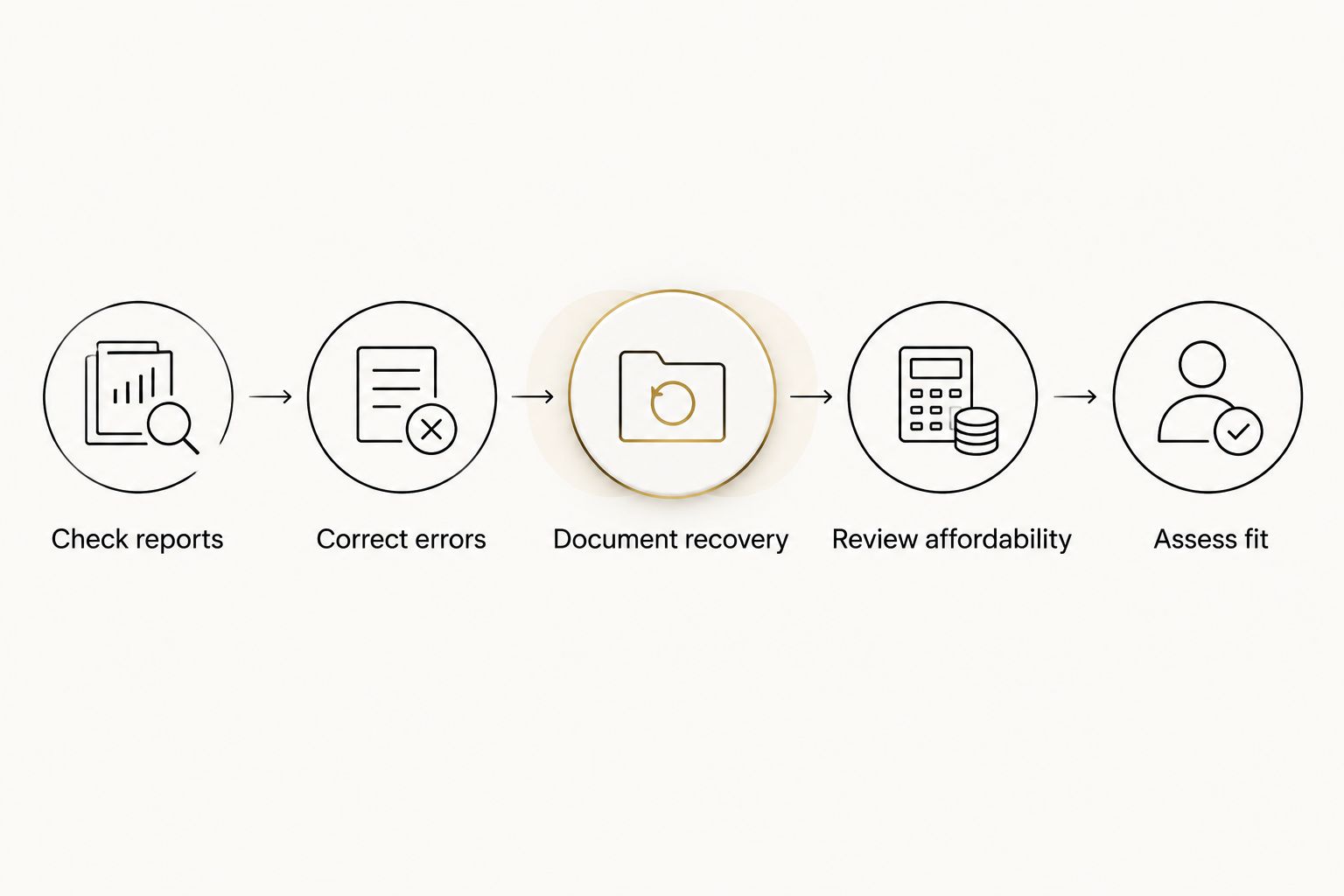
A prepared file makes the discussion more useful, but it does not guarantee approval. The aim is to identify a suitable application, or a clear reason to wait, before you submit it.
Discuss your home loan application
Ask Mortgage Pros about your credit history, income evidence and next application steps.
Should I apply now or improve my credit history first?
Apply only after you understand the issue and have checked whether your circumstances fit a lender’s criteria. Waiting is useful when it addresses a specific problem, such as outstanding arrears, incomplete records or a budget that does not support repayments.
Waiting without a plan is different. Ask what needs to change, what evidence will demonstrate the change and when it makes sense to reassess. Do not rely on a promise that a particular credit score will guarantee approval.
For a 2026 decision, compare the consequences of proceeding with the consequences of waiting. Your objective is a manageable home loan, not an approval that leaves your household without room for ordinary expenses.
Does paying a default help me get a home loan?
Paying a default does not remove its accurate listing, but it changes the debt’s status. Keep proof of payment and check that the report reflects the updated position.
The lender still decides whether that default fits its policy. Its age, the circumstances behind it, your subsequent conduct and your current financial position remain relevant. Do not assume that paying a default immediately creates eligibility for every home loan.
Can a bigger deposit or guarantor overcome bad credit?
A bigger deposit or a guarantor does not erase your credit history or replace affordability checks. A deposit reduces the amount you need to borrow, while a guarantee creates a separate obligation for the guarantor.
A guarantor arrangement also needs its own suitability and risk assessment. Do not ask a family member to provide security on the assumption that it automatically solves a credit problem; the borrower and guarantor both need to understand the proposed arrangement.
What should I compare if a lender will consider my application?
Eligibility is only the first filter. Before accepting a loan in 2026, read the proposed terms and ask how the loan works during repayment and if your circumstances change.
Check the following points:
- Repayment structure: Understand whether repayments reduce principal, when they fall due and whether the structure suits your income pattern.
- Loan features: Check whether features you need are included and whether restrictions apply to their use.
- Ongoing obligations: Understand what you must maintain or provide after settlement.
- Exit conditions: Ask what applies if you sell, repay early or seek to refinance.
- Refinancing assumptions: Assess the loan on its current terms rather than assuming another lender will accept you later.
A future refinance is another credit decision, not an automatic next step. An acceptable application today does not establish what your income, property value or lender criteria will look like later.
FAQ
Can I get a home loan with bad credit in Australia in 2026?
Yes, a home loan is possible with bad credit, but approval depends on your credit history, current financial position and the lender’s criteria. Check your reports and obtain an assessment before submitting an application.
How long does a paid default stay on my credit report?
A default generally stays on an Australian credit report for 5 years, even after payment. The record should be updated to show that it has been paid.
How long do missed repayments stay on my credit report?
Repayment history information generally stays on an Australian credit report for 2 years. A lender considers that history alongside the rest of your application.
Will checking my own credit report hurt my credit score?
Checking your own credit report does not create a lender credit application enquiry. Reviewing it before applying helps you identify errors and understand the information a lender will assess.
Can I remove accurate bad credit from my report?
You cannot require accurate negative information to be removed simply because it affects a loan application. You can request correction of information that is inaccurate, incomplete or otherwise incorrectly recorded.
Can a doctor get a home loan with bad credit?
A doctor can be considered for a home loan with bad credit, subject to lender criteria and affordability. Medical employment does not override credit requirements; income evidence and the credit issue both need assessment.
Can Mortgage Pros help me understand my next home loan step?
Mortgage Pros provides home loan advice and approval support. Contact the team with your credit reports, income evidence and current commitments to discuss your circumstances; approval remains subject to lender assessment.
One last thing
Your credit report and your credit score are not the same thing. A score summarises information; the report lets you identify the specific account, date or status that needs attention.
Before your next application, prepare a short summary of each credit issue, its current status and the evidence supporting it. Ask for a clear next action: proceed with an assessed application, correct a report entry or address a financial problem first. Contact us today to discuss that next step.
This article provides general information, not personal credit advice. Your circumstances and lender criteria determine the appropriate course of action.
Related guides
- How to choose a doctor mortgage broker for complex income
- How long does mortgage pre-approval take?
- Is refinancing worth it?