
The cost to refinance a home loan in 2026 is the total of your existing lender’s exit charges, the new loan’s setup charges, government registration fees and any applicable break cost or lenders mortgage insurance. The less obvious cost is interest: adding fees to your loan or restarting a longer repayment term can reduce the benefit of switching.
- How much does it cost to refinance a home loan? Add exit, setup, registration and applicable insurance charges.
- Compare refinancing against repricing your existing loan before paying switching costs.
- Fixed-rate break costs and a longer repayment term can change the outcome.
- Mortgage Pros provides home loan refinancing advice for individual borrowers and property investors.
How much does it cost to refinance a home loan in 2026?
Your refinancing cost is the sum of the charges that apply to your particular switch, not just the new lender’s application fee. Get an itemised exit estimate from your existing lender and a written fee breakdown for the proposed loan before deciding.
The calculation should separate upfront expenses from ongoing fees and interest. The guide to whether refinancing is worth it explains the broader decision; this page focuses on identifying the costs and checking when you recover them.
| Cost to check | When it applies | What to request |
|---|---|---|
| Discharge or settlement administration | When your existing lender closes and releases the loan | An itemised discharge estimate |
| Fixed-rate break cost | When you leave a fixed-rate arrangement early and a break charge applies | A calculation for your intended settlement date |
| Application or establishment fee | When the incoming lender charges to establish the loan | Written confirmation of the fee and any waiver |
| Property valuation | When the incoming lender charges for its valuation | Confirmation of whether the valuation is included |
| Mortgage registration and discharge | When the security is discharged and a new mortgage registered | The applicable state or territory charges |
| Legal or settlement work | When separate legal or settlement charges apply | An itemised settlement estimate |
| Lenders mortgage insurance | When the new lender requires insurance for the proposed borrowing | Confirmation of the premium or an approved exemption |
| Ongoing loan fees | When the replacement loan has recurring charges | The annual total for the features you will use |
Not every charge applies to every refinance. Ask which charges you must pay separately, which will be deducted at settlement and which would be added to the new balance.
Why this matters
A lower interest rate does not automatically make a refinance worthwhile. Switching costs, recurring fees and a longer repayment schedule can absorb the saving.
Compare the total cost over the same remaining loan term. If your main goal is lower repayments, distinguish between savings from a better rate and repayments reduced by spreading the debt over more years.
That distinction also protects your equity. Borrowing extra to cover switching costs leaves you owing more, even when you do not pay those costs from your bank account on settlement day.
Variable-rate refinancing: check exit and setup charges
A variable-rate refinance requires you to compare the outgoing loan’s discharge charges with the incoming loan’s establishment and ongoing fees. Do not assume that an advertised fee waiver removes every switching expense.
Ask your current lender for a payout estimate that separates the outstanding balance, accrued interest and exit charges. Your outstanding principal is debt being transferred, not itself a refinancing fee.
Then ask the new lender whether valuation, settlement and registration expenses appear in its estimate. A useful comparison shows the full transaction, rather than presenting the application fee as the total cost.
Best for: borrowers whose proposed savings or required loan features justify the switching expenses. The drawback is that a small rate improvement can take longer to recover those expenses.
Fixed-rate refinancing: obtain a dated break-cost quote
Breaking a fixed-rate loan can trigger a break cost under the loan contract. The amount depends on the contract and the lender’s calculation, so a discharge fee schedule alone is not enough.
Request a written break-cost quote for your expected settlement date. Confirm how long the quote remains valid and whether the calculation needs updating before settlement.
For a split loan, identify which portion is fixed and ask what happens if you refinance only the variable portion. Moving part of a loan is not simply an administrative choice; the lender’s security requirements also matter.
Best for: borrowers whose documented benefit from switching outweighs the applicable break and setup costs. The drawback is that leaving early can add a substantial expense that a headline rate comparison misses.
Repricing your existing loan: compare before switching
Ask your current lender to review your rate before committing to a refinance. Repricing changes the pricing of an existing loan; refinancing replaces the loan, often with another lender.
| Option | Best for | Main benefit | Main limitation |
|---|---|---|---|
| Reprice the existing loan | Borrowers satisfied with their current loan structure | Can avoid the costs associated with moving lenders | Does not necessarily change features or loan conditions |
| Refinance a variable loan | Borrowers seeking a different rate, structure or features | Allows a fresh comparison of suitable loans | Requires assessment and switching-cost checks |
| Refinance a fixed loan early | Borrowers with a clear reason to leave before expiry | Allows a change before the fixed period ends | An applicable break cost can reduce the benefit |
Obtain the existing lender’s revised offer in writing. Compare it with the proposed replacement loan using the same balance, remaining term and repayment type.
Do not switch solely because the new advertised rate is lower. Choose the option that meets your needs after fees, features and repayment timing are included.
Why refinancing costs vary
Your 2026 refinancing estimate needs to reflect the loan you are leaving, the property securing the replacement loan and the borrowing you request.
- Existing loan conditions: a fixed-rate arrangement introduces a different exit-cost question from a variable-rate loan.
- Property location: mortgage registration and discharge charges depend on the relevant state or territory.
- Loan-to-value ratio: the requested balance relative to the lender’s valuation affects whether lenders mortgage insurance needs checking.
- New loan features: an offset account or package can carry recurring fees that belong in the comparison.
- Settlement structure: multiple properties, loan splits or changes to security require a more detailed assessment.
- Capitalised expenses: adding eligible costs to the loan increases the balance on which interest is calculated.
These factors explain why another borrower’s refinance bill is not a reliable budget for your application. Your written estimate should identify the assumptions behind each charge.
How to calculate your refinancing break-even point
The break-even point is when the saving from the replacement loan has recovered your switching costs. It is useful, but it does not replace a comparison of total interest over the remaining term.
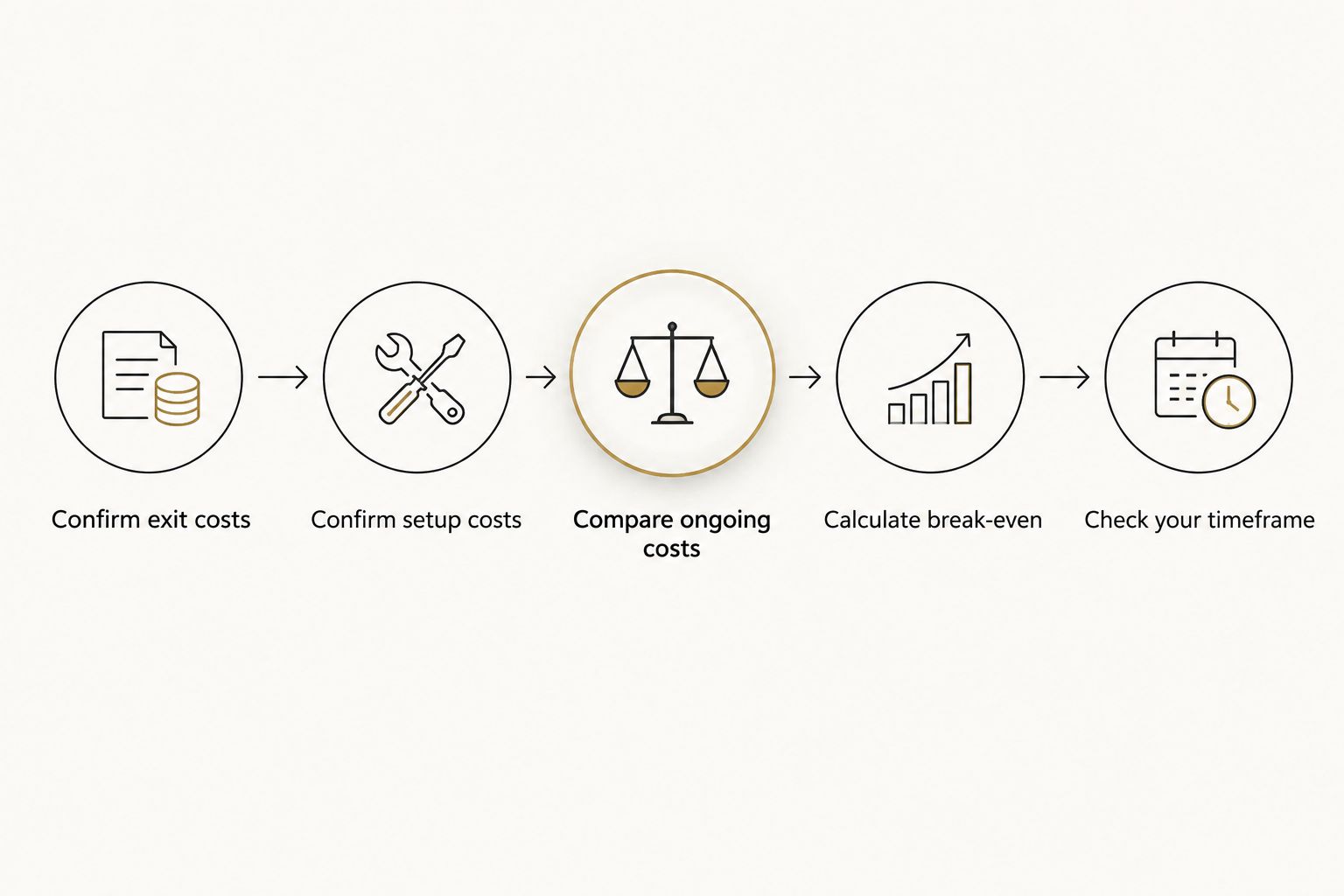
Use this sequence before authorising a move:
- Confirm exit costs. Obtain an itemised payout and discharge estimate, including any fixed-rate break charge.
- Confirm setup costs. Collect the proposed loan’s application, valuation, settlement and registration charges.
- Compare ongoing costs. Include recurring fees and compare interest using the same balance and remaining term.
- Calculate break-even. Divide total switching costs by the monthly saving after allowing for recurring fees.
- Check your timeframe. Compare that recovery period with how long you expect to keep the replacement loan.
A break-even calculation assumes the saving continues. Variable rates, changing balances and changes to how you use an offset account can alter the outcome.
For your 2026 comparison, keep the assumptions visible beside the result. Record whether the calculation holds rates constant, includes recurring fees and preserves your existing repayment term.
If the replacement loan does not produce a positive ongoing saving, there is no savings-based break-even point under those assumptions. You would need a separate reason for switching, such as a required change to the loan structure.
What should doctors check before refinancing?
Medical borrowers should check whether the replacement loan preserves any profession-based terms attached to their existing lending. Do not assume that an existing lenders mortgage insurance exemption transfers automatically to another lender.
If you are moving from hospital employment into private practice, locum work or self-employment, discuss income documentation before arranging the discharge. A favourable rate is only useful if the replacement loan meets the lender’s assessment requirements.
The guide to refinancing a doctor home loan to a standard loan covers the specific comparison medical borrowers need to make.
Mortgage Pros provides home loan refinancing advice for doctors who need their borrowing circumstances assessed before switching. Ask for a comparison that includes exit charges, proposed lending conditions and the remaining repayment term—not just a rate.
Check your refinancing costs today
Ask Mortgage Pros to assess your current loan, switching costs and refinancing options.
Can you add refinancing costs to the new loan?
Some refinancing expenses can be included in the replacement borrowing, subject to lender approval and available equity. This changes how you pay the expense; it does not remove it.
Ask for the proposed opening balance before accepting the loan. Compare it with the amount required to repay your existing lender, and have every difference explained.
Paying a fee through your mortgage means borrowing that fee. Interest then applies under the new loan’s terms, which can make the eventual cost greater than the original expense.
Also check whether the increased balance changes the loan-to-value ratio or insurance position. A convenient settlement arrangement should not obscure a larger debt.
Does a lower repayment mean refinancing is cheaper?
A lower repayment does not prove that refinancing reduces your total borrowing cost. Extending the term spreads repayment of the principal over a longer period and can increase total interest.
Request a comparison that keeps your current remaining term unchanged. Then review a longer-term option separately if cash-flow relief is your priority.
Both objectives are legitimate, but they answer different questions. Label the decision clearly: lower total cost, lower required repayments, or a change in loan features.
Should you wait until your fixed rate ends in 2026?
Compare the cost of leaving now with the cost of staying until expiry. Include any applicable break charge, the repayments before expiry and the loan terms available after the fixed period ends.
Waiting avoids an early-exit decision, but it does not establish that the eventual replacement loan will be cheaper. Future rates are not guaranteed.
Ask for a dated assessment rather than relying on an old break-cost estimate. Review the position again if the proposed settlement date changes.
FAQ
How much does it cost to refinance a home loan in Australia?
Refinancing costs consist of the applicable exit, establishment, valuation, settlement, registration and insurance charges. Obtain itemised estimates from both lenders and check ongoing fees separately.
Do I have to pay lenders mortgage insurance again when refinancing?
A replacement lender can require lenders mortgage insurance based on its assessment of the new loan. Do not assume insurance paid on your previous loan or an existing exemption carries across.
Can I refinance without paying a fixed-rate break cost?
A fixed-rate break cost depends on your contract and the lender’s calculation when you leave. Request a dated quote rather than assuming that a charge always applies or that none will apply.
Is refinancing cheaper than asking my bank for a better rate?
Refinancing is not automatically cheaper than repricing your existing loan. Compare the revised offer from your current lender against the replacement loan after switching costs and recurring fees.
Will refinancing fees be paid upfront or at settlement?
Payment timing depends on the fee and the settlement arrangement. Ask which amounts you must pay separately, which are deducted at settlement and which are included in the new borrowing.
Can a mortgage broker help me compare refinancing costs?
A mortgage broker can help assess refinancing options and compare relevant costs and loan conditions. Ask Mortgage Pros to explain the proposed balance, remaining term, applicable fees and any charges for the advice or service.
One last thing
Before signing your 2026 refinance documents, compare the proposed opening balance with your current payout figure. That simple check can expose capitalised charges or extra borrowing hidden behind a lower repayment.
Ask for a written explanation of the difference before you authorise settlement. Contact us today to discuss your refinancing costs and the outcome you want from the replacement loan.
Related guides
- Best offset home loan accounts
- Best refinance home loan deals
- How to choose a doctor mortgage broker for complex income