
There is no single minimum income for an investment property loan in Australia in 2026: you need enough lender-accepted income to cover the proposed repayments, existing debts and assessed living expenses. Expected rent can support your application, but lenders do not necessarily count every dollar, and you must also budget for property expenses and periods without tenants.
- How much income do I need for an investment property loan? Enough accepted income to meet the lender’s repayment assessment.
- Mortgage Pros provides investment property loan advice for individual borrowers and investors across Australia.
- Rental income helps borrowing capacity, but gross rent is not the same as money available for repayments.
- Check income evidence, existing debts and property expenses before committing to a purchase.
How much income do I need for an investment property loan?
Your required income depends on the loan and your household commitments, not a universal salary threshold. A lender assesses whether your accepted income can support the proposed debt alongside your existing obligations.
Start with the income you can document. Then separate the amount you receive from the amount a lender will accept for its assessment.
| Income source | How it supports an application | Main limitation |
|---|---|---|
| Employment salary | Provides evidence of recurring earnings | Employment circumstances and deductions affect assessment |
| Overtime and allowances | Can supplement base salary when accepted | Treatment depends on consistency, evidence and lender policy |
| Self-employed earnings | Can demonstrate income from your business | Business turnover is not your personal assessable income |
| Rental income | Helps support investment loan repayments | Lenders can discount rent and assess property expenses |
For a personal assessment, contact Mortgage Pros with your income documents, existing loan details and intended purchase budget. Ask for an explanation of which income sources the assessment includes, rather than only a maximum borrowing figure.
Why this matters
A salary figure alone cannot tell you whether an investment property is affordable. Borrowers with similar earnings can have different borrowing capacities because their debts, dependants, deposits and income evidence differ.
In 2026, treat an online borrowing estimate as a starting point, not approval. A lender still needs to assess your application, and the proposed property must meet its requirements.
Keep these questions separate:
- Can I qualify? This depends on the lender’s assessment.
- Can I manage the repayments? This depends on your actual household and property cash flow.
- Can I handle interruptions? This depends on the funds available if income or rent stops.
Passing the first test does not answer the other questions. Set a purchase budget that leaves room for ownership costs, not just scheduled repayments.
Why the income you need varies
Your income requirement changes with the size and structure of your application. These factors explain why a generic minimum salary is not a reliable buying target:
- Loan amount: Borrowing more increases the repayment commitment your income must support.
- Existing debts: Your home loan, personal loans and credit facilities affect the assessment.
- Living expenses: Household spending and dependants reduce the income available for debt repayments.
- Income consistency: A regular salary and fluctuating business earnings require different supporting evidence.
- Rental income: The lender’s accepted rental amount can differ from the advertised or expected rent.
- Loan structure: The term and repayment arrangement affect repayments and how affordability is assessed.
Do not change these details simply to make a calculator produce a larger result. Use accurate figures and ask which factor is limiting your borrowing capacity.
How do I work out whether my income is enough?
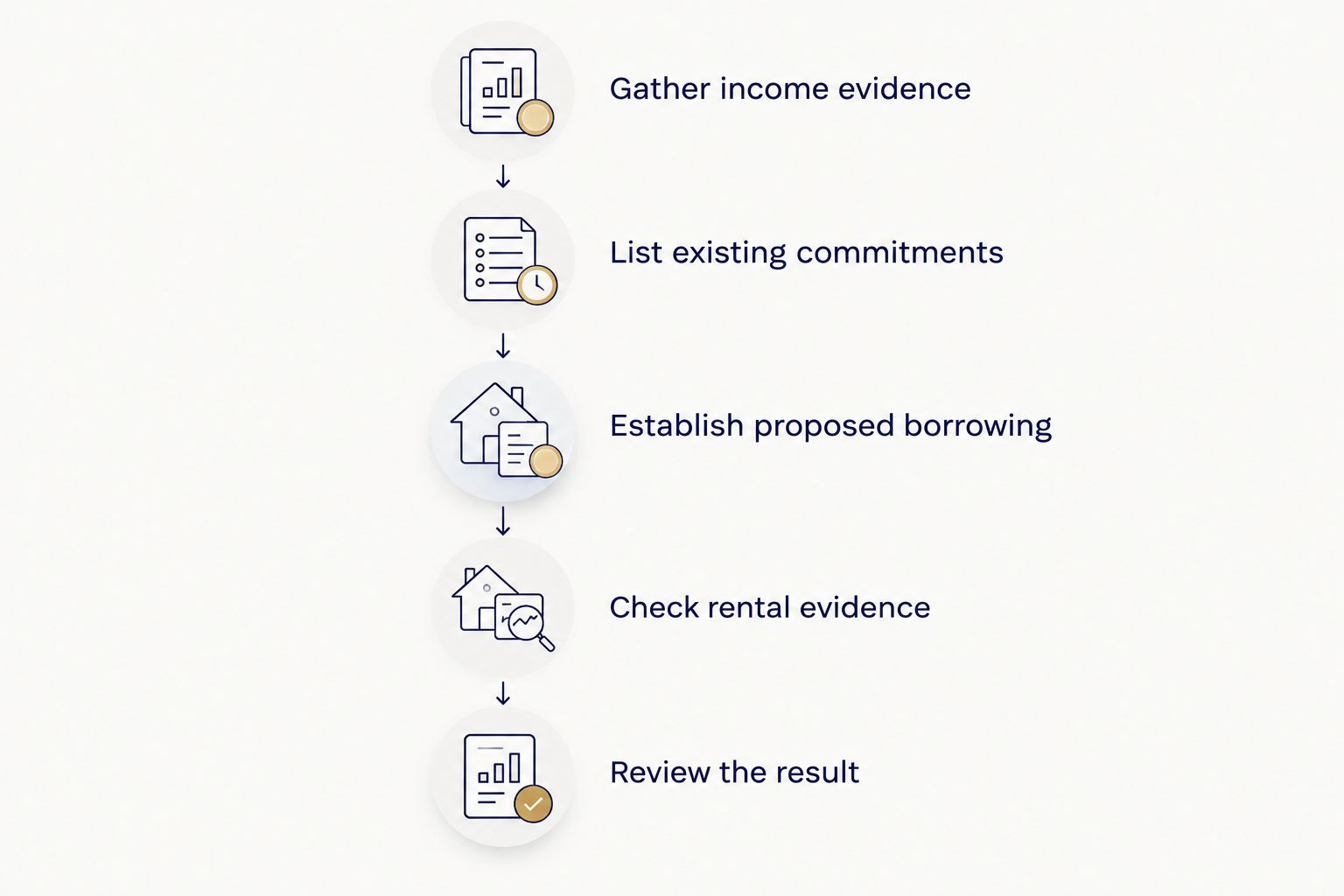
Use this sequence before you choose a property. It gives a broker or lender the information needed to assess your position without relying on a salary-only estimate.
Gather income evidence
Collect current payslips and documents showing how you are paid. If you receive overtime, allowances, business income or rent, identify each source separately rather than presenting one combined total.
For self-employed borrowers, prepare tax and business financial documents relevant to the assessment. Ask what evidence is required before assuming your latest turnover represents usable personal income.
List existing commitments
Record your home loan, other mortgages, personal loans and credit facilities. Include the limits on credit cards, not just the balances you currently owe.
List recurring household expenses accurately. An assessment based on understated spending will not give you a dependable purchase budget.
Establish the proposed borrowing
Separate your deposit from the funds needed for purchase costs and your remaining cash buffer. Money allocated to one purpose is not also available for another.
If you intend to borrow against an existing property, include that additional debt in the assessment. Equity can provide security or deposit funds, but it is not earnings.
Check rental evidence
Obtain appropriate evidence of the proposed property’s rent. An existing lease or rental appraisal helps establish the rental figure for assessment, subject to lender requirements.
Ask how much rent is accepted and which expenses are included. Do not assume the rent received will equal the amount used in the borrowing calculation.
Review the result
Request an assessment using your actual commitments and intended loan structure. Identify any conditions that still need to be satisfied.
For a 2026 purchase, update the assessment if your employment, debts, deposit or target property changes. An earlier estimate does not automatically apply to a different application.
Can rental income help me qualify?
Rental income can support an investment property loan application, but gross rent is not a repayment guarantee. A lender can accept only part of the rent and account for investment property expenses when assessing affordability.
Keep the time periods consistent when reviewing your own budget. Convert weekly rent to annual rent using 52 weeks, then divide the annual amount by 12 months to calculate a monthly equivalent.
That conversion organises the figures; it does not predict uninterrupted rent. You still need to account for vacancy, repairs, insurance, rates and any applicable strata expenses.
Ask your broker to distinguish:
- Rent shown in the lease or appraisal.
- Rent accepted for the lender’s assessment.
- Rent remaining after your actual property expenses.
These figures serve different purposes. Comparing a gross rental figure directly with a loan repayment leaves out part of the ownership budget.
Does a larger deposit reduce the income I need?
A larger deposit reduces the loan amount when the purchase amount and other funding needs stay the same. That reduces the debt your income needs to support, but it does not remove the income assessment.
The trade-off is liquidity. Putting more cash into the purchase leaves less accessible money for repairs, vacancies and other unexpected expenses.
Assess the deposit and cash buffer together. Do not use every available dollar merely to make the proposed loan smaller without checking how you will manage the property afterwards.
A guarantor or additional property security does not replace repayment capacity either. Security addresses the lender’s position if the loan is not repaid; serviceability addresses your ability to repay it.
How should I budget for vacancy and ownership expenses?
Your investment property budget in 2026 should work beyond the day a tenant moves in. Loan repayments and property bills can continue when rental income stops.
The effect of vacancy costs and lost rent is a cash-flow shortfall, not just a lower rental return: ownership expenses continue while rent is absent. Budget for that interruption before deciding how much of your employment income you can commit elsewhere.
Separate predictable bills from irregular expenses. Rates and insurance need funding even when no major repair occurs; repairs require a separate allowance based on the property’s condition and your circumstances.
Ask yourself:
- Can your household cover repayments without relying on uninterrupted rent?
- What money remains accessible after settlement?
- Which property bills fall due separately from loan repayments?
- What happens if your employment income also falls?
There is no universal cash-buffer amount that fits every investor. Base yours on your obligations and risks rather than treating lender approval as proof that no buffer is needed.
What if my income includes overtime, locum work or private practice?
The amount you earn and the amount accepted for lending are not always identical. Variable or mixed income needs evidence showing its source, consistency and the circumstances in which it is earned.
For medical borrowers, separate employment income from business earnings. Hospital salary, on-call payments, locum receipts and private-practice revenue should not be treated as interchangeable entries.
| Income arrangement | Evidence to discuss | Benefit and limitation |
|---|---|---|
| Salaried employment | Payslips and employment details | Recurring pay is easier to identify, but employment circumstances still matter |
| Salary plus overtime | Payslips showing base and additional earnings | Additional earnings can help when accepted, but treatment varies |
| Locum work | Contracts and supporting income records | Records can establish a work history, but income can fluctuate |
| Private practice | Tax documents and business financials | Business earnings can support borrowing, but revenue is not personal profit |
Avoid counting the same earnings twice across salary, business distributions and tax documents. Explain how the amounts connect.
Mortgage Pros is best for investment property loan borrowers seeking broker advice rather than a salary-only estimate. Broker guidance helps you understand the assessment, but it does not replace lender approval or your own affordability check.
Check your investment loan borrowing position
Discuss your income, existing debts and proposed investment property before setting your purchase budget.
Should I repay debt before applying?
Reducing existing debt can improve your position, but the effect depends on the debt and the lender’s assessment. Paying a balance down and closing a credit facility are different actions.
Ask which commitment is restricting your borrowing capacity before using deposit funds to clear debt. You need to understand both the assessment benefit and the cash you will have left.
If you already own property, refinancing also needs a separate assessment. A different loan arrangement does not automatically make a new investment affordable.
What should I ask before making an offer?
Before making an offer in 2026, ask whether the assessment covers the intended investment purchase, your current debts and the income you actually receive. Confirm what remains conditional.
Request clear answers to these questions:
- Which income sources have been accepted?
- How has expected rent been treated?
- Does the assessment include any deposit borrowing?
- What property or document checks remain outstanding?
- What changes would require another assessment?
Do not treat an indicative borrowing figure as an unconditional commitment to lend. Understand the finance requirements and obtain appropriate professional advice before signing a purchase contract.
FAQ
Can I get an investment property loan on a single income?
A single income can support an investment property loan if it meets the lender’s assessment requirements. Your loan amount, debts, expenses and accepted rental income determine the result, not the number of applicants alone.
Is there a minimum salary for an investment property loan?
There is no universal minimum salary for an investment property loan in Australia. The required income depends on the proposed borrowing, accepted income sources, living expenses and existing commitments.
Will the bank count all my rental income?
Do not assume the bank will count all your rental income. Lenders apply their own assessment policies and can discount rent or account for property expenses.
Can I use equity instead of having enough income?
Equity does not replace sufficient income for loan repayments. Borrowing against equity creates an additional debt that needs to be included in the assessment.
Does interest-only mean I need less income?
Interest-only repayments do not remove the lender’s affordability assessment. Principal is not reduced during the interest-only period, and repayments change when principal repayments begin.
Can overtime help me qualify for an investment loan?
Overtime can help when the lender accepts it as assessable income. Provide evidence of the payments and ask how consistency and employment circumstances affect their treatment.
One last thing
Ask for your maximum borrowing capacity and a separate budget you are comfortable repaying. The lender’s limit answers an approval question; your budget must also cover the periods when the property needs money instead of producing it.
Mortgage Pros can help you assess an investment property loan against your income and commitments. Contact us today before you commit to a purchase budget.
Related guides
- How much can I borrow as a doctor in Australia?
- Can doctors use overtime and on-call pay for a home loan?
- How is self-employed dentist income assessed for a home loan?
- Is refinancing worth it?