
There is no single Australian LMI waiver limit by profession in 2026: the maximum loan-to-value ratio (LVR) depends on the lender, your professional eligibility, the property and the loan application. For doctors, dentists and surgeons, confirm the applicable waiver conditions before treating a smaller deposit as enough to buy.
- An LMI waiver by profession is lender-specific, not a universal entitlement for medical professionals.
- Mortgage Pros specialises in home loans for doctors, dentists and surgeons seeking mortgage-broking support.
- LVR measures the loan against the lender’s property valuation; it does not measure borrowing capacity.
- Confirm professional eligibility, maximum LVR and property restrictions before relying on an LMI waiver.
Why this matters
An LMI waiver removes lenders mortgage insurance from an eligible loan; it does not remove the obligation to demonstrate that you can repay it. Your deposit, transaction costs and repayment capacity remain separate questions.
For a medical borrower, the useful comparison is not simply which profession receives the highest advertised LVR. It is which lender accepts your exact registration, income structure and proposed property under its current policy. Start with the home loan lender guide for doctors if you are comparing the broader lending options alongside a waiver.
Mortgage Pros is best suited to doctors, dentists and surgeons seeking specialist mortgage-broking support rather than applying directly to a lender. A broker can help assess the application, but only the lender decides whether its waiver and credit conditions are satisfied.
LMI waiver limits: the comparable numbers
LVR is the loan amount divided by the lender’s assessed property value, expressed as a percentage. It provides a consistent way to compare borrowing levels, but it is not itself a profession-based benefit.
The table below separates ordinary LVR arithmetic from medical-waiver eligibility. The percentages are comparison scenarios, not advertised offers or confirmed profession-specific limits.
| Reference point | Loan as a share of property value | Equity or deposit share before transaction costs | What it tells you |
|---|---|---|---|
| Standard LMI reference point | 80% LVR | 20% | LMI is usually relevant when borrowing exceeds this level |
| Higher-LVR illustration | 90% LVR | 10% | A waiver requires an applicable lender policy and an eligible application |
| Higher-LVR illustration | 95% LVR | 5% | Less deposit equity supports the same property value; approval is a separate assessment |
| Overall: all medical professions | No universal maximum | No universal minimum | Confirm the lender’s profession-specific and property-specific conditions |
Of these illustrations, 95% LVR represents the highest borrowing relative to value, while 80% LVR represents the lowest. Neither figure establishes a medical professional’s entitlement to a waiver, and the highest LVR is not automatically the most suitable loan.
The percentage pairs are mathematical illustrations using the standard LVR formula; the general 80% reference point follows ASIC’s Moneysmart explanation of lenders mortgage insurance for Australian home loans. This 2026 comparison is an eligibility guide, not a lender-policy survey: it cannot establish a current maximum for any profession or individual application.
How to use these benchmarks
- Separate the 80% reference point from a waiver. Avoiding LMI through a larger deposit is different from receiving a professional concession above that level.
- Compare equivalent applications. A 90% LVR owner-occupied purchase is not an equivalent comparison with a 95% LVR investment application.
- Keep purchase costs outside the deposit calculation. The 10% and 5% shares above describe equity against value, not the total cash required to complete a purchase.
- Ask for the applicable ceiling, not the headline ceiling. The relevant maximum must accommodate your profession, loan amount, property and loan purpose together.
LMI waiver by profession: what needs confirmation
A professional title does not establish a universal deposit requirement. Lenders define their eligible occupations and supporting evidence, so use your precise registration and employment details rather than the broad description ‘medical professional’.
For a 2026 application, ask for confirmation against the current policy before committing to a purchase budget. The following table is an eligibility checklist, not a ranking of professions or a promise that each occupation receives a concession.
| Profession or applicant group | Professional detail to establish | Income detail to establish | Limit question to resolve |
|---|---|---|---|
| Doctors | Exact medical registration category and current status | Salary, contracts, locum work or practice income | Which maximum LVR and loan amount apply to this applicant? |
| Surgeons | Relevant registration and specialty details | Hospital earnings and private-practice income | Does the proposed borrowing fit the policy after income assessment? |
| Dentists | Current dental registration and professional status | Employee earnings or self-employed practice income | Does the waiver cover this employment structure and loan purpose? |
| Nurses and midwives | Exact registered occupation | Base earnings, allowances and variable income | Is this occupation expressly included in the lender’s waiver policy? |
| Other health professionals | Exact occupation and relevant registration or accreditation | Employment or business income | Is there a concession for this specific profession rather than healthcare generally? |
| All applicants | Identity, residency and required professional evidence | Assessed income, liabilities and living expenses | Do both waiver eligibility and ordinary credit requirements pass? |
Do not rank professions by deposit size without matching lender conditions. A doctor’s possible eligibility under one policy does not establish eligibility for a nurse, pharmacist or another healthcare worker under that policy.
The table describes the questions needed to compare Australian medical-borrower applications in 2026. It does not assign numerical limits because a profession alone does not determine the approved LVR.
Doctors: establish the registration category
For doctors, begin with the professional category the lender recognises and the evidence it requires. Do not assume that an employment contract, medical qualification and registration record answer the same question.
Then separate professional eligibility from income acceptance. A salaried hospital doctor and a doctor earning through locum contracts can share a profession while presenting different income evidence. Ask which documents support each part of the application before arranging finance around a particular deposit.
Surgeons: separate eligibility from income assessment
For surgeons, the waiver question and the borrowing-capacity question need separate answers. Confirmation of professional eligibility does not establish how much hospital and private-practice income the lender will accept.
Provide a clear breakdown of the income streams you want considered. This helps identify whether the proposed loan is constrained by the waiver ceiling, the income assessment or another lending condition.
Dentists: identify the borrower and business structure
For dentists, establish whether the application relies on employee earnings, self-employed income or both. Professional registration does not replace financial evidence for a practice owner.
Keep the residential property transaction distinct from any practice-finance arrangements. Ask whether business debts, guarantees or commitments affect the home loan assessment, even where the professional eligibility requirement is satisfied.
Other medical professionals: check the occupation expressly
For nurses, midwives and other health professionals, ask whether the lender lists the exact occupation as eligible. Do not translate a general reference to healthcare workers into confirmed waiver access.
If a profession-based concession does not apply, compare the available standard lending pathways on their own terms. A different pathway is not automatically worse, but it needs its own deposit, repayment and eligibility assessment.
Which limits matter beyond maximum LVR?
A headline percentage leaves important conditions unresolved. Before relying on an LMI waiver, establish how each of the following applies to the proposed application.
Loan amount
Ask whether the waiver has a maximum loan amount and whether the proposed borrowing fits within it. A percentage limit and a dollar limit answer different questions; satisfying one does not establish that the other is satisfied.
Also clarify whether the lender assesses the requested facility alone or other relevant lending exposure. Use the lender’s explanation rather than assuming that every property or loan split receives a separate concession.
Property and valuation
The lender’s valuation is central to LVR. If that assessed value is below the purchase price, the borrowing represents a larger share of the security value than a purchase-price calculation suggests.
Ask about property-type and location restrictions before relying on a waiver for a particular purchase. A professional concession does not make every property acceptable security.
Loan purpose
Confirm whether the policy applies to buying a home, buying an investment property, refinancing or releasing equity. Do not carry approval assumptions from one purpose into another.
For an existing borrower, distinguish refinancing the current balance from increasing the debt. The application needs to reflect the actual transaction, including any additional funds requested.
Income and residency
Ask which income components the lender will recognise and what evidence supports them. Overtime, allowances, locum earnings and business distributions should be identified separately rather than presented as an unexplained total.
Residency and visa conditions also need an explicit answer where relevant. Professional registration and eligibility to work do not, by themselves, settle a lender’s residency requirements.
Compare the pathways, not just the waiver
The main benefit of a profession-based waiver is avoiding an LMI charge where the application qualifies. Its limitation is equally important: the concession does not establish that the loan has the most suitable overall terms.
| Pathway | Best for | Main advantage | Main limitation |
|---|---|---|---|
| Profession-based LMI waiver | Eligible medical borrowers comparing higher-LVR lending | Removes LMI where the lender’s waiver conditions are met | Professional, property and credit conditions still apply |
| Larger deposit | Borrowers prioritising lower debt relative to property value | Reduces the amount borrowed for the same purchase | Commits more cash to the property |
| Standard loan with LMI | Borrowers comparing a purchase without a professional concession | Provides another lending pathway to assess | Adds an insurance charge that protects the lender, not the borrower |
Compare the interest rate, fees, repayment structure and useful features across equivalent loan amounts and terms. Avoid deciding on the waiver alone while ignoring the obligations attached to the loan.
For a 2026 purchase, ask for a side-by-side assessment of the eligible waiver pathway and a suitable alternative. The decision should reflect your cash position and repayment capacity, not simply the smallest deposit shown in an advertisement.
How to confirm your applicable waiver limit
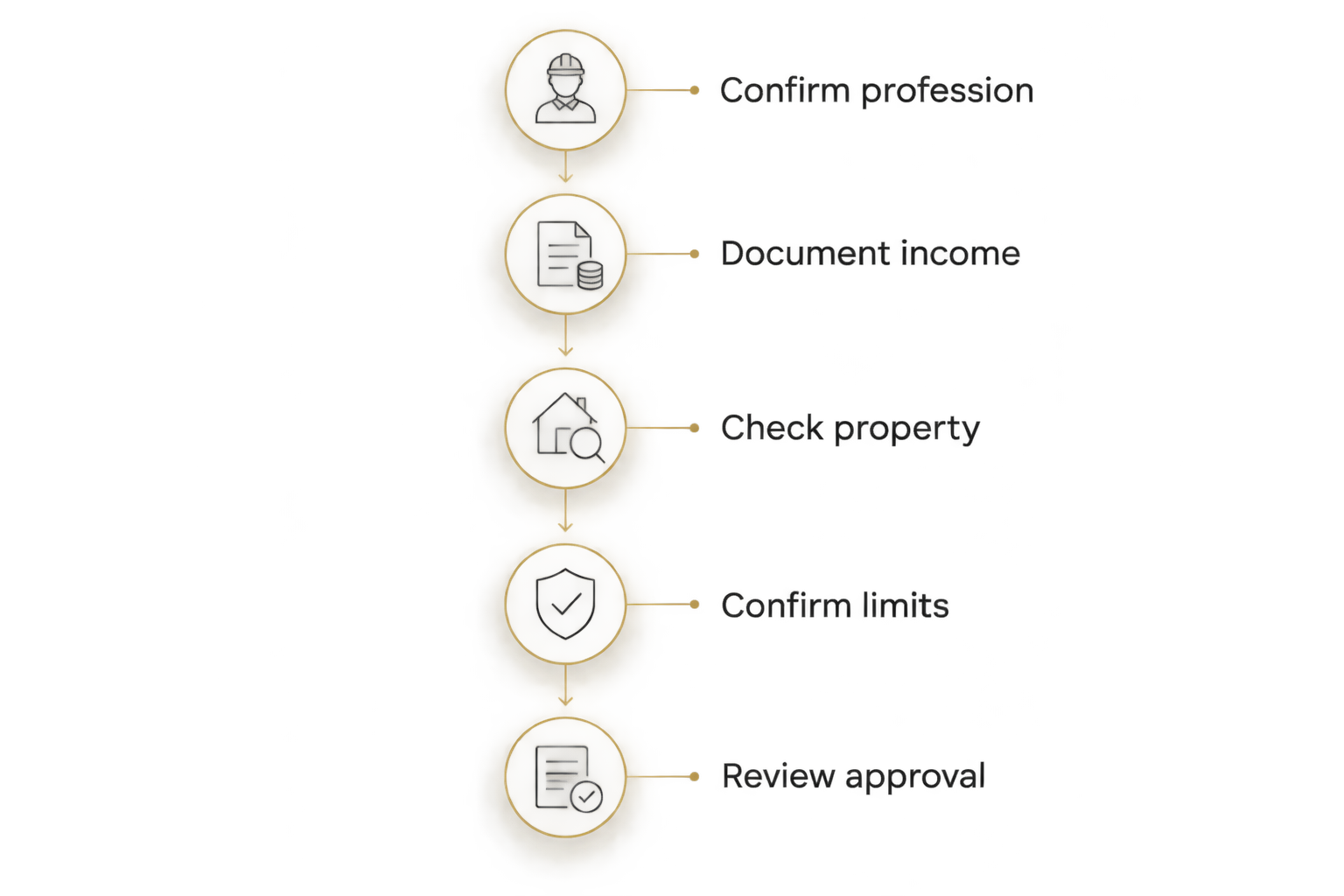
A useful assessment ends with conditions you can act on, not a general statement that medical borrowers receive concessions. Follow this sequence before setting a finance-dependent purchase budget.
- Confirm profession. Provide your exact occupation, registration status and employment structure so the relevant policy can be identified.
- Document income. Separate salary, variable earnings, contracts and business income, and ask what supporting evidence is required.
- Check property. Identify the loan purpose, proposed property and expected borrowing so security restrictions can be considered.
- Confirm limits. Request the applicable maximum LVR, loan amount and remaining conditions in writing.
- Review approval. Check what remains conditional before treating an assessment or pre-approval as permission to commit.
The sequence matters because an eligible profession is only the starting point. Property acceptability and repayment capacity still need to support the transaction.
Prepare your professional registration details, identification, income records, existing loan statements and a summary of liabilities. Include the proposed property and purchase budget where available; the lender or broker can then identify additional documents required for the actual application.
Ask Mortgage Pros to assess your medical home loan options and distinguish waiver eligibility from borrowing capacity. Contact us today with your profession, employment structure and intended purchase or refinance.
FAQ
What is the maximum LMI waiver by profession in Australia?
There is no single maximum LMI waiver by profession across Australian lenders. The applicable LVR and loan amount depend on the lender’s policy, your exact occupation, the property and the credit assessment.
Do all doctors qualify for an LMI waiver?
A medical qualification alone does not guarantee an LMI waiver. The lender must accept the applicant’s professional category and the complete loan application under its current conditions.
Can dentists and surgeons receive the same waiver as doctors?
Do not assume dentists and surgeons receive identical waiver terms to other doctors. Confirm the eligible profession, maximum borrowing limits and income requirements for the particular lender.
Does a 95% LVR waiver mean I only need a 5% deposit?
A 95% LVR corresponds mathematically to a 5% equity contribution against the lender’s assessed property value. Transaction costs and any difference between the purchase price and valuation require separate consideration, and a waiver at that LVR must be confirmed.
Does an LMI waiver increase my borrowing capacity?
An LMI waiver does not replace the lender’s repayment-capacity assessment. Income, living expenses, liabilities and the lender’s assessment rules still determine the borrowing amount it will approve.
Can I use a medical LMI waiver when refinancing?
Refinance eligibility depends on the lender’s applicable waiver policy and the proposed application. Confirm the treatment of the existing balance, any additional borrowing and the current property valuation.
How can Mortgage Pros help with medical home loans?
Mortgage Pros provides mortgage-broking support and specialises in home loans for doctors, dentists and surgeons. Contact the team to discuss your professional status, income structure and proposed purchase or refinance; lender approval remains subject to assessment.
One last thing
The property valuation can change your deposit requirement even when your profession has not changed. A waiver assessment based on an expected value is not a substitute for checking the lender’s accepted value and final conditions.
Before committing to a purchase in 2026, ask for one clear summary covering the applicable LVR, required cash contribution and outstanding approval conditions. Request an assessment today rather than building your budget around a profession-based headline.
Related guides
- Can dentists qualify for a home loan with no LMI?
- How surgeons combine hospital and private income for a home loan
- Is a no-LMI loan better for doctors than saving a bigger deposit?