

Best overall: a medical-professional lender whose LMI-waiver rules match your income and property. Best for hospital-employed surgeons: a lender that accepts your documented salary components. Best for private-practice surgeons: a lender that can assess your business income. This 2026 guide explains how to choose a no LMI home loan for surgeons without mistaking a waiver for loan approval.
- The best no LMI home loan for surgeons matches medical eligibility, income assessment and property requirements.
- Mortgage Pros provides mortgage broking for surgeons, not direct lending; request an assessment before choosing a bank.
- Hospital salary, private-practice income and refinancing need different lender checks.
- An LMI waiver does not remove deposit requirements, repayments or credit assessment.
Why this matters
Lenders mortgage insurance, or LMI, protects the lender rather than you if you default and the property sale leaves a shortfall. Avoiding it does not reduce your responsibility to repay the loan.
For surgeons, the useful comparison is not simply which bank recognises your profession. You need a lender that accepts your registration, employment structure, income evidence and proposed property under the same application.
Mortgage Pros is a mortgage broker for surgeons seeking help matching medical home-loan requirements to their borrowing circumstances. Start with an assessment through Mortgage Pros before treating a lender's medical eligibility criteria as confirmation that you qualify.
What makes the best no-LMI home loan for surgeons?
Use these criteria to build your 2026 shortlist. A lender must meet your essential requirements before loan features become relevant.
- Medical eligibility: Confirm that your professional registration, career stage and residency status meet the lender's current waiver rules.
- Accepted income: Establish how the lender assesses salary, overtime, on-call payments, private billings and business distributions.
- Deposit and valuation: Check the permitted loan-to-value ratio, acceptable deposit sources and treatment of the property valuation.
- Property eligibility: Confirm that the property type, location and intended use fit both lending and waiver requirements.
- Repayment suitability: Compare the proposed repayment structure, offset arrangements, extra-repayment rules and ongoing obligations.
- Evidence requirements: Choose an application pathway you can support with documents, not anticipated future earnings.
Surgeon home-loan options at a glance
The ranking below compares lender profiles, not named banks. Each profile serves a different borrower situation; none represents a verified lender offer or an approval promise.
| Rank and lender profile | Best for | Standout assessment focus | Key limitation |
|---|---|---|---|
| 1. Medical-professional lender | Surgeons starting their shortlist | Matching professional eligibility with the proposed loan | Medical eligibility alone does not establish borrowing capacity |
| 2. Salaried-income lender | Hospital-employed surgeons | Treatment of salary and additional employment income | Variable earnings need separate assessment |
| 3. Mixed-income lender | Surgeons combining hospital and private work | Assessing distinct income sources together | Business revenue is not the same as personal income |
| 4. Self-employed-income lender | Established private-practice surgeons | Business earnings, ownership and liabilities | Financial records must support the income claimed |
| 5. Refinance lender | Surgeons reviewing an existing mortgage | Current valuation, loan balance and replacement structure | Switching requires a fresh lending assessment |
1. Medical-professional lender: best starting point for surgeons
A medical-professional lending policy is the logical first screen when you want an occupation-based LMI waiver. Ask whether the proposed application qualifies under that policy, including the borrower structure and property, rather than asking only whether surgeons are an eligible profession.
In 2026, get the applicable conditions confirmed before choosing a property budget. Professional status and repayment capacity are separate assessment questions.
Medical-professional lender pros:
- Directly addresses the occupation-based waiver question.
- Establishes which professional evidence you need.
- Lets you check the waiver alongside property and loan requirements.
Medical-professional lender cons:
- Recognition of your profession does not guarantee approval.
- The permitted loan structure still needs checking.
- Waiver eligibility does not establish whether repayments suit your budget.
Best for: Surgeons beginning a lender shortlist before committing to a purchase.
Verdict: Hold any lender selection until professional, property and income eligibility are confirmed together.
2. Salaried-income lender: best for hospital-employed surgeons
For a hospital-employed surgeon, focus on how a lender assesses the components of your pay. Base salary, overtime, allowances and on-call earnings should be identified separately in the application evidence.
Ask what income the lender will accept from your current employment arrangement. Do not assume your latest payslip total becomes your assessed annual income.
Salaried-income lender pros:
- Keeps the assessment centred on your employment evidence.
- Separates regular salary from variable payments.
- Helps you identify documents needed for a recent role change.
Salaried-income lender cons:
- Additional pay needs its own assessment.
- A new contract does not establish that every payment is ongoing.
- Existing commitments still affect borrowing capacity.
Best for: Surgeons whose principal income comes from hospital employment.
Verdict: Hold until the lender confirms which salary components support the proposed loan.
3. Mixed-income lender: best for hospital and private earnings
A surgeon combining hospital work and private practice needs an assessment that distinguishes employment income from business income. Private billings must be considered alongside the expenses and structure of the practice.
Prepare a clear explanation of how money reaches you personally. The guide to combining hospital and private income for a home loan covers this distinct borrowing question.
Mixed-income lender pros:
- Considers the complete income structure rather than salary alone.
- Separates employment evidence from practice financial records.
- Helps identify overlapping income figures before submission.
Mixed-income lender cons:
- Multiple income sources require more explanation.
- Practice turnover does not establish personal repayment capacity.
- Recent changes in your work mix need supporting evidence.
Best for: Surgeons receiving both hospital salary and private-practice income.
Verdict: Hold until every income source is documented without double counting.
4. Self-employed-income lender: best for private-practice surgeons
Private-practice surgeons need a lender assessment suited to their ownership and income structure. Relevant evidence can include tax returns, financial statements and records explaining business liabilities and personal drawings.
Ask how the lender will assess your actual arrangement before relying on a borrowing estimate. Ownership of a profitable practice does not, by itself, establish the income available for mortgage repayments.
Self-employed-income lender pros:
- Places business earnings and liabilities in the assessment.
- Identifies the financial records needed to explain your position.
- Allows ownership and income distributions to be considered together.
Self-employed-income lender cons:
- Preparing consistent financial evidence takes work.
- Business commitments need to be disclosed alongside personal debts.
- A change in ownership or trading structure needs explanation.
Best for: Established private-practice surgeons whose borrowing depends on business earnings.
Verdict: Hold until the lender confirms the evidence and income calculation it will use.
5. Refinance lender: best for reviewing an existing mortgage
For an existing homeowner, first establish whether an LMI waiver is necessary at the proposed loan-to-value ratio. Then assess the replacement loan against your current needs, including repayments, loan features and the consequences of switching.
A 2026 refinance decision should use a current property valuation and loan balance. Your original purchase deposit does not describe your present equity position.
Refinance lender pros:
- Assesses the loan against your current circumstances.
- Creates an opportunity to review the repayment structure.
- Establishes whether an occupation-based waiver is relevant.
Refinance lender cons:
- Refinancing requires a fresh credit assessment.
- A valuation can differ from your estimate.
- Switching can involve costs and changes to existing features.
Best for: Surgeons reviewing an existing mortgage rather than buying their first property.
Verdict: Hold until the replacement loan has a clear purpose beyond avoiding LMI.
Understand the deposit before choosing a lender
Loan-to-value ratio, or LVR, expresses the loan as a percentage of the lender's assessed property value. A 90% LVR means the loan equals 90% of that value; the remaining 10% is outside the loan, before purchase expenses and other adjustments.
An 80% LVR corresponds to a 20% equity contribution on the same basis. LMI generally applies to standard home lending above 80% LVR, although lender policies and exceptions differ.
These percentages explain the calculation, not a surgeon-specific lending offer. A no-LMI loan is not the same as a no-deposit loan.
Keep these questions separate:
- What deposit can you contribute?
- What property value will the lender accept?
- What LVR does the proposed application produce?
- Does the waiver apply at that LVR?
- What purchase expenses must you fund separately?
A waiver removes an insurance requirement under the relevant lending arrangement. It does not fund your deposit or establish how much you can safely repay.
How to shortlist a surgeon home loan in 2026
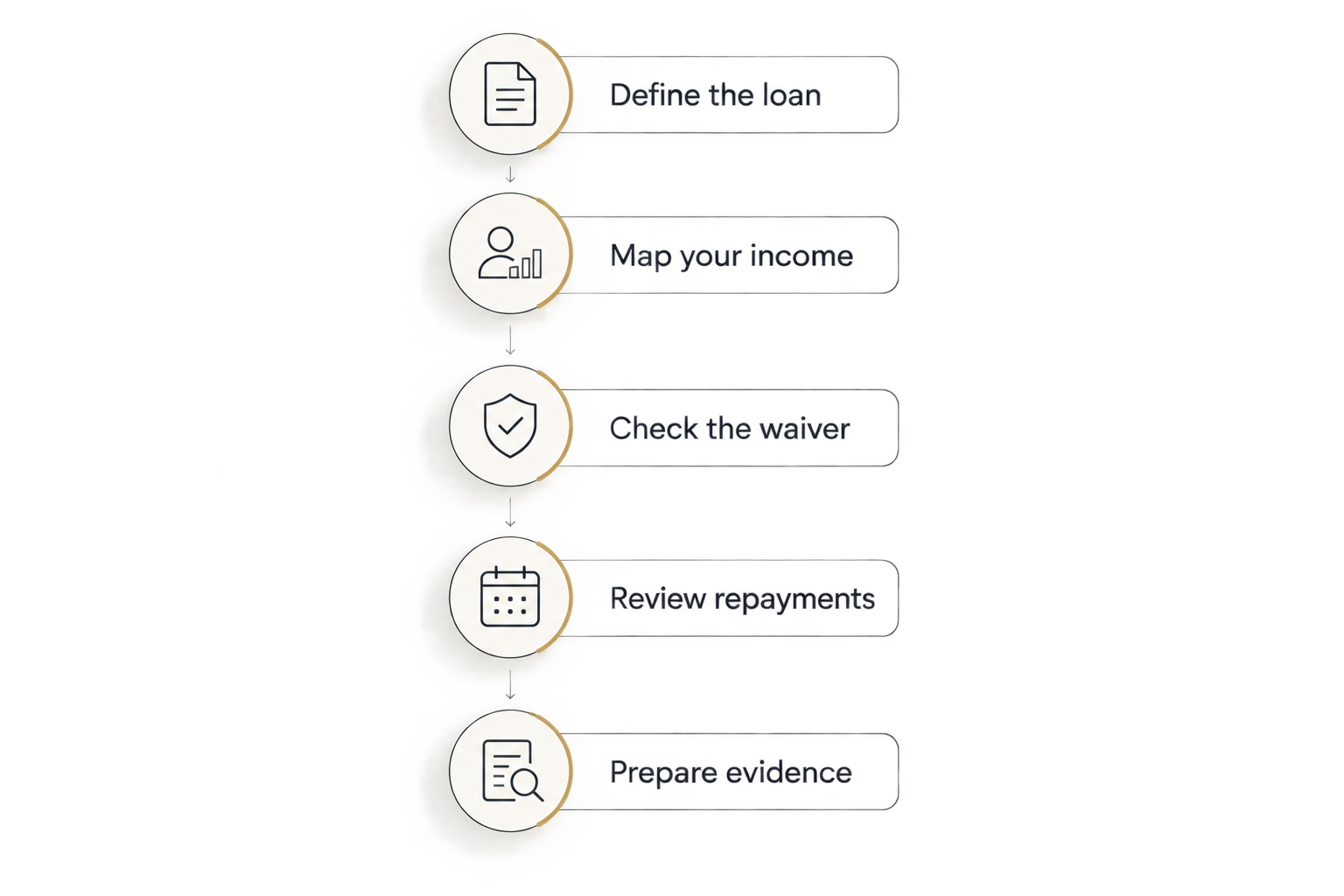
Use this sequence before submitting a formal application. Mortgage Pros provides home-loan advice and approval support; the lender makes the credit decision.
Define the loan
Set out whether you are buying, investing or refinancing. Include the proposed ownership structure, property type and funds you intend to contribute.
Map your income
Separate hospital salary, additional employment payments and private-practice earnings. Identify any recent changes in employment, practice ownership or working hours.
Check the waiver
Ask for confirmation of the professional, borrower and property requirements applying to your proposed loan. Confirm the permitted LVR rather than assuming a medical waiver has no borrowing limit.
Review repayments
Assess the proposed repayments against household spending, existing debts and a cash buffer. Do not use the maximum approved borrowing amount as your spending target.
Prepare evidence
Gather the identity, registration, income, deposit and liability documents requested for your circumstances. Explain inconsistencies before submission rather than leaving the lender to interpret them.
Once these checks are complete, request a shortlist with the reasons each lender fits. Ask which requirements remain conditional and what evidence is still needed before proceeding.
Request a surgeon home-loan assessment
Discuss your income, deposit and LMI-waiver questions with Mortgage Pros.
How the options are ranked
This guide ranks assessment priorities, not bank performance. Medical eligibility comes first, followed by the income structure that determines which lender profile deserves closer attention.
The criteria are professional eligibility, accepted income, deposit and valuation, property requirements, repayment suitability and evidence. No lender receives a recommendation based solely on recognising surgeons as an eligible profession.
Which option should you choose?
Start with a medical-policy eligibility check, then narrow the shortlist by your income structure. Hospital-employed surgeons should resolve salary treatment; surgeons with private earnings should resolve business-income assessment.
For a 2026 refinance, establish your current LVR before making the waiver the centre of the decision. The right outcome is a suitable mortgage, not simply an application with no LMI.
FAQ
What’s the best no LMI home loan for surgeons?
The best no LMI home loan for surgeons is one whose waiver rules, income assessment and property requirements fit the proposed application. Choose a lender only after those requirements and repayment suitability have been checked together.
Do surgeons automatically qualify for an LMI waiver?
No, being a surgeon does not automatically establish eligibility for an LMI waiver. The lender must also assess the borrower, proposed loan and property against its requirements.
Can a surgeon get a no-LMI loan with a small deposit?
A smaller-deposit application depends on the lender’s permitted LVR and waiver conditions. You still need an acceptable contribution, funds for relevant purchase expenses and sufficient repayment capacity.
Can hospital salary and private-practice income be combined?
Hospital salary and private-practice income can be considered in a home-loan assessment, subject to the lender’s income rules. The application must distinguish personal income from practice revenue and avoid counting the same earnings twice.
Does no LMI mean I do not need a deposit?
No, an LMI waiver does not remove the deposit requirement. It addresses mortgage insurance, while deposit sources, purchase expenses and repayment capacity remain separate assessment questions.
Should I refinance just to obtain a surgeon LMI waiver?
No, an LMI waiver alone is not a sufficient reason to refinance. Check whether LMI is relevant at your current LVR and assess the replacement loan’s structure, obligations and switching consequences.
Can Mortgage Pros approve my surgeon home loan?
Mortgage Pros provides mortgage broking advice and approval support, but the lender decides whether to approve the loan. Request an assessment to discuss your income, deposit and professional circumstances.
One last thing
Ask what happens if the valuation is lower than expected. A lower accepted value raises the LVR for the same loan amount, which can change the deposit needed or whether the proposed structure meets the waiver rules.
Make that question part of your enquiry before committing to a purchase. General information only; lending decisions and suitability depend on your individual circumstances.
Related guides
- Can doctors get a home loan during probation?
- Is a no-LMI loan better than saving a bigger deposit?
- How to choose a doctor mortgage broker for complex income