
Breaking a fixed rate home loan in 2026 has no standard cost: your lender calculates any break charge using your loan contract, the amount being repaid and the remaining fixed period. The break charge is separate from discharge, refinancing and settlement costs. Request a written payout quote for your intended repayment date before deciding whether to switch, sell or repay early.
- How much does it cost to break a fixed rate home loan? Your lender’s dated payout quote provides the answer.
- Compare the break charge and refinancing costs with savings over the same remaining loan term.
- Mortgage Pros helps borrowers assess home loan refinancing; a lower advertised rate alone does not justify switching.
- Check extra repayment limits before making a lump-sum payment during your fixed period.
Why this matters
A lower interest rate does not automatically make refinancing worthwhile. Leaving a fixed loan involves a separate calculation: whether the benefits of changing outweigh the costs of ending your current arrangement.
Your repayment can also fall because the replacement loan runs for longer, rather than because it is cheaper overall. Before committing, use the guide to whether refinancing is worth it to frame the broader decision.
Compare total costs over the same period, not just the next monthly repayment. That distinction matters whether you are refinancing voluntarily or selling a property before the fixed term ends.
How much does it cost to break a fixed rate home loan?
The amount is specific to your loan and repayment date. A lender’s break-cost calculation generally considers its financial loss from receiving the fixed-rate funds earlier than agreed; the calculation is not simply the interest you would otherwise pay until expiry.
Ask your lender for an itemised quote in 2026, rather than relying on an online estimate or another borrower’s experience. Confirm whether the document shows only the break charge or the complete amount required to close the loan.
| Component | What it covers | What to check |
|---|---|---|
| Break charge | Compensation calculated under the fixed-loan contract for early repayment | Calculation date, repayment amount and quote validity |
| Outstanding principal | The loan balance you still owe | Whether the balance includes recent repayments |
| Accrued interest | Interest owing up to the repayment date | The settlement date used |
| Discharge and administration charges | Applicable charges for closing the existing loan | Your contract and itemised payout statement |
| Replacement-loan costs | Applicable establishment, valuation, registration or settlement expenses | Written details from the proposed lender |
The outstanding principal is debt you already owe, not an additional penalty for leaving. Keep that distinction clear when comparing an exit quote with the cost of staying.
What if the lender quotes no break charge?
No break charge does not necessarily mean no switching costs. Discharge, registration and replacement-loan expenses still need checking, and your outstanding balance and accrued interest remain payable.
Ask the lender to confirm the break-charge component separately. A total payout figure without an itemised breakdown is not enough to assess the financial effect of changing loans.
What are your options before the fixed period ends?
Breaking the loan is not the only approach. Your reason for changing determines which alternatives deserve a comparison: reducing interest, accessing equity, selling or gaining repayment flexibility.
| Option | Best for | Main benefit | Main limitation |
|---|---|---|---|
| Break and refinance | Borrowers whose verified benefits outweigh switching costs | Changes the loan before fixed expiry | An upfront break charge can outweigh savings |
| Wait until fixed expiry | Borrowers who can delay changing | Avoids ending the fixed arrangement early | Your current loan conditions continue until expiry |
| Make permitted extra repayments | Borrowers wanting to reduce debt within contractual limits | Reduces principal without necessarily closing the loan | Limits and break-charge triggers depend on the contract |
| Ask about loan portability | Borrowers selling and buying another property | Could preserve an existing arrangement if approved | Availability, security requirements and approval conditions vary |
Best for reducing uncertainty: compare a dated exit quote with a clear stay-until-expiry calculation. Do not assume waiting is automatically better, or that refinancing always wins when advertised rates fall.
If you are selling, ask about portability before arranging the discharge. Treat it as a question for your lender, not an entitlement: moving security requires lender acceptance and can involve conditions that do not suit your transaction.
Why fixed rate break costs vary
A useful 2026 comparison starts with your contract, not the cash rate alone. Lenders use their own contractual methods, and the relevant market reference is not necessarily the advertised rate offered to new borrowers.
The main factors to check are:
- Amount repaid early: A full discharge and a partial repayment involve different amounts. Ask for a quote matching your actual plan.
- Time remaining: The unexpired fixed period affects the calculation. Confirm the exact expiry date rather than relying on the year you fixed.
- Market-rate movements: Changes in the lender’s relevant funding or wholesale reference rates affect its calculation of economic loss.
- Contract terms: Your agreement sets out the calculation method, permitted repayments and events that trigger a charge.
- Repayment date: A quote is tied to stated assumptions and a validity period. A changed settlement date can require a fresh calculation.
Your original fixed interest rate matters within the contractual calculation, but comparing it with a new advertised rate does not reproduce the lender’s result. Ask the lender to explain the calculation inputs if the quoted charge is unclear.
How do you check whether breaking the loan is worthwhile?
Use the following process before instructing a discharge or making an extra repayment outside your allowance. It separates the lender’s exit calculation from your own decision about whether changing makes sense.
- Check your contract. Locate the fixed expiry date, extra repayment allowance and early repayment provisions. Identify which loan splits are fixed.
- Request a quote. Specify whether you intend to repay part of the balance or close the loan. Give the proposed repayment date.
- List switching costs. Obtain written details of applicable exit and replacement-loan charges. Keep the break charge separate.
- Compare like-for-like. Use the same remaining term, repayment type and comparison period. Include the loan features you will actually use.
- Confirm settlement details. Check quote validity and obtain an updated figure if your timing changes. Do not treat an indicative estimate as a final payout instruction.
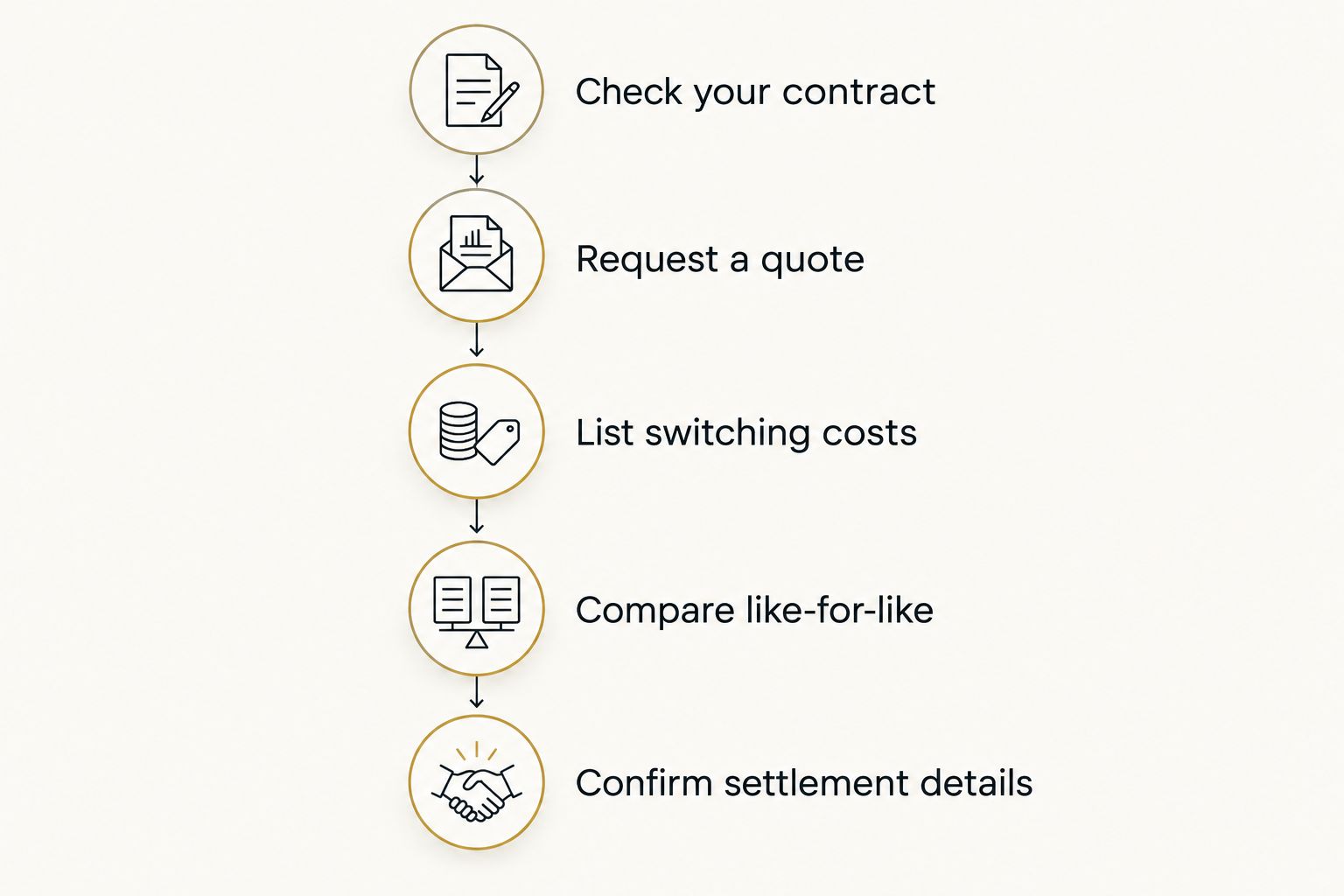
Your comparison should distinguish an immediate cash-flow benefit from a longer-term interest saving. If a new loan extends your repayment term, lower repayments alone do not demonstrate that refinancing saves money.
Mortgage Pros is best for borrowers seeking mortgage broking support to assess refinancing before committing to a switch. The lender still determines the break charge, and a broker comparison does not replace a written payout quote or guarantee approval.
Review your refinancing options
Discuss your fixed loan, intended repayment date and refinancing goals with Mortgage Pros.
How should you compare breaking now with waiting?
For a decision made in 2026, start with the period from your proposed switch date to your current fixed expiry. Compare the cost of keeping your existing loan through that period with the cost of the replacement arrangement, including applicable switching charges.
Then consider the longer-term effect separately. Rates after fixed expiry are uncertain, so distinguish confirmed contractual costs from assumptions about future rates.
Keep the loan term consistent
Ask for a comparison using your existing remaining loan term. Extending the term spreads repayments further into the future and changes the result, even if the new interest rate is lower.
Also match principal-and-interest repayments with principal-and-interest repayments. Switching repayment types changes cash flow and the pace at which you reduce debt.
Compare features you will actually use
An offset account or more flexible repayments can matter, but only if those features fit your finances. Confirm any account charges, access restrictions and the portion of the loan to which an offset applies.
Do not count the same benefit twice. For example, money committed to paying switching costs cannot simultaneously remain in an offset account reducing interest.
Treat cash-flow pressure separately
If repayments are becoming difficult, tell your lender promptly and ask about its financial hardship process. Refinancing requires assessment and is not a substitute for discussing immediate payment difficulties.
Avoid committing to a replacement loan solely because it produces a smaller repayment. Understand what changes, what it costs and how long you remain in debt.
What should doctors check before refinancing a fixed loan?
For doctors, dentists and surgeons, the exit calculation and the new application are separate issues. A manageable break charge does not establish that the replacement lender will accept your income or offer the same lending conditions.
If your income includes overtime, on-call payments, locum work or private practice earnings, ask what evidence the proposed lender requires. Confirm the assessment before relying on a borrowing estimate to support a property transaction.
Mortgage Pros provides home loan broking for doctors, dentists and surgeons. Ask for a comparison that checks both the existing fixed-loan exit costs and the suitability of the replacement home loan; profession alone does not establish eligibility.
Keep any existing professional lending benefits in the comparison. Do not assume a new lender will reproduce your current conditions or that refinancing automatically preserves an existing lenders mortgage insurance arrangement.
Can I make extra repayments without breaking my fixed loan?
Extra repayments depend on the allowance in your fixed-loan contract. Check how the allowance is measured, when it resets and whether exceeding it triggers a break calculation.
Before transferring a lump sum in 2026, ask your lender to confirm the permitted amount in writing. Also check redraw access: permission to make an extra repayment does not establish that you can withdraw it later.
Will waiting until my fixed rate expires avoid a break charge?
Waiting until the fixed period expires generally avoids a charge for ending that fixed arrangement early. Other costs still need checking if you then refinance or discharge the loan.
Confirm the expiry date and what rate and repayment arrangements apply afterwards. Start preparing before expiry so that waiting is a deliberate choice rather than a missed deadline.
Does refinancing with my current lender avoid break costs?
Changing arrangements with your current lender does not automatically remove the consequences of ending a fixed contract early. Ask whether the proposed internal switch triggers a break charge and request written terms.
Compare the internal offer with keeping your current arrangement and with suitable external alternatives. Staying with the same lender simplifies neither the cost calculation nor the need to check conditions.
FAQ
How much does it cost to break a fixed rate home loan in Australia?
There is no standard amount: your lender calculates the break charge under your loan contract for the intended repayment date. Request an itemised payout quote that separates the break charge from principal, accrued interest and other charges.
Can I calculate my fixed rate break fee myself?
You cannot confirm the payable amount from your loan rate and balance alone. The lender’s contractual calculation uses additional inputs, so use its written quote for your decision.
Do falling interest rates increase fixed loan break costs?
Falling relevant market rates can increase a lender’s calculated loss from early repayment. The result depends on the contractual calculation, not simply a change in the cash rate or an advertised home loan rate.
Do I pay a break charge if I sell my house?
Selling can trigger a break charge if settlement requires repayment before your fixed period ends. Ask for a payout quote using the proposed settlement date and check whether portability is an available alternative.
Can I add a break charge to my new home loan?
Financing switching costs requires the new lender’s approval and sufficient borrowing capacity and security. Adding costs to the loan also means paying interest on the additional borrowing.
Can Mortgage Pros help me compare breaking and waiting?
Mortgage Pros provides home loan refinancing advice and approval support. Bring your fixed expiry date, current loan details and lender’s payout quote so the discussion addresses your actual circumstances.
One last thing
A break-cost quote is not a permanent figure. If your settlement date, repayment amount or loan position changes, ask whether the lender needs to recalculate it before you authorise payment.
Keep the current quote with your refinancing comparison and settlement instructions. To review your fixed loan and next steps, contact us today.
This article provides general information, not personal financial advice. Your loan contract, lender’s quote and individual circumstances determine the appropriate decision.
Related guides
- How much does it cost to refinance a home loan?
- Refinancing a doctor home loan to a standard loan
- Is it worth switching to a fixed rate?