

You need enough usable equity to cover the investment property's deposit and purchase costs, plus the borrowing capacity to repay the additional debt. Your total home equity is not the amount a lender will necessarily release, and using equity replaces a cash deposit with borrowing rather than removing the deposit requirement. For a purchase in 2026, confirm both your usable equity and your borrowing limit before committing.
- How much equity do I need to buy an investment property? Enough usable equity for the deposit and purchase costs.
- An 80% loan-to-value ratio is a common planning reference, not a guaranteed equity-release limit.
- Mortgage Pros suits borrowers seeking mortgage broking support for equity release and investment property finance.
- Equity release increases debt secured against your existing property; rental income does not guarantee approval.
How much equity do I need to buy an investment property?
Your equity requirement depends on the investment loan's deposit requirement, the purchase costs you must fund, and any savings you contribute. Calculate the funding gap first; then check whether your usable equity covers it.
The basic calculation is:
Equity funding required = investment deposit + purchase costs − cash contributed.
For help assessing that funding gap, Mortgage Pros provides mortgage broking support for borrowers seeking equity and investment property finance.
Total equity versus usable equity
Total equity is your property's value minus the debt secured against it. Usable equity is the portion a lender agrees to let you borrow against after applying its valuation, lending limits and credit assessment.
| Measure | What it tells you | What it does not establish |
|---|---|---|
| Total equity | The difference between property value and secured debt | How much additional borrowing will be approved |
| Usable equity | Potential additional borrowing within an assessed lending limit | Whether the investment purchase is affordable |
| Borrowing capacity | Debt a lender assesses you can service | Whether the property provides enough security |
A common Australian planning reference is an 80% loan-to-value ratio, or LVR. ASIC's Moneysmart explains that lenders mortgage insurance commonly applies when borrowing exceeds 80% of a property's value; individual lending policies and exemptions differ.
Using that reference:
Potential usable equity = lender-assessed property value × 80% − existing secured debt.
This is a screening calculation, not a loan offer. A lender can approve less, and a higher permitted LVR does not remove the need to demonstrate repayment capacity.
Why this matters
A large equity figure can make an investment purchase appear funded before the borrowing assessment has started. The missing question is whether you can afford the debt used to access that equity as well as the investment loan.
Your existing home can also be exposed when it secures borrowing for the investment. That makes the loan structure, repayment buffer and consequences of missed repayments just as important as the deposit.
For your 2026 purchase plan, keep three questions separate: how much security you have, how much you can borrow, and how much debt you are comfortable carrying. Approval answers only part of that decision.
Work out the deposit before calculating equity release
A 20% deposit corresponds to an investment loan at 80% LVR when the purchase price and lender's valuation align. It is a useful planning reference, not a universal minimum deposit or a promise that the lender will accept the property.
A smaller deposit increases the proportion funded by the investment loan. It can also introduce lenders mortgage insurance or different eligibility requirements, depending on the lender and borrower.
A larger deposit reduces the investment loan balance. However, if you borrow that larger deposit against your home, you have shifted debt between loans rather than necessarily reduced your total borrowing.
Assess the combined debt, not just the investment loan's deposit percentage. A low-LVR investment loan can sit alongside a substantial increase in your existing home's debt.
Include purchase costs separately
Your deposit is not the complete funding requirement. Allow for transfer duty where applicable, conveyancing or legal work, inspections, registration charges and relevant loan establishment expenses.
Obtain figures for the state or territory and the property you intend to buy. Do not use an owner-occupier concession or another buyer's estimate without checking whether it applies to your investment purchase.
Keep an emergency reserve separate from the amount available for settlement. Money allocated to repairs, vacancies or household emergencies should not simultaneously appear in your deposit calculation.
How to check whether your equity is enough
Follow this sequence before you make an unconditional commitment. It prevents an estimated property value from becoming the foundation of an unaffordable purchase.
- Confirm property value. Use a lender-accepted valuation for the lending decision, rather than relying solely on an online estimate or your preferred sale price.
- Check secured debt. Identify the existing mortgage and other facilities secured against the property. Ask how the lender treats undrawn limits and linked facilities.
- Calculate usable equity. Apply the lender's permitted LVR and subtract the relevant secured debt. Keep this separate from total equity.
- Assess borrowing capacity. Include the proposed equity-release borrowing, the investment loan, existing commitments and household expenses.
- Confirm purchase funding. Reconcile the deposit, purchase costs, cash contribution and reserve before arranging settlement.
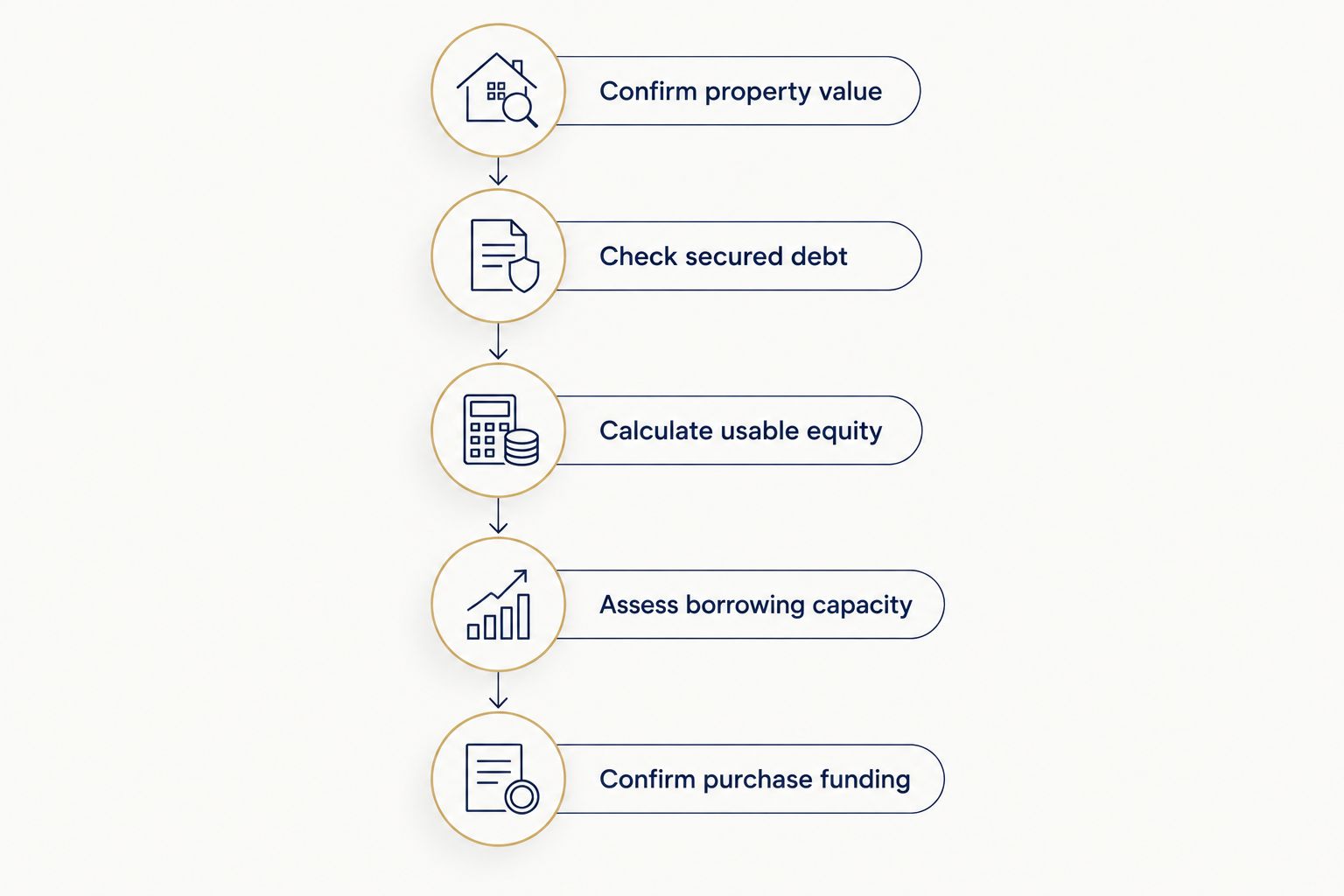
Ask for the assessment to show both the proposed loan balances and the repayments. A single maximum purchase figure does not explain how much additional debt sits against your home.
Why the equity you need varies
There is no single equity amount that applies to every investment purchase. These factors change either the funding requirement or the amount a lender will release:
- Investment property value: The deposit requirement changes with the purchase amount and the lender's valuation of the property being bought.
- Existing home valuation: A lower lender-assessed value leaves less room for additional borrowing against your current property.
- Existing secured debt: More debt against the same property value means less equity available within a given LVR limit.
- Lending policy: Permitted LVR, property restrictions and lenders mortgage insurance requirements affect the proposed structure.
- Income and commitments: Living costs, other debts, income evidence and the treatment of expected rent affect repayment capacity.
- Cash contribution and costs: Savings reduce the amount you need to release; purchase expenses and retained reserves increase the funds you must account for.
For a 2026 assessment, use your current income documents, debt balances and expenses. An earlier borrowing estimate does not establish what a lender will approve for a new purchase.
Should you use equity, savings or both?
Best for reducing additional borrowing: savings you can contribute without exhausting your reserve. Equity release serves a different purpose: it provides borrowed funds when you want to use property security rather than fund the entire deposit from cash.
| Funding approach | Best for | Main benefit | Main limitation |
|---|---|---|---|
| Equity release | Borrowers with usable equity and sufficient repayment capacity | Provides borrowed funds towards the deposit and costs | Increases debt secured against the existing property |
| Cash savings | Borrowers with available cash beyond their reserve | Reduces the additional borrowing needed | Leaves less cash available after settlement |
| Equity and savings | Borrowers balancing cash retention with debt reduction | Allows the contribution to be divided between sources | Still requires approval for the borrowed portion |
None of these approaches removes the investment property's ongoing expenses. Compare the post-settlement position, including repayments and cash remaining, rather than choosing solely on how quickly you can assemble a deposit.
Refinancing is a method, not extra equity
Refinancing can be a way to arrange equity release, but changing lenders does not create equity by itself. The assessed property value, debt balance and permitted lending limit still determine the security position.
Compare the proposed loan structure and total borrowing with your current arrangement. A lower repayment achieved by extending the loan term is not the same thing as reducing total interest paid.
What if you are a doctor with complex income?
Doctors, dentists and surgeons can have income that needs more explanation than a single salary figure. Hospital employment, private practice, overtime or locum work should be documented clearly so the lender can assess the actual income sources.
Mortgage Pros specialises in home loans for doctors, dentists and surgeons. That focus is relevant when an investment purchase combines equity release with medical income assessment; it does not remove the lender's valuation or repayment checks.
If your earnings come from several sources, read how to choose a doctor mortgage broker for complex income. Prepare the supporting documents before relying on a borrowing estimate.
Can you buy an investment property without cash savings?
Usable equity can fund a deposit and purchase costs if the lender approves sufficient additional borrowing. That is not a deposit-free purchase: the deposit is funded by debt secured against another property.
You still need to account for settlement timing and money required before loan funds become available. Confirm how the contract deposit will be paid before signing, and retain accessible funds for expenses after settlement.
Does enough equity guarantee an investment loan?
Enough equity does not guarantee an investment loan because security and repayment capacity are separate lending tests. A lender can accept the property as security while declining the proposed borrowing on income or commitment grounds.
Expected rent also does not replace an affordability assessment. Ask how the lender treats rental income, property expenses and your existing liabilities rather than assuming the rent will cover the loan for assessment purposes.
Keep investment borrowing clearly separated
A separate loan split for investment-related borrowing can help you trace where the funds went. Mixing private spending and investment spending in the same borrowing account makes that record harder to maintain.
The Australian Taxation Office bases interest deductibility on the use of borrowed funds, not simply on which property secures the loan. Borrowing against your home does not automatically make the interest deductible, and securing a loan against an investment property does not automatically make private spending deductible.
Before moving funds in 2026, ask your accountant about the proposed transaction and record-keeping. A mortgage broker assesses lending arrangements; personal tax advice needs to address your own circumstances.
Confirm the structure before you apply
Ask for a clear explanation of which property secures each loan and whether the properties will be cross-collateralised. Cross-collateralisation means multiple properties support the lending arrangement, which can complicate a later sale or refinance.
Also confirm the repayment type, loan term and the process for accessing approved equity. These details affect how the borrowing operates after approval, not just whether you can complete the purchase.
Mortgage Pros is best suited to borrowers who want mortgage broking support for equity release and investment property finance. Contact the team with your current loan balance, property details, income information and intended purchase budget to discuss the assessment.
Check your investment borrowing position
Discuss usable equity, repayment capacity and the funding needed for your investment purchase.
FAQ
How much equity do I need to buy an investment property in Australia?
You need enough usable equity to cover the investment deposit and purchase costs after allowing for any cash contribution. You must also qualify for the additional borrowing needed to release that equity and buy the investment property.
Can I use all the equity in my home?
You cannot assume all your home equity is available to borrow. The lender applies its valuation, permitted loan-to-value ratio and credit assessment to determine the amount it will approve.
Is a 20% deposit compulsory for an investment property?
A 20% deposit is not a universal requirement for an investment property. Smaller-deposit borrowing depends on lender policy, the property and your eligibility, and lenders mortgage insurance can apply.
Does releasing equity increase my mortgage repayments?
Releasing equity adds borrowing and repayment obligations. The effect on your repayments depends on the additional loan amount, interest rate, repayment type and loan term.
Can rental income help me qualify for the investment loan?
Rental income can form part of a lender’s investment loan assessment, but the lender decides how much it accepts. Your other income, expenses, liabilities and the proposed debt still need assessment.
Is interest on an equity-release loan tax deductible?
Interest deductibility depends on how you use the borrowed money, not just the property securing it. Keep investment borrowing traceable and obtain personal tax advice before mixing investment and private transactions.
Can doctors use home equity to buy an investment property?
Doctors can apply to use home equity for an investment purchase, subject to valuation, lending policy and repayment capacity. Multiple income sources need appropriate documentation; professional status does not guarantee approval.
One last thing
A smaller investment loan does not necessarily mean less total debt. If you borrow the deposit against your home, include that borrowing when assessing the investment's repayments and risk.
Before making a 2026 offer, request a written funding breakdown showing the equity release, investment loan, cash contribution, purchase costs and remaining reserve. Contact the team before committing, rather than treating available equity as approval.
General information only, not personal financial or tax advice. Lending approval and loan suitability depend on your circumstances.
Related guides