

Home loans for dietitians are mortgages assessed against your income, deposit, debts and property, with the aim of financing a home or investment purchase. This 2026 guide explains how to prepare your application when you earn a salary, work across clinics or receive private-practice income, without assuming your profession qualifies you for a special lending policy.
- Home loans for dietitians depend on documented income and lender criteria, not an automatic medical-professional concession.
- Mortgage Pros suits dietitians seeking home loan advice and approval support.
- Separate salary, contractor receipts and business profit before comparing borrowing capacity.
- Confirm any lenders mortgage insurance concession specifically covers dietitians before relying on it.
Why home loans matter for dietitians
Your income structure matters more than your job title. A salaried dietitian and a private-practice owner need different evidence, even when their work is similar. An application needs to explain how you earn, what you retain after business expenses and which earnings are ongoing.
For a mixed-income borrower, a borrowing calculator is a starting point rather than an assessment. Entering clinic turnover as personal income produces a misleading budget because turnover does not account for practice expenses. The guide to self-employed home loan lenders covers the separate assessment questions business owners face.
For your 2026 purchase, establish the evidence a lender needs before choosing a property budget. You need a loan you can repay comfortably, not simply the largest amount a calculator displays. That distinction becomes especially important when a new clinic role, reduced hospital hours or practice expansion changes your income.
How to prepare a dietitian home loan application
1. Map every income source separately
Start with your payslips, contracts and business records. Group earnings into 3 income categories: employment income, contractor income and business income. These are preparation categories, not a promise that a lender will assess every payment in the same way.
For each source, record who pays you, how regularly you receive payment and whether you incur expenses to earn it. If you work at a hospital and consult privately, keep those records separate rather than presenting a single unexplained total.
Explain recent changes directly. A move from wages to contracting changes the evidence available, even if your clinical workload stays similar. Your application should show that change rather than leave an assessor to infer it from deposits.
- List each employer, clinic or business entity paying you.
- Match employment income to payslips and employment terms.
- Separate contractor receipts from wages.
- Identify business expenses before estimating personal earnings.
- Record recent changes in hours, ownership or employment status.
2. Build a repayment budget before testing borrowing capacity
Create your own household budget using account records and known commitments. Build 2 monthly budgets: your current position and your expected position after purchase. Include the expenses that change when you become an owner, not just the proposed mortgage repayment.
A private-practice dietitian should also distinguish business reserves from household savings. Money held for tax, rent or supplier payments is not automatically available for a deposit. Keep those obligations visible when calculating what you can contribute.
A lender's borrowing limit and your preferred repayment level answer different questions. Decide what fits your household before asking how far an application can stretch. Include irregular household bills rather than treating a quiet spending month as representative.
- Review everyday spending using actual transactions.
- Record credit cards, personal loans and other repayments.
- Allow for ownership expenses such as insurance and maintenance.
- Keep business obligations separate from personal savings.
- Set a repayment limit that leaves room for irregular expenses.
3. Check eligibility without assuming a medical concession
Ask lenders directly whether their current policy covers dietitians, your employment arrangement and your proposed borrowing level. Request the eligibility conditions rather than relying on a product label aimed at healthcare workers.
Being a dietitian does not establish eligibility for a doctor home loan or an LMI waiver. Lenders mortgage insurance, or LMI, protects the lender rather than the borrower. Any exemption needs to be confirmed for your specific application.
Mortgage Pros provides home loan advice and approval support for individual borrowers and investors. For home loans for dietitians, the practical benefit of broker assistance is help comparing applicable criteria; the limitation is that the lender still decides approval. You can also contact the team to discuss which evidence your circumstances require.
- Confirm that the occupation policy specifically includes dietitians.
- Ask which qualifications or professional memberships require evidence.
- Check how employment type affects eligibility.
- Request confirmation of any proposed LMI concession.
- Compare the complete loan terms, not the concession alone.
4. Assemble evidence that explains your earnings
Begin with documents you already hold, then request a lender-specific checklist. A salaried applicant needs evidence of employment income; a practice owner needs records that explain business earnings and expenses. Mixed-income applicants need both stories to reconcile.
For your 2026 application, use consistent figures across the application form, supporting records and any explanation of recent changes. Do not describe gross clinic receipts as take-home pay or count business transfers twice.
A broker can help identify gaps before submission, but cannot replace missing evidence with an explanation alone. If accounts are unfinished or a contract has changed, establish what the lender will accept before applying. Avoid requesting documents blindly: the relevant financial periods and acceptable formats depend on the lender and application.
- Gather current identification and address evidence.
- Collect payslips and employment documents where applicable.
- Prepare tax returns and financial statements when requested.
- Explain transfers between business and personal accounts.
- Document existing debts and available credit limits.
- Keep the source of deposit funds traceable.
5. Compare loan structures against your cash flow
Write down the features you need before comparing products. For a dietitian with variable private-practice receipts, access to savings and the treatment of extra repayments deserve attention. For a borrower prioritising repayment predictability, fixed-rate conditions need careful review.
Variable, fixed and split loans serve different purposes; none is automatically the right choice for a healthcare professional. Compare each structure against your expected ownership period, savings habits and plans to move, refinance or reduce the balance.
An offset account and redraw are also different arrangements. An offset is a separate account linked to an eligible loan; redraw involves accessing eligible extra repayments under the loan's conditions. Check access rules rather than treating the features as interchangeable.
- Identify whether repayment predictability or flexibility matters more.
- Read the conditions on additional repayments.
- Check offset eligibility and account conditions.
- Review redraw access and restrictions.
- Ask about consequences of changing or ending a fixed arrangement.
6. Check the property and purchase conditions
Research the property before treating loan pre-approval as permission to buy unconditionally. Pre-approval is conditional and does not guarantee that a lender will accept a particular property or approve the final application.
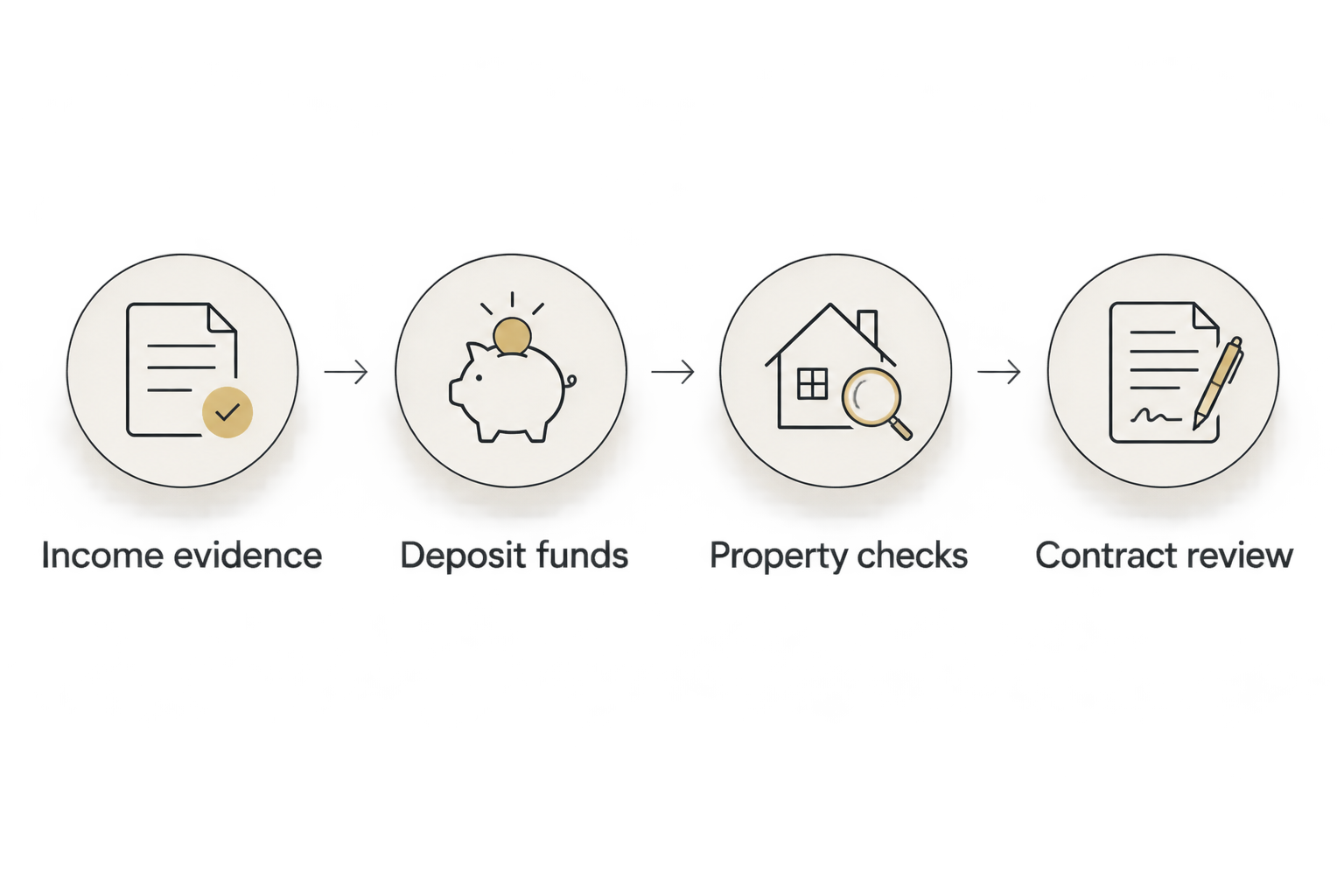
Use 4 purchase checks: income evidence, deposit funds, property checks and contract review. Each addresses a separate risk. A suitable borrower can still encounter a valuation issue, while a suitable property does not resolve an unexplained deposit or changed income.
In 2026, confirm the status and conditions of your approval before making commitments. Ask your conveyancer or solicitor about the contract and any finance condition; obtain legal advice before bidding at auction. Keep your lender or broker informed if your circumstances change during the search.
- Income evidence: confirm the assessment reflects your current work.
- Deposit funds: verify savings remain available after other obligations.
- Property checks: ask about valuation and property restrictions.
- Contract review: obtain advice on purchase obligations and deadlines.
7. Reconcile your bank records before submission
Review the statements requested for your application and explain transactions that do not match the income summary. For a dietitian combining wages and private consultations, bank statement requirements involve more than showing money arriving: the records also need to distinguish customer receipts, transfers, expenses and personal drawings.
Do not assume another borrower's document period applies to you. Ask which accounts and statement periods the selected lender requires, including business accounts where relevant. Submit complete documents in the requested format, rather than screenshots that omit transaction details.
Before lodging your 2026 application, flag unpaid obligations, unusual deposits or changes in income. An explanation supported by records is more useful than an unexplained discrepancy discovered during assessment. Keep financial commitments stable where practical, and disclose any new borrowing or employment change promptly.
- Reconcile payslip amounts with salary deposits.
- Label transfers without counting them as new earnings.
- Explain substantial non-income deposits and their source.
- Supply complete statements for the requested periods.
- Check that declared debts match current account records.
Compare your application options
Choose an application route based on the help you need, not your profession alone. Preparing independently gives you control over the research, while broker assistance adds support with lender criteria and documentation. Neither route removes the lender's assessment.
| Option | Best for | Main advantage | Key limitation |
|---|---|---|---|
| Direct lender application | Salaried dietitians comfortable managing an application | Direct discussion about that lender's requirements | Does not compare other lenders for you |
| Broker-assisted application | Dietitians needing help with mixed income or lender selection | Support comparing criteria and organising evidence | Coverage depends on the broker's lender panel; approval remains with the lender |
| Prepare before applying | Borrowers with unresolved records or changing employment | Time to clarify income, debts and deposit evidence | Delays the purchase application |
Ask any broker which lenders they can consider, what services they provide and how they are paid. For a direct application, ask the lender the same detailed questions about income treatment and required evidence. Compare answers against your circumstances rather than choosing by familiarity alone.
Common mistakes dietitians make
Assuming healthcare employment guarantees a concession
A policy covering doctors does not establish eligibility for dietitians. Get occupation-specific confirmation before building a purchase plan around reduced deposit requirements or an LMI exemption. Your qualification and the lender's eligible-profession list are separate matters.
Using practice turnover as personal income
Consultation receipts are not the same as money available for household repayments. Account for practice costs and obtain the financial records the lender requests. Avoid counting a transfer from your practice account as additional income on top of the receipts already recorded.
Treating a new contract as proven ongoing income
A new clinic agreement explains future work terms, but it does not establish an earnings history by itself. Ask how the lender assesses that arrangement before relying on the full contract amount. Provide evidence of the transition from previous employment where requested.
Mixing deposit savings with operating reserves
A healthy account balance can include tax provisions and money needed to run your practice. Identify genuinely available deposit funds before signing a purchase contract. Otherwise, you risk planning around money already committed elsewhere.
FAQ
Can dietitians get a home loan in Australia?
Dietitians can apply for Australian home loans, with approval subject to the lender’s assessment. Your income evidence, deposit, debts, credit history and proposed property all affect the application.
Do dietitians qualify for doctor home loans?
A dietitian qualification does not automatically establish eligibility for a doctor home loan. Ask the lender to confirm whether its occupation policy specifically includes dietitians and whether you meet the remaining conditions.
Can a self-employed dietitian get a mortgage?
A self-employed dietitian can apply for a mortgage using the business and personal financial evidence the lender requires. Distinguish turnover from profit and explain how business earnings support personal repayments.
Can I use hospital wages and private-practice income together?
A lender can assess employment and private-practice income within the same application, subject to its criteria. Provide separate evidence for each source and avoid counting business transfers twice.
How much deposit does a dietitian need?
The required deposit depends on the lender, loan, property and your eligibility for any applicable scheme or concession. Confirm the full funds required for purchase rather than considering the deposit alone.
Is pre-approval enough to buy a property unconditionally?
Pre-approval does not guarantee final loan approval or acceptance of a particular property. Confirm the outstanding conditions and obtain legal advice before entering an unconditional purchase commitment.
Can Mortgage Pros help with home loans for dietitians?
Mortgage Pros provides home loan advice and approval support for individual borrowers and investors. Discuss your employment and private-practice arrangements so the enquiry addresses your actual income structure.
One last thing
The clearest application is not necessarily the one with the highest income; it is the one whose figures reconcile. Before applying, check that your income summary, account deposits and financial records tell the same story.
Ask Mortgage Pros to review your home loan circumstances before you commit to a purchase. Bring your income breakdown, deposit position and existing commitments so the discussion starts with the decisions that affect your application.
Discuss your home loan today
Explain your salary, private-practice income and purchase plans before submitting an application.
Related guides
- Home loan lenders for medical professionals
- How guarantor home loans work
- How long mortgage pre-approval takes