

IT professionals’ home loans are mortgages assessed against your employment, income and deposit with the aim of financing a property you can afford. This 2026 guide explains how to document salary, contracting revenue and share-based remuneration, compare loan structures, and prepare an application without assuming your occupation guarantees special terms.
- Home loans for IT professionals depend on verified income and lender policy, not job title alone.
- Mortgage Pros suits borrowers seeking home loan advice and application support rather than managing the process alone.
- Separate base salary, bonuses, contracting revenue and share-based remuneration before comparing borrowing capacity.
- Choose loan features around cash flow, repayment flexibility and contract gaps—not just the advertised interest rate.
Why this matters
The income on your employment package is not necessarily the income a lender accepts. Base salary, discretionary bonuses, employer superannuation and share-based remuneration serve different purposes in a home loan assessment. Establishing those differences before house hunting gives you a more useful budget than entering your total package into a calculator.
Start with the principles behind how much you can borrow based on income, then check how a lender treats your particular pay structure. A borrowing estimate is a planning tool, not permission to sign an unconditional purchase contract.
Why home loans matter for IT professionals
An IT job title does not describe how you earn your living. A permanent developer, fixed-term cybersecurity consultant and software business owner can have similar headline earnings but require different supporting documents.
Your application needs to explain the arrangement clearly. Contract end dates, changes between PAYG employment and self-employment, and payments from overseas clients all create questions that a salary figure alone cannot answer.
For your 2026 application, focus on three separate tests: whether the lender accepts your income, whether you can meet repayments, and whether the property meets the lender’s security requirements. Passing one test does not settle the others.
How to prepare your home loan application
Define your employment and income structure
Start with your employment agreement, payslips and bank statements. Write down who pays you, how payments are calculated, and whether you receive them as an employee, sole trader or company director. Your job title belongs beside that explanation, not in place of it.
For PAYG contracting, distinguish the recruitment agency that employs you from the client where you perform the work. For self-employed consulting, separate business turnover from the income available after business expenses. These distinctions help you ask the right policy questions before submitting an application.
- Identify your legal employer or trading entity.
- Separate permanent, fixed-term, casual and self-employed work.
- Record contract commencement, expiry and renewal dates.
- List base salary separately from every variable payment.
- Explain recent changes in employment structure.
Separate reliable earnings from variable remuneration
Create a simple income worksheet using your own records. Give each income source a separate row, with its payment frequency and supporting evidence. This makes discrepancies easier to resolve before a lender requests clarification.
Do not treat an unvested share award as cash salary. Employee shares, restricted stock units and options have different conditions, and a lender’s treatment depends on its policy. Ask whether the assessment uses salary alone or also accepts documented variable earnings; do not build your purchase budget around an assumed answer.
- Match base salary to payslips and salary credits.
- Collect bonus records showing payment history.
- Separate vested shares from unvested awards.
- Identify foreign-currency earnings and their supporting records.
- Exclude employer superannuation from take-home cash flow.
Check lender policy before choosing a loan
You can start by asking lenders directly how they assess your employment arrangement. Ask specific questions about contract history, probation, variable earnings and self-employment documents. A general statement that a lender accepts IT professionals does not answer those questions.
A broker provides another route for seeking home loan advice and approval support. Mortgage Pros is best for borrowers who want home loan application support rather than a self-directed search. Ask which lenders are being considered and why; a broker’s recommendation is not a substitute for lender approval.
- Ask whether your employment structure meets current policy.
- Confirm which income components count towards serviceability.
- Request the required document list before applying.
- Ask which lenders were considered and why others were excluded.
- Contact us to discuss your circumstances with Mortgage Pros.
Build a deposit and cash-flow plan
Use your savings records and household spending to establish what you can contribute without exhausting your reserves. Keep the purchase deposit separate from the funds needed for settlement expenses, moving and ongoing ownership. Check state or territory duties and eligibility rules with the relevant revenue office.
Loan-to-value ratio, or LVR, is the loan amount divided by the lender’s property valuation, multiplied by 100%. ASIC’s Moneysmart guidance on lenders mortgage insurance explains that LMI is usually payable when borrowing exceeds 80% of the property’s value. A 20% deposit therefore matters, but it does not remove other purchase expenses or guarantee approval.
- Calculate LVR using the lender’s valuation, not an assumed value.
- Separate deposit savings from purchase expenses.
- Retain a cash reserve for household needs and contract gaps.
- Check any proposed concession against current eligibility rules.
- Confirm whether LMI applies to the actual application.
Assemble a consistent evidence file
Organise the documents yourself before starting an application. Your employment agreement, payslips and bank credits should tell the same story. If they differ because of a recent promotion, salary sacrifice or payroll adjustment, obtain an explanation rather than leaving the lender to infer one.
For self-employed IT professionals, ask which financial periods and documents the lender requires before commissioning additional work from your accountant. Business accounts, personal returns and tax assessments have different roles. Alternative-documentation lending still requires evidence and is not a way around affordability checks.
- Collect identity and residency documents relevant to your circumstances.
- Match income documents to bank deposits.
- Gather contracts, renewals and employment confirmations.
- Prepare business financials and tax records where required.
- List debts, credit limits, dependants and household expenses.
Choose features that match your cash flow
Compare loan features manually using lender documents and a spreadsheet. Separate the interest-rate structure from the income-assessment pathway: being a contractor does not automatically make a fixed, variable or split loan the right choice.
A 100% offset account reduces the loan balance used to calculate interest by the eligible linked account balance. Redraw is different: it provides access to eligible extra repayments under the loan’s conditions. For your 2026 comparison, check access rules, fees and repayment restrictions rather than treating those features as interchangeable.
- Compare variable, fixed and split structures against your needs.
- Check whether an offset account is included and how it operates.
- Read redraw conditions before relying on access to funds.
- Check extra-repayment limits and early-exit conditions.
- Consider repayment timing alongside your actual pay cycle.
Confirm conditions before committing to a purchase
Read the pre-approval letter and ask what remains outstanding. Conditional pre-approval is not an unconditional commitment to lend against any property. Changes in employment, debts, income or the proposed security can affect the final decision.
Keep your broker or lender informed if you change roles, take unpaid leave or sign a new contract during the application. Before signing a purchase contract, obtain legal advice about finance conditions and settlement obligations. The lender’s assessment and your legal obligations are separate matters.
- Record approval conditions and the expiry date.
- Confirm the proposed property is acceptable security.
- Disclose changes in employment or financial commitments.
- Obtain legal advice before committing to contract terms.
- Check settlement funding and remaining requirements.
The application sequence is straightforward: establish your income, check policy, prepare evidence, compare features and confirm conditions. Completing those stages in order keeps product comparisons tied to a realistic application.
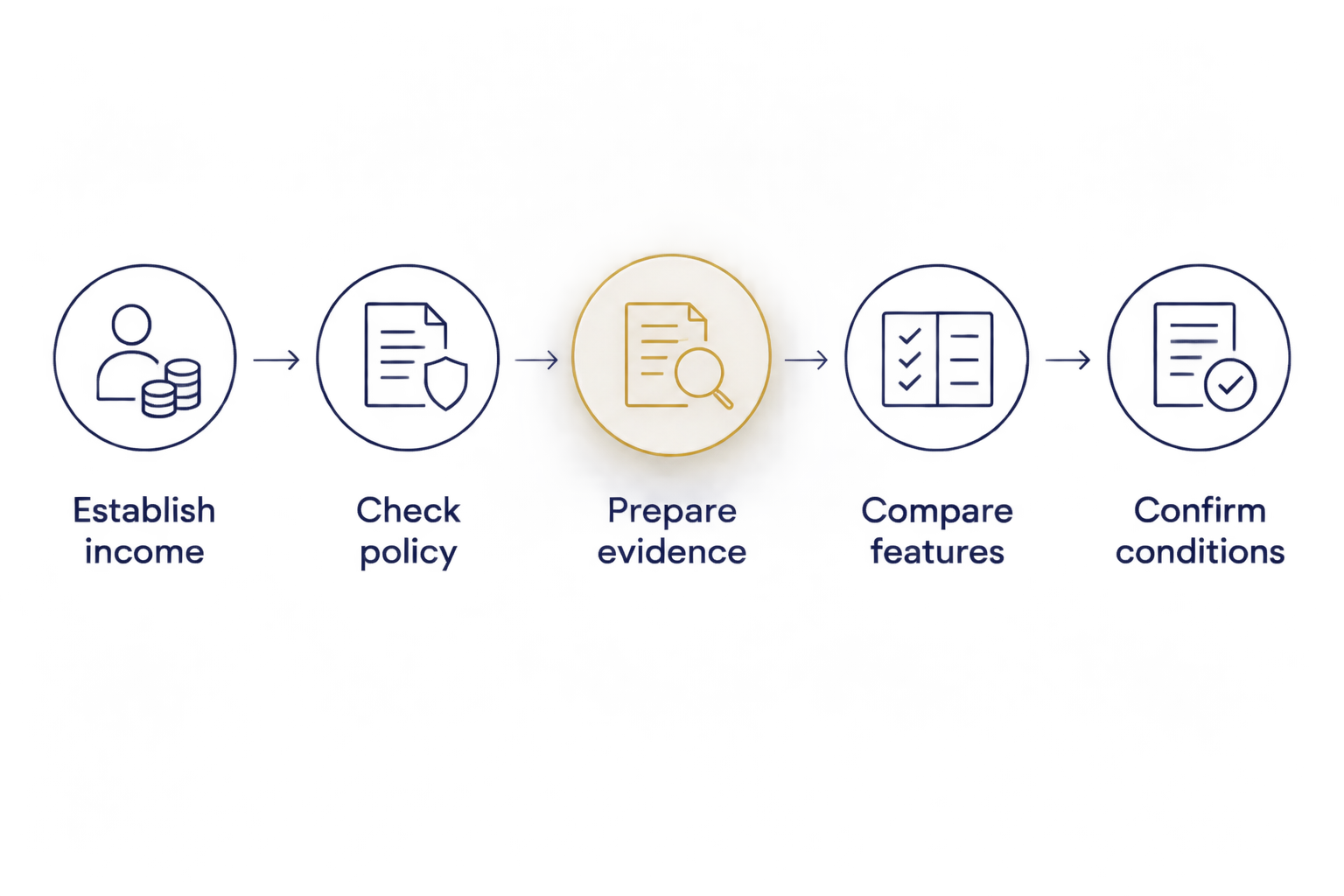
Compare application pathways for IT professionals
Choose the assessment pathway that matches how you earn, then compare the loan itself. The following options describe income assessment, not named products. None guarantees acceptance, and each lender sets its own evidence requirements.
| Option | Best for | Main advantage | Key limitation |
|---|---|---|---|
| Standard PAYG assessment | Permanent employees with documented salary | Salary evidence provides a clear starting point | Bonuses, probation and share-based pay still require policy checks |
| Contractor assessment | IT professionals working under employment or service contracts | Makes contract terms and work history central to the enquiry | An accepted contract type does not guarantee all income is accepted |
| Self-employed full-documentation assessment | Consultants and business owners with completed financial records | Supports assessment using documented business and personal finances | Turnover is not the same as assessable personal income |
| Alternative-documentation assessment | Self-employed applicants whose records do not fit a standard pathway | Uses alternative evidence where the lender permits it | Evidence requirements and product terms still need close review |
A contractor paid through payroll does not automatically belong in a self-employed assessment. Equally, a company director receiving regular transfers should not assume those transfers will be treated like an unrelated employer’s salary. Explain the underlying arrangement before selecting a pathway.
Decide whether to apply directly or use a broker
Best for a self-directed borrower: approaching a lender directly. You control the enquiry and deal with that lender’s team. The limitation is scope: that lender assesses its own options, so you need to make separate enquiries to compare alternatives.
Best for a borrower seeking advice and application support: using a mortgage broker. Mortgage Pros provides mortgage broking services for home buyers and property owners. Ask about the lenders considered, remuneration and any borrower-paid fees; the service does not remove the lender’s credit assessment or guarantee approval.
| Route | Best for | Main advantage | Key limitation |
|---|---|---|---|
| Direct lender enquiry | Borrowers comfortable managing their own comparison | Direct discussion with the proposed lender | Comparison is limited to that lender’s options |
| Mortgage broker enquiry | Borrowers seeking advice and application support | Assistance with the home loan process | Recommendations depend on the lenders considered; approval remains with the lender |
Before making either enquiry, prepare a short summary of your employment, income components, deposit and purchase plans. A specific question about your contract or share income is more useful than asking which lender is best for everyone in IT.
Discuss your home loan application
Explain your employment, income and property plans to Mortgage Pros.
Common mistakes IT professionals make
Treating the total remuneration package as salary
Employer superannuation, discretionary bonuses and unvested equity are not interchangeable with regular cash salary. Build your household budget from money you actually receive, then confirm which components the lender accepts for its separate assessment.
Presenting a contract rate without the working arrangement
A daily rate alone does not explain unpaid leave, business expenses, contract gaps or employment status. Supply the agreement and work history, and ask how the lender converts that evidence into assessable income.
Assuming professional status guarantees an LMI waiver
An IT qualification or senior title does not establish eligibility for a professional lending concession. For a 2026 application, request confirmation against the lender’s current occupation, income, deposit and lending criteria before relying on a waiver.
Leaving an employment change unexplained
Moving from permanent employment into contracting changes the evidence supporting your application. Discuss the timing before switching arrangements if a property purchase is imminent. Do not assume a higher headline income resolves a shorter documented history.
FAQ
What are the best home loans for IT professionals in Australia?
The best home loans for IT professionals fit the borrower’s income structure, deposit and repayment needs. Compare income eligibility before comparing features, because a suitable-looking loan is not useful if the lender does not accept your evidence.
Can I get a home loan as an IT contractor?
IT contractors can apply for home loans, subject to lender assessment. Provide your contract, payment evidence and work history, and confirm whether the lender treats your arrangement as PAYG employment or self-employment.
Will a lender count my bonuses or restricted stock units?
Treatment of bonuses and restricted stock units depends on the lender’s policy and your supporting evidence. Separate base salary from variable remuneration and ask what the lender accepts before relying on a borrowing estimate.
Do IT professionals automatically qualify for an LMI waiver?
No, an IT occupation alone does not establish eligibility for an LMI waiver. Confirm the lender’s current criteria and your individual eligibility before including a concession in your purchase plan.
Can I apply while I am on probation?
You can make a home loan enquiry during probation, but acceptance depends on lender policy and your circumstances. Disclose your probation status and provide your employment agreement and relevant work history.
Is pre-approval a guarantee that I can buy a property?
No, conditional pre-approval is not a guarantee of final approval. The lender still needs to satisfy its conditions, including requirements concerning the property and your financial circumstances.
What should I prepare before contacting a mortgage broker in 2026?
Prepare a summary of your employment structure, income components, deposit, debts and property plans. Have supporting documents available so the discussion can address your actual circumstances rather than a headline salary.
One last thing
Resolve the uncertain income component before shopping at your maximum budget. Ask for borrowing estimates with and without bonuses, share income or contracting revenue whose acceptance has not been confirmed. That comparison shows how much your purchase plan depends on a policy decision rather than dependable salary.
For your next step, contact the team with that income breakdown and your property plans. A clear explanation of how you earn is the starting point for a useful home loan discussion.
Related guides
- Home loan lenders for casual and contract workers
- Home loan lenders for self-employed borrowers
- Comparing offset home loan accounts