

Best default shortlist: mainstream banks for a straightforward residential build. Best for a relationship-led comparison: mutual banks and credit unions. Best for borrowers needing a different credit assessment: specialist non-bank lenders. Best starting point when your current mortgage affects the project: your existing lender. This 2026 guide explains how to compare the best construction loan lenders by approval fit, progress-payment requirements and the loan you will keep after construction.
- The best construction loan lenders fit your borrower profile, building contract and progress-payment schedule.
- Mainstream banks are a starting point for straightforward builds, not an automatic winner.
- Compare construction finance and the completed home loan together, rather than choosing on an introductory feature.
- Mortgage Pros provides home loan advice for Australian borrowers; it is a broker, not a construction loan lender.
Mortgage Pros is a mortgage broker for Australian borrowers who want home loan advice rather than a lender-only comparison. Choose your construction lender by how it funds your actual building contract, not by its position on a generic bank list.
Why this matters
A construction loan releases funds progressively rather than advancing the entire approved amount at settlement. That makes the lender's payment process part of your building project, not just a banking detail.
The wrong fit creates friction when an invoice falls due, a valuation changes the funding position or the builder requests a variation. Your approval needs to work with the contract before construction starts.
For a 2026 application, assess 2 loan stages: construction and post-completion. A workable drawdown arrangement does not automatically make the eventual home loan the right choice.
What makes the best construction loan lenders?
Use these criteria before comparing lender names. Each criterion answers a practical question about whether the finance will support your project.
- Borrower fit: Does the lender accept your income evidence, employment circumstances, existing debts and intended property use?
- Project fit: Does the lender accept the construction arrangement, builder, property type and location? Identify any restrictions before lodging an application.
- Funding sequence: When must you contribute your own funds, and what triggers each lender payment? Match that sequence to the building contract.
- Drawdown process: What invoices, inspections and approvals are required? Establish who requests payment and how payment reaches the builder.
- Completed-loan fit: What repayment structure and features apply after construction? Compare the ongoing loan alongside the building-stage arrangement.
Approval fit comes before features. An attractive home loan feature does not solve an unacceptable building contract or a gap between the amount approved and the amount needed.
Construction loan lender routes at a glance
These are ranked starting points for different borrower situations, not claims that every lender within a category has the same policy. Banks, mutuals and non-bank lenders still require individual assessment.
| Lender route | Best for | Standout reason to compare | Key limitation |
|---|---|---|---|
| Mainstream banks | Straightforward residential construction | Assessing a conventional building contract and the eventual home loan together | A standard policy does not accommodate every borrower or project |
| Mutual banks and credit unions | Borrowers prioritising the lender relationship | Comparing the actual service and drawdown process | Mutual status alone says nothing about construction eligibility |
| Specialist non-bank lenders | Borrowers whose circumstances need another assessment route | Checking whether a different credit policy fits the application | Specialist does not mean easier approval or better overall terms |
| Your existing lender | Projects tied to an existing mortgage or property security | Assessing construction alongside current debt and security | Familiarity is not evidence that the new loan is competitive |
1. Mainstream banks: best for straightforward residential builds
Mainstream banks belong on the initial shortlist when you are building a residential property under a conventional construction arrangement. The decision still turns on the particular bank's acceptance of your income, building contract and security.
Treat this route as a baseline comparison, not a promise of approval. Ask the bank to explain both the construction-stage requirements and the home loan arrangements after completion.
Mainstream bank pros
- You can compare construction funding and the eventual home loan within the same application discussion.
- You can assess the lender's existing transaction and mortgage facilities alongside the proposed construction finance.
- A bank's written requirements give you a concrete checklist to discuss with your builder before signing.
Mainstream bank cons
- The lender's standard credit policy still excludes applications that do not meet its requirements.
- Familiarity with the bank does not establish whether its inspection and drawdown process suits your contract.
Best for: Borrowers with a straightforward residential project who want a starting point for comparison.
Before selecting a mainstream bank in 2026, ask what happens when a progress claim differs from the approved schedule. Get a clear explanation of inspections, borrower contributions and payment authorisation; do not leave those questions until the builder issues an invoice.
Verdict: Hold until the bank confirms project eligibility and explains the complete funding sequence.
2. Mutual banks and credit unions: best for relationship-led selection
Mutual banks and credit unions provide another lender category to assess when the relationship and service process matter to you. Compare individual institutions rather than assuming customer ownership produces a particular construction loan outcome.
The useful question is practical: who will handle your application and progress-payment enquiries? Identify the service arrangement before deciding whether this route suits you.
Mutual bank and credit union pros
- This route lets you assess a customer-owned institution alongside other lender categories.
- You can make the application contact and drawdown support process explicit selection criteria.
- You can compare the institution's completed home loan arrangements with its construction requirements.
Mutual bank and credit union cons
- Customer ownership does not guarantee construction lending eligibility, favourable terms or a particular service standard.
- Each institution's project restrictions still need checking; the category is not a single shared policy.
Best for: Borrowers who place weight on the ongoing lender relationship and want that relationship tested against practical requirements.
Ask the institution to walk through a progress-payment request from submission to release. Establish who answers questions, what documents are needed and how incomplete requests are handled. Compare those answers with other lenders rather than relying on general claims about personalised service.
Verdict: Hold until the institution demonstrates that its construction process fits your project.
3. Specialist non-bank lenders: best for another assessment route
Specialist non-bank lenders are a category to investigate when your circumstances require a different credit assessment. That does not mean every non-bank lender accepts self-employed income, unusual security or a project another lender has declined.
Start with the specific reason your application needs another route. A lender is useful only when its actual policy addresses that issue without creating an unacceptable funding or repayment arrangement elsewhere.
Specialist non-bank lender pros
- You can investigate credit policies outside the mainstream bank shortlist.
- You can focus the comparison on the exact income, security or project issue affecting your application.
- You can assess an alternative lender against the same drawdown and completed-loan criteria used for banks.
Specialist non-bank lender cons
- Specialist positioning is not a guarantee of approval or acceptance of an unusual building arrangement.
- A policy that accepts your circumstances still needs assessment against the whole loan agreement.
Best for: Borrowers who need an alternative assessment route for a clearly identified issue.
For a 2026 comparison, distinguish between a borrower problem and a project problem. Different income evidence does not resolve an unacceptable builder, and acceptance of a property type does not establish borrowing capacity. Ask which issue the proposed lender actually addresses.
Verdict: Hold until the lender confirms the relevant policy fit and the full loan conditions.
4. Your existing lender: best for mortgage-linked construction
Your existing lender is a useful starting point when the build depends on a property or mortgage you already hold. Examples include rebuilding on land with existing debt or restructuring borrowing connected to the construction project.
This route deserves attention because the current mortgage and security arrangements affect the proposed funding structure. It does not deserve automatic preference simply because you already bank there.
Existing lender pros
- You can assess the construction proposal alongside the mortgage already secured against the property.
- You can identify whether current debt must be retained, changed or repaid as part of the project.
- You can clarify how existing security arrangements interact with the proposed construction finance.
Existing lender cons
- An existing relationship does not remove the need for a new credit and project assessment.
- Staying without comparison leaves the completed-loan terms and construction process untested against alternatives.
Best for: Borrowers whose construction project is directly connected to existing property debt.
Ask for a clear outline of the proposed structure before authorising changes. Identify which property secures which debt, how funds become available and what happens to the existing mortgage. Compare another eligible route before treating convenience as the deciding factor.
Verdict: Hold until the existing lender's proposal has been compared with an eligible alternative.
How the ranking works
The ranking puts straightforward project fit first, then separates relationship-led selection, alternative credit assessment and existing-mortgage coordination. Each route has a distinct purpose; none is a universal winner.
For the best construction loan lenders in 2026, the deciding evidence is the proposed lender's requirements for your application. A category recommendation narrows your search. It does not replace the lender's assessment or the loan documents.
Mortgage Pros provides home loan advice and approval support for Australian borrowers. A broker is an advice and application-support route, not another lender category; confirm which lenders are being compared and why each belongs on your shortlist.
Check the funding process before committing
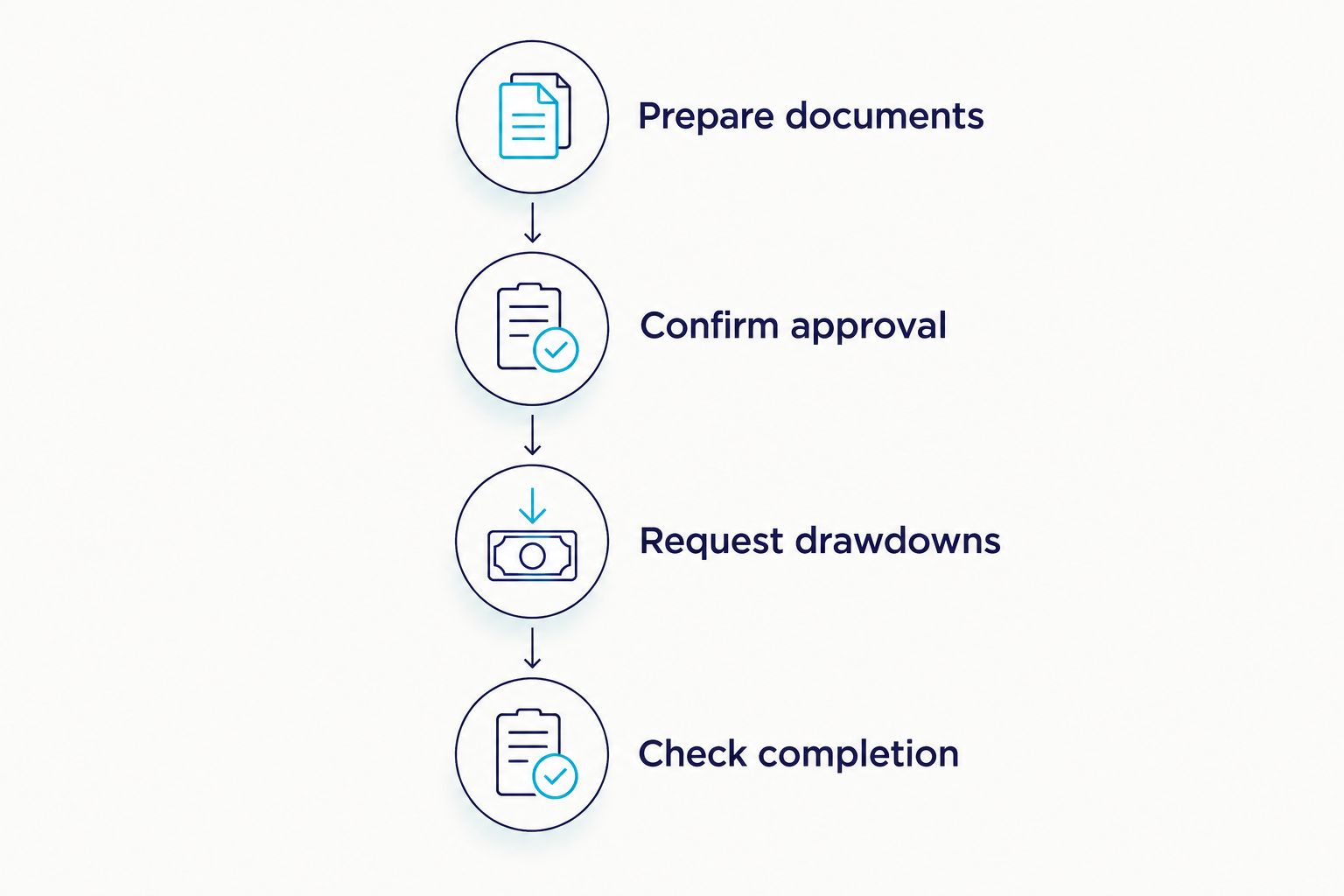
Use these 4 checks to connect your lender comparison with the building contract. Complete them before assuming that an approval means every construction payment is ready to proceed.
Prepare documents
Gather the building contract, plans, relevant approvals and the lender's requested borrower documents. Check that the contract's payment stages match the funding arrangement being proposed.
Identify exclusions and variations separately. An item outside the agreed construction scope still needs a funding source; do not assume the lender will absorb it into the approved amount.
Confirm approval
Read the conditions attached to approval. Establish which conditions must be satisfied before settlement and which apply before later drawdowns.
Confirm the required borrower contribution and when it must be used. Keep your contribution, construction funding and contingency plan distinct so the same money is not allocated twice.
Request drawdowns
Follow the lender's requirements for each progress-payment request. Check who submits the request, whether an inspection is required and who receives the released funds.
Compare that process with the builder's payment obligations. A builder's invoice and a lender's approval to release funds are separate events. Resolve a mismatch before it becomes a payment dispute.
Check completion
Establish what the lender requires before releasing the final construction payment. Ask how the loan moves into its post-construction repayment arrangement and which documents confirm that transition.
Review the finished loan as carefully as the building-stage finance. The repayment structure needs to suit your household after the project ends, not just while work is underway.
A useful lender comparison explains this whole sequence in plain language. Keep the written requirements with your contract so you can refer to the same documents when questions arise.
Discuss your home loan plans
Get home loan advice and approval support from Mortgage Pros.
Compare repayments beyond the construction period
Progressive funding changes how the outstanding balance develops during construction. Where an interest-only construction arrangement applies, interest is charged on the amount drawn, subject to the loan terms; it is not the same as repaying principal.
Ask when principal-and-interest repayments begin and what loan term applies at that point. Confirm the transition in the agreement rather than assuming the construction period has no effect on the ongoing mortgage.
Also check how any desired features operate during each stage. An offset account or redraw facility should be assessed against the lender's actual terms, not treated as automatically available throughout construction.
For your 2026 decision, put the construction process and completed-loan obligations on the same comparison sheet. A lender that fits the build still needs to fit the mortgage you retain afterwards.
Which construction loan lender route should you choose?
Start with mainstream banks if your borrower circumstances and residential building contract are straightforward. Use that as a comparison baseline, then change the shortlist when a specific requirement points elsewhere.
Choose a mutual or credit union comparison when the lender relationship is a priority. Investigate specialist non-bank lenders when a defined credit-policy issue needs another assessment route. Start with your existing lender when current mortgage security is central to the project, but compare an alternative before committing.
Do not submit applications indiscriminately. First establish project eligibility, the funding sequence and the post-completion structure; those answers turn a broad lender list into a useful decision.
FAQ
What’s the best construction loan lender in Australia in 2026?
The best construction loan lender is the lender whose credit policy, project requirements and drawdown process fit your build. Start with mainstream banks for a straightforward project, then compare other routes when a specific borrower or project requirement calls for them.
Is Mortgage Pros a construction loan lender?
Mortgage Pros is a mortgage broking firm, not a construction loan lender. It provides home loan advice and approval support for Australian borrowers.
Is a bank better than a non-bank construction lender?
Neither category is automatically better for construction finance. Compare the individual lender’s acceptance of your circumstances, payment process and completed-loan terms.
Can I use my existing lender for a construction loan?
Your existing lender is a starting point when construction involves property already securing your mortgage. The lender must still assess the proposed borrowing and project, and an existing relationship does not guarantee approval.
How are construction loan funds paid to the builder?
Construction loan funds are generally released progressively against approved building stages. The lender specifies the required invoices, inspections and payment authorisations, so match those requirements to your contract.
Are construction loan repayments interest-only?
Some construction loans use interest-only repayments during construction, but the loan agreement determines the arrangement. Confirm when principal-and-interest repayments begin and how the transition affects your ongoing obligations.
What happens if my building costs change?
A change in building costs needs a separate funding assessment; the lender does not automatically increase the approved loan. Check the lender’s variation requirements and establish how any additional contribution will be funded before committing to the change.
One last thing
Before choosing a lender, ask one precise question: What must happen before the builder's next invoice can be paid? The answer should identify the documents, checks, borrower contribution and payment authorisation involved.
That question tests the construction loan where it matters: the connection between the contract and the money. Keep the answer in writing and use it to compare eligible lenders before you commit.