

Best overall: a single full-offset account for everyday savings. Best for shared budgeting: multiple full-offset accounts. Best for combining fixed and variable borrowing: a split loan with an offset against the variable portion. This 2026 guide compares account structures, rather than naming a lender winner without current loan terms.
- The best offset home loan accounts reduce interest without making your savings an extra loan repayment.
- A single full-offset account is the default choice for borrowers keeping savings alongside everyday banking.
- Multiple offset accounts suit separate household budgets, provided every linked balance receives full offset treatment.
- Mortgage Pros provides home loan advice for borrowers comparing offset account arrangements.
Why this matters
An offset account can reduce the loan balance used to calculate interest while keeping your money in a separate transaction account. But the offset feature alone does not make a home loan the best choice. You need to compare the loan, the account rules and your likely savings balance together.
Mortgage Pros is best for borrowers seeking home loan advice when comparing offset account structures. Its mortgage broking service helps home buyers and property owners assess borrowing arrangements; the lender's contract determines how an offset actually works. You can explore Mortgage Pros when you want advice on that comparison.
For your 2026 shortlist, start with how you use money. A household that spends most of its income shortly after payday needs a different comparison from a borrower maintaining substantial savings throughout the month.
What makes the best offset home loan accounts?
Use these criteria before comparing account structures or lender offers:
- Offset coverage: A full offset applies the entire eligible account balance against the linked loan balance for interest calculations. A partial offset applies less than the full benefit.
- Correct loan linkage: Confirm which loan account receives the offset benefit, especially when borrowing is split into separate portions.
- Everyday access: Check payment facilities, transfer arrangements and account access against how you actually bank.
- Total borrowing cost: Compare the interest rate and relevant fees with an otherwise suitable loan without an offset.
- Budgeting fit: Choose a single balance or separate accounts according to how you manage bills, savings and shared spending.
- Ownership and purpose: Check account ownership, authorised access and the implications of moving money when an investment property is involved.
Do not rank an account by its name or the number of features attached to it. The useful offset is the one that applies your accessible savings to the right debt without making the overall loan unsuitable.
Offset home loan accounts at a glance
These are ranked account arrangements, not five verified lender products. Account features and eligibility must be checked against the specific loan you are considering in 2026.
| Rank and account arrangement | Best for | Standout feature | Key limitation |
|---|---|---|---|
| 1. Single full-offset account | Everyday savings and simple banking | Entire eligible balance offsets the linked loan | Spending reduces the offset balance |
| 2. Multiple full-offset accounts | Separate household budgets | Different balances can offset the same eligible loan | Each account's eligibility needs confirmation |
| 3. Split loan with variable offset | Combining fixed and variable borrowing | Offset savings work against the eligible variable portion | The fixed portion does not automatically benefit |
| 4. Full offset against an investment loan | Keeping savings separate from investment debt | Withdrawals come from the separate account | Ownership and tax treatment need advice |
| 5. Partial-offset account | Comparing an existing partial-offset loan | Some offset benefit rather than none | Less interest reduction for the same balance |
1. Single full-offset account: best for everyday savings
A single full-offset account keeps your accessible money in one account linked to an eligible home loan. The lender uses the loan balance less the eligible offset balance when calculating interest, subject to the loan's terms. Your savings remain separate from the loan principal.
For example, assume a loan balance of $600,000 and a full-offset balance of $50,000. The balance used to calculate interest is $550,000 while those balances remain unchanged. This is an illustrative calculation, not a lender offer or a forecast of savings.
Single full-offset account pros:
- The entire eligible savings balance contributes to the offset calculation.
- One account gives you a clear view of available cash.
- Everyday payments and savings can sit together where account facilities allow.
- Moving money out does not require a redraw from the loan.
Single full-offset account cons:
- Everyday spending reduces the balance receiving the offset benefit.
- Combining bills and savings can make budgeting less clear.
- A loan with an offset still needs a total-cost comparison against alternatives.
Best for: Borrowers who want straightforward access to savings and do not need separate budgeting accounts.
For a 2026 comparison, check whether salary deposits, card payments and direct debits can run through the account. Then assess the balance you expect to keep there, not the largest balance you have ever held.
Verdict: Buy into this structure if simple banking is your priority and the overall loan comparison supports it.
2. Multiple full-offset accounts: best for separate household budgets
Multiple offset accounts let you separate money for different purposes while linking eligible balances to a home loan. You can distinguish household bills, everyday spending and savings without putting everything into one visible balance. The lender must support the arrangement on your chosen loan.
For example, $20,000 in one eligible full-offset account and $30,000 in another provide a combined $50,000 offset balance. That calculation applies only if both accounts fully offset the same linked loan.
Multiple full-offset accounts pros:
- Separate balances make different savings purposes easier to identify.
- Bill money can stay apart from everyday spending.
- Eligible account balances contribute to the linked loan's offset calculation.
- Separate access arrangements can support household money management where permitted.
Multiple full-offset accounts cons:
- Opening another account does not guarantee that it receives offset treatment.
- More accounts create more balances and payment arrangements to monitor.
- Account ownership and access rules can restrict your intended setup.
Best for: Households that budget with separate money pools and want those eligible balances to reduce home loan interest.
Ask which accounts qualify, whether they link to the same loan and how ownership affects eligibility. In your 2026 assessment, treat account count as a budgeting feature, not proof of a better financial outcome.
Verdict: Buy into this structure when separate budgets help you manage money and every intended account receives full offset treatment.
3. Split loan with variable offset: best for mixed loan structures
A split home loan divides borrowing into separate portions, commonly fixed and variable. An offset can apply to the eligible variable portion, while the fixed portion follows its own terms. Do not assume that money in one offset reduces interest across both portions.
Consider an illustrative $400,000 variable portion, a $200,000 fixed portion and $30,000 in a full offset linked to the variable portion. The variable interest calculation uses $370,000; the fixed portion remains $200,000 unless its terms provide otherwise.
Split loan with variable offset pros:
- You can combine a fixed portion with an eligible offset-linked variable portion.
- Savings remain accessible in the separate offset account.
- Separate loan portions make the offset's destination identifiable.
Split loan with variable offset cons:
- Offset savings do not automatically reduce interest on the fixed portion.
- A small variable portion can limit the amount of savings receiving a useful offset benefit.
- Changes to the fixed portion can involve contractual restrictions or break costs.
Best for: Borrowers who want fixed and variable borrowing together rather than an entirely variable loan.
Choose the split with your expected savings balance in mind. Ask what happens when the offset balance exceeds its linked variable loan balance; do not assume excess money offsets another portion.
Verdict: Hold until the loan split and offset linkage match your savings plan.
4. Investment-loan full offset: best for separate savings
A full offset linked to an investment loan keeps your savings outside the loan itself. Withdrawing those savings is different from redrawing money previously repaid into the loan. That distinction matters when tracing borrowing used for income-producing purposes.
Australian tax treatment depends on the use of borrowed funds and your circumstances, not simply the property securing the loan. An offset arrangement is not a guarantee of deductibility. Get tax advice before changing how investment debt or savings are held.
Investment-loan full offset pros:
- Savings remain separate from the investment loan principal.
- You can access offset money without making a redraw from the loan.
- Eligible balances reduce the amount used to calculate loan interest.
Investment-loan full offset cons:
- Account ownership and loan linkage require careful checking.
- Tax outcomes cannot be determined from the account label alone.
- Reducing interest also changes the interest expense incurred; it is not a separate tax benefit.
Best for: Property investors who want accessible savings held separately from investment borrowing.
Mortgage Pros provides home loan advice for investors, while a qualified tax adviser should address deductibility and record-keeping. Keep those decisions connected, but do not treat mortgage advice as a substitute for tax advice.
Verdict: Hold until the loan arrangement, account ownership and tax implications have been checked.
5. Partial-offset account: best for an existing-loan comparison
A partial-offset account provides less than full offset treatment for the money held in it. The exact calculation depends on the lender's terms. An account described as an offset should not be assumed to provide a full benefit.
This structure belongs on your shortlist when you already have a partial-offset arrangement or are assessing a specific loan that includes one. It is not the default recommendation for borrowers seeking full use of their eligible savings.
Partial-offset account pros:
- It provides an offset benefit where the loan's terms allow it.
- Savings remain in a separate account rather than becoming loan repayments.
- Reviewing an existing arrangement helps you compare switching with staying.
Partial-offset account cons:
- The same savings balance receives less offset benefit than under full offset treatment.
- The calculation requires closer reading of the account terms.
- A partial offset does not remove the need to compare the whole loan.
Best for: Borrowers assessing an existing partial-offset loan against suitable alternatives.
For a 2026 comparison, request the actual calculation method and use the same expected account balance across competing arrangements. Comparing a partial offset with a full offset without adjusting the calculation gives a misleading result.
Verdict: Skip as your default; consider it only when the whole-loan comparison supports it.
How the ranking works
The ranking prioritises full offset treatment, clear loan linkage, usable access and a structure that matches your finances. A single full offset comes first because it meets the everyday-savings use case without requiring multiple accounts or loan portions.
Multiple accounts rank next for budgeting separation. Split and investment arrangements solve more specific needs. Partial offsets sit last because they provide less offset benefit for the same eligible balance.
This is a decision guide, not a lender performance ranking. The best offset home loan accounts in 2026 must still be assessed alongside their linked loans.
Check the arrangement before you apply
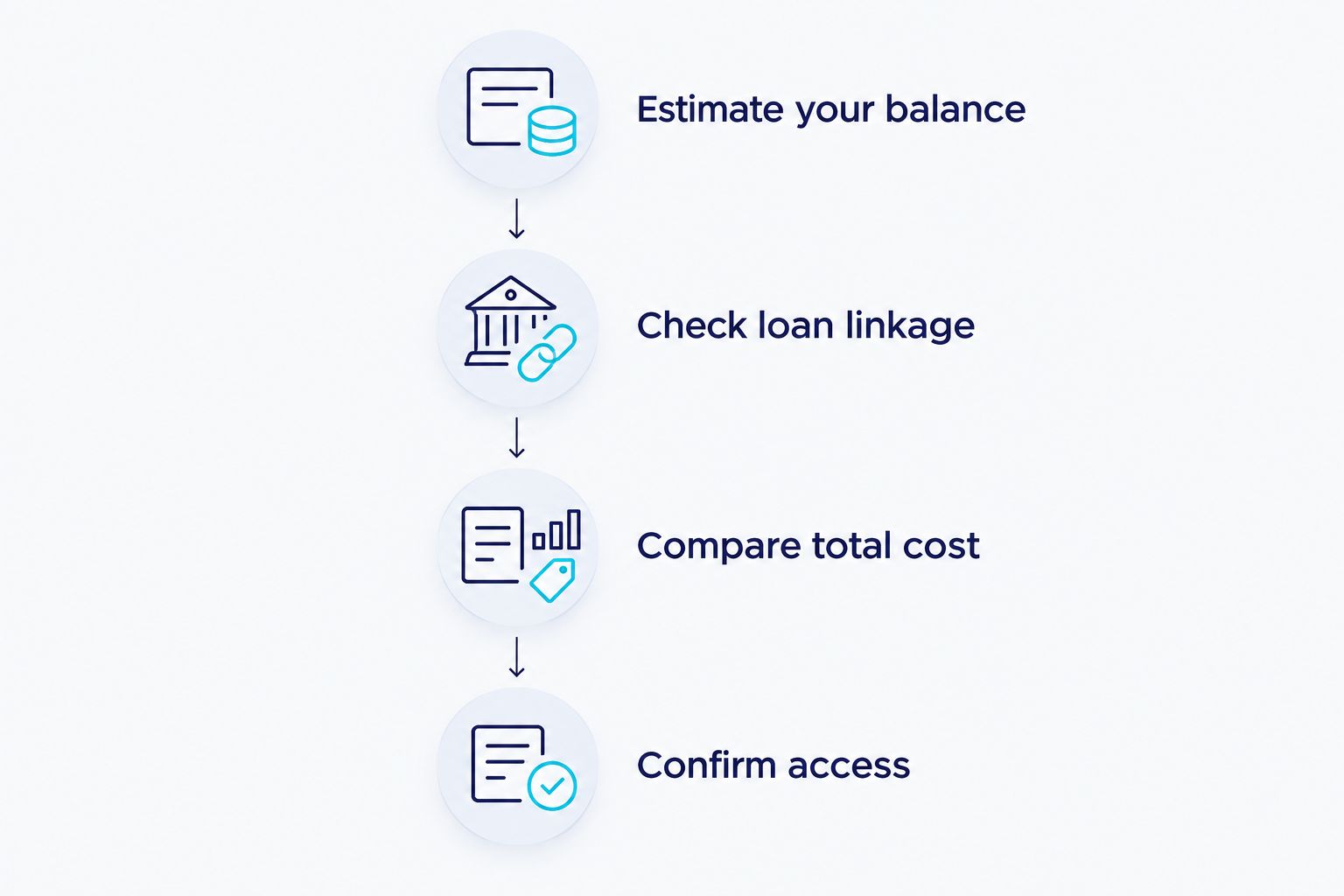
Use this sequence to turn an account preference into a loan comparison:
- Estimate your balance: Use the money you expect to retain after bills and spending, not a temporary deposit.
- Check loan linkage: Confirm the exact loan portion receiving the offset benefit.
- Compare total cost: Assess interest and relevant fees against a suitable alternative without an offset.
- Confirm access: Check ownership, payment facilities and transfer arrangements before moving everyday banking.
Ask for the comparison in writing so you can identify the assumptions behind it. A large opening balance is not a useful guide if you will spend most of it soon after settlement.
Discuss your offset loan options
Compare offset arrangements with home loan advice from Mortgage Pros.
Which offset account should you choose?
Choose a single full-offset account as the starting point for everyday savings. Move to multiple accounts when separate budgets improve your money management. Consider a split arrangement only when you also want fixed and variable borrowing.
For investment borrowing, settle the ownership and tax questions before moving funds. Keep partial offsets on the comparison sheet, but do not treat them as equivalent to full offsets.
Your final choice should follow the expected benefit and total loan cost, not the most elaborate account setup.
FAQ
What’s the best offset home loan account in 2026?
A single full-offset account is the default starting point for borrowers keeping everyday savings alongside an eligible home loan. The best lender choice depends on current loan terms, relevant fees, account access and your expected savings balance.
Is a full offset better than a partial offset?
A full offset provides more offset benefit for the same eligible savings balance than a partial offset. Compare the whole loan before choosing, because the offset feature does not determine total borrowing cost on its own.
Can I have more than one offset account?
You can have multiple offset accounts when the lender and loan product permit them. Confirm that every intended account qualifies and identify which loan each account offsets.
Does an offset reduce my home loan balance?
An offset reduces the balance used to calculate interest, rather than directly repaying the loan principal. Your money remains in the separate account until you spend it or transfer it.
Is an offset account the same as redraw?
No, an offset account holds money separately, while redraw provides access to eligible extra repayments made into a loan. Access conditions differ, and investment borrowing requires particular care when funds are redrawn.
Can an offset work with a fixed home loan?
Offset eligibility on a fixed home loan depends on the lender’s product terms. In a split arrangement, confirm whether the offset applies only to the variable portion rather than assuming both portions benefit.
How much money should I keep in an offset account?
There is no universal savings balance that makes an offset the best choice. Compare the expected interest reduction from your usual balance with the total cost of the linked loan and a suitable alternative.
One last thing
More offset accounts do not create more offset benefit when the combined eligible balance is unchanged. Splitting savings between fully eligible accounts linked to the same loan changes your budgeting arrangement, not the total balance offsetting that loan.
Choose separate accounts because they help you manage money. Choose the home loan because its terms suit your borrowing needs.