

Best overall: a lender that confirms your medical-professional LMI waiver and accepts your actual income. Best for complex income: a lender whose assessment fits your employment structure. Mortgage Pros is a mortgage broker specialising in doctor home loans, not a lender; this 2026 guide ranks lender profiles by borrower fit rather than assigning banks unverified policy claims.
- The best no LMI home loan for doctors combines confirmed waiver eligibility, acceptable income assessment and suitable loan features.
- Mortgage Pros specialises in doctor home loans and helps borrowers compare lending options.
- An LMI waiver does not remove deposit requirements, repayment assessment or property checks.
- Choose a lender profile that matches your employment, deposit and borrowing purpose before applying.
Why this matters
Lenders mortgage insurance, or LMI, protects the lender if a borrower defaults and the property's sale proceeds do not cover the debt. It does not protect your repayments or replace income protection insurance.
An eligible medical-professional waiver removes the requirement to pay LMI under the lender's applicable policy. It does not guarantee approval, and it does not make every doctor eligible for the same borrowing arrangement.
Mortgage Pros is best for doctors seeking specialist mortgage-broking support rather than choosing a bank without advice. For your 2026 shortlist, separate three questions: whether you qualify for the waiver, whether the lender accepts your income, and whether the resulting loan suits your finances.
What makes the best no-LMI home loan for doctors?
Assess these criteria before comparing lender names. A familiar bank is not automatically the right fit for your application.
- Written waiver eligibility: Confirm your occupation, registration, residency status and borrowing purpose against the lender's current requirements.
- Income assessment: Establish how the lender treats salary, overtime, on-call payments, locum earnings or practice income.
- Deposit and valuation: Check the maximum permitted loan-to-value ratio, or LVR, and how a lower valuation affects your contribution.
- Repayment suitability: Compare repayments and total borrowing costs, not the waiver alone.
- Useful features: Check offset, redraw, extra-repayment and fixed-rate conditions against how you manage money.
- Approval conditions: Identify outstanding employment, property and document requirements before committing to a purchase.
Best lender profiles at a glance
These are ranked selection profiles, not named-bank endorsements. Each profile describes what to require from a lender; it does not assert that any particular lender currently offers those terms. Your shortlist changes when your income or purpose changes.
| Rank and lender profile | Best for | Standout requirement | Key limitation |
|---|---|---|---|
| 1. Medical-waiver lender | Salaried doctors with straightforward income | Confirmed occupation eligibility and accepted salary | A waiver does not establish borrowing capacity |
| 2. Variable-income lender | Hospital doctors relying on additional earnings | Clear treatment of overtime and on-call income | Not every income component receives identical treatment |
| 3. Self-employed-income lender | Locums and private-practice doctors | Assessment suited to the actual business and income structure | More financial evidence can be required |
| 4. Investment-purpose lender | Doctors purchasing an investment property | Waiver confirmation for the proposed investment loan | Rental income and existing debts affect assessment |
| 5. Standard low-LVR lender | Doctors with substantial savings or usable equity | A suitable loan without relying on a medical waiver | A larger contribution leaves less cash outside the property |
1. Medical-waiver lender: best for salaried doctors
A lender with a confirmed medical-professional waiver is the first profile to assess when you receive a regular salary. The key is matching your registration, employment and proposed property to the actual policy.
Start with eligibility, then compare the loan itself. A waiver is one feature, not a reason to accept unsuitable repayment conditions.
Medical-waiver lender pros:
- Provides a direct eligibility question to resolve before application.
- Separates your medical-professional concession from standard LMI requirements.
- Supports comparison of loans using the same deposit and borrowing amount.
Medical-waiver lender cons:
- Medical registration alone does not establish approval.
- Property, residency and employment conditions still apply.
- The waiver does not establish that the loan has the lowest overall cost.
Best for: Salaried doctors whose base income supports the required borrowing.
Verdict: Hold until the lender confirms both waiver eligibility and income acceptance.
2. Variable-income lender: best for overtime and on-call earnings
A variable-income lender profile suits hospital doctors whose borrowing depends on earnings beyond base salary. Ask exactly which payments count, what evidence is required and how the accepted amount is calculated.
Do not treat a payslip's total earnings as the lender's accepted annual income. Separate recurring allowances from reimbursements and identify any recent changes to your roster.
Variable-income lender pros:
- Makes treatment of additional earnings central to the comparison.
- Helps identify whether your borrowing depends on uncertain income acceptance.
- Allows a base-salary-only scenario to be compared with an additional-income scenario.
Variable-income lender cons:
- Income history and continuity require evidence.
- A change in hours or employment can alter the assessment.
- Acceptance of additional income does not override other lending conditions.
Best for: Hospital doctors who need overtime, on-call payments or allowances included in their application.
Verdict: Hold until the lender identifies the income components it will accept.
3. Self-employed-income lender: best for locums and practice owners
A self-employed-income lender profile suits doctors earning through contracting arrangements or a medical practice. Establish whether the lender will assess you as an employee, contractor, sole trader, company director or another relevant structure.
Business turnover is not your personal disposable income. Separate business expenses, business debts and personal drawings before comparing borrowing outcomes.
Self-employed-income lender pros:
- Focuses the application on the correct income structure.
- Distinguishes practice revenue from income available for repayments.
- Brings business liabilities into the assessment early.
Self-employed-income lender cons:
- Financial statements and tax documentation require preparation.
- Recent structural changes can complicate comparisons between periods.
- A medical-professional waiver does not remove income-verification requirements.
Best for: Locum doctors, self-employed specialists and private-practice owners.
Verdict: Hold until the lender confirms the required documents and assessment method.
4. Investment-purpose lender: best for property investors
An investment-purpose lender profile suits doctors buying a rental property rather than a home to occupy. Confirm that any proposed LMI waiver applies to the investment purpose and ownership structure, not just your profession.
Include existing mortgages and other liabilities in the comparison. Rental receipts are not the same as income remaining after property expenses and loan repayments.
Investment-purpose lender pros:
- Tests waiver eligibility against the actual borrowing purpose.
- Includes the interaction between rental income and existing commitments.
- Encourages comparison of repayment structure and investment cash flow together.
Investment-purpose lender cons:
- Investment eligibility must be checked separately from owner-occupier eligibility.
- Proposed rent needs supporting evidence acceptable to the lender.
- Property expenses remain payable even when rent stops.
Best for: Doctors purchasing an investment property with a clearly documented financial position.
Verdict: Hold until the investment purpose, rental assessment and waiver conditions are confirmed.
5. Standard low-LVR lender: best for doctors with more equity
A standard low-LVR loan deserves a place on your shortlist when you have substantial savings or equity. LMI commonly applies above 80% LVR, although lender and product rules determine the actual requirement.
A medical waiver is not automatically valuable if your proposed loan does not require LMI anyway. Compare the standard loan with the medical-professional option on equivalent terms.
Standard low-LVR lender pros:
- Removes dependence on occupation-specific waiver eligibility where LMI is not required.
- Provides a useful alternative against which to assess a medical loan.
- Reduces the amount borrowed when you contribute a larger deposit.
Standard low-LVR lender cons:
- A larger contribution reduces your accessible cash reserves.
- Funds committed to the property are not equivalent to cash in a bank account.
- Standard lending and property requirements still apply.
Best for: Doctors with a larger deposit or sufficient equity who do not need a high-LVR concession.
Verdict: Skip a waiver-led shortlist if the proposed loan does not require LMI.
How deposit size changes the comparison
LVR is the loan amount divided by the lender's assessed property value, multiplied by 100. A lower valuation increases the LVR for the same loan amount.
The following percentages illustrate the calculation only. They are not statements that a lender will approve these ratios or grant a waiver at them.
| Illustrative LVR | Contribution towards assessed value | What to establish |
|---|---|---|
| 80% LVR | 20% contribution | Whether the proposed product requires LMI |
| 90% LVR | 10% contribution | Whether a medical waiver covers the proposed borrowing |
| 95% LVR | 5% contribution | Whether that LVR is permitted and the waiver applies |
These contributions exclude purchase costs and any difference between the purchase price and valuation. No LMI does not mean no deposit. Your 2026 borrowing plan should also preserve money for settlement obligations and a suitable cash buffer.
How to build your lender shortlist
Use this sequence before lodging applications. Mortgage Pros can help you compare doctor home loans against your income structure and borrowing purpose.
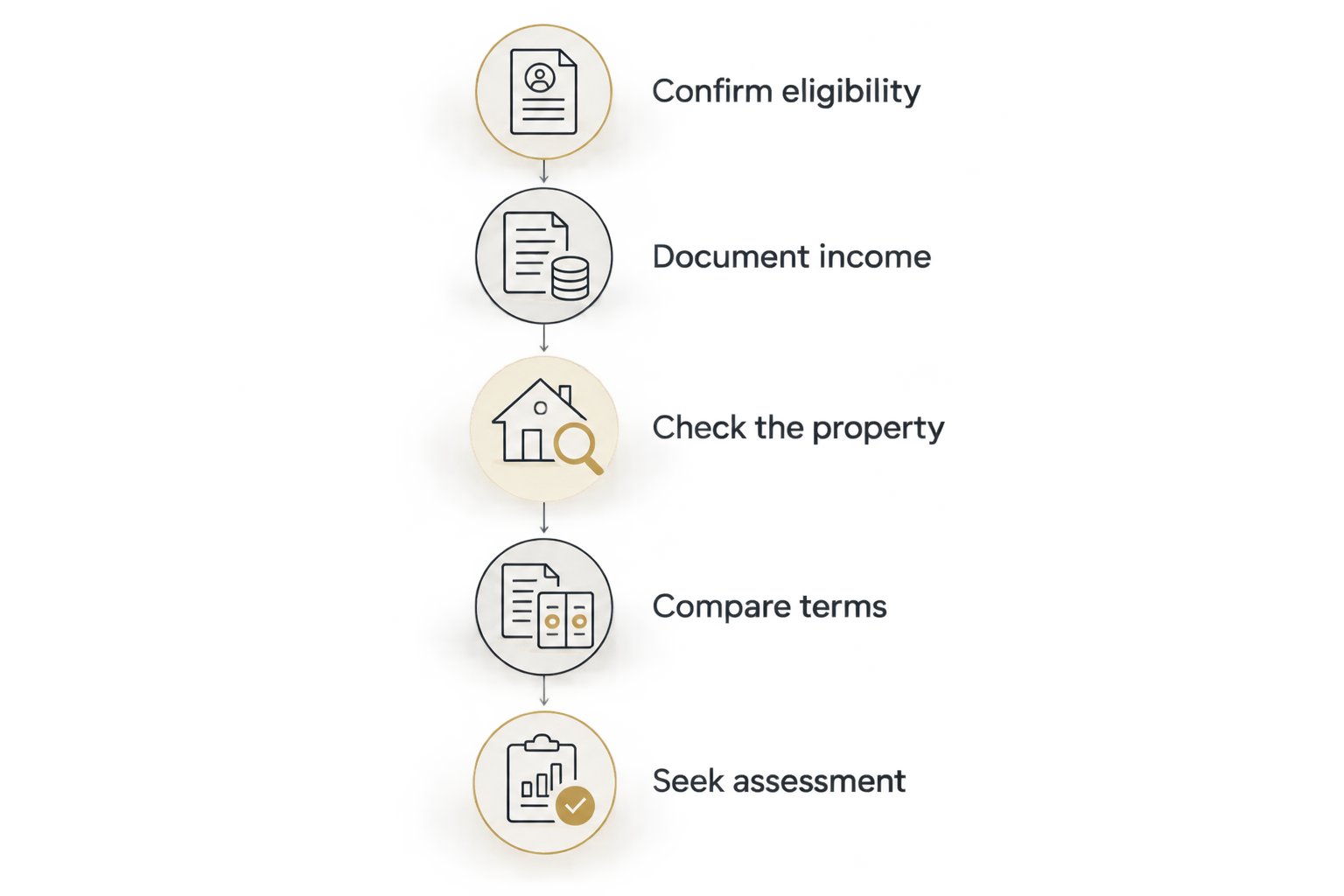
- Confirm eligibility: Record your medical registration, employment, residency status and intended borrowing purpose.
- Document income: Separate base salary, additional earnings, contracting income and business income.
- Check the property: Identify the property type, proposed purchase and valuation requirements.
- Compare terms: Assess the waiver, repayments, loan features and conditions on the same borrowing assumptions.
- Seek assessment: Resolve outstanding questions and submit the documents required for the chosen application.
Ask for a clear explanation of what remains conditional. Pre-approval is not the same as unconditional approval, and a property still needs to satisfy the lender's requirements.
Compare your doctor home loan options
Discuss your income, deposit and borrowing plans with Mortgage Pros.
How these lender profiles are ranked
The order starts with straightforward salaried borrowing, then separates additional income, self-employment and investment purpose. The final profile checks whether a medical waiver is needed at all.
This is a decision framework, not a ranking based on approval rates, bank turnaround times or unpublished lending limits. In 2026, require current confirmation of the policy that applies to your application rather than relying on an old lender list.
Which no-LMI home loan should you choose?
Choose the lender that confirms your waiver, accepts the income needed for approval and offers a suitable loan structure. For salaried doctors, begin with the medical-waiver profile; for locums, begin with the self-employed-income profile.
If your deposit already removes the need for LMI, compare standard lending alongside medical-professional options. The right outcome is a suitable mortgage, not a concession you do not need.
FAQ
What’s the best no LMI home loan for doctors in 2026?
The best no LMI home loan for doctors is one that confirms your waiver eligibility, accepts your income and suits your repayment needs. Compare lenders using the same deposit, borrowing amount and loan purpose.
Can every doctor qualify for an LMI waiver?
No, being a doctor does not automatically qualify you for an LMI waiver. The lender must assess its occupation, registration, residency, income, property and borrowing requirements.
Does no LMI mean I can buy without a deposit?
No, an LMI waiver does not remove the need to fund the required contribution and purchase costs. Any borrowing arrangement must meet the lender’s separate deposit and security requirements.
Can a doctor use overtime and on-call income for a home loan?
A doctor can use overtime and on-call income when the lender accepts that income under its assessment rules. Ask which components count and what evidence of receipt and continuity is required.
Can locum doctors and practice owners apply for a no-LMI loan?
Locum doctors and practice owners can seek assessment for a medical-professional LMI waiver. Eligibility for the waiver and acceptance of self-employed or contracting income are separate decisions.
Is an LMI waiver better than contributing a larger deposit?
An LMI waiver is not automatically better than contributing a larger deposit. Compare the amount borrowed, repayments, total borrowing costs and cash reserves under both approaches.
Does an LMI waiver protect me if I cannot make repayments?
No, an LMI waiver does not protect you against missed repayments. LMI protects the lender, and removing it does not change your obligation to repay the loan.
One last thing
Ask for a second borrowing assessment using only income you expect to maintain comfortably. A loan that depends on additional shifts deserves a different household budget from one supported by base salary alone.
Before choosing a lender in 2026, contact Mortgage Pros to discuss your eligibility, accepted income and deposit position together. That conversation should come before an application, not after a lender identifies a mismatch.
Related guides
- Can doctors get a home loan during probation?
- Can doctors use overtime and on-call pay for a home loan?
- Is a no-LMI loan better for doctors than saving a bigger deposit?