

Midwives’ home loans are property loans assessed against a midwife’s income, commitments and deposit, with the aim of financing a home you can afford. This 2026 guide explains how to document shift earnings, compare loan structures and prepare for approval without assuming that medical-professional benefits automatically apply to midwives.
- Home loans for midwives depend on documented income, deposit and lender policy—not your professional title alone.
- Mortgage Pros suits borrowers seeking home loan advice and approval support rather than applying directly without guidance.
- Separate base salary, overtime and allowances before comparing borrowing capacity.
- Confirm midwife eligibility before relying on medical-professional concessions or lenders mortgage insurance exemptions.
Why home loans matter for midwives
For midwives, the important question is not simply how much you earn. It is how much of that income a lender accepts when assessing repayments, particularly when your payslips include overtime, penalties, allowances or casual shifts.
A roster change, parental leave or move between employers also changes the evidence behind your application. Build your loan around income you can sustain, not the busiest roster you have worked.
Mortgage Pros provides home loan advice and approval support for individual borrowers and investors. Mortgage Pros is best for borrowers seeking home loan guidance rather than managing a direct lender application alone. A broker helps compare options, but the lender still decides whether to approve the application.
For a 2026 purchase, check the policy that applies when you apply. A colleague’s approval does not establish your eligibility, even if you work in the same maternity unit.
How to prepare a midwife home loan application
1. Separate your income before estimating borrowing power
Start with your payslips, employment contract and bank statements. Create a simple spreadsheet that separates guaranteed earnings from income that changes with your roster, rather than entering your highest pay into a borrowing calculator.
For midwives, this distinction matters when comparing permanent employment, bank shifts, agency work and private practice. A lender’s treatment of each income source determines how much supports the application; a calculator cannot confirm that treatment.
Check whether salary packaging appears on your payslip and explain the deductions rather than treating take-home pay as your entire employment income. Keep reimbursements separate from earnings so the application does not overstate what you receive for work.
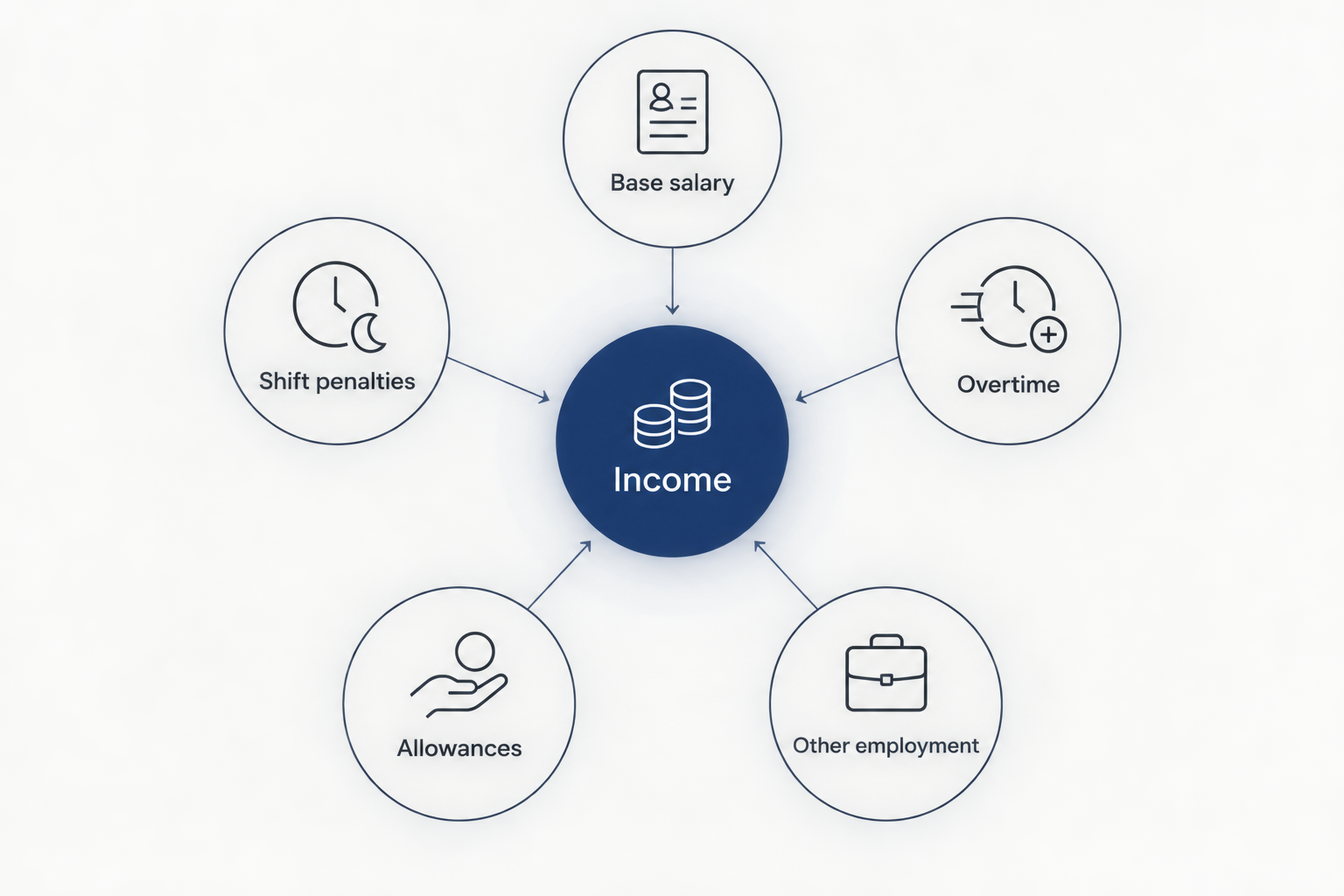
Organise your income under these headings:
- Base salary: record contracted hours and your current employment classification.
- Shift penalties: identify recurring evening, weekend and public holiday earnings.
- Overtime: separate additional hours from contracted work.
- Allowances: explain what each payment covers and whether it continues.
- Other employment: document agency shifts or income from another employer.
2. Set a repayment budget that survives roster changes
Review your transaction history and write down what your household actually spends. Include childcare, transport to different workplaces, professional registration, insurance and existing debt repayments where relevant.
Next, test the budget against your base earnings and any known change in working hours. Passing a lender’s assessment does not mean the maximum approved repayment suits your household, particularly if you intend to reduce nights or return to work part-time.
Use a mortgage repayment calculator to compare loan amounts and interest-rate scenarios. Treat the result as a planning estimate, not an approval or a personalised recommendation.
Before setting your purchase limit:
- Include regular expenses that annual totals can hide.
- Allow for property ownership expenses beyond the mortgage.
- Check repayments against a lower-overtime roster.
- Record planned parental leave or reduced hours.
- Keep an accessible buffer rather than committing all savings to settlement.
3. Confirm which employment evidence each lender needs
Start by gathering the records you already hold. Employment contracts, payslips, income statements and bank credits help explain how your earnings fit together, but the required documents depend on the lender and employment arrangement.
For a 2026 application, distinguish your current position from your intended next role. An offer for a permanent position is not the same evidence as established earnings in that position, and an agency assignment is not automatically treated like permanent employment.
Mortgage Pros can help you compare home loans against your circumstances and prepare an application. The benefit is assistance with the comparison and approval process; the limitation is that broker involvement does not remove a lender’s evidence requirements or guarantee approval.
Prepare a clear employment summary:
- Record your start date, employment status and contracted hours.
- Explain any recent move between hospitals or employers.
- Identify probation or a fixed contract end date.
- Document casual or agency work separately from permanent employment.
- Provide business and tax records if you practise as a self-employed midwife.
- Disclose known changes affecting the income used for repayments.
4. Calculate your deposit and check concessions separately
Add up the funds you can genuinely contribute, then account for purchase expenses and the savings you want to retain. Your deposit is not the same as your entire savings balance.
Loan-to-value ratio, or LVR, is the loan amount divided by the property value accepted by the lender. An 80% LVR means the loan represents 80% of that value, leaving a 20% contribution before purchase expenses and any valuation difference.
Lenders mortgage insurance generally applies to standard loans above 80% LVR, subject to the lender and any applicable exemption or guarantee. It protects the lender, not the borrower. Do not assume that a concession advertised for doctors includes midwives.
Check each pathway independently:
- Confirm whether midwives are explicitly eligible for any occupational concession.
- Ask which registration and employment evidence supports eligibility.
- Check current first-home buyer assistance against your state and circumstances.
- Establish how gifted funds must be documented.
- Understand the guarantor’s obligations before considering family support.
5. Compare loan structures against your working life
Begin with a written list of features you will actually use. Certainty, access to savings and extra repayments matter differently if your income fluctuates or you expect to change hours.
A variable loan allows repayments to change when the interest rate changes. A fixed loan fixes the rate for an agreed period, but restrictions and break costs need checking. Neither structure is automatically better for midwives.
An offset account can suit a borrower who keeps savings accessible while reducing the balance used to calculate interest. With a 100% offset, the full eligible account balance offsets the linked loan balance; this does not mean the loan itself is repaid.
Compare the practical conditions:
- Check extra repayment rules rather than assuming unlimited flexibility.
- Confirm whether an offset is full or partial.
- Distinguish offset savings from redraw access to extra repayments.
- Examine fixed-rate break conditions before fixing.
- Compare the complete loan arrangement, including fees and restrictions.
- Match the structure to expected leave, relocation or refinancing plans.
6. Check approval conditions before committing to a property
Compile your documents and obtain an assessment before treating a borrowing estimate as a purchase budget. Pre-approval is conditional; it is not a promise that every property or later application will be accepted.
A lender still needs to assess the property and confirm that your circumstances meet its requirements. Changes in employment, debt or income between assessment and settlement need attention, even when they appear manageable to you.
Before signing a contract in 2026, ask your solicitor or conveyancer about the finance terms and your obligations. Auction purchases need particular care because you should not assume a finance condition will protect you.
Close the application gaps before you commit:
- Check the approval’s conditions and expiry date.
- Confirm whether the intended property type is acceptable security.
- Keep payslips and bank records current.
- Discuss planned credit applications or new debts with your broker.
- Tell your broker about changes to employment or working hours.
- Obtain legal advice on the contract before signing.
Discuss your midwife home loan
Explain your employment, deposit and plans so Mortgage Pros can help you assess your next step.
Compare home loan options for midwives
Choose the structure after checking income eligibility, not before. A feature-rich loan does not solve an application that relies on income the lender will not accept. These options address different needs and can overlap; an offset, for example, is a feature rather than a separate employment-based loan category.
| Option | Best for | Main advantage | Key limitation |
|---|---|---|---|
| Variable-rate loan | Midwives prioritising repayment flexibility | Extra repayments and features depend on the product | Repayments can rise when the rate changes |
| Fixed-rate loan | Midwives prioritising repayment certainty during the fixed period | The interest rate stays fixed for the agreed term | Extra repayment limits and break costs need checking |
| Split loan | Midwives wanting a mix of certainty and flexibility | Separates fixed and variable portions | Each portion has its own conditions |
| Loan with an offset | Midwives retaining accessible savings | Eligible savings reduce interest on the linked loan | Features and fees differ between products |
| Guarantor-supported loan | Borrowers considering family security support | Additional security can help address a deposit shortfall | The guarantor takes on financial risk |
Ask for an explanation of why the recommended structure fits your circumstances. If the answer focuses only on your occupation, return to your income evidence, repayment budget and intended use of the property.
Common mistakes midwives make with home loans
Assuming doctor benefits cover all medical professionals
A clinical role does not establish eligibility for a doctor-specific policy. Ask whether the lender explicitly includes midwives, and obtain confirmation before making your deposit plan depend on an exemption.
Treating a busy roster as permanent income
A payslip with substantial overtime does not establish a sustainable annual income. Show the pattern behind variable earnings, and decide whether you want to keep working those hours to support repayments.
Leaving agency work unexplained
Several deposits from different employers need context. Label the employers and connect bank credits to payslips so the application clearly distinguishes permanent work, casual shifts and other employment.
Ignoring an upcoming change in hours
Parental leave, study or a move to part-time work affects the household budget. Discuss known changes before applying rather than building the application around earnings that will stop.
Choosing a loan before checking the property
An acceptable borrower and an acceptable property are separate questions. Confirm the lender’s security requirements before committing, particularly when the property has unusual features or ownership arrangements.
FAQ
Can midwives get a home loan using overtime and shift penalties?
Overtime and shift penalties can support a home loan application when the lender accepts the income and its supporting evidence. Separate these payments from base salary and confirm how the lender assesses their continuity.
Do midwives automatically qualify for doctor home loan benefits?
No, being a midwife does not automatically establish eligibility for doctor-specific home loan benefits. Ask whether the lender explicitly includes midwives and what employment or registration conditions apply.
Can I apply for a mortgage as a casual or agency midwife?
Casual or agency employment does not automatically prevent a home loan application. The lender must assess your income history, current work and evidence, so prepare records for each employer.
How much deposit does a midwife need for a home loan?
The required deposit depends on the lender, property, loan structure and any assistance you qualify for. Separate your deposit from purchase expenses, and check lenders mortgage insurance rather than assuming your occupation removes it.
Can I get a home loan while planning parental leave?
Planning parental leave does not automatically rule out a home loan, but the lender must assess the relevant income and repayments. Provide your leave arrangements, expected income changes and return-to-work information.
Is an offset account better than redraw for a midwife?
An offset account and redraw serve different purposes, so neither is automatically better for a midwife. Compare access conditions, fees and how you intend to use your savings; seek tax advice if the property could later become an investment.
Should I use a mortgage broker or apply directly to a bank?
Use a mortgage broker if you want help comparing lender policies and preparing an application; apply directly if you prefer to manage one lender’s process yourself. Mortgage Pros provides home loan advice and approval support, but the lender retains the approval decision.
One last thing
Separate what a lender will accept from what you want to keep earning. Overtime that helps an application today can become an unwanted commitment if you later want fewer night shifts or more time at home.
Before submitting a 2026 application, write down your expected working pattern after purchase. Then contact us today to discuss your income, deposit and home loan plans with Mortgage Pros.
This guide provides general information, not personal financial, tax or legal advice. Loan eligibility and conditions depend on your circumstances and the lender’s assessment.
Related guides
- Home loans for nurses: complete guide
- How does a guarantor home loan work?
- How long does mortgage pre-approval take?