

Instead of manually transferring spare cash to your home loan, set up scheduled extra repayments and check how your redraw facility treats those payments. This 2026 workflow shows you how to reduce your loan balance, verify access to eligible repayments and avoid confusing redraw with money held in an offset account.
- Redraw facility extra repayments reduce your loan balance; access to those funds remains subject to your lender’s rules.
- Mortgage Pros helps borrowers review home loan arrangements, including refinancing and equity needs.
- Keep minimum repayments active, confirm restrictions and verify each extra payment before relying on available redraw.
- An offset account holds separate cash; redraw involves accessing eligible amounts previously paid into your loan.
Why this matters
Extra repayments and redraw serve different purposes. Paying extra reduces your outstanding loan principal; redraw lets you access eligible advance repayments under your loan contract. Taking money back out increases your loan balance and reduces the interest-saving benefit.
Mortgage Pros is best for borrowers seeking mortgage broking advice on home loan arrangements, including doctors. Start with Mortgage Pros if you need help reviewing your existing loan before changing how you repay it.
The key decision is not simply whether redraw exists. You need to know whether your lender permits the repayment pattern you want and whether the withdrawal rules suit your cash needs. Do not treat available redraw as an unrestricted savings account.
Before you start
- Access and records: Have access to your lender’s banking service, your repayment account, your loan contract and a recent statement. Confirm who can authorise transfers and redraw requests on a jointly held loan.
- Repayment rules: Check your required repayment, repayment frequency, extra-repayment restrictions and redraw conditions. Fixed-rate loans can restrict additional repayments or trigger break costs when contractual limits are exceeded.
- The overlooked gotcha: Paying extra does not automatically replace your next scheduled repayment. Keep the required payment arrangement active unless your lender confirms otherwise, and check whether your displayed redraw balance differs from the amount immediately accessible.
For a 2026 setup, use the terms that apply to your current loan, not a general description from when you first borrowed. Ask your lender to explain anything unclear before you transfer money you need for upcoming commitments.
Repayment and redraw settings
Confirm the loan rules
- Identify the exact loan account or split receiving the extra repayments. If your mortgage has fixed and variable portions, check the conditions for each separately.
- Ask your lender whether additional repayments are permitted and whether a limit applies. Confirm how the limit is measured and what happens if you exceed it.
- Confirm whether redraw is enabled, whether activation or approval is required and which borrowers must authorise withdrawals.
- Ask about withdrawal minimums, transaction limits, processing conditions and any applicable charges. Confirm how the lender calculates the amount available to redraw.
- Record the lender’s answers alongside your loan documents so you can check them later.
Expected result: You know which account accepts extra repayments, what restrictions apply and how eligible funds can be accessed. Do not proceed on the assumption that every loan split has identical features.
Banking menus and button names differ between lenders. Follow your lender’s current instructions rather than choosing a similarly named transfer option without checking where the money will go.
Separate loan reduction from cash access
Before configuring payments, decide whether your main goal is reducing debt or keeping cash accessible. These approaches are related, but their treatment of your money differs.
| Approach | Best for | Benefit | Limitation |
|---|---|---|---|
| Extra repayments with redraw | Borrowers prioritising loan reduction who accept lender-controlled access | Extra repayments reduce principal and associated interest while they remain in the loan | Access depends on redraw conditions; withdrawing increases debt again |
| Offset account | Borrowers wanting separate transaction cash linked to an eligible loan | An eligible offset balance reduces the balance used to calculate interest | The account does not itself repay principal; eligibility and offset treatment depend on the product |
Choose the arrangement around how you need to use the money, not just the feature name. Neither option guarantees a better outcome without considering the loan’s full terms and your spending behaviour.
If your home could later become an investment property, obtain tax advice before choosing between extra repayments and an offset account. Redrawing for private spending can affect interest deductibility when a loan also has an income-producing purpose.
Scheduled extra repayments
Set the payment amount and timing
- Review the cash left after required repayments, living expenses and known commitments. Keep money for upcoming bills outside the extra-repayment schedule.
- Choose a recurring amount your ordinary income can support. Do not base a permanent commitment on overtime, on-call payments or irregular business receipts that have not arrived.
- Choose a transfer date after your income normally clears. Allow for the timing differences between your pay cycle and your loan’s required repayment dates.
- Use your lender’s supported method to establish the additional payment. This might involve changing an authorised repayment amount or creating a separate scheduled transfer; confirm which method suits your account.
- Check that the instruction goes to the correct loan split and does not cancel or replace a required repayment unintentionally.
Expected result: A recurring instruction directs your chosen surplus to the intended loan account while your minimum repayment arrangement remains covered.
For doctors receiving salary plus variable clinical income, a conservative recurring amount separates everyday affordability from occasional surplus. Review additional income after it arrives rather than committing it in advance.
Verify the first payment
- Open the transaction history for the account funding the payment and confirm the debit has processed.
- Check the home loan transaction history for the corresponding credit. Distinguish a scheduled instruction from a completed transaction.
- Review the outstanding loan balance and the lender’s available-redraw figure separately. Interest and other account movements mean the overall balance change is not always identical to the transfer amount.
- Confirm the next required repayment remains covered. Save the payment confirmation and your updated loan record.
Expected result: Both sides of the transfer show a completed transaction, and you understand how the lender has treated it.
Keep 3 records for this workflow: the payment instruction, the completed transaction and the updated loan record. Together, they help distinguish a scheduling problem from a posting or redraw-availability issue.
The 2026 verification checkpoint is completion, not intention. A recurring instruction on your screen is not proof that an extra repayment reached the loan.
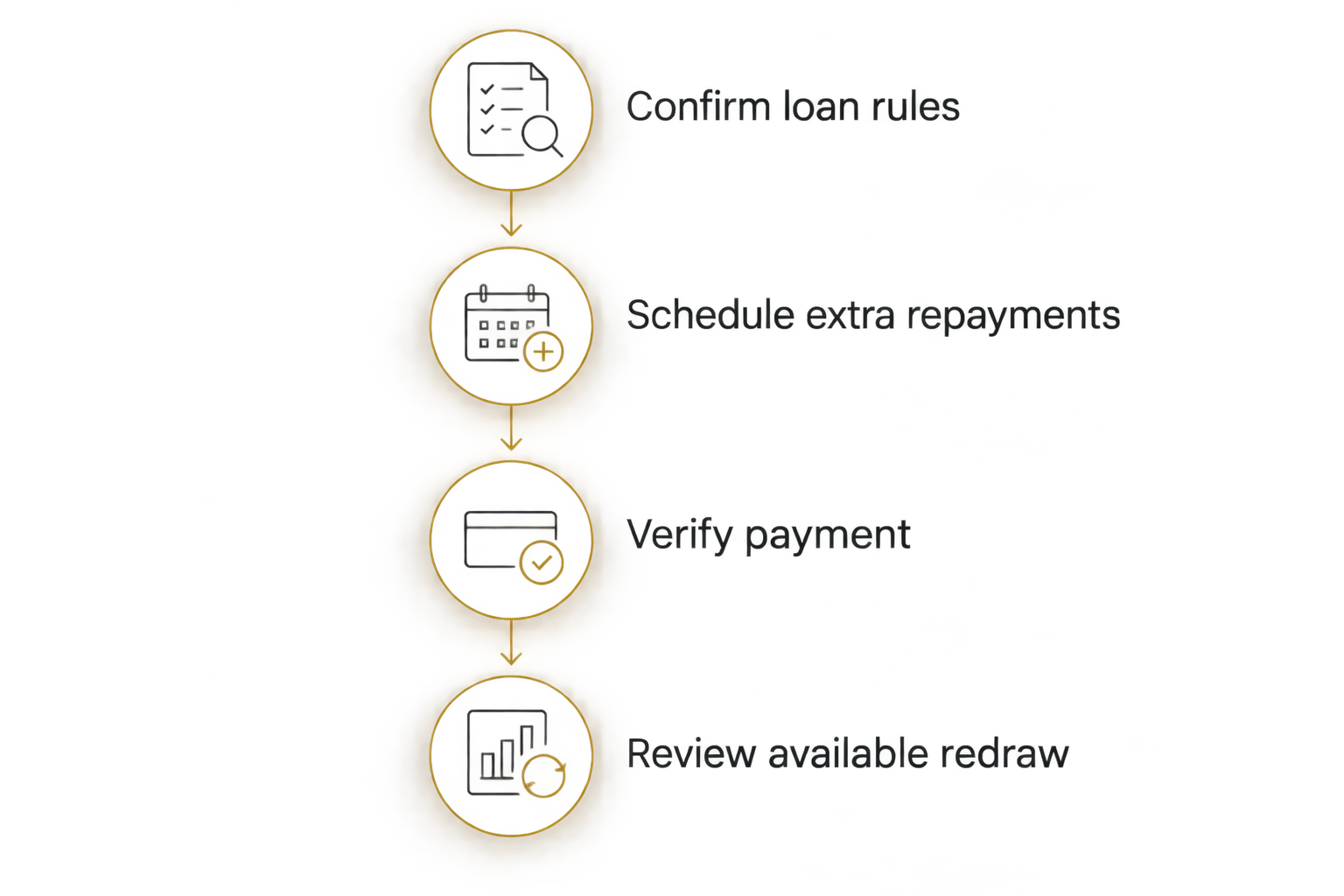
Review available redraw
Check the amount your lender identifies as available, rather than adding up past extra payments yourself. Your loan contract determines access, and the displayed amount can change as repayments, withdrawals and loan adjustments occur.
Before making an important commitment, confirm the withdrawal method and timing directly with your lender. Do not fund a time-sensitive payment on the assumption that redraw will be immediate. Keep essential cash accessible through an arrangement you understand.
Variant: add extra repayments when variable income arrives
A recurring payment suits predictable surplus; a manual top-up suits income that changes. Doctors receiving overtime, locum income or private-practice receipts can use the same verification process without increasing their permanent repayment instruction.
- Wait until the income clears into your account.
- Set aside money for tax and other commitments where relevant, with advice from your accountant.
- Recheck your remaining extra-repayment allowance if the loan has restrictions. Include earlier top-ups rather than assessing the new payment in isolation.
- Transfer the surplus you have chosen to commit to the loan.
- Verify the completed repayment and updated redraw position using the checks above.
Expected result: Irregular surplus reduces the loan balance without creating a recurring payment that depends on uncertain future income.
Keep 2 payment instructions distinct if you use both methods: your recurring extra repayment and your one-off top-up. Recording them separately makes accidental duplication easier to identify.
For your 2026 review, assess variable-income top-ups against actual receipts and current commitments. A strong income month does not automatically justify a permanent increase.
Troubleshooting
The extra payment has not reached the loan
Check whether the transfer is scheduled, pending, rejected or completed. Confirm the destination account details and available funds in the paying account, then ask the relevant bank to trace the transaction if the records do not reconcile.
Do not immediately send the same payment again. First establish whether the original instruction will still process, particularly if another debit would leave you short for required repayments.
Available redraw is lower than expected
Compare the loan’s transaction history with its redraw conditions. Recent payments, earlier withdrawals and the lender’s calculation method can explain differences between your own total and the accessible amount.
Ask the lender to explain the specific difference. Do not assume the amount paid ahead, the reduction in principal and available redraw are interchangeable figures.
You cannot submit a redraw request
Check whether redraw is active and whether the request meets the lender’s withdrawal rules. Joint-authorisation requirements, transaction limits or account restrictions can prevent a request from proceeding.
Contact the lender before relying on that money for settlement, tax or another deadline. Arrange an alternative source of accessible funds if the lender cannot confirm access in time.
Your required repayment still comes out
An extra transfer does not necessarily change the lender’s scheduled debit. Check whether you created an additional payment rather than amending the existing repayment arrangement.
Keep enough money available for the required debit until the lender confirms any change. Cancelling it without confirmation risks a missed repayment even when you believe the loan is ahead.
An extra repayment triggers a restriction
Stop further additional transfers and ask the lender how the relevant contractual limit applies. This is particularly important for fixed-rate portions of a split loan.
Do not assume moving the next payment to another split resolves the issue. Confirm that split’s terms and check any existing standing instructions before restarting.
Customise your workflow
Mortgage Pros can help review how your repayment arrangements fit your broader home loan needs. The benefit of broking advice is help assessing loan arrangements; the limitation is that your lender’s contract still governs redraw access, and tax questions require a qualified tax adviser.
Build your next review around these practical checks:
- Income changes: Reassess the recurring extra amount when your reliable income or household commitments change.
- Property plans: Seek tax advice before redrawing if the property is rented out or could become an investment.
- Loan changes: Reconfirm scheduled payments and redraw arrangements after refinancing or changing loan products.
- Access needs: Review whether money earmarked for near-term expenses belongs outside the loan.
For a 2026 loan review, bring your current statement, repayment instructions and questions about access to funds. Ask for a review of the whole arrangement rather than a recommendation based only on whether a loan advertises redraw.
Review your repayment setup today
Discuss extra repayments, redraw access and your home loan needs with Mortgage Pros.
FAQ
Do extra repayments automatically become available to redraw?
Not necessarily: access depends on your loan’s redraw conditions. Confirm whether redraw is enabled and how your lender calculates the accessible amount before relying on it.
Does redrawing extra repayments increase my home loan balance?
Yes, withdrawing through redraw increases the outstanding loan balance. It reduces the interest-saving benefit of leaving those extra repayments in the loan.
Can I stop normal repayments if I have paid extra?
Do not stop required repayments unless your lender confirms that your arrangement permits it. An extra payment does not automatically cancel a scheduled debit or change your contractual obligations.
Is an offset account the same as a redraw facility?
No, an offset account holds money separately, while redraw provides access to eligible amounts already paid into your loan. The access rules and potential tax consequences differ.
Can I make extra repayments on a fixed-rate home loan?
Your fixed-rate loan contract determines whether extra repayments are permitted and what limits apply. Confirm those terms before transferring money because exceeding a limit can trigger break costs.
Can doctors use overtime income for extra home loan repayments?
Doctors can put surplus overtime income towards extra repayments where their loan terms permit it. Wait until the income arrives, account for commitments and verify the payment before relying on any resulting redraw.
Can redrawing money affect investment loan interest deductions?
Yes, the purpose of redrawn funds can affect interest deductibility. Ask a qualified tax adviser before mixing private spending with borrowing used for an income-producing purpose.
One last thing
A large redraw figure is not a reason to redraw. Each withdrawal puts debt back onto the loan, so check the purpose and effect before treating it as spending money.
Contact Mortgage Pros through the contact us page to discuss your repayment setup today. This guide provides general information, not personal financial or tax advice; your loan terms and circumstances determine the appropriate approach.
Related guides
- Redraw facility home loans
- Offset home loan accounts
- How to choose a doctor mortgage broker for complex income