

Instead of chasing documents and approval updates separately, organise the pre approval to settlement process around written lender decisions, contract deadlines and a final funds check. This 2026 workflow shows you what to prepare, who handles each task and what must be confirmed before you move ahead.
- The pre approval to settlement process requires property assessment, formal approval, signed loan documents and settlement readiness.
- Mortgage Pros suits medical borrowers seeking home loan advice and approval support.
- Pre-approval does not guarantee finance for a particular property or protect your contract deadlines.
- Doctors should document employment changes, overtime and private-practice income before committing to a purchase.
Why this matters
Pre-approval is not permission to make an unconditional commitment. A lender still needs to assess the property and satisfy its lending requirements, while your purchase contract creates separate legal obligations.
Mortgage Pros provides mortgage broking advice and approval support, including home loans for doctors. Mortgage Pros is best suited to medical borrowers seeking home loan advice and approval support. A broker coordinates the lending application; your solicitor or conveyancer advises on the contract and transfer of ownership. Neither role replaces the other.
Keep these responsibilities separate in your 2026 purchase plan. A finance update from your broker does not extend a contractual deadline, and a signed purchase contract does not oblige a lender to fund the purchase.
Before you start
- Gather your evidence: identification, income documents, savings and deposit records, existing loan statements, credit commitments and living expenses. Ask your broker for the lender-specific document list rather than assuming every application needs identical evidence.
- Arrange access and ownership: appoint a solicitor or conveyancer, confirm your broker's secure document-submission method, and create 1 shared tracker listing each task, responsible person, deadline and written confirmation.
- Check the hidden dependency: read the pre-approval conditions and expiry date before making an offer. Employment changes, new debts or an unacceptable property can require reassessment even while the pre-approval remains within its stated validity period.
For doctors, include the evidence behind each income component you want assessed. Hospital salary, overtime, on-call payments, locum work and private-practice earnings should not be treated as interchangeable.
Pre-approval and purchase readiness
Establish your borrowing position
- Give your broker a complete financial picture. Declare debts, credit limits, dependants, regular expenses and foreseeable changes. Explain whether you are buying a home or investment property, because the intended use matters to the application.
- Read the written pre-approval. Confirm the borrowing amount, expiry date, outstanding conditions and whether the assessment still depends on income verification. Ask what additional assessment is required once you select a property.
- Set your purchase limit. Separate the loan amount from the cash you need to contribute. Include the contract deposit, settlement contribution and applicable transaction expenses; have your conveyancer explain the amounts and timing relevant to your purchase.
Expected result: you know your working purchase limit, what the lender has actually assessed and which conditions remain unresolved.
Do not use every dollar of an indicative borrowing figure as your search budget without checking the required cash contribution. The contract deposit and the lender's required contribution are connected, but they are not necessarily the same amount or payable at the same time.
Confirm your purchase pathway
- Have the contract reviewed before committing. Ask your solicitor or conveyancer to explain finance conditions, deposit obligations, settlement dates and any cooling-off rights that apply. Rules vary by jurisdiction and transaction type.
- Send property details to your broker. Supply the address, proposed purchase amount and relevant contract information. Ask whether the property type or location raises lending restrictions and what valuation process the lender requires.
- Match the contract timetable to the lending work. Confirm who will monitor the finance deadline and request an extension if needed. Only rely on an extension once your legal representative confirms it has been properly agreed.
Expected result: your legal and lending advisers understand the proposed purchase before you take on obligations that depend on finance.
The purchase method changes your risk. Use this comparison to identify the checks you need, not to choose a contract strategy without legal advice.
| Purchase pathway | Best for | Advantage | Limitation | Required check |
|---|---|---|---|---|
| Private treaty with an agreed finance condition | Buyers seeking contractual protection while finance is assessed | A properly drafted condition can provide protection under its terms | Protection depends on the wording, deadlines and compliance | Have your legal representative explain exactly how the condition operates |
| Auction purchase | Buyers prepared to proceed under auction contract terms | The successful bid establishes the purchase outcome | Generally involves an unconditional commitment without cooling-off protection | Obtain legal advice and clarify finance and property risks before bidding |
Neither pathway removes the lender's need to assess the security property. Pre-approval alone does not eliminate the funding risk of an auction purchase.
Property assessment and formal approval
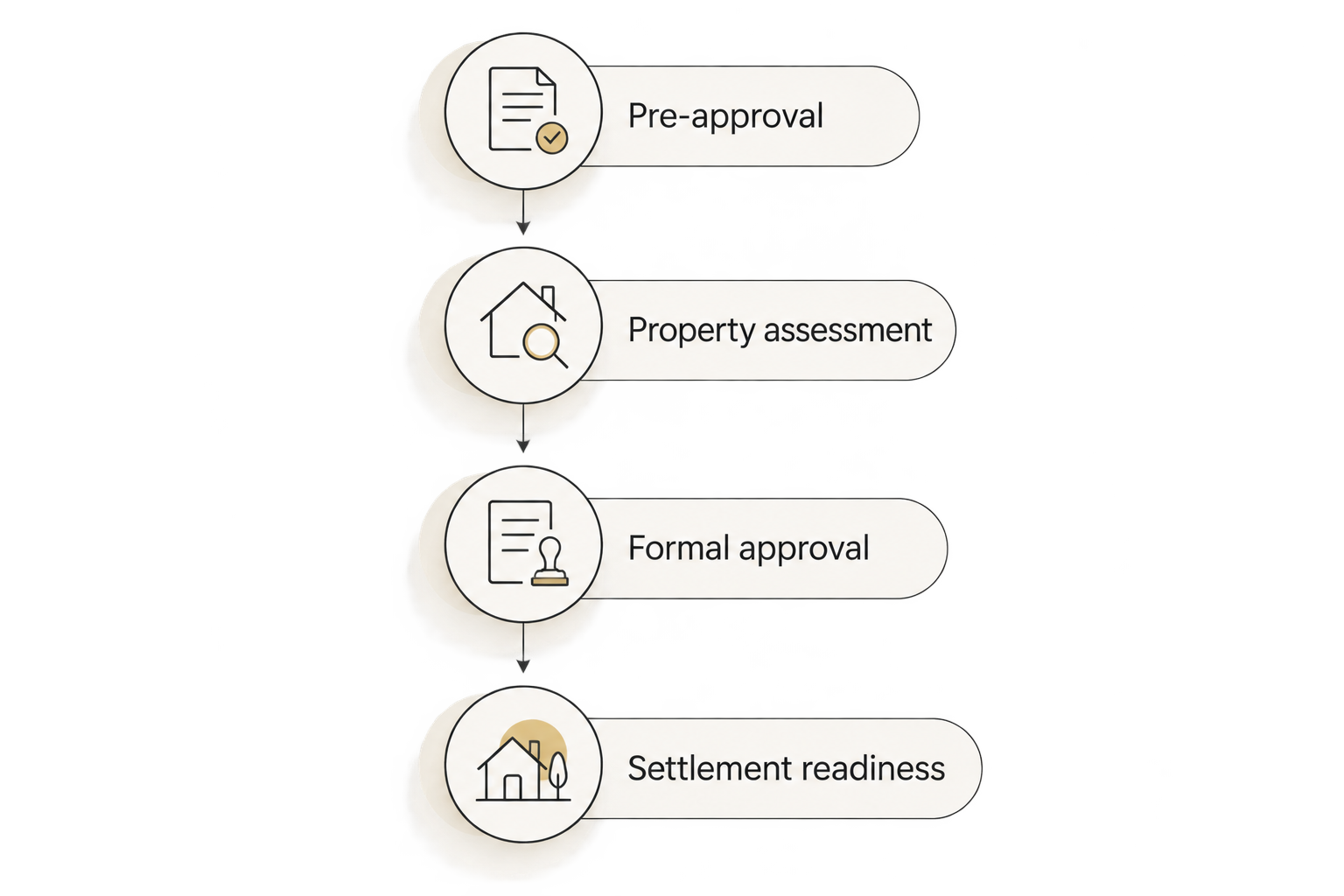
Once you have an accepted purchase, the application moves from an indicative borrowing position to a specific property and transaction. For your 2026 tracker, use 4 approval gates: pre-approval, property assessment, formal approval and settlement readiness. These are checkpoints for organising the purchase, not standard lender processing stages or promised turnaround times.
Complete the lender assessment
- Submit the purchase documents promptly. Give your broker the signed contract and any requested supporting material through the agreed secure channel. Make sure names and property details match the application.
- Supply updated evidence when requested. The lender can require current payslips, statements or explanations before issuing its final decision. Disclose changes rather than relying on documents that no longer describe your circumstances.
- Review the valuation outcome with your broker. If the lender's valuation is below the purchase amount, ask how this changes the loan and your contribution. Do not assume the lender will fund the difference.
- Obtain the written approval decision. Ask your broker to explain the approved amount, loan structure and any remaining requirements. Give your legal representative the finance outcome before any contractual finance deadline expires.
Expected result: you have a written lending decision for the property and understand what still needs to happen before funds can be advanced.
Formal approval and settlement readiness are different checkpoints. Even after credit approval, loan documents, identity checks, mortgage requirements and funds arrangements still need completion.
For doctors moving between hospital appointments or into private practice, notify your broker before the change. A stronger future income expectation is not a substitute for evidence the lender accepts today.
Loan documents and settlement readiness
Complete the funding arrangements
- Check the loan documents before signing. Review borrower names, loan amount, repayment arrangements and the agreed structure. Ask your broker to explain lending terms and obtain legal advice where required; do not sign documents you do not understand.
- Complete signing and identity requirements. Follow the lender's actual instructions for electronic signing, witnessing or verification of identity. There is no universal portal or button sequence across Australian lenders.
- Confirm your cash contribution. Ask your conveyancer for the settlement funds calculation and the deadline for cleared funds. Independently verify payment instructions using a known, trusted contact number, especially after any email requesting changed account details.
- Check readiness with both teams. Ask the broker or lender whether all funding requirements are satisfied and ask your conveyancer whether the legal settlement arrangements are ready. Arrange insurance from the point your contract and legal advice require, not automatically from key collection.
Expected result: the lender can provide funds, your contribution is in place and your conveyancer has confirmed the arrangements needed to settle.
Before settlement, obtain 3 confirmations: lender funding readiness, your conveyancer's readiness and receipt or availability of your required contribution. A booked settlement time is not the same as confirmation that all parties are ready.
In your 2026 tracker, keep the latest written update against each confirmation. If a requirement remains outstanding, record its owner and next action rather than marking the whole purchase complete.
After settlement, wait for confirmation from your legal representative before arranging key collection. Check that loan accounts and repayment instructions match the documents, and retain the settlement statement with your purchase records.
Plan your next approval step
Discuss your purchase timeline, income evidence and outstanding lending requirements.
When circumstances change after pre-approval
Run a reassessment whenever a material fact changes; do not wait until the lender discovers it during final checks. This adjacent workflow is particularly relevant to medical borrowers changing appointments, adding locum work or purchasing a different property.
- Record the change: identify the new employment arrangement, debt, deposit source, property or settlement date.
- Send supporting evidence: provide the revised contract, payslip, statement or purchase document your broker requests.
- Request a revised assessment: ask whether the existing pre-approval still applies and whether the borrowing limit or conditions have changed.
- Recheck your contract position: have your legal representative assess any effect on finance deadlines or settlement obligations.
Expected result: your purchase decision rests on current circumstances rather than an earlier assessment.
Mortgage Pros supports home loan applications for doctors, dentists and surgeons. Broking advice helps organise the lending assessment, but it does not guarantee approval or replace independent legal advice about an unconditional purchase.
Troubleshooting
Your pre-approval expires before you find a property
Ask your broker what the lender requires to renew or reassess it. Supply current evidence and obtain written confirmation before treating the earlier borrowing amount as usable; renewal is not automatic.
The valuation creates a funding gap
Ask your broker to recalculate the lending position and contribution using the lender's valuation. Discuss lawful contractual options with your conveyancer before committing additional funds or allowing a finance deadline to pass.
The lender requests more evidence of medical income
Separate base salary from variable earnings and provide the evidence requested for each component. Ask which income has been accepted in the assessment; do not build your purchase limit around unconfirmed overtime or projected private billings.
Loan documents contain an error
Stop and request correction through the lender or broker. Do not alter documents yourself unless instructed, and have your conveyancer assess whether the correction affects settlement timing.
Settlement is booked but funding is not ready
Ask for the exact outstanding requirement, responsible party and next update. Tell your conveyancer immediately so they can advise on contractual consequences and any extension process; do not assume a booking protects you from delay.
Customise your workflow
Keep the same approval gates but adapt the evidence to your circumstances. A salaried doctor starting a new appointment needs a different income discussion from a surgeon combining hospital employment and private practice.
For a guarantor arrangement, include the guarantor's assessment and legal requirements in the tracker. For settlement involving released savings or scheme funds, confirm the release process early rather than treating those funds as immediately accessible.
Use the 2026 checklist as an ownership system, not a promised schedule. Ask each professional what they need next, when they need it and what written confirmation closes the task.
FAQ
What is the pre approval to settlement process in Australia?
The process moves from an indicative lending assessment to property assessment, formal approval, loan documentation and settlement. Your broker coordinates lending requirements, while your solicitor or conveyancer handles the legal purchase and settlement work.
Does pre-approval mean my home loan is guaranteed?
No, pre-approval does not guarantee a home loan for a particular property. The lender must satisfy its remaining requirements, including property assessment and any updated financial checks.
How long does it take to get from pre-approval to settlement?
There is no single timeframe for every purchase. The contract sets the settlement deadline, while lender assessment, valuation, document completion and legal requirements determine whether the transaction is ready on time.
Can I bid at auction with pre-approval?
Pre-approval alone does not remove the financial risk of bidding at auction. Obtain legal advice about the auction contract and ask your broker what property and lending assessment remains before you bid.
Can a doctor change jobs after getting pre-approval?
A doctor changing jobs should notify their broker before relying on the existing pre-approval. A new employer, probation period, contract arrangement or income mix can require lender reassessment.
What happens if the bank valuation is below my purchase amount?
A lower valuation can change the loan amount available and the cash contribution required. Ask your broker to calculate the revised position and your conveyancer to explain your contractual options.
What should I check immediately before settlement?
Confirm lender funding readiness, your conveyancer’s readiness and your required contribution. Independently verify payment instructions and wait for legal confirmation that settlement has completed before arranging key collection.
One last thing
The most useful question is not whether your loan is approved; it is what still prevents settlement. Ask it after formal approval and again before the scheduled settlement date, because document or funds requirements can remain outstanding after the credit decision.
Contact Mortgage Pros today to discuss your home loan application and identify your next approval step.
Related guides
- How long does mortgage pre-approval take?
- Can doctors get a home loan during probation?
- How surgeons combine hospital and private income for a home loan