

Best overall: a lender that accepts your actual income and meets your borrowing needs. Best for salaried lawyers: a lender with suitable PAYG assessment. Best for a smaller deposit: a lender offering a professional policy for which you qualify. This 2026 guide ranks lender options by borrower situation, rather than treating your legal qualification as a guarantee of approval.
- The best home loan lenders for lawyers match your employment structure, deposit and borrowing needs.
- Salaried lawyers should compare PAYG assessment; partners should check how partnership income is assessed.
- Professional eligibility and lenders mortgage insurance treatment require separate checks.
- Mortgage Pros provides home loan broking for individual borrowers and property investors.
Why this matters
Your occupation is only one part of a home loan application. A lender also assesses your income, expenses, debts, credit history and the property offered as security. Being a lawyer does not replace those checks.
Mortgage Pros helps individual borrowers and investors secure and manage home loans. Mortgage Pros is best suited to borrowers who want home loan broking rather than a single-bank application. For lawyers comparing home loan lenders, that distinction matters: advice should start with your circumstances, not a bank name.
In 2026, use a profession-specific offer as a reason to investigate a lender, not as your final selection rule. An attractive eligibility benefit does not resolve an unsuitable income assessment or loan structure.
What makes the best home loan lenders for lawyers?
Use these criteria before comparing lenders. They separate an offer that sounds relevant from a loan that fits your application.
- Income assessment: The lender needs an assessment approach suited to your salary, variable remuneration, partnership distributions or business income.
- Professional eligibility: Confirm whether the policy covers your qualification, practising status and employment arrangement. A professional policy is not automatically a lawyer policy.
- Deposit and security: Check the accepted loan-to-value ratio, mortgage insurance treatment and property requirements together.
- Loan structure: Compare repayment type, offset and redraw arrangements, and restrictions relevant to how you intend to use the loan.
- Whole-loan cost: Examine interest, fees and relevant comparison-rate information rather than selecting on one promotional feature.
- Approval conditions: Distinguish initial eligibility from credit approval, property acceptance and conditions that remain outstanding.
Loan-to-value ratio, or LVR, expresses the loan as a percentage of the lender's assessed property value. An 80% LVR means the loan represents 80% of that value, leaving a 20% value margin outside the loan. The property value represents 100% of the calculation.
That margin is not the same as your total upfront cash requirement. Purchase expenses also need funding, and a lender valuation can differ from the agreed purchase amount. Lenders mortgage insurance generally applies above 80% LVR, subject to lender policy and any applicable exemption; it protects the lender, not you.
Lawyer home loan lender options at a glance
The ranking below is a decision guide for 2026. Each option has a distinct purpose; the first option is the default for a straightforward salaried application, not a universal winner for every lawyer.
| Rank and lender option | Best for | Standout assessment focus | Key limitation |
|---|---|---|---|
| 1. PAYG-focused lender | Salaried lawyers with straightforward income | Documented employment income | Variable remuneration needs separate assessment |
| 2. Professional-policy lender | Eligible lawyers prioritising a smaller deposit | Profession-specific eligibility and mortgage insurance treatment | Qualification alone does not establish eligibility |
| 3. Partnership-income lender | Equity partners receiving partnership income | Partnership earnings and distributions | Supporting evidence differs from a salary-only application |
| 4. Refinance-fit lender | Lawyers reviewing an existing mortgage | Replacement loan terms and retained features | Switching needs a whole-loan assessment |
| 5. Self-employed-income lender | Lawyers operating their own practice | Business income and personal borrowing capacity | Business turnover is not personal assessable income |
These categories can overlap within one lender. The purpose is to identify the assessment question you need answered first, then compare lenders that can answer it satisfactorily.
1. PAYG-focused lender: best for salaried lawyers
A PAYG-focused lender assesses your application primarily through documented employment income. This is the logical starting point if you work for a law firm, government department or in-house legal team and receive a regular salary.
Keep base salary separate from bonuses, overtime and other variable remuneration. You need to understand which components the lender accepts and what evidence supports them; your total remuneration package is not automatically your assessable income.
PAYG-focused lender pros:
- A clear match for a salary-led application.
- Employment records provide a direct starting point for income verification.
- You can compare ordinary home loans without relying on a professional concession.
PAYG-focused lender cons:
- Variable income requires its own policy check.
- A standard salary assessment does not establish access to professional benefits.
- Recent employment changes require attention to the lender's evidence requirements.
Best for: Employed lawyers whose borrowing capacity rests mainly on regular salary.
Before choosing, ask how the lender treats your employment status and each income component. If a bonus is essential to the application, resolve its treatment before relying on a borrowing estimate.
Verdict: Choose a PAYG-focused lender when accepted salary income supports the loan without relying on unconfirmed concessions.
2. Professional-policy lender: best for eligible low-deposit borrowers
A professional-policy lender has occupation-based lending criteria or concessions. For a lawyer seeking a smaller-deposit home loan in 2026, this category deserves investigation before assuming standard mortgage insurance treatment applies.
The important distinction is eligibility versus approval. Even when your occupation meets a professional policy, the lender still assesses borrowing capacity, credit conduct and the property.
Professional-policy lender pros:
- Lets you investigate profession-specific treatment directly.
- Provides a focused route for checking mortgage insurance eligibility.
- Makes practising status and professional evidence part of the initial comparison.
Professional-policy lender cons:
- Not every professional policy covers every lawyer.
- Employment structure and other criteria can affect qualification.
- A concession does not establish that the underlying loan is your best fit.
Best for: Lawyers whose main constraint is their deposit and who meet the lender's specific professional criteria.
Ask for the policy to be checked against your circumstances, including your role and employment arrangement. Then compare the resulting loan with standard alternatives on structure and whole-loan cost.
Verdict: Choose a professional-policy lender only after both the concession and the underlying home loan suit your application.
3. Partnership-income lender: best for equity partners
A partnership-income lender has an assessment approach suitable for income earned through a legal partnership. The application needs to explain the relationship between partnership earnings, your entitlement and the income available to service your personal loan.
The title of partner is not enough to determine the assessment route. A salaried partner and an equity partner can have different income arrangements, so describe how you are paid before asking which lender fits.
Partnership-income lender pros:
- Directs attention to partnership income rather than job title alone.
- Supports a document list tailored to your actual remuneration structure.
- Helps identify questions about distributions before an application proceeds.
Partnership-income lender cons:
- Salary evidence alone might not establish the full income position.
- Changes in ownership or distributions complicate the evidence required.
- Accepted income still depends on the lender's assessment policy.
Best for: Equity partners whose personal borrowing capacity depends on partnership earnings or distributions.
Identify the income you receive, the documents that substantiate it and any liabilities relevant to your application. Have your broker confirm the assessment approach before assuming all distributions count.
Verdict: Choose a partnership-income lender when its assessment reflects your documented partnership arrangements.
4. Refinance-fit lender: best for reviewing an existing mortgage
A refinance-fit lender offers a replacement loan that meets your current borrowing needs. Your starting point is the existing mortgage: its balance, remaining term, repayment structure and features you actually use.
Refinancing is not just another purchase-loan comparison. You need to check discharge and establishment expenses, any relevant break costs, and whether the new structure changes your repayment path.
Refinance-fit lender pros:
- Lets you reassess the loan against your current circumstances.
- Creates an opportunity to reconsider features and repayment structure.
- Makes the existing mortgage a concrete comparison point.
Refinance-fit lender cons:
- Switching involves expenses and a new credit assessment.
- Extending the term can reduce repayments while increasing total interest.
- Replacement offset or redraw arrangements need checking rather than assumption.
Best for: Lawyers who already own property and want to review their mortgage.
For a 2026 refinance, compare the replacement loan over a consistent remaining term before considering a term extension. A lower scheduled repayment and a better overall outcome are different claims.
Verdict: Choose a refinance-fit lender when the complete replacement arrangement improves the outcome you want, not merely the headline repayment.
5. Self-employed-income lender: best for practice owners
A self-employed-income lender assesses business-derived income for personal borrowing. This category fits lawyers operating their own practice where salary alone does not explain their financial position.
Business turnover is not the same as profit, and profit is not automatically the amount a lender accepts as personal income. The assessment needs to account for the business structure, supporting records and relevant liabilities.
Self-employed-income lender pros:
- Starts with business-derived income rather than forcing a salary-only comparison.
- Gives business records a clear role in the application.
- Helps separate practice finances from personal borrowing needs.
Self-employed-income lender cons:
- Requires more income explanation than a straightforward salary application.
- Fluctuating earnings need assessment under the selected lender's policy.
- Business debt and guarantees need disclosure and review.
Best for: Sole practitioners and practice owners whose home loan depends on business income.
Organise the lender-requested financial records before narrowing the shortlist. Ask which income figure the lender will assess and why, rather than using practice turnover as a borrowing estimate.
Verdict: Choose a self-employed-income lender when documented business income supports the personal loan under its assessment rules.
How to turn the ranking into a lender shortlist
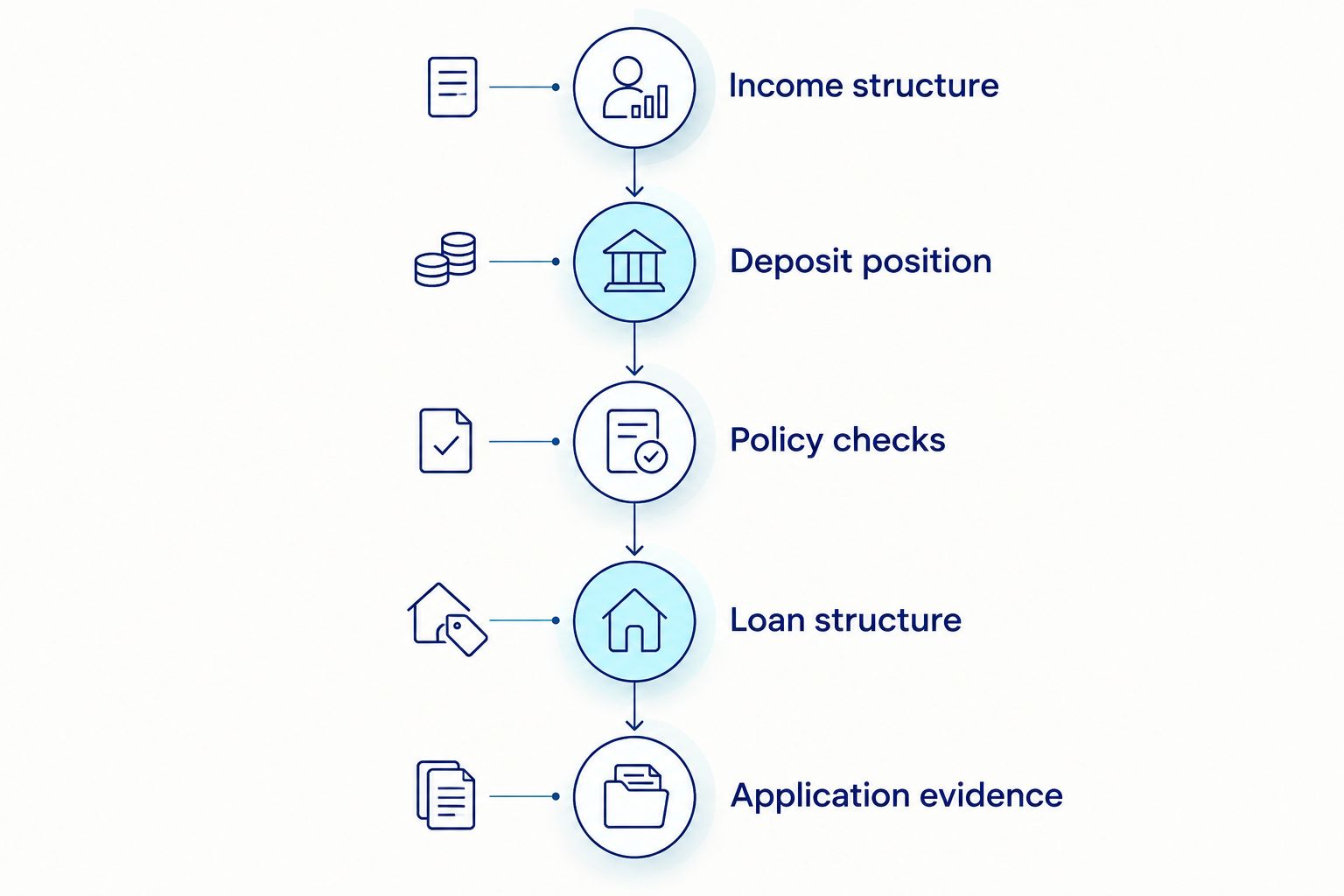
Follow this sequence before submitting an application. It keeps your comparison focused on the issues that determine whether a lender is suitable.
- Income structure: Identify whether salary, partnership income or business income drives your application.
- Deposit position: Establish your available contribution and distinguish purchase expenses from the deposit.
- Policy checks: Confirm income treatment, professional eligibility and property requirements.
- Loan structure: Compare repayments, features, restrictions and whole-loan cost.
- Application evidence: Assemble the documents required for the selected lender and resolve outstanding questions.
Keep the comparison like-for-like. Changing the loan term, repayment type or borrowing amount between offers makes it harder to judge which arrangement serves your goal.
Discuss your home loan options
Ask Mortgage Pros about your income structure, borrowing needs and home loan application.
How the lender options are ranked
This guide ranks assessment routes by their usefulness for distinct borrower situations, not by unverified lender performance. Salary assessment is the default starting point; deposit constraints, partnership income, refinancing and practice ownership each change the priority.
The criteria remain consistent: accepted income, eligibility, security requirements, loan structure, whole-loan cost and approval conditions. A lender belongs on your shortlist only when its policy fits your application.
Which home loan lender should you choose?
For an employed lawyer with straightforward income, start with PAYG-focused lenders. If your deposit is the constraint, investigate professional-policy eligibility alongside that comparison rather than assuming it replaces ordinary lending checks.
Partners and practice owners should resolve income assessment first. Existing borrowers should compare refinance outcomes against their current mortgage before deciding to switch.
Mortgage Pros provides home loan broking for borrowers comparing these routes. For your 2026 decision, choose the lender that accepts your documented circumstances and delivers the loan structure you need—not the lender most closely associated with your profession.
FAQ
What’s the best home loan lender for a lawyer in 2026?
The best lender is the one whose income assessment, eligibility rules and loan structure fit your circumstances. Salaried lawyers, equity partners and practice owners need different assessment questions answered before comparing offers.
Do lawyers automatically qualify for a mortgage insurance waiver?
No, being a lawyer does not automatically establish eligibility for a mortgage insurance waiver. Check the lender’s professional policy against your qualification, practising status, employment arrangement and proposed loan.
Is a professional home loan better than a standard home loan?
A professional home loan is not automatically better than a standard home loan. Compare any concession alongside accepted income, loan features, restrictions and whole-loan cost.
Can a law firm partner use partnership income for a home loan?
Partnership income requires assessment under the selected lender’s policy. Explain your entitlement and distributions, and provide the supporting records the lender requests rather than assuming a salary-only assessment applies.
What does an 80% LVR mean for a lawyer’s home loan?
An 80% LVR means the loan equals 80% of the lender’s assessed property value. The remaining 20% is the value margin outside the loan; purchase expenses are separate from that calculation.
Should I refinance just to reduce my repayments?
A lower repayment alone is not enough to establish that refinancing improves your mortgage. Compare switching expenses, retained features and total interest, especially if the replacement loan extends your remaining term.
Can Mortgage Pros help me compare home loan options?
Mortgage Pros provides mortgage broking for individual borrowers and investors, including home loans and refinancing. Discuss your income structure, deposit and borrowing goals so the comparison starts with your circumstances.
One last thing
Your job title and your income structure are different facts. Two lawyers with the same title can need different lender assessment routes because one receives a salary and the other receives partnership or business income.
Start your lender enquiry by explaining how you earn, not simply what you do. That gives the home loan comparison a useful starting point.